

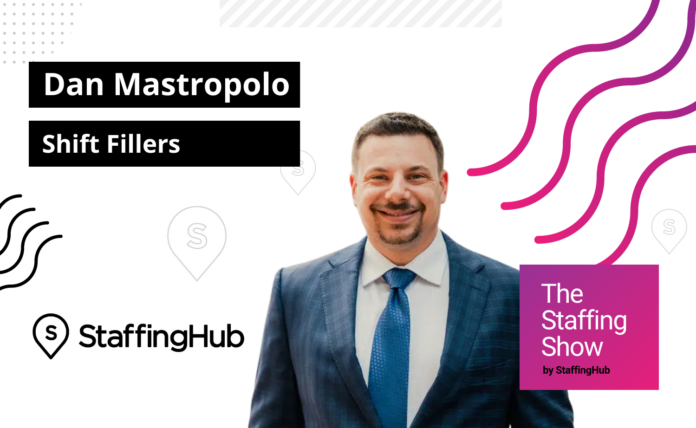
What does it take to build one of the fastest-growing staffing firms in the U.S.? In this episode, David Folwell sits down with Dan Mastropolo, Chief Visionary Officer at Shift Fillers, to discuss the company’s technology-first approach to staffing and the strategies that helped it earn the top spot on Staffing Industry Analysts’ 2026 Fastest-Growing Staffing Firms list. Dan shares how Shift Fillers has leveraged automation, referral networks, and operational innovation to scale rapidly, the lessons learned from growing the business, and why technical leadership, AI, and financial discipline are becoming essential for staffing firms. He also offers his outlook on the industry’s future, workforce trends, and the evolving role of technology in staffing. Tune in now!
[0:01:13] DF: Hello, everyone. Thank you for joining us for another episode of The Staffing Show. Today, I am joined by Dan Mastropolo from Shift Fillers. Dan, very excited to be having this conversation with you today. It’s an exciting time for you. I just saw on SIA that Shift Fillers was the number one fastest growing staffing firm on the SIA Fastest Growing Firms list. Excited to dig in, learn about what you’re doing and what you’re doing differently. Let’s go ahead and jump in.
[0:01:42] DM: Yeah. No, thank you. It’s been really exciting. It’s been something we’ve been working on chasing, honestly, since we started. It’s really just a demonstration of the team’s commitment to our model, and really a couple years of compounding hard work all coming together at the same time.
[0:01:58] DF: Yeah. I feel like, since we’ve known each other, we’ve been working together, and since your inception at Shift Fillers, you guys have approached the market a little bit differently, and I think that’s really showing now in terms of the results you’ve seen. Can you tell the audience a little bit about who is Shift Fillers, and what are some of the things that you guys have done differently over the last few years that make your business unique?
[0:02:19] DM: Absolutely. What was really unique with Shift Fillers from day one is we actually decided to start the company right at the beginning of COVID. We didn’t know COVID was going to happen, but the timing of it and really, also getting that pace of the market after the fact of a more remote workforce was just timely and what we were basically trying to bring to market. From an ownership group, we brought together a lot of industry veterans specific to the white-collar space. What Shift Fillers really was birthed and we’ve really never changed our model was really trying to stay demonstrated as a business that could go do high-volume, vendor on-prem light industrial staffing with very limited overhead and brick and mortar, and using technology to really prevail as our main mechanism to bring humans and technology together.
When we really first started, the only thing that really evolved is early on we looked at the MSPs like our end client, and there was a big reason for it. They had a lot of the industry spend. They had some of the higher volume clients. At the time we came into market, a lot of them were looking at going through what we call supplier optimization. They were over supplier saturated. They couldn’t really get the fill rates. Data was always hard. And so, we came in and really as a partner for them to say, “Look, we’ll use a direct sourcing, very demonstrated curation, community model.” But we wanted to do it with the vendor on-prem, because we knew to get the tech implemented, we needed to have human oversight of it and keep that off of end client, or MSP.
The only thing that really changed from when we started is we have almost virtually very limited MSP business today. We are really directly with the client, and that really evolved just with the use cases and the business growth. But what’s always been uniquely different about us is we knew that if we put together the right tech stack and essentially, had the right tools, we could basically get to large, deep talent pools and really gamify a lot of the inner workings of how we basically communitize. Then, what really you’re watching now is the compounding effort of that talent that we’re getting so large in the accounts that we’ve had for years, that we’ve now been able to really stay a sole supplier for these huge accounts that are sourcing 700 to 1,000 people a week, without us really having any jeopardy of competition coming in to take that from us. It’s been a really cool journey, but it’s definitely been iterated multiple times to get to that.
[0:04:44] DF: Yeah. It’s pretty incredible to see what you’ve done. I have to say, you are probably the most technical staffing agency operator that I talk to. You’re in Claude Code up late at night, always grinding out, figuring out how to do things more efficiently, how to connect systems in unique ways, and you’ve grown extremely fast because of that, I think, and that’s a foundation. What are some of the highlights and also, what are some of the operational challenges you’ve had over the last few years?
[0:05:10] DM: When we first started the business, we were really honestly trying to stay out of a traditional staffing ERP, like a Bullhorn or Avionte, or any of those, and we started originally with a very fluid ATS-plus scheduling. Did a lot through integrations, and those things were really helpful early on, but it came with its own challenges as we started to scale, because just like anything else, it’s easy when you’ve got 100 people on payroll, it’s a whole different thing when you get to 1,500, 1,600 on payroll.
At an early stage, we were more focused on the talent experience and focused on those type of tools, and what we evolved over time was really still now needing more of an operational backend that could handle complexity of billing and specific compliance items and operations really needed to keep that all glued together. What evolved and still stayed true is we still have very much a custom tech stack. But essentially, how we integrate and work our technologies together has definitely evolved as we’ve gotten more mature.
The second thing is we’ve gone through iterations of our leadership and just overall operational staff, right? I think firms sometimes forget, but we’ve grown businesses to the size that we are today a couple of times over in our careers from the ownership group. What got us from zero to say, 10 million is not the same group that got us 10 to 30, and what now has gotten us from 30 to 50, 60 million, right? We’ve iterated that, because the complexity of things that we deal with in the models that we have have changed. We have such a large staff-og programs, where we have a long-term temp lifecycle, where some people never go contract to hire. They’re just temps forever. That comes with a different set of compliance risk, different set of things that you need to be prepared for for risk and safety and legal and other things of that nature. Those things have really changed, but it’s the tech that allows us to do those well and also protect our risk, because of the fact that we control the data, we can be predictive in the analytics, and we can be really, really quick to be reactionary, or proactive in how we’re managing these accounts, which a lot of companies just when you’re dealing with 90 accounts, or 70 accounts in a market, it gets much harder trying to handle those logistics than what we have as a controlled environment by being so deep with the client relationships we have.
[0:07:29] DF: You’ve done some unique things on that front, and you mentioned the concept of direct sourcing. I think you actually brought that to me and kept saying your platform is like a direct sourcing tool and actually helped us build out a component and product feature within our Staffing Referrals element. One of the things that I’ve seen you do operationally is you’ve focused on how you’re going to find the next talent and how you’re making sure you have the right supply in place. Can you tell me a little bit about what you’re doing differently to make sure you have people continuing to show up and that you’re actually – your fill rates are where you need them to be?
[0:08:02] DM: Yeah. I’ll get a big shout out to our COO and CHRO and Karen Febus on that one. Karen really is a heck of an operator that just has spent a lot of her career in labor planning and just the logistics of what goes into that. Overall, my job day-to-day is to support her technically. There’s a handful of things. You mentioned, Staffing Referrals has been a partner of ours pretty much since day one. A lot of that went to our understanding and the decade longs that we’ve spent actually studying the DNA of a shift-based worker. Going back to how we started in COVID, right? That was also a big boom of where we started to see gig economies start penetrating into W2 workforce and more and more candidates wanting to get to a world, that they could not be pigeonholed to single employer, work their day how they want.
Secondarily, when you really understand that DNA, the reality is these candidates are not necessarily just in job boards and really to get to this, what I always call total talent ecosystem. You have a fraction of the workforce today that wants to work the traditional 40 hours, plus over time. You have another one that just wants 32 hours and then you have a whole other side of the workforce that’s like, “No, I want 12 to 24 hours and I want to pick when I work, how I work.” Well, that was always an understood mythology of ours, right? Our technology supports all of those mechanisms.
Going back to the communitization, our job, especially in a low wage worker, is to gamify their experience. For us, we took a lot of those principles into not just our referral program, but how we incentivize show-up rates and tenure and all the other things that basically breed, basically long-term employment and average length of assignment and average hours worked. I joke around all the time, people make staffing way harder than it needs to be. But our money is made off of hours worked 100%, right? For you to get the end result, it’s our job as operators to basically build solutions that incentivize the right behavior. That’s really what we’ve done very well and at the same time, we reward it.
[0:10:14] DF: It is cool. I think you’ve gone into this with the very few people coming to the early stages with the as aggressive as an approach as you have, from what I’ve seen anyways, towards focusing on sourcing from your existing network. How has that played a role? Let me zoom out a little bit. I think a lot of staffing firms, they say, “All right, for every 50 new hires, we need to get one new recruiter.” How has your company scaled in terms of the recruiting workforce compared to the placements? What does that look like compared to a traditional model?
[0:10:44] DM: Yeah. I think we’ve had a competitive advantage in this, to be honest. Because a lot of staffing firms that have been around for a long time, they carry a pretty substantial SG&A cost in their brick and mortar. They have a lot of typically overhead in terms of a branch manager, a regional recruiting staff, a sales staff, plus the brick-and-mortar call, right? We’ve never had a brick and mortar the entire time we started. But because we started that way, it was much easier for us to control and tweak our margin mechanics as we’ve gotten bigger to keep that economy of scale.
For us, we use a fairly large funnel recruiting team that we pod by company. That actually allows us to be that much more lethal in our delivery, because one, we’re not necessarily client saturated in a market, so we’re able to dedicate the time, the resources to support the volume. Two, because we’re hiring the same skill sets over and over and over again, it gets much easier to compound our recruiting and funnel team’s ability to know a client like the back of their hand, know what’s expected, uphold the compliance, know the roles, be able to paint that picture of what day to day looks like.
Then, once again, because we do get so much volume from our referral network, it’s not really us selling the candidates on a job, it’s their own network selling the candidate on a job. I just use any real example, right? How many of us get a call? “Hey, I went to a restaurant, you need to go check it out.” You go take it and go to the restaurant.” It’s the same thing. Once again, because we’ve built that into the mechanic, my chances of getting somebody to say four, six, eight, 10, 12 weeks or longer on assignment are substantially higher, because you and me working together as friend to friend, we’re going to hold each other accountable, but I’m more than likely enjoying the work, because I came in through you and now we’re getting to work together, right? It’s not rocket science in some of this. It’s you have just as many analytics as me that show people are more than willing to take a job from somebody that they know and those analytics of length and tenure tend to parallel, because they came in through a trusted source. It’s hard to not call out all the drama going on with LinkedIn and all the -.
In a world that basically, either with job ghosting, or actual candidate ghosting, that’s a terrible experience for somebody day one, or even coming into a mechanism, or a company. When you’re getting a big talent population coming through trusted source, I automatically typically have more trust than say, what I would have gotten if I’m trying to call this candidate blindly off of an Indeed.
[0:13:15] DF: Yeah, absolutely. And with the AI resumes are up to 20% to 30% of all applicants now, it’s pretty crazy. It’s just agents talking to agents at this point. What are a few things that – what did you get wrong along the way? What would you have done differently, looking at where you’re at now? Yeah. All super linear, right?
[0:13:33] DM: Yeah. No. I mean, I think there’s a couple of different things just in hindsight. It’s never easy scaling as fast as we did. I mean, we had a really strong revenue growth trajectory from day one. You saw that in the CAGR growth that SIA published for us. I think, I want to say, we’re one of the first number ones to finish at a triple digit CAGR growth on that list. There’s just little things. One, we definitely got the tech stack wrong early. We tried to be almost too tech heavy, which caused a lot of things to just be fragmented and overspend in some overhead early to maintain and manage that.
The second thing I think is we definitely probably underestimated the sales cycle for the type of ICP we were chasing early. Our normal sales cycle for some of these accounts are probably six to 12 months. That gets really scary at certain times when you have some seasonality in the business. Then, I think, the other thing, once again, most businesses have a tendency to hold on to personnel longer and hope that you can get people to a place that you feel like you can coach them, rather than maybe just sticking with your gut and cutting that fat early. We’ve gotten much better about making decisions faster. I think for an infant company still at only five years, we went through a major acquisition in 2023. That time period of molding in and getting into a bigger company and trying to almost shove us into their ecosystem, right? Those things were really challenging. But ultimately, you learn lessons through any of those.
I think the other piece is it’s not easy penetrating a new market any time. Because of the fact that we tend to go into markets a lot of times blind, trying to get everything to spin at the right is really, really challenging. But now that we’ve been more mature in the cycle, we have a playbook for it. I think to round it and summarize that up, we joke around, but it’s a very real statement. Fail early, don’t be afraid to fail. You learn a lot more from those mistakes than necessarily what we do get right. Being able to stay nimble and pivot to that has been a big, big reason of why we’ve been able to also compound it in a short period of time.
[0:15:49] DF: Yeah. I mean, those are great lessons and some good examples about where you pushed hard and had some challenges. For those that are listening that are on the chase, trying to figure how to build their agency faster and grow faster, what advice would you have to them to go out and fix this quarter and focus on?
[0:16:07] DM: That’s a great question. I’ve had this conversation actually with a couple operators this week, too. My top two or three advice items, right? You can’t be everything to everybody and people need to understand that early. When you try to basically tackle, say, light industrial commercial, skilled trade, plus admin, plus this, it’s really hard to get scale, because you’re just constantly taking whatever is getting thrown at you. I call it the purple squirrel method, right? We want the revenue, but it’s actually really distracting from getting the compounding growth of just saying, I support these five or 10 roles in a single vertical and really going that back to just basic scaling up rhythm system kind of mythologies, right?
The companies that scale 10 to 100X come into it with a specific niche in a market that they know needs, basically, their innovation, or disruption, and they stay true there to get their core base. Then they add on after the fact. One major positive I have both to Karen and I as operators and owners for the business, we have been very laser-focused on what we do well, how we do it well. That really has been a catapult for our revenue growth and also our EBITDA growth. That’s one.
The second thing that I would just say is it still really boils down to technology and technology leaders in this industry. I see way too many firms that are still pigeon-holding themselves into product to product type relationships, because they don’t have a technical leader. I was just at ASA’s board meeting a couple months ago and every single conversation we see posted is around AI, AI being the future. But my one statement was, well, how many of us in this room are technical leaders and where is the tech leaders’ voice? If that’s really the case, tech leaders should be basically front and foremost in the industry right now.
[0:17:57] DF: Yeah, that’s really funny.
[0:17:58] DM: They’re not, right? They’re still sitting in a shadow. You know how big of an advocate I’ve been for tech leadership. I’m in the executive, or the enterprise CIO, CTO group. This has to evolve more than the enterprise groups for us to really get ahead as an industry. I think a lot of owners, because we came out of sales and recruiting, we’re just so scared that we don’t know how to manage that. We don’t know how to budget it. The reality is if you’re not taking advantage of that today, you’re getting left behind by a long shot. With the evolution of AI, that gap is going to grow even faster, just like we’re seeing the AI IQ grow at a rate that’s unheard of in most just standard education. We need that. We need more. You can’t be afraid to do it earlier than what you’re anticipating, especially with the amount of tech leaders we have in product in our industry.
The last thing I would say is you really need to understand the evolution of what staffing is going through, all right? What I mean by that is, historically, we’ve always had this world of direct hire and contract labor. That is just no longer the model that staffing is. We have completely started to transition into what I call this total talent management, or global workforce optimization. We all know, the industry has gone through so much margin compression since COVID. Very few operators am I watching, A, know their financials and have good financials to know what that’s actually compressing. They’re just saying, “Yes, I’ll take it at 29%, 30%, 35%,” because they don’t want to lose the business. But that is dangerous. If you’re not keeping up with the financial literacy of the business, that can come back and bite you for numerous things.
You have that one bad debt, you think you can sell at X multiple, you’re nowhere close. Those things are really, they mean a lot and you can make way better decisions. For us, we’ve done a really good job of making sure that those things are able to be watched every week quickly, so that if we are being asked to bid something, we know exactly what we can do it for, how we can do it, and just really be mindful of that. I still see a very big gap on the financial side of this industry. We don’t have a lot of financial leaders either. When you take that between tech and finance, it’s a little scary for what I would call our startup mid-market sub 30 million businesses, because I definitely think the industry is going to see some roll-up if people aren’t careful within the next few years.
[0:20:30] DF: It is really funny, because everybody knows AI is having – transforming the industry in such a major way. Then there’s so many companies that don’t have a head of – somebody that’s actually taking that on. It’s like everybody’s just playing around with it. It’s transformation for every industry. If you’re in a professional job, it’s going to impact you in your day-to-day in a major way. It’s just a matter of how much and how soon.
[0:20:55] DM: It is. What’s more scary is just because of the fact that people understand at a concept level, they really don’t understand what’s happening behind the scenes. I want to say on average, I probably get 30 to 50 emails a week, or LinkedIn messages for numerous AI tools. Mostly top of the funnel. There’s been probably over 200 that have come into our market in the last year. Every single one of them basically does the exact same thing. They’re going to tell you it’s better than X, Y, and Z. But nobody really understands how they should be vetting those vendors. What’s scarier is if I hear the term, “Oh, we plug in, fill in the blank,” one more time without somebody actually being able to articulate what that actually means, it just gets scarier and scarier. You have to know how the models are built. You have to know where they’re pulling data. You have to know how to hold that accountable. If you’re feeding it garbage, which most people on product have no clue what’s sitting on their server behind the scenes, haven’t touched the data in years, you’re actually compounding a major problem for both user experience and potentially just data privacy in general.
[0:22:07] DF: Well said. There’s so many components to that and things I think people need to be aware of. Last question I’ve got for you is with how deep into the tech game you are, your knowledge on the AI front, I think you see it from the financial, the zoomed out financial world as well, what do you think the next few years look like in staffing? What’s your forecast in terms of where things are going?
[0:22:27] DM: Yeah. Great question there, too. I have a couple of hypotheses. One, I think you’re going to see an evolution where you will see a lot more companies starting to build their own stack. Once again, I’m going to say, they get built more probably around the back and middle office more than the front. The reason I say that is we need the ability to obviously, be able to control our time labor management, the billing side of the house equally to the growth that some of us are going through. However, for ones that have good data governance, have their own server architecture, it is not hard nowadays with things like Claude Code that you can go build a front office ATS for a fraction of the cost of what we’re paying in licenses and seat fees on the platforms today.
Secondarily, a lot of the legacy software that our industry has historically been run on are pushing 20, 30 years in existence. For them to evolve and iterate newer tools into that architecture is not easy, especially for ones that are operating cross border and having multiple data governance and regulations that I will anticipate get harder and harder over time to be basically built in.
Once again, I just think and I see, because I consult for so many companies, a lot of companies are getting control of their data, getting more in position so they don’t feel victim of, “Oh, man. I’m stuck,” for just the sake of it being stuck. They’re starting to do some really cool things on their own, which once again, from an owner perspective, why wouldn’t I go down a path to get a little bit better valuation for being more tech-enabled than not, right? I see a lot of those things. I think the second thing that I see is our industry, too, when you take once again, what I’ll call 10 million and under and maybe that 30 to 10 million category, we have a lot of owners in the industry that are just starting to get up there in age, right?
What more than likely started as them starting a business for legacy impact, a lot of people just watch their parents be miserable in this industry for a long time, the demand of it, right? That their kids don’t want the business, or they don’t have enough business in their client concentration to get the valuations that they maybe were hopeful for. When you look at some of the faster growing companies, ones that are a little bit more tech-enabled, that becomes a pretty interesting area for us to pay attention for M&A and really rolling some of those things into companies like a Shift Fillers, because of the fact that I can normally get that one or two account that’s 90% of the business that fits a model like what we have, rather than me having to go sell into that market and shortening up those sales cycles, right?
The M&A activity is definitely starting to pick up from what I can tell. I see a lot of other roll-up type consortiums coming into this, and I don’t really see that slowing down. I see it accelerating, because of once again, AI can play a pretty big part in that and getting data analysis and integrations faster than what it would normally take for say, somebody to roll a business today.
Then lastly, I just think that the interesting piece is going back and I’ll tie this into your last question twofold is, if people are struggling in say, the light industrial, commercial, white-collar space, what I’ll call that lower skill, higher volume capacity, because of it, we are starting to see skill trades start taking over as one of the hottest industries in the market. Obviously, there’s a multitude, right? You have all these data centers that are – I saw, I think they were responsible for one-third of the entire economic growth in the labor report this last month.
[0:26:12] DF: Wow, that’s crazy.
[0:26:13] DM: If you think about it, right? It’s not just the building of the data center, it’s also the work that happens within the data center and then companies that then support the data center. There’s a really big trajectory there that if you’re not paying attention to that, you should be paying attention to that. Historically, right? Most of us as operators, we came out of big firms where skill trade was a no-no, CDL was a no-no. We only direct hire it. We never contract it. It’s just not the case anymore. You can get really good comp rates and other things of that nature. You can find the right partner. You can EOR a lot of that stuff, too.
People got to stop thinking out of in the box and start looking outside of the box and understand that there are plenty of resources to help you evolve your business to let you go dabble without taking such substantial risk. I do think that you’re going to start to see a lot of companies and even big-sized companies start going into verticals that they have historically stayed out of, because it’s just where the job growth and overall changes of the industry are going to come from.
[0:27:10] DF: That’s great advice. I’m definitely seeing a skilled trade construction as booming at the moment. It’d be interesting to see if it pans out in. I feel like some of the – historically what we’ve seen is you have the booming one and then everybody sprints to that. By the time they get there, it’s like all right, well, now we have the supply and demand is back into a difficult spot. It does look like for the foreseeable future, that’s a good path. Dan, this was a great conversation, some really great insights for our listeners today. Congrats again. Well-deserved. Amazing to see at that number one spot. What do you think is next in store for Shiftfillers? You’re going to do back-to-back years?
[0:27:42] DM: I think we got a really good shot at it, to be honest. We’ve had a really tremendous 2026. I think for us, really, in the future, what we’re really trying to chase now is starting to get the data more prevalent into how we’re doing what we’re doing and really starting to try to just continue to compound it at a scale. Our next major milestone is getting to 100 million. It’s been our number one goal since we’ve started.
[0:28:04] DF: Let’s go.
[0:28:06] DM: We’re starting to get over the 50% mark of that. It’s really exciting. I’m super proud of the team and everything that they’ve stayed committed to us for.
[0:28:13] DF: Awesome. Well, congrats again. Nice work. Great talking with you as always. I appreciate you sharing your insights and see you next week at Connect.
[0:28:21] DM: Yeah. Sounds great, man. Thank you.