

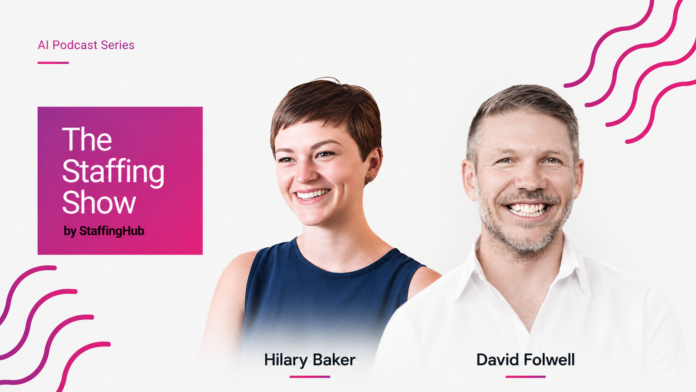
AI has the ability to improve productivity when it’s used correctly. Welcome back to another episode of the new segment of The Staffing Show. Managing director of StaffingHub, Hilary Baker, is here with David Folwell to discuss all things AI. This time, they’re touching on the promise of AI, what increased productivity actually means, and what’s going wrong if that promise isn’t being delivered. Tuning in, you’ll hear all about how AI has affected David’s productivity recently, the danger of pointing AI at the wrong tasks, what the right use of AI looks like, and more. We delve into how to avoid falling into AI “rabbit holes” before discussing why using plan mode is essential before starting an AI project. We even touch on David’s favorite AI models and how to select models as a business owner. Finally, you’ll be inspired to try something new this week to improve your AI literacy, and therefore, your overall productivity. Thanks for listening!
[0:01:13] HB: Welcome back to the new segment of The Staffing Show where we talk about everything AI. I’m Hilary Baker, Managing Director of Staffing Hub. And I’m sitting here with Dave Folwell. Every episode, it’s the same deal. We take a real problem that people are dealing with AI right now and staffing. We get into it. We’ll leave you with three things that you can run this week, a prompt to paste in. And Dave is going to tell you exactly what he is watching this week.
Today we are going to dive into the promise of AI itself. Chances are every AI pitch you’ve ever sat through makes the same promise. Your team will absolutely positively definitely get more done. And on paper, it always looks like it’s working. Everybody’s using it. Everybody says it saves them an insane amount of time, but there is a huge disconnect.
We just did a research report, and one of the data points that we pulled in was from PWC, and they asked over 4,000 CEOs this January. 56% said that AI has not raised their revenue or cut costs. Neither one. It’s not showing up in either of those numbers. What is going on? That’s what we’re going to dive into today. AI is supposed to be making us more productive, and it doesn’t always seem to be. What’s going on?
[0:02:33] DF: I got the exact counter to that as I sit on the other side of the 56%. It’s interesting when you look at the stats at the high level like that, and it’s like, “All right. Well, can you see the direct impact on the bottom line?” I would argue, well, then maybe you haven’t structured it correctly. Maybe you haven’t lined it up with your goals, your priorities, or sort of measuring the productivity gates.
I think the biggest thing that I see that a lot of people are not paying attention to, or I don’t know if it’s true if they’re not paying attention, but the thing that is very clear to me is people are getting more done. People are producing more of most things. And for a lot of people, they’re doing it faster. There are times where it can be significantly worse. But I would argue AI has the capacity to drastically increase productivity when used correctly. And it’s not always showing up in the bottom line immediately. I think that we’re still in the early stages, the wild, wild west of it, and it’s going to take a little time for that to trickle through and for people to even have ways of measuring how that impacts the business. My stance is on the other side, but I’m interested and excited to jump into this with you.
[0:03:35] HB: Yeah. So you’ve built your organization around AI, especially over the past year or so. Would you say that overall, your business, your organization is more productive? Not like it feels faster, but more productive. Can you see that in the numbers?
[0:03:55] DF: Well, first of all, I would say our organization.
[0:03:59] HB: Sure.
[0:04:00] DF: Here’s the thing. This isn’t normal. I’ve actually measured this, and this isn’t normal and maybe a little bit crazy. But I looked back at how many hours I worked last week or last month. I worked 288 hours in the last 30 days, which is a lot. We’re doing a huge overhaul on our platform from a front-end. We’ve launched a few new products. So, there’s a lot going on right now. That’s 29 days out of 30 I was working. One of them was actually 18 hours. It was a bit over the top.
But during that period, I measured this, and my AI ran for 159 of those hours. And if you think about what that’s doing while I’m working, it’s essentially having an additional employee that’s doing work while I’m doing work. The way that I look at what I’ve been able to accomplish over the last 30 days, I would say it’s 8 to 14x what I was able to do a year ago. There are things that used to be a full-time job that I’m doing in 10 hours in a week. The lift for me has been immense.
Has it given me any hours back? No. It’s actually done the opposite. It’s actually taken more hours, but it’s taken more hours because of what I’m able to produce and the excitement around producing it. I think that I’m putting more time into work and into delivery, but I’m also delivering more.
A specific example of this is I am not a developer. I’m not a coder. And last month I merged 43 PRs into our platform for things that I was just like, “Oh, I can take a look at that, and I’m in here, so let’s just push it.” And the capabilities that we have now, when leveraged correctly, are insane. I think that the productivity gains are immense. The idea that we’re going to get a bunch of time back is maybe where this all falls apart in some people’s head. It’s like, “Oh, I’m getting AI, so now I’m going to have all this free time.” And a weird parallel to that is during the Industrial Revolution, everybody said, “All right, well, there are all these economists that figured out once we had all these machines to automate all of our jobs that we’re going to have 20-hour work weeks by the ’90s.” I don’t remember the exact time frame. And it was like, “Oh, once we automate all this stuff, we’ll have this time back, and we’ll use it to go be free.” And there’s a human tendency to get that time back and then figure out what you can do next to push things forward. And that’s what I’m doing right now.
And for me, the Fable release, which for those of you that aren’t familiar, Claude released their most powerful model called Fable last – actually released it, pulled it back because of the government, and then released it again. And when that came back online, for me, that was like go time. And I was like, “All right, my skill set just doubled or tripled.” I launched a new website, and that would have been a multi-person project over the course of, I don’t know, 3 weeks, 5 weeks. Used to pay $30,000 to $50,000 for a website like that and was able to do that solo. Not solo, but with the help of the team in terms of editing. There’s huge impacts in productivity when used correctly. Obviously, not everybody’s seeing that go back to their time. And I think a lot of organizations, I would also argue, don’t have a structure or process and aren’t necessarily measuring or doing the right things.
[0:07:28] HB: Let’s talk a little bit more about these rabbit holes because, as you mentioned, AI can save time, but the time is getting eaten. But sometimes AI genuinely can add time onto a task or onto a day. For example, I’ve been writing emails for a very long time for marketing purposes, for outreach, for a lot of different reasons. And I’m like, “Oh my gosh, AI, AI can just do this for me.”
And every time I pointed it towards that task, I’m like, “That’s not right. That’s not right. That’s not me.” And I get to the end of the project, and I’m like, “I genuinely could have gotten that done faster.” And that is just a very small example of, A, something that can be fine-tuned, and it can write emails as long as I’m giving it the right information. But the flip side of that is it genuinely has been a rabbit hole on several different occasions.
It’s like you spend hours fiddling with something, fine-tuning something, overhauling something, the iteration loops, or just chasing this output that you had in your head that it just never quite arrived to. Nobody’s measuring that time spent with AI. Where are you seeing that happen in your day-to-day?
[0:08:52] DF: I think there’s two components to this. One is there’s the new product early adoption, figuring out what it can do, time suck. I don’t know what you call that, but there’s we’re learning how to do a new thing with the thing that’s never existed before. That takes a lot of time and gets just eaten up and looks like it doesn’t increase productivity. And then the second thing is on the type of task you work on.
And I think that the type of task is where I’ve learned this the hard way, just like you. I think the tendency for anyone jumping into AI is to say where are the safe spaces to use AI? What is the thing that I do the most of that I want to use it for? And what we’re really doing is we’re saying what is the thing that I’m really good at that I know how to do well? And how can I get it to do a better job at it than me? And it’s like you already do that well and you already know how to do it well. I think that it’s pointing AI at the wrong tasks. And I know email is something that – gosh, I have had emails that would have taken me 10 minutes take me an hour early on. I mean, I shouldn’t say I do still use it, but I have crafted it in a way that’s really important.
And I think one of the things that I’m going to go specific, just on the email example, is if you’re just like, “Oh, I’m going to have it write emails better than me. Oh, look, this email is terrible. I don’t think it works. Or it’s taking me more time now.” It’s like, well, that use case isn’t going to solve itself by just continuing to do the same thing. So, that’s not the right use case for you.
The problem is actually in the email or writing example specifically; you need to have your entire voice and writing style codified into a voice DNA. There’s ways to do that. It takes a lot of time to do that. That’s not something you do overnight. But if you want something to write just like you or a little bit better than you, you need to spend a lot of time building the checks, the balances, the kind of like coding that into the system and giving it the context. It’s not going to do it out of the box.
And I think that the right use of AI is what are the hard things that are actually constraints to your business that you couldn’t do before or didn’t have time to that it can go out and solve. I mean, it’s great at long horizon, huge context. What does this huge set of data tell me that I didn’t know about our business? What do all of these last hundred recruiter calls that are all recorded and transcribed? What insights can I gather from these recruiter calls? And what is my team doing well? What are they missing? And what are five things that I could change about our recruiting process to improve productivity or get more placements?
I think looking at the long-horizon task, looking at the right type of task. If you’re just using it for improve my writing, I think that’s most people’s entry point into it. And it’s decent at some things. But Hilary, you and I have learned firsthand painfully. Painfully by wasting hours.
[0:11:57] HB: So painfully.
[0:11:57] DF: So painfully. But that you can sit there and iterate forever. And it’s not always going to be the fastest way. And that writing your draft first, writing – I mean, I think this is also – I’m go on a little bit of a tangent here, but one of the things that people get concerned with is like, “Is AI eating at my logic and my skill set, or is it improving me? Is it taking away my critical thinking skills?” is something I have a lot of people talk to me about.
And I saw a video online the other day that was really amazing, and it said that there’s two different ways to think about when skills take things away from you versus help you improve as a person. And they gave the example of how humans historically have always done context offloading. For example, we write something in a book; we have a map. Those are all just taking cognitive load, putting it somewhere else so we can come back to it. And the person who talked about this said, you can tell pretty easily when AI is actually good if you’re using it in a way that is beneficial and actually improving how you’re thinking or a way that is actually taking away critical thinking skills.
And the key tell is I said when you look at a map, and then you walk away, you now have something new in your brain, like a new mental model of how to do something. You don’t have to have the map with you all times. And so you’ve actually created this – connected new neurons. When you’re working with AI, if you’re working with it and you feel like when you got to move away from it, you have a better understanding of the problem, a better understanding of the concept, and you actually learn throughout that process, you can kind of feel that, that means you’re probably using it in a way that’s actually improving critical thinking.
And as a partner, a thought partner, when you use it to outsource critical thinking altogether, if you use it and you’re like, “Hey, that solved the problem. I have absolutely no idea what problem is – how it did it or what the problem is,” that is actually where this could be problematic long run. So, that was a bit of a rabbit hole on its own, but I thought that was interesting to share.
[0:13:59] HB: That’s fair enough. I was also going to ask you, we’re talking about rabbit holes kind of in the abstract. How do you know when you’re in one. And how do you know if you keep going, the output will genuinely be better?
[0:14:11] DF: Great question. I mean, there’s a bit of judgment that comes with the experience over time. And I’m one of those people who try to spend as much time learning as possible, but I also will just run through the wall over and over and over again. I keep just learning by failure, which has I think helped accelerate some of the learning, too.
And I think key things for that are defining what you’re working on upfront, defining what success looks like upfront. And honestly, at this point, this was not true a year ago, but at this point, you can kind of ask AI, “Here’s what I need to accomplish. Here’s the context I’m going to give you. Are you able to accomplish this?” And if you’re able to define the outcome well enough, it, for the most part, will tell you where it can help you and where it can’t. And if you can spend the time to plan better, to think a little bit more strategically about the outcomes, then you can actually end in a spot where you aren’t having to go down the rabbit holes.
I think the biggest risk with AI, and I’ve spent hours doing this, is you just start like, “Oh, I have a question, or I have a thought about this thing.” And then an hour and a half later, you’re like, “Wow, I haven’t solved anything. I’ve just learned a bunch about a problem. And is this even the right problem?” I think that the age of AI is honestly the people who are going to excel in the age of AI are systems thinkers, people who are process-oriented and really spending the time to plan and think about what you want to solve, what are the priorities that you want to solve, and going about it from that perspective. I think that’s the new skill that’s going to be more and more important with AI. When you can outsource knowledge work, you really have to think about what you’re going to outsource and have a clear defined plan with clear defined outcomes to make it work.
[0:16:05] HB: And I know that we’re going to share the things to try this week, but I’m going to add one. Use plan mode if you’re starting a new like always starting a new – always start in plan mode. Because if you just start talking to the AI and it goes, that most of the time is when I end up in a rabbit hole. I don’t take the time to use plan mode upfront for it to be like – because that will tell you exactly how it’s going to approach the problem. And that is a very, very easy way to identify where it might go wrong, where it might head in the right direction. Catch it early. Figure out what its plan is first.
[0:16:42] DF: Great feedback. And for those of you listening, that plan mode is in I think Claude Code and Codex right now.
[0:16:47] HB: I think it’s in Codex as well.
[0:16:50] DF: Yeah. I don’t know if it’s in the ChatGPT or Claude front end, but the equivalent of that is before you jump in to help me solve this problem, here’s what I need you to do. I still think most people are going into AI with the I need you to do X for me. And as it’s gotten smarter, one of the better approaches can be – especially with the higher-end models, if you’re in Opus 5, or Fable, or 5.6 Soul, any of those, if you are going in and doing what we call meta-prompting of, “Hey, I’m trying to figure out how to solve this. Here’s what I think the outcome I need is. Can you ask me the questions that you need to understand the problem and help me solve this in this chat?” And if you can ask it to ask you, which is a really funny way of doing it, but it will actually help you kind of tease out all of the information it needs to accomplish the task. And I have found that to be one of the most impactful steps.
It’s very similar to plan mode. Plan mode in Claude Code, for those of you who don’t know, will kind of work through the problem. It will do that. It’ll ask you questions, then it’ll come up with a whole set of here’s the plan, and then you approve the plan. And so you can do that same thing by just asking. I would like to spend a few minutes planning this out and need you to ask me what you need to accomplish our goal here. That will save you, oh gosh, hundreds of iterations.
[0:18:19] HB: Yeah. And it will also help you kind of codify the gotchas in the task that’s in front of you which is also very important. And I feel like we could probably talk about this for a long time. I’m going to ask you though very quickly about the models. You mentioned Fable. For your own productivity, what have you found model-wise is the win and where and when?
[0:18:43] DF: Yeah, I mean I think that it’s funny as everybody’s like, “Well, what model do you use?” I kind of use them all on a day-to-day basis. I think the one important thing if you’re a business owner, I would pick – there’s two things actually. One, I think it’s important that you have your team on a standardized set of tools and that you have an AI policy in place, and that everybody knows what tools you’re using, and you start building that context somewhere.
Right now, I would argue I think Claude is probably the leader from a business perspective with all of the connections and the business tools. ChatGPT is very, very close. And honestly, I use that. I find ChatGPT is my personal take. I find ChatGPT to be a little bit more logical and rational, and Claude a little bit more creative.
The thing that I think is something to think about as a business owner, and there are people that are out trying to solve this problem, is that the AI models right now, Claude, ChatGPT, they’re trying to lock you into their environment and their ecosystem by making it so that they own the context layer. If they store memory on all of your team and have the memory of all of the decisions you make, then they become the tool that it’s really hard to use.
If you’ve been using Claude for 6 months and you go try to use ChatGPT, it will feel not great because it won’t have all of the memory of who you are and the decisions you’ve made. And I think that the thing that I like to think about as being tool-agnostic or LLM-agnostic so that you can port your memory, your context, your decisions from one tool to another because I think that way you’re not going to get stuck in a pricing war.
I also know that there are really amazing third-party frontier models that are coming out that people are not spending a ton of time talking about, but it was like Kimi K3 just released, and there’s some other models that are able to do stuff locally for free. And I think that a lot of this knowledge work, if you have the context set up and the right tools and intuition over time, being able to transfer those skills between the tools will be really important. All of that said, day-to-day for me right now, I’m a Claude Code and Claude Chat. Use Projects heavily and find the most impact there. But I do kind of bounce around between the few and use them to audit each other as well.
[0:20:59] HB: What’s the one development that you’re watching most closely this week?
[0:21:02] DF: It’s a continuation of what I was talking about previously with loop engineering. The thing that I’m excited about is the long horizon, long-running tasks. The way that I think about AI is it’s a really intelligent, low-cost labor that’s willing to run 24 hours a day. And for me right now, thinking about where are the areas in our business that we can actually apply that and get the gains from that knowledge work and those capabilities to do that. And this is where everybody – where AI becomes difficult. So there’s a lot of planning, putting evaluations in place, and making sure you have the outcomes designed right.
And then one of the things specific to staffing in our world today is the, I think, cool new developments is seeing what does the UI and UX of an ATS look like in the future. Or what does the UI and UX of Staffing Referrals look like in the future? And how much of what we do in software will be driven through an AI chat versus driven through the traditional let’s train people how to hit these buttons?
I’ve personally have started using the Claude Chrome extension to navigate websites on my behalf. If I ever need to cancel a website, I do not need to go find the cancellation anymore. I just open up my Chrome extension, and I say cancel this subscription. And then I come back to it 15 minutes later, and I’ll have the cancel button ready to go, and it’s good. I think that how we navigate the web is changing. And I think that’s going to be an exciting experience in the next couple years when it comes to all of our software.
[0:22:41] HB: So, the thing to try this week is just all surrounding logging your time, figuring out where the time with AI is actually going. So, log the numbers with every activity metric sitting next to the result that it was supposed to achieve for you. This tool was supposed to increase my applications by X. Is it doing that? Is it not doing that? If activity is up and the result it’s supposed to drive is flat, you found the gap that you need to be solving for.
Also, on a more general level, just log your AI time for a week. How long are you spending with it to – for example, going back to the email example, how long did it take you with AI? How long did it used to take you? Is it a gain? Is it a deficit? Do that for a handful of different things and figure out where some of the time-wasting might be outweighing what you could be gaining in other areas.
And then lastly, take those gains that you’re getting with AI and point it at something that actually makes money for you and doesn’t just save time for you. Point it at a revenue-generating activity, whatever that looks like for you. Run it and see if you can get those numbers headed in a positive direction for you. We have a prompt to help you in the show notes get to where you need to go on that.
[0:24:00] DF: And I would just add one thing that Hilary has and been – it’s actually really fun having this series with you because we’re picking the topics that are top of mind for us, and these things are helping to improve our processes here. One of the things that you can actually do if you’re using AI heavily enough is you can say look at my calendar for the last 30 days. Look at my AI usage for the last 30 days. Help me analyze what’s happened, where I’ve used it, where I haven’t, and give me some organization around that.
So, I think you can actually do – Hilary’s recommendations are absolutely the perfect way of kind of approaching that. And then I think you can have it also assist with kind of documenting what you’ve done and where the gaps are. And most of the tools, if you’re using the top model, will actually be able to tell you that. So, it’s something that’s fun to be able to dig in and start measuring these things. I think it’s really important to measure them and think about how we’re approaching work as our work is changing for all of us.
[0:24:55] HB: Yep. For sure. All right. Well, thanks for the time, Dave. This was awesome. And we’ll see you next week.
[0:25:01] DF: Awesome. Thanks, Hilary.
[0:25:02] HB: Bye.