

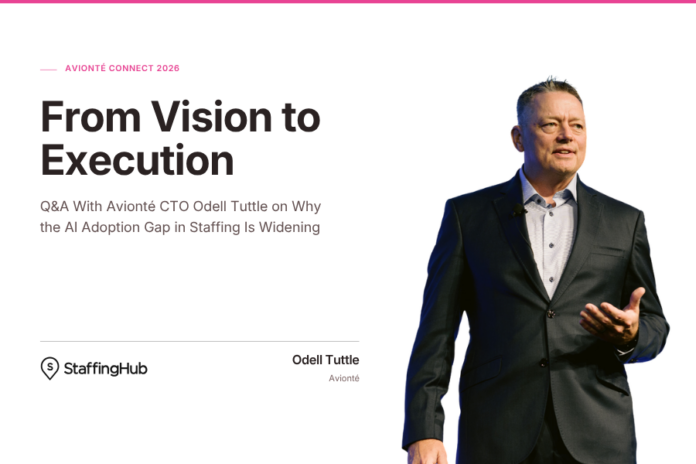
Ask Odell Tuttle where AI conversations in staffing stood two years ago, and where they stand now, and he’ll tell you the difference in one sentence: back then, everyone was still deciding whether to believe it was coming. Now they’re all doing it, and pushing organizations like Avionté to go faster.
Tuttle is CTO at Avionté and has given the AI keynote at Avionté CONNECT since 2023, before most of the industry had caught up to what he was describing. He’s spent almost 30 years building large-scale software platforms, and he’s watched AI in staffing move from a hypothetical to something backed by real usage data, hundreds of thousands of interviews run through Avionté’s AI interview bot, and a growing performance gap between firms that fully commit to automation and firms that don’t.
At CONNECT 2026, under this year’s theme of “Intelligence with Purpose,” Tuttle sat down with StaffingHub to talk about what’s changed in his own keynote, why agencies running five or more automated workflows are twice as likely to be growing rapidly, what “AI-first” really means when you’re hiring, and where humans stay irreplaceable no matter how far the technology goes.
Q. The conference theme this year is “Intelligence with Purpose,” and you’ve given the AI keynote at CONNECT since 2023, back when the industry was just starting to catch on. What’s different about your speech this year versus the ones you gave the last two years?
Odell Tuttle: We’ve come through quite an evolution in a few short years. Part of why those first AI keynotes happened is that I’ve always been a passionate early adopter of tools like AI. I joked in that first one about trying to build a neural network on my Commodore 64 back in junior high. At that point, AI was on the horizon. We could feel it coming, but it wasn’t mainstream yet.
Last year’s keynote was titled “Let’s Talk About Staffing’s AI-Powered Future.” That one was about vision. This year, we’re talking about what we’ve actually built: the execution against that vision, and the products we’re rolling out to support it.
Q. Is there anything you believed about how AI would impact the industry back in 2023 or 2024 that turned out to be wrong?
OT: Nothing completely wrong. We joked about AI taking over the world, but in terms of how we thought it would drive efficiency, improve quality, and improve the user experience, we’re starting to see a lot of that materialize. If anything, some of it moved slower in certain areas than we expected. But the interest in it, and the desire to adopt it, is accelerating fast.
Q. Last year you made the case that AI could quadruple recruiter productivity. What does that look like now?
OT: Last year, we used an example: a recruiter who might otherwise get through 50 candidates, managing those screening calls and interviews, could oversee 200 if you gave them a handful of AI agents. That was hypothetical at the time.
What we’re seeing now is that AI-backed features like Avionte PIXEL, our interview bot, have gone through hundreds of thousands of interviews. Each one of those represents time a recruiter didn’t have to spend. Users are telling us they’re spending less time on the mundane, and we keep building more features to pull those repetitive tasks out. I don’t know if the number is exactly four times, but we’re starting to see that progression, and we’re hearing them ask for more of it.
Q. In our State of Staffing report, we found that the deeper an agency’s AI adoption, the more likely it was to grow last year. Are you seeing that gap widen between firms pulling ahead and those staying stagnant?
OT: For sure. And it’s not about whether you’re doing some AI. It’s about whether you’ve really fully embraced it. Our own data shows that agencies running five or more automated workflows across their enterprise are twice as likely to be growing rapidly instead of stagnating.
Q. Is there a point where firms that waited to adopt AI won’t be able to catch up?
OT: I don’t know if it’s ever completely out of the question, but you’re certainly putting yourself at a disadvantage if you’re waiting to play catch-up.
Q. What advice would you give a staffing agency owner who feels far behind on this?
OT: Get educated. If you or your team don’t have the intellectual curiosity to push AI across your organization and build out the workflows, bring in people who do. Look at how you’re hiring, and make sure you’re hiring people who are AI-first.
What that means, applied to people, is this: if I give you a problem, is your first instinct to try to do it yourself, or to figure out how to get AI to do it? You want your team thinking the second way, because AI tools keep adapting. Things you couldn’t do a month ago, you might be able to do now. Things you can’t do now, you might be able to do next month. It’s about building that culture across your whole business, not just parking it in IT or one silo.
Q. You mentioned hiring for “AI-first.” Beyond how someone approaches a new problem, what else do you look for in a hire to know they’re AI-first, or capable of becoming that way?
OT: Intellectual curiosity, mainly. Do they experiment with new tools? Are they early adopters of technology, or are they someone who’s afraid of change? That’s a real indicator.
There’s also something that became obvious once AI started building software: the skills you need to write code in a programming language are different from the skills you need when you’re interacting with AI that’s building the software for you. In some ways, the new programming language is English, or whatever language you speak natively. So a strong ability to work with abstract concepts and structure them into a clear prompt is a new skill set, and it’s unique to this moment.
Q. You’ve predicted recruiters will end up managing a team of AI agents rather than just running step-by-step workflows. How close is that, and how are agencies approaching it?
OT: We’re seeing it incrementally, focused right now on specialized agents. Interview agents like PIXEL. Search and match agents. Data cleanup agents that help with data hygiene. We even have agents working behind the scenes, like our Echo plugin agent, which uses AI to self-heal in your browser if it runs into trouble.
Today, it’s small areas and specialized agents. What we’re building toward is a workflow layer, essentially a backplane that lets us put more and more agents into it, working toward a more holistic, fully agentic system.
Q. The skill set of a recruiter is going to have to evolve alongside that shift. What do you think that looks like?
OT: They’ll need to be strong in their business domain: understanding their business, their data, how they operate, and their workflows. And they’re going to have to keep building the muscle they already have as technology integrators. I was surprised when I first got into this space at how much staffing agencies already operate that way. Now it extends to workflow automation, using agents to help build your automated agency.
Q. Every AI conversation eventually comes back to how essential people remain to this industry, since relationships drive staffing. As these tools get better, where do you see humans staying in the loop no matter what?
OT: Humans are absolutely essential in AI, especially in human capital management. This is a relationship-based industry first. The way we see it, AI frees up time so people can spend more of it on relationship management and face time, rather than at a keyboard, because AI takes away some of the manual work.
There’s another dimension too: regulation. There are areas where AI is not allowed to make hiring decisions, period. Humans stay in the loop in that process, and as far as we know, that continues indefinitely. So there are two major areas: the relationship side and compliance.
Q. What are you most excited about in the conversations you’re having here at CONNECT?
OT: This has been a really interesting year. In previous years, we were educating people: AI is coming, it’s exciting, look at it, and there was a lot of trepidation, skepticism, or just not enough awareness of what it really was. This year, they’re all talking about it, they’re all doing it, and they’re pushing us to move faster. That’s a real difference, and it’s exciting to me.
Q. What are operators asking you about this year that surprised you?
OT: I was a little surprised by how much, over the past 12 months, everyone brushed up on their AI knowledge and is now focused on how fast they can get it incorporated. A year ago, we were convincing them this was coming and that they’d want it, and that the ones who didn’t adopt would fall a beat behind. Now this industry is thinking hard about automation and AI, whether that’s because our message landed or just because time passed. Probably the latter.
Q. A year from now, what will staffing firms be doing differently than they are today?
OT: We’ll have gained another year of maturity on these components. Some of that’s still in training wheels right now, because people are experimenting with it in certain segments, some of it brand new products and features, will be in a more mature state by next year. There’ll be regular operation, and we’ll have better baseline data on how much these tools are improving efficiency. I think it’s going to be an incremental step forward in maturity and adoption, not a leap.