
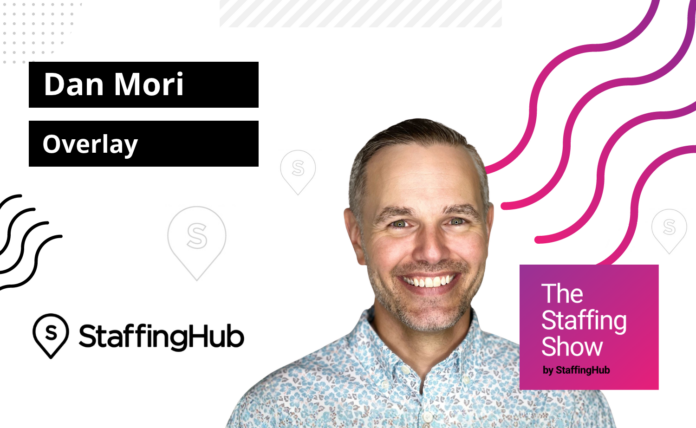
Years ago, Dan Mori came back from staffing conferences full of ideas for new tools and watched his recruiters tune out. Now he sees agency leaders doing the same thing with AI.
Dan Mori, founder of the Staffing Sales Summit, joins David Folwell to explain why he co-founded Overlay. It’s an AI tool that connects the systems recruiters and salespeople already use, and they can run all of them from one conversational interface.
You’ll hear:
- Why rolling out a new tool can tell producers “you’re not good enough”
- How 15 seconds of tab switching adds up across a recruiter’s day
- How Overlay handles prospecting, outreach, and recruiting workflows
- How Dan’s team cleaned up its ATS so recruiters search the database before the job boards
- His year-end planning process and advice for leaders trying to scale
[0:01:13] DF: Hello, everyone. Thank you for joining us for another episode of The Staffing Show. Today, I’m joined by Dan Mori, who is the founder of the Staffing Sales Summit and the co-founder of Overlay, which is a new AI tool we’re going to be talking about today. Dan, one of my favorite guests to have on. Super excited to be here with you today.
[0:01:31] DM: David, man, it’s always a pleasure to be here and to kind of talk shop about the staffing industry, man. Thanks for having me back.
[0:01:36] DF: Awesome. Well, we’re going to jump right in since a lot of you know who Dan is. Last time you were on, we debated job boards versus your own database. What’s changed in the last 12 months, and what did you get wrong?
[0:01:49] DM: I’m sure I got a lot wrong, honestly, but what’s changed is we’ve been more intentional about searching the database first. Actually, we had to do a bit of a root cause analysis to figure out why it wasn’t happening. Right? It’s like, if we have the data, if it’s there, but our people have a habit of going out to the job boards first, why is that happening?
And when we started to look into that, we realized one of the biggest culprits was data hygiene. And really surfacing in two main areas is that our people, when they would go run a search after decades of amassing contacts in our applicant tracking system, they would get a search and it would have so many candidates coming back that it would seem like insurmountable work to do. It’s a huge list to pile through.
And when they look at that compared to posting on a job board and then having people just sort of filter in, the job board seems more convenient. And I get that. And then the other piece we realized was there was duplicate records or bad data. Not every phone number was accurate. Candidates occasionally change numbers. Maybe email addresses go stale. So we realized one of the biggest impediments for people actually using the data that we paid for to get in there in the first place was it just wasn’t organized in a good way. And because we got more intentional about that, our people are more comfortable because they trust the data now and they’re seeing the results to actually source from our ATS as a first source.
[0:03:12] DF: That’s great. It does seem like everybody talks about having hundreds of thousands of people in their database. And then you ask them, where do they source all their talent? And it’s job boards. Though it is changing. I think that a lot of people are leaning into the database. They’re leaning into referrals, leaning into different sources on that front.
One of the things you just mentioned on there was it sounded the kind of reachability or availability and the data cleanliness. Are there any specific things that you guys did to improve the capabilities of the search?
[0:03:39] DM: Yeah. So a couple of different things that we did. One, we actually clean up the way that we search. We started thinking about, “Hey, there’s better, smarter ways to do searches.” And we actually, I got to give a lot of props to Steve Popovich because he actually orchestrated a lot of that. So we actually worked on our search and match functionality. So it could actually be a little bit cleaner. We did implement some automations for the initial outreach.
So once we search somebody and it returns some people, the first outreach can be automated just to notify them of an available job. And if they’re interested in it, they could sort of opt in, if you will, and then that would show up on a pair sheet for a recruiter to call from. So that was one thing to kind of help lessen the load.
The other piece is just data hygiene practice. So we did an initial cleanse where we had to go through every single record and look for duplicate records, use kind of a data enrichment model to really validate that the data was still good in there. And once we went through that and did that initial cleanup – which takes a while; it’s not an easy lift. It does not work as easy as I make it sound right now. But once we went through that, then we had to actually put data hygiene practices in place to say if a candidate goes untouched for X number of days or X period of time, they’re going to go to inactive. So now we’ve really segmented our database into passive and active candidates. And that’s helped out a lot. And the fact that we’re doing that, we’re sort of cleaning as we go and we’re keeping up with it, it makes the entire thing much more manageable and usable, frankly.
[0:05:04] DF: Yeah, that’s great. That’s great. I know one of the other areas that we’ve talked about is you’ve said leaders stack tools and the tools kind of land on the recruiter’s desk and the leaders sit there and ask, “Why aren’t you using it?” How has this played out for you? What are you seeing on this front when it comes to who’s using what tool and how that’s impacting the business?
[0:05:21] DM: I got to tell you a story. So I’m almost embarrassed that I almost fell back into this same situation. But 15 years ago, I didn’t realize that I was becoming this guy. But 15 years ago, I used to go to every staffing conference I could go to. I used to watch every webinar I could attend, like you name it. I would go to it. I would learn about it. And honestly, I could figure out a way to have every tool that someone was trying to sell me.
And I was just like wide-eyed and like, “This is amazing.” And there was one particular conference. It was actually Executive Forum like 15 years ago. And I came back from it, and I had so many ideas, and I learned about so many tools and vendors. And I got back to the office, and I was so excited. And I was like, “We’re going to do this, and we got to do this, and we got to do this.” And I could visibly see the recruiters just disengage. So I asked, I’m like, “Hey, what’s going on? Why aren’t you guys as excited as I am about all of this?” And they’re just like, “Because it’s just a cycle. We just know that when you go to a conference, you’re going to have –”
[0:06:23] DF: Yeah. Here’s 10 new things.
[0:06:25] DM: Yeah. It’s like Baskin-Robbins, 31 new flavors. And you’re going to want us to do all of it. And sometimes you don’t remember that we have a job to do. We’ve got to put people in jobs. And that’s the core thing. And I was like, “Oh gosh, you’re right. I’m sorry.”
Way back then, I learned a lesson. Maybe pick one thing that’s really going to move the needle and just put the other stuff in the parking lot, right? And then circle back to it if and when it makes sense. But we’re doing it today with all these AI tools. We’re all super excited. And it’s like, “I can do this, and I can get Claude. I can use Grok for this.” And everyone’s got an AI something, you know? And it’s like we need to slow down.
And I actually wrote a post on LinkedIn the other day talking about we don’t need one more thing. We don’t need one more tool. We need to focus on getting clients, getting orders, filling jobs. And I actually had my most senior person at my staffing company reach out to me and was like, “Yeah, you nailed it.” She actually took a copy of the article and circulated it to the entire leadership team of the company and said, “This is it right here. This.”
So I knew I hit it on the head. Like, yeah, we’re stacking tools. We want to solve all these problems. But leaders don’t realize there’s two major flaws with it. The number one reason that we don’t get the results or the ROI out of our technology that we’re implementing is because of lack of adoption. Because when it gets down to the ground level, people aren’t adopting it the way that we want to because we’re trying to roll something out across disconnected people, disconnected processes, disconnected tools, right? So it’s hard to adopt all that, right? Especially in a one-hour training session. Yeah. Good luck. It doesn’t work that way.
And the second one, and this couples to it, is anytime that you introduce a new tool to a person, to a producer, whether it’s sales or recruiting, David, it is near verbatim. This is what leaders say. We found a better way to do this. We’re going to improve our results by implementing this tool. And while leaders might be well-intentioned when they say that, what the producer hears is you’re not good enough. The way that you’re doing it isn’t good enough.
[0:08:21] DF: You’ve got to change.
[0:08:22] DM: Yeah. And it’s like who wants to adopt something that is introduced that way to them? It doesn’t make me feel good. So anyway, yeah, there’s a lot of tools getting stacked. It’s getting dropped on the desk of the producers, and they’re all out here, like, “How do I just do my job? I just want the orders. I just want to get clients.”
[0:08:37] DF: Yeah. It’s funny you brought up all the ideas. And I’m definitely in that camp as well. And I’ve had to limit the number of things I introduced to the team. It’s like, I might be piloting 10 things, but I only get to like one per month to the team. I saw a thing the other day that I was like, with the new product ideas, you actually have to make sure your organization – your ideas can only flow and integrate into the organization at the scale and level that you have made it to allow for those ideas to come through, which makes a lot of sense.
And I want to jump also into where the market is today. We’re hearing across every conversation I have, orders are coming back. We’re seeing a lot of demand for staffing services. I’ve heard that recruiters are spending 20% to 40% of their time on admin tasks today. So you’ve got more orders coming in. You’ve got people that are kind of, I would say, underwater already with the work that they have on their plate. What does the desk look like now? And how do you see it changing?
[0:09:34] DM: So I think it’s only going to get more like that. I think they’re still underwater. And in fact, I heard from a number of kind of my consulting, my advisory clients recently that the orders are coming back and the recruiters are starting to feel like more of a workload coming in for demand, which I think we’re all seeing that. And I see that as well.
But I think that we’re trying to optimize workflows. We’re trying to figure out how to do it better. And so there’s this learning curve. And anytime that you’re adopting new technology, new processes for efficiency, your production is going to cut by 20%. I think you’re trying to do more with less. And I think that people are spending a lot of time doing the administrative work that kind of bogs them down, but they really don’t want to spend their time.
[0:10:14] DM: Yeah. And could you walk me through how you see – and I know you’re not as close to maybe the day-to-day recruiter experience. But when it comes to how many tabs they have open, what the different number of tools that they’re using. I do hear this as a problem is people are like, well, we bought another software. It’s another thing for a recruiter to do. What does that look like for a recruiter today?
[0:10:36] DM: I think, I mean, it looks like frustration. When they have disconnected systems and they can’t just work in a natural flow state, I think it really slows them down and it causes this pressure where they will skip a step, maybe unintentionally, sometimes intentionally if they don’t understand the value of it. And maybe it doesn’t have a lot of value to them personally. Maybe there’s some upstream or downstream value to it.
So I think when they’re switching tabs and they have to go from like the ATS to the job boards or to their inbox or to whatever it might be, I think that just creates this mental lag because you have to actually kind of get your head around that change. Like, okay, I’m here. I got to do this thing. And then I got to switch over and get to pull this order from the client that came in via email. And then I got to parse those details out. Maybe it’s an attachment. Maybe it’s copy and paste. Then you got to put it back in there. And then it’s a lot of going back and forth. And all that takes a little bit of time. And people, it seems like 15 seconds here, 15 seconds there. It just adds up. And that switching is a problem.
[0:11:32] DF: Yeah, I feel like switching costs is such a huge component of that. Switching gears off of kind of like what’s going on in the recruiter’s world. Some exciting stuff for you personally, and I guess professionally and personally at these moments. But I know you launched your new AI product, Overlay, yesterday. Why don’t you dig in, tell us a little bit about what Overlay is and what it does?
[0:11:53] DM: Yeah. At the risk of sounding overly promotional based on what we were just talking about with all the tools and technology, it certainly was not any intentional setup, but really that situation plays out in every agency out there. Everyone has a tool. Everyone’s got a tech stack. Everybody’s got different things that are kind of plugged together. And I saw it with my own eye.
And I will say while we were developing Staffing Dashboard, this was all going on. And while I love the insights tool and I love the idea of like how do you actually have better data, better visibility, better insights, at the end of the day, man, the number one problem the agencies need to solve is more orders, more fills, more clients. That’s it. People were like, “How do we do more?” And everyone’s looking for another tool to solve this thing. And what I realized is a lot of times they would buy three tools to solve three independent problems. And there was a lot of overlap with those tools, but they would still expect people to use the three different tools to solve those three problems. And it’s like, “That’s a lot.” There’s got to be a way. There has to be a way just to have something, a dashboard, an interface, something that just plugs it all into it. There has to be an Amazon of technology out there. And it really wasn’t. Not the way that we envisioned it.
Steve and I, we were just talking shop. Trying to envision how would we solve this. If we’re going to solve this problem, where we could connect all of the tools that a producer uses into one thing so they could just go to one place and just conversate with this, it could trigger everything.
And we ran through some iterations. We truly created the beta test. This is kind of a funny story. But we created this beta test only to showcase how workflows can happen in agency. And we brought it up on the virtual summit session we led. It wasn’t even really a product then. And people were like, “Holy cow, I want that.” And we realized that we weren’t the only ones that had the problem of producers, recruiters, salespeople, all using these crazy tools. So we’re like, “Okay, let’s build this out.”
And we just looked at the most common workflows that producers use, whether it be prospecting and building campaigns and all of this stuff, and like, “Let’s just build this out where we can click a button.” I call it speed dial because I’m old, you know? And Steve is like, “I’ve heard that was a thing at some point.”
[0:14:07] DF: The Rolodex. Call it the Rolodex.
[0:14:08] DM: Rolodex. I had to remove that one from my vernacular. But that’s what we built, man. We’re like, okay, we’re going to basically click this button, and it’s going to be the prospecting button. And it’s just going to pull in our UCP or ICP and our UVP data that we already loaded in there. It’s going to go look at a prompt and say, “Find people or find companies that look just like this ICP. This is our ideal client profile.” And we’ll go do a web search. And then it will bring them up within whatever geography we pick and just pulls them in. And then we connect it to our data enrichment tool, which we’ve got Clay and Apollo. So we’ve got a couple of different ones that we’ve connected to.
And we just say, “Okay, here’s our list, go enrich it.” And again, it’s all without ever leaving Overlay. And it just goes into that data enrichment tool. I never have to go log into that thing again. And we’ll go use that for what it’s used for, brings the enriched data back in. And then you just click, okay, add these to a sales campaign, a sales planner. However, you structure your campaigns. You can customize it however you want with whatever prospecting activities, all right in the tool, super easy. And it’ll just load them right in, keeps track of it in a nice Trello style project management card system that’s super easy. And it just progresses through a system.
So if you make a call – and again, I know you mentioned Ringover just a bit ago, if you’re connected to Ringover, if you had a call, you just click call, and it will just open up your Ringover and it will just dial the prospect. And if you record your calls, then the transcript will drop right into your ATS. If you don’t, you can leave a note and then writes it right there all of it without leaving. When it goes to email, it will draft your email, and you can tweak it. It’s looking at relevant prospect data, like what jobs they’re hiring for, what challenges they might be facing. And then you just click Gmail or Outlook or whatever your email client is, and it will just open that up for you and send it off. And it’s just, it’s super easy.
And on recruiting, it’s the same thing. We just connected all these tools, Staffing Referrals. If you weren’t on the session yesterday, you got to shout out, because that would be a tool that we connect in there. But it’s just a place to aggregate literally everything.
[0:16:07] DF: Kind of like the command center for a recruiter to go in there and be like, “Hey, all of your tools are here. Stop switching all the tabs.” You’ve got it.
[0:16:13] DM: Yeah. It’s not like all the tools are just listed at one spot and they got to click on it to get to it. It’s the system Overlay is just trained to go run that tool based on a conversational input. So you could basically say, “Hey, I need to broadcast this job out, and I want to optimize referrals.” And then it would go plug in to Staffing Referrals, and it would go broadcast that job out to the ambassador network and be trying to optimize for referrals first. And it would stack rank those people in the prospect responses or the candidate responses in that order if that’s what you’re trying to optimize for.
And that way it just, it runs all of those things and the recruiter, the salesperson never has to leave. Managers can log in. The use case that I think, I don’t want to say elementary, but like people love this, is that they’ll be like, “How many open orders do I have? How many active candidates are on my database – orders by clients.” Do a stack rank match of all of the active candidates for those jobs.
What I think are like basic questions. When you think about it, it’s actually hard. There’s actually multiple steps you have to do to do those searches within an ATS. And if you can just ask the system to do it, it will go do all those things behind the scene and return back what you want to know the way you want to know it. I think we’re really solving a problem because as we demonstrated it, people are just like, “Yeah, does it connect with this?” Yeah, it does. “Can I plug this into it?” Yeah, you can. So it’s been great so far.
[0:17:36] DF: That’s amazing. That’s amazing. I do feel like the context switching, the tool switching, I mean, I’m trying to – got an Open Brain project that tries to keep context between all of the different AI tools. I’m running into the same problem you’ve got. I’ve got to like, save to my Open Brain, so when I go over to my next AI tool, I’ve got the information there. I think that centralization is definitely a key thing that people need.
One of the other areas that I know you and I talked about a little bit and I know you’re always excited about and very strategic with is we’re going into Q4 right now and looking at planning season for 2027. For a lot of people, what steps do you take at this stage knowing you’re going into Q4 to make sure that you’re planning strategically and looking at things the right way moving into next year?
[0:18:19] DM: I love that question. And really, it’s my favorite time of year is strategic planning season because I like to be able to look at where we’re at in the year, look at what our plan was for this year and say, “Did we miss? Did we not? What did we do well that we need to make sure we sustain and build on? What didn’t we do so well that we need to improve upon?” I love to look at that with the leadership team.
And what we do, I’ve got an eight-step kind of year-end process where we start to basically pull all of the data together, analyze it. We look at our run rates to see are we going to hit our goal? Are we not? Do we have momentum going into next year or not? And then we start to look at things like how much work went into getting our clients this year, to getting our orders? How much work went into filling our orders? We analyze all of that stuff because that helps us know what goals are feasible for next year.
And then together as a team, we’ll sit down, and we have the heads of each of our departments: operations, sales, technology, payroll. And we all come together and like, “Hey, what can we do next year?” And then they start putting a number out there. And then we check for feasibility of that number and say, “Okay, is it even feasible? Can we hit that number? Do we have the sales team? Do they have the tools and resources needed? Do they have the ability to do the work that the clients needed to do that?”
Recruiting. Do you have the team and resources you need to get the number of candidates that you got to put through our pipeline in order to fill these orders that we need to get in order to hit this financial goal? Payroll back office. Do you have the team in place to be able to do this? And they start thinking through things like how much work is going to go into actually hitting that goal. And if we can validate that number with work and resources, we’re off and running. And if we can’t, then you figure out: is it worth filling the gap, or do we need to adjust the goal?
And that’s the process that we’re going through right now. And I think it’s a fun time of year because now we’re going to be a bit more acquisitive. So if we say, hey, we think that we can hit this certain number organically, but we want to go a little further, we’re going to go into the market and see what we can actually acquire to be able to acquire the Delta, because we’re coming into a scale period.
[0:20:14] DF: With AI, with all these different tools that are coming out, are you seeing increases in recruiter productivity? Is that changing how you’re planning or what you see as possible in terms of growth?
[0:20:27] DM: We are. So Steve Popovich led a tech initiative for us to implement some of those automations of our screening, because we realized that if we had a manual engagement step at the very top of the candidate screening funnel, it would actually limit the number of candidates that we could actually put into the pipeline, right? Which creates a bottleneck at the top of the bottle, which is you don’t want that. He was able to implement that.
Actually, because we’re able to have more people come into the top of the recruiting pipeline, and then filter out there, we can actually have the middle of the pipeline where the recruiters are engaging. They can actually handle more work, and they get more throughput because the people they’re actually working with are better qualified, they’re better screened, they’re engaged in the process. So what we realize is by making that AI adjustment at the top end has actually allowed us to have more candidates come out the kind of the bottom of the funnel, so we get better coverage on our jobs. That’s been a big one.
We haven’t launched anything with AI specifically with sales at scale yet. I will say the tools are – I want to say is lacking, but they’re not quite as robust as we’ve seen on the recruiting side. But I think where we’re coming into play with Overlay is they’ll actually be letting AI build out their campaigns, the prospecting, loading all that stuff up. So they don’t have to manually go do that. And then they’ll just work through the campaign more time selling.
And that’s our big thing. We just want to improve quantity and capacity. And if we can do that for all of our producers, they’ll be able to produce more. And if they can produce more, that’s good for us and it makes them more money. So it’s good for them.
[0:22:06] DF: Yeah. Well, that’s great. For the people that are listening to this right now saying, “What do I do next? How do I grow my business faster?” What are the things that worked for you this year? What are some of the things you’ve learned that you’re like, “Man, we did that. It was new. We implemented it and we’re going to double down on it again next year?” And what are some of the things that you’re maybe going to do the opposite of? Any key lessons learned that are maybe different from other years or insights that you think would help those that are listening and trying to figure out how to scale faster?
[0:22:33] DM: Yeah, I love that question. Definitely learned a lot this year. If I had to give kind of two words just to guide this answer, it’s going to be simplify and focus. And I feel like this year was a catalyst for like a lot of tools to come out. And I think it’s only going to expand in the next year as we start to scratch the surface of possibilities.
And I would say, don’t get distracted. If you’re a leader and you want to work scaling, don’t get distracted with that. Really, always be asking yourself what is the most important thing that we have to do to fill a job, right? And then move backwards from that. How do we get that order? How do we get that candidate? When we look at it like that, that’s how we realized that our biggest bottleneck was actually at the top of the funnel.
So we realized that if we put AI practice out there to filter right there at the top end, not only could we actually provide a better candidate experience allowing candidates to be engaged with at a greater rate, it actually provided better filtering. Giving our recruiters a better experience and the ability to perform. Just looking at like be very focused on where you can actually make the biggest impact and not try to throw a lot of stuff out there, and then simplify. If you can really lean into the less is more mindset, I think that you’ll scale.
And then the last thing, and I got to stress this, our industry at its very core is the people business. It’s a human to human. It’s a relational piece. And the more and more that people try to solve the problems that we’re facing by digitizing, by AI-fying, and by essentially outsourcing that relation piece, it’s only going to devalue our service.
Clients, they still want to talk to you. They still want to meet you at networking events. They still want to go grab a cup of coffee. It might not feel like that with how busy the world has gotten. But trust me, it is still a relational-driven business. So I would say if there’s a way to really empower your people, to give them the time and the ability to develop strong relationships with candidates and clients to improve that experience across the board, that is going to become a UVP.
Their clients will get tired of – if they think that you’re just a digital AI agency, honestly, they’ll figure out how to replace you with something they can do internally. Focus on the human aspect of it. Don’t erase the human from the staffing business.
[0:24:42] DF: That was great insights. And Dan, enjoyed having you on the show, as always. Very excited about Overlay and seeing you next week in Denver for Staffing World.
[0:24:51] DM: Awesome. Can’t wait, man. Any closing thoughts?
[0:24:53] DF: I would say – and I know this is going to sound redundant, man, and this is whether you’re a staffing agency or a service provider, don’t lose sight of the number one thing that we do. We put good people in good jobs. Don’t lose sight of that. If you always keep that front and center and that’s the problem you’re always trying to solve is how do we do this piece better, you’re going to be able to stay hyper-focused on solving the real problem for your clients. So just don’t lose sight of that. Yeah. Don’t have shiny object syndrome.
[0:25:20] DF: Awesome. Well, thanks again, Dan. Appreciate it. And we’ll see you next week.