

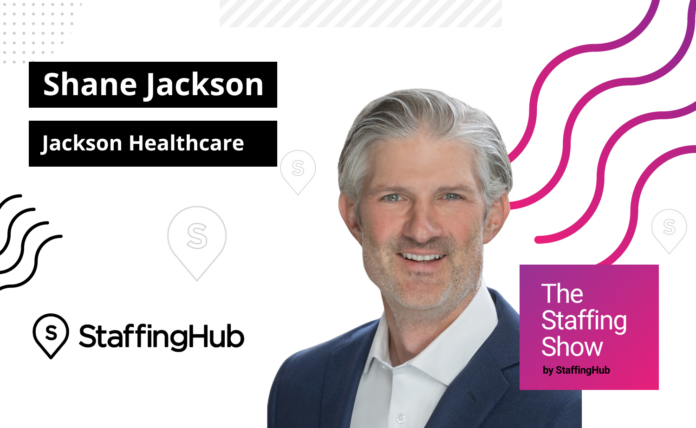
Healthcare staffing is facing tighter margins, faster technology shifts, and rising customer expectations, but long-term value still starts with people, expertise, and trust. In this episode of The Staffing Show, David Folwell talks with Shane Jackson, President of Jackson Healthcare and author of Fostering Culture and This Is the Thing, about building durable companies in a changing market. Shane explains how specialization shapes Jackson Healthcare’s 20-plus brands, why principles must remain firm while methods evolve, and how leaders make their values credible through the decisions they reward and enforce. They also dig into the essential role of healthcare staffing, how a 10% MSP fee is reshaping the value chain, and why Shane thinks AI will raise the value of judgment and domain expertise.
[0:01:13] DF: Hello, everyone. Thank you for joining us for another episode of The Staffing Show. Today, I am super excited to be joined by Shane Jackson, who’s the president of Jackson Healthcare, which owns more than 20 brands, over 2 billion dollars in revenue, serving 20 million patients a year. It’s a Fortune 100 Best Companies to Work For, Forbes Top Private Companies, EY Entrepreneur of the Year national finalist, author of Fostering Culture, and This Is the Thing. I recently had the opportunity of listening to Shane talk at NATHO, and now it was insightful, but it changed how I think about values and how you can actually drive values in your organization to make them stick and have an impact. Shane, I’m really excited to have you on the show today.
[0:01:59] SJ: Thanks, Dave. Thanks for having me.
[0:02:00] DF: To kick things off, I know I gave a brief background there for you, but I’d love for you to share a little bit about how you got to where you are today and what Jackson Healthcare is up to.
[0:02:11] SJ: Yeah, sure. Well, you gave a little bit of it. Jackson Healthcare started in 2000. My father founded the company, 2000. I had just finished grad school, and he invited me to pass up on other job offers I had with my MBA and to come join and help do this. The real thesis behind the company back in 2000, if you remember back then, that was in the middle of the dot-com boom. The idea was that we could leverage the Internet as a way to create differentiation in healthcare services, businesses analysis. His background, at that time, he had two businesses that he was involved with that we put together to become what eventually was Jackson Healthcare. Although, we didn’t name it that for many years. It was just like, we were starting businesses and coming up with plans and trying to leverage technology.
One of those initial two businesses was a little locum tenens staffing company that he had backed. We created a job board just for locums, which no one had really done then. We renamed the company Locumtenens.com, and that today is our largest business. As you mentioned, we have a number of different brands. We actually do a lot of different things in healthcare. Staffing is the biggest part of our business, though it’s not all of it, and locums is the biggest part of our staffing business. We actually have multiple brands that we do locums and a lot of different things. Happy to talk about that.
I guess, it was really 2013, my dad came to me and said, “Hey, I’m tired of doing things I have to do. I just want to do stuff I want to do.” Since 2014, the last 12 years, I’ve run the company day-to-day. I guess, yeah, that’s who we are.
[0:04:04] DF: That’s awesome, man. I noticed you guys have over 20 brands total, which is crazy, and it’s a lot to manage. One of the more interesting things when I was doing a little research before we talked, so I noticed that you guys even have an amoxicillin company that you’ve purchased and acquired. I’d love to hear a little bit of the backstory on that.
[0:04:23] SJ: Yes. That is quite a story. We were talking before the show, everybody typically finds that way more interesting than healthcare staffing. Yeah, this would have been, I guess in 2021, we were still in the throes of all the COVID shutdowns and that sort of thing. As I mentioned, my dad, primarily over the last few years, he’s done a lot of philanthropic work, a lot of investing, that sort of thing, still staying involved in the business on strategic decisions and that sort of thing, but he’s done a lot of things outside the company. He called me, or something and he said, “Hey, just FYI. I just want to let you know, I’m going up to Bristol, Tennessee this weekend.” I was like, “Why? What in the world are you doing up there?” We’re still in COVID. He had not traveled at all. “I mean, where are you going?” He said, “I’ve got a friend who works in bankruptcy and he’s a trustee and he’s told me about this little business up there.” He said, “I’m not going to do anything with it. It’s a favor to him. I’m going to go up and take a look at and tell him what I think.”
Fast forward, he’s on the plane to the ride home and he calls me and he said, “I just left Bristol, Tennessee and went through this amoxicillin manufacturing plant, and I think we need to buy it.” I was like, “Wait. Who’s we, first of all? What are you talking about?” What he got up there and found out is that it’s the only plant in the country that can make amoxicillin and augment these penicillin-based antibiotics, which by the way, one in six antibiotic prescriptions written in the United States every year is for amoxicillin, and it’s by far, the most prescribed. It’s the number one antibiotic on the market by far. Anyone who has kids, there’s a kid with an ear infection, you know about amoxicillin, right?
There was one plant in the country that could make it. It had been foreknown for years and it was in bankruptcy. Of course, you also remember what else was happening during COVID in 2021, with just all the shortages of everything versus the PPE, and then just huge focus on the supply chain. That actually continued past, I guess, about a year and a half ago, winter; there actually was a big shortage of antibiotics and amoxicillin in particular. My dad just said, “Look,” he said, “I feel it’s our just patriotic duty to save this thing. Because if this goes under, the only people we can buy this from are pretty much from countries that don’t really like us that much.”
This healthcare services business decided to go into the generic pharmaceutical manufacturing business, which is no picnic. I mean, there’s a reason why virtually all pharmaceutical manufacturing has gone offshore. It is incredibly, incredibly difficult. It’s been a long journey. It’s been five years now, right at about five years, that we’ve owned it. We have now fortunately been able to finally get the US government to start buying from us. We’re unsuccessful in the last administration. This administration has got a purchase from us, which is you would think would be a no-brainer, but it’s great.
Then also, been fortunate to find some really good American companies who are placing a value on supply chain security, and specifically supporting American companies that can help make sure that we have access to these antibiotics. It’s a tough, tough business. We’ve got a great team, and then they’re doing some good things.
[0:08:05] DF: That’s incredible. I did not know that backstory. That’s a good deed. It does feel like that’s something we should have secured and supply of here in the States. One of the things that I want to talk about as well is I know sometimes in staffing, we’re going to jump over to the staffing side of the world now. I was at a dinner party recently, and somebody was talking about staffing like, “Oh, it’s the middleman job,” and they’re talking about how staffing is sometimes not always perceived with the right lens. I know we’ve talked previously about some of the good that it does in the world. Could you just explain a little bit about how you see staffing and the value that it provides to the healthcare industry?
[0:08:41] SJ: I think staffing in general, even outside of healthcare, at times gets a bit of a bad reputation. Some of that is self-inflicted and maybe deserved, but I think largely, just misperceptions. I’ve been critical of our industry over the years, because I think there’s a lot of people in the industry who just take a very transactional approach to it. It’s an industry that there’s relatively low barriers to entry. It’s not really that difficult to set up a shingle and start working in the staffing business. That being the case, somebody coming into it with a very short-term perspective, just trying to make a little money and then maybe move on to the next thing, it leads to transactional relationships, which are typically more one-sided, right? It’s like, “Hey, how do I just make money on this, and don’t care if I create problems, or maybe do things that aren’t really good?” I do think over the years that that has impacted our industry.
I think in healthcare, in general, I think the nature of the shortage on some of these positions, you can take nursing, or physicians, or whichever, you’ve got healthcare organizations trying to provide care for their patients. They can’t find people, right? In healthcare, a significant part of the reason that healthcare organizations use staffing agencies is for that interim period when they’re trying to hire someone permanently and they can’t.
In a lot of other staffing industries outside of healthcare, that’s part of it. But there’s also a lot more strategic reasons, right? It may be projects that they’re doing. It may be a seasonal thing where they want to staff something up, or in an area where it’s like, okay, I don’t need to maintain this expertise forever. I want to contract with it and that sort of thing. In healthcare, some of that exists, but it’s much more a substitute for a permanent person. As a healthcare organization, if I’m trying to find someone permanently and I can’t and I need to use temporary staff for that, it’s almost admitting I failed at what I was trying to do, right? And then there’s some resentment there. I think that that’s caused a bit of a negative perception.
The perspective I take on this is backing it up a few thousand feet and away from the, okay, what’s going on here? Why are you using-? All of that sort of thing, and just the nature of the transaction itself. Our company, we run a pretty good-sized company. We use staffing agencies. Yeah. We do, for different positions. Typically, can negotiate that contract pretty hard, because I understand exactly how they work, right? We have great, great staffing partners who help us with different kinds of the business.
If you think about that, regardless of what it is, if you’re a business engaging a staffing partner to help you, what you’re doing is you’re saying, there is something I need, and by the way, it’s the most important asset of our business, which is the human capital. There’s some expertise here, some labor availability. Here’s something that is important to me that I need, and I don’t have the capacity, bandwidth, expertise, whatever, to get it. It’s so important that I need to use an expert to help me get that.
Regardless of everything else going on, that’s what happens in staffing. The nature of the problem that we are solving for companies, that my staffing agencies help solve for me, is a super important problem, right? I need this human capital expertise, and I don’t have capacity for it. I don’t have the expertise to find it. I need to focus on other things, like whatever; that’s a valuable transaction. Then the other piece of that for us in the staffing business that we get to see is we also get them to work with talent. If these people who are maybe in a career transition, maybe trying to figure out where they want to go, maybe they’re – we see in locums a lot- these are side gigs, so they can pay off student loans and that sort of thing. It’s tremendous just joy and benefit of this industry, getting to work with a talent, because we get to engage with them on something that’s so core and important to their life. At the end of the day, it’s the dignity of work.
I think there’s a lot of nobility in what we do. I think that the reason our industry has grown and persisted and continues to is because regardless of the noise around, at the end of the day, we’re doing something very valuable around the most important part of a business, which is human capital. I think it’s a great industry to be in. But the players in it, we need to make sure that we focus on the long-term value, transactional interactions that detract from the business, long term value that builds up trust in the business.
[0:13:54] DF: Well said. I think, honestly, as you were talking about, parallels to my thoughts on marketing agencies, where I’m like most marketing agencies, it’s like, I don’t have a good perception of them, but there are some amazing ones who do it well. I think staffing agencies, I think moving away from the transactional relational is the key. Man, it’s such an important thing. If you actually focus on the quality of the hire, putting somebody to work, helping them find the job they need, it’s really pretty incredible.
From a market perspective where you sit, I know SIA has seen the market mostly flat this year. How does that compare to what you were seeing in the market? Is there something that we’re missing, or does that align with what you’re seeing overall as well?
[0:14:33] SJ: Yeah, I think SIA is pretty right on it right now. I haven’t always agreed with their numbers up in, you know. Probably talked about that before. I think they’re right. Now I’m talking about healthcare staffing, mostly right now. The other areas, I’m not qualified to really talk about. I think if you look at nursing, I think probably the industry is going to end up being down a little bit year over year, but that’s mostly just because of the downward –
[0:15:00] DF: Coming off COVID.
[0:15:01] SJ: – path from the past year. I think the market seems to have stabilized for the most part this year. I think it’s what we’re seeing, what everyone else is seeing. Allied, I think is probably pretty similar. Locums will be up a little bit, but it’s nothing like what it’s been. We’ve really seen volume demand really flatten out in locums as well. Yeah, I think SIA is pretty right. I think they’re basically saying the same thing for next year. Right now, unfortunately, I don’t have evidence to say I would disagree with that.
[0:15:35] DF: I know that we’re returning to the mean. If you zoom out far enough, we’re right on the curve of where we would have been if you didn’t have the COVID spike in some instances. When it comes to the actual structure of the industry, I mean, there’s AI, there’s the VMS, MSP, there’s a whole bunch of dynamics at play right now that I’m hearing about from different agencies I talked to. I’m curious to know if there’s some core shifts that you think are going to have a major impact over the next few years, or how you see things playing out.
[0:16:04] SJ: Yeah. Well, I think if you look at the market from a revenue perspective, yes, we have regressed back to the mean. If you look at it from a gross profit perspective, I think –
[0:16:15] DF: Yeah, exactly. Yeah.
[0:16:18] SJ: That’s the biggest thing. You talk about structural issues. That’s the biggest issue going forward. I think we’re a lot, pretty much everybody missed in predicting what was going to happen post-COVID. It wasn’t only top line. It was what’s happened with margin. I think there’s, again, particularly in nursing, you see this in a lot of places. I mean, it’s just been a real restructure of the value chain in the allocation that some of the value that the staffing companies used to provide and then capture in the transactions has really been taken over by the MSPs and the agencies have been really largely left with the more commoditized part of the value chain. It’s going to be interesting to see what happens there.
I do think that there’s really been a shift too far, frankly, in the value that the MSPs are extracting from these transactions. I think that’s gone too far. I think we’re going to see probably over the next couple of years a market correction back that way, because it’s just frankly not sustainable and just a little bit irrational.
[0:17:26] DF: Yeah. I’ve heard that from a lot of agency owners of the – It’s like, “Yeah. Well, we’re back to our normal numbers, but now we have a 5% to 8% fee that we’re paying on top of what we were before.”
[0:17:35] SJ: 10%.
[0:17:37] DF: So, 10% they are going to get with. It’s like, that’s not a meaningful or easy way to make money with that from a strategic perspective for the people that are listening to this. I know you will share exactly what you were doing with each of your businesses. One of the things that a lot of our customers talk to is they’re offshoring, they’re going to try to reduce costs. Others are trying to figure out, well, how do we drive top-line revenue? Any thoughts on what the take is for the next move for Jackson?
[0:18:04] SJ: Yeah. I mean, I think we’re probably having the same conversations everyone is, right? I mean, I don’t think we are going back to, like in nursing and across healthcare staffing, I don’t think we’ll be going back to the gross margins of 2019. Everyone, I think is saying, “Hey, we have to figure out delivery models that work in this environment, that work in multiple types of channels,” through an MSP, direct business, all those different things that are flexible enough to work in that. Of course, we are as like other people as well is just maniacally focused on how we continue to add value in the process. We have long term relationships to all those sorts of things. A lot of focus there.
Then the other pieces as well, and I think I alluded to this a minute ago, but is how technology continues to evolve our market, right? How are we automating and creating cost efficiency around the low value parts of the business so that we can continue to differentiate on the high value pieces and having really that domain expertise that we can leverage to deliver for, for our customers. My guess is like, nothing I just said is not even said in every single conference room in history, right? But that’s what we’re all focused on.
[0:19:34] DF: Yeah. The underlying theme is: how do you automate the transactional stuff and figure out how to create more value on the partnership, the relationship side of it, which is something you guys are on that as well. This is maybe a little bit of a one-off that I’m curious if we’re seeing the statement-of-work concept come into play in accounting, finance, and IT. I’ve recently heard of some people talking about that in the healthcare space of almost like a project-based play, where they’ll say like, “This is what we’ll guarantee you for the year at X rate.” Have you had any of that come up, or any?
[0:20:07] SJ: Yes, but not in traditional statement-of-work business, like an IT, that sort of thing. Yeah. I mean, we are seeing more different types of structures around work. Like, “Oh, you need a nurse there for 13 weeks, right?” There is, I think, more, kind of like, I don’t know if it’s creativity, but things that are –
[0:20:32] DF: Different models.
[0:20:34] SJ: I would not directly equate it to an IT statement-of-work type of project. But I do think we’re saying evolution there for sure.
[0:20:42] DF: Yeah. That’s interesting. Well, jumping back to your portfolio, tell me a little bit about the changes that you’ve made over the years at Jackson, and I’d love to know some of the hard lessons you’ve learned along the way as well.
[0:20:57] SJ: Oh, man.
[0:20:58] DF: Big question.
[0:21:02] SJ: That’s a lot. Is the question around the portfolio and the structure that we have?
[0:21:06] DF: Yeah. Well, I think it’s interesting that you have over 20 brands you’re running, which is normally, we’re seeing the consolidation of it where people are rolling them up. It’s unusual to see the broad approach like that. I would love to know what are some of the challenges you’ve had along the way.
[0:21:20] SJ: Sure. Yeah, happy to talk about that. For us, we have a fundamental belief in the power of focus and specialization. The more you can focus on something, the more you can specialize in it, the more opportunity you create to become an expert. That principle applies at every level in our organization from the overall org chart down to how we think about it creating specific jobs and roles. For me, just utilizing an overall business strategy is if I can be the expert at something, I can deliver above-market value to the customer. The question is, how do we become that expert? The more narrowly you’re able to define a subject, or the more opportunity you have to become an expert in that. That’s just a guiding principle that we have.
To your question, it impacts the way we structure our business in general. When we’re looking at a new service line, or doing something, the thought process we go through of, is this a company, like a new standalone company? Or is this just maybe a service line, a division of a different business? There’s a few things we look at. But we’re looking at the buyer. Is this a market we’re already in? Is the decision maker the same or different? That sort of thing.
Our default is if there’s an opportunity to create a team who is empowered and has the flexibility to focus on something, that’s what we want to do. Because if I can go create a team of 10 people, it’s like, go and do this. Figure this new market out. Figure this thing out. The fewer shackles I put on them, the more flexibility they have to be creative and innovate and fail and do all that sort of thing.
[0:23:09] DF: I see.
[0:23:10] SJ: You might hold that team inside one of my companies; all of a sudden there’s a bureaucracy, and you have to do it this way, because our database has it, and all that sort of thing. That’s always our bent. But if we go like, hey, this is the same decision maker we’re already selling to. This is a candidate we’re already talking to. We actually do way, way more of creating and putting in new service lines into our businesses than we do of actually standing up new companies. Whenever possible, we want a business that the market perceives is totally focused on that. That’s the theory behind it.
Now, there are a lot of instances though, where there’s overlap, right? Certainly, you see among our staffing businesses and that sort of thing. Although less than you’d think, but there are overlap. That’s where we really create mechanisms and opportunities for our companies to collaborate. The difference is, and I was actually telling someone this story this morning. This was several years ago. I had two of my company presidents in my office, and I was talking to them. I was like, “Hey, I see this thing here. If you guys will work together and you will do this, you can create this service, and it will be new,” and we set on all that sort of thing, and we talked through it. I’m like, “Okay, you guys got it?” They’re like, “Yup, we’re on it.” Great.
I called him back 90 days later. “Tell me where we are on this,” and they hadn’t done anything. I tell the story a lot internally. It’s the moment I realized that I had no real authority here, like people don’t – But the lesson I learned was the fallacy of incenting one thing and expecting another. In other words, they were both, they had these businesses that they were responsible for running, and their incentive was to create great value. I like both of those businesses; this idea might have been great for me.
[0:25:05] DF: Yeah. But it’s completely outside of their day-to-day.
[0:25:09] SJ: They didn’t get value out of it, right? It didn’t help them. What we did is we switched it. Now it is I just put those two guys in a room and I go, “Hey, talk about challenges you’re having. Talk about opportunities you’re trying to get into, markets you’re trying to get into.” When they find things that benefit them both, they work together. Just like any business that would – we’re going to do this joint venture. We’re going to partner with you on this in whatever.
Our companies work together lots, lots. But they do it because it is usually beneficial to them. Because it’s that, they put the time, effort, and resources in to do it, versus me trying to force this synergy, which doesn’t really work.
[0:25:51] DF: It’s almost a skunk work strategy lab, where you’re like, all right, go out and try to have business within the business that you’re having. Go start this. Trying around with the calm tiger team, is that right? It’s like, here’s the group, go do this, try to solve this problem. That then becomes one of the businesses inside. When it comes to your actual, and this is a little bit in the weeds, but I talk about this a lot with other healthcare staffing agencies, the actual division of work, when it comes down to the recruiter level, are you having the recruiter specialized on like, you’re an ER, you work with the ER teams, you work with in specializing at that level as well?
[0:26:26] SJ: Oh, absolutely. Yeah.
[0:26:28] DF: As far as you can go. Yeah.
[0:26:30] SJ: As much as we can. I mean, I have on the locum side, I have recruiters that only recruit a certain specialty of doctors. One on the northern part of California. I mean, it’s very, very specialized. I mean, they just know it so well; they can just really perform highly in that.
[0:26:51] DF: It is a consistent theme that everybody I talk with, the companies that are growing the fastest that are moving the fastest, and not just large ones like yourself, they are specializing more. I think that, you know, the language to talk to the recruiters when you do that, which is why it’s important. When it comes to managing 20 different brands, what’s your day-to-day look like? How do you do that?
[0:27:12] SJ: I mean, in a lot of meetings and that sort of thing. I mean, but part of the advantage I have is that the people I work with day to day are company presidents. I always just make this joke, and it’s not even a joke. Honestly, it’s just a statement. None of them actually need me to do their job. These are highly competent people. It’s not like I’m having to sit over their shoulder and go, “Oh, let me show you how to do this, whatever.” The way I engage with our presidents, frankly, for me is very fun and fulfilling. I mean, we get to sit down and talk about the stuff that they can’t talk to anybody else about. I mean, this is one I’m just talking about all the time. It is lonely at the top. When you’re leading a business and all these guys, they have great teams and stuff and do whatever. Eventually, there are just things you can’t talk to anybody else about. Well, that’s what I’m here for. As you talk through some of those things. Then ask a lot of questions like, “Hey, how are you thinking about this? Let’s think about the long term,” and that sort of thing. Those are frankly just very rewarding conversations to have. I really enjoy it.
[0:28:23] DF: One of the things that I was extremely excited to talk to you about, and I think it’s something that obviously, with your books that you’ve written, you’re interested in and an expert at is the concept of driving value-based growth and driving values into the organization. I know at your presentation, you mentioned that we often mix up our actual decisions with principles that drove them. I was just wondering if you could give me an example of where Jackson pivoted on a decision, because the underlying principle demanded it.
[0:28:52] SJ: Let me give just a little bit more of the context on this. I think this really comes under the topic of change, right? How do you as an organization go through change and as an individual go through change? Which again, given everything we talked about earlier, everything going on in our market, massive amounts of change, massive amounts of uncertainty about change to come, how do you actually navigate through that? One of the things we talk about a lot is this idea, this chapter, my book, my first book, says, “Principles are sacrosanct, and methods are not.” Because we often confuse methods and principles. This is how this plays out.
At some point in the past, your business had a problem; your team sat down. You’re like, “Hey, how are we going to do this?” You came up with this idea, and you tried it, and it worked. You’re like, “Great.” Then that problem happened again, and you used it again, and it worked again. You’re like, “Great.” And so, you just keep doing it. Eventually, that just becomes a norm for you. This is how we do this thing. It’s just, everybody knows it, and we just do it. The longer it works, the more successful it is, the more ingrained it becomes as a norm. Here’s the problem. Now this practice, this norm we started 10 years ago, the set of circumstances that led us to that decision has changed. The technology has changed, the market has changed, whatever. It’s just different.
Now we’ve got like, okay, but this is how we do it. This is comfortable to us. It’s been so reinforced for us, because it’s worked so many times. Whoa, I don’t want to change this. This shows up in organizations and we’ve seen this. Organizations like, “No, but that’s not how we do it. In our culture, that’s not what we do.” In some of these, in a business processes, but even interpersonal communication, culturally, that’s not how we do it. It’s like, well, you’re asking me to go into my culture by changing, or whatever.
What we really try to do is focus on it’s like, look, no, no, no, no. There’s a principle that was behind that decision 10 years ago. That principle is just as true as it ever was, focus in specialization, or empowerment of people, or whatever. Some principle, they’re like, that’s a sacrosanct principle for us. But the method that we apply that is going to change over time. This is language that we have to use a lot. By the way, obviously, over probably the last couple of years, we’ve had to really, really lean into and even train our people around, as you’re dealing with some of these tensions from change is, how do you navigate that in a way that enables people to change, be okay with it and feels like you’re not going against your culture in doing so?
[0:31:38] DF: Yeah. I thought people are so resistant to change. Then also, I mean, my years at GE, there’s a lot of, well, this is how we do it here, in a lot of moments where it’s like, well, okay. But the world is shifting rapidly, so what are we going to do to adjust? One of the things that you brought up at NATHO as well and just hit me over the head was like, it’s like, “I’ve had many years of being like, here are values, putting them on our slides, presenting them to the team. Here’s our core values.” Then six months later being like, “Well, wait a second, why did this thing happen when that doesn’t align with the core values that we have here?” You talked specifically about how you actually get core values to stick and why that concept doesn’t work. I’d love for you to just dig in a little bit on that.
[0:32:20] SJ: There’s nothing wrong with talking about your values. We have our values up on walls and in presentations and all that. That’s not the problem. The problem is when you have values in your presentations and up on the walls, and then you make decisions that are values different than what’s in your presentation up on the wall. That’s where I think we get in trouble. I think for a long time, leaders have felt like, “Hey, I need to say some stuff here. I need to talk about mission.” These Gen Zers especially, they really care about-. We need to put up these lofting, signing ideals so people want to come work for us. Then they get there, and you go like, I mean, I can just see what we do here. None of that’s real.
I mean, I’m just a firm believer that what you value, what the things that you believe to be true are going to drive what you do, like your decisions, right? It’s just easy. If that’s true, it also stands to reason that that means if I see what you do, I can tell what you value. When I talk to leaders about this, I’m like, “Look, yeah, if you want to, put them up on a wall, but that’s really almost superfluous.” Because everybody knows what you value, because they see what you do, they see what you reward, they see what you incent, they see what you punish, all those sorts of things. The right is just to get consistency in how you live them and how you apply them. Then talk about it, so that everyone has clarity and people understand it more quickly when they come into the organization and that sort of thing. The important part is living it and not talking about it.
[0:34:03] DF: Yeah, and which obviously makes a ton of sense. I think that’s where the, I think, the disconnect at a lot of organizations is where like, “Oh, here are the values.” Then people smirk, or laugh, or like, “Cool. That’s not actually how we operate here.” I know you’ve talked about as well the idea that values and the organizational culture is caught and not taught. You guys have changed some of the ways that you operate at Jackson to make sure that you’re actually – that these are sticking with people. I think you talked about first day and how you operate with people. Would you be open to sharing a little bit of that approach?
[0:34:36] SJ: Yeah, I’m happy to talk about that. Let me give you, by the way, just back to the last point. The biggest example place I’ve seen this, and I’m – we’ve got a bunch of staffing people listening to it. I guarantee that every single leader of the staffing doesn’t, they’re going to go, “Yup. Been there.” This disconnect between the values you say and the values you actually live shows up when you have a high performer who’s a cancer to the organization. It’s the hardest thing. Let me tell you, I’ve been there. Now it’s a little bit easier for us, because we’re big. But let me tell you, when you’re a small shop, and you got the salesperson who is bringing in most of the business, making most of the placements, whatever, but they don’t treat people the way you think they ought to be treated, they’re not honest, they’re not whatever. You pick it, they’re not doing it. You’re faced with a decision: do I keep this person in my organization or not?
I’m just being real. If we had people on video, I bet they’re nodding their heads right now; it is one of the one of the hardest things to do. I would say, I’ve said this for years, there is no such thing as a star performer who’s a cancer. It doesn’t matter. But it takes in that moment a lot of courage and discernment to say like, “Is this important enough to me that I’m going to make this call? How am I going to handle that?” Speaking of people like you can say, “Oh, we believe in honesty and treating with kindness and all that,” well, this person over here doesn’t do any of that, and they’re the highest paid person in the company, and you haven’t done anything about it. Sorry.
[0:36:07] DF: It’s like, cool. Everything else is out the door. Yeah. Have you had to make that decision multiple times? Is that –
[0:36:14] SJ: Oh, many times. I’m going to tell you, we have a lot of different companies, and some of them are pretty big, and some of them are really small. We went through it earlier this year, one of our company presidents, one of our small companies, struggled. Got somebody clearly, clearly not living in line with our values, but she was responsible for the biggest book of business this company had. It was hard. She made the decision. Their numbers are down a little bit long term. She’ll be better for it. Their company will be healthier for it, because her people trust her with that. She means what she says now, but it’s going to hurt her budget for this year.
[0:36:51] DF: Yeah. It’s like the five dysfunctions of a team story. Such a hard thing to follow through with in those moments.
[0:36:58] SJ: Sorry, until you realize, you were asking us, you asked me a question about caught, not taught. Yeah, this is something we talk about a lot, this idea that you learn better through experience than you do through really any other method. My theory on this really came from my experience with my dad. As I mentioned, he started the company, and I was – just a few years of work experience. I was in my mid-twenties when we started the company, and he brought me on to help him. Over those first few years, really probably, probably first three years or so, there were just so many times where he would come in, and he’d go, “Hey, I want you to just come sit in this meeting with me.” He’d say, “No, you can’t add any value here.” He said, “But I just want you to see how I handle this,” which is humbling, because I’m like, “Hey, there’s absolutely nothing valuable you’re going to contribute, but I want you to be there.” I mean, maybe I could help with something. No, you can’t at all. Okay.
[0:37:59] DF: Sit there and be quiet.
[0:38:01] SJ: Yeah. As I mentioned, I mean, I have an MBA. The education I got from that was nothing compared to sitting in meetings and watching my dad handle all these situations for years. I think it points to a few things. One, it’s how people learn. Two, I think it points to that for us as leaders to develop leaders, or to develop high potentials in anything, we have to create the room for them to be doing things that are unproductive, so that they can learn. In today’s market, that’s harder than ever. I mean, we’re all talking about how gross margin is down. There’s more competition; it’s just harder than ever. We’re all focused on reconstructing the model so that we can deliver speed, efficiency, all that sort of thing. You’re going, “Oh, wait, and now you want me to take my high potentials and put them in a meeting where they’re not contributing anything? That’s crazy.”
If you want to create the understanding of people of not just hey, let me just tell you how to do this, but actually, here’s why and understand that, they’ve got to have that exposure to people to be a part of it and experience it. For us, that’s a big part of how we think about training and developing.
[0:39:24] DF: When you say to get them together, be unproductive, you mean, sit down and talk about how things are done, tell stories about it. Is that the –
[0:39:32] SJ: Yeah. I mean, that’s definitely part of it. I mean, but some of it is like, and just, again, in the staffing world, it’s like, “Hey, I’m about to do this phone call with this doctor, call this nurse, just come listen to it.” You’re not going to do anything. Just be on the call. “I’m about to do this presentation with this customer. Just sit and be part of it. You’re not going to say anything. I just want you to listen.” That sort of thing. Then the other is exactly what you said. I’m a big believer in the value of storytelling. Taking unproductive time to just go, “Hey, yeah, let me tell you the story about this customer. Let me tell you the story about when this happened, whatever,” to get people into context, to understand not just what you do, but why you do it. “Why do you all do this?” “That’s right. Oh, let me tell you where this came from.”
[0:40:19] DF: Yeah. One of the things that also came up during presentation was the idea of having people have a purpose that you work with and having them understand their purpose and then how that can align to the brand and the values. One of the unconventional things that I thought was really interesting was you had a chart at the end that you shared that was about communicating your values clearly with clarity, simply, versus somebody understanding their own values. I thought that was insanely enlightening to me and something I’ve never thought about ever within an organization. For the context for the audience, your presentation was about getting that organizational alignment. I would love it if you could share a little bit about that as well.
[0:41:03] SJ: Yeah. The research that you’re talking about is a bit dated now, 15, maybe 20 years old. I think mid-2000s. I don’t know if anyone’s done more recent research on it, but I have found it to be true. Basically, what they were doing is they were measuring the alignment between values, clarity, and commitment to the organization, or to the team and the idea of being you have higher values clarities that make you more committed, or less. But they measured values clarity on two axes. One was clarity around the organization’s values. The other was clarity around your personal values.
What they learned was that there was no impact on commitment to the team at all based on how much clarity you have on the team’s values, or the organization’s values. All of the difference was made on how much clarity you have on your own personal values. If you have clarity of your own personal values, you will be highly committed to the team, regardless of whether you have clarity on the organizational values, which, to your point, I remember seeing this research years ago; I was like, what in the world? Why are we spending all this time training on that? I don’t even get it. There is a good reason. I still think you need to do that.
If you think about it, it makes sense, because if I know what’s really important to me, what drives me, what I want out of life, all those sorts of things, if I find a place where I’m like, “Oh, these guys are doing something that’s important to me and you’re doing it the way – these are my people. I’m in.” Right? If I don’t know that, it doesn’t matter where I go. Whatever. I don’t care. Yeah, all this is happening. We go sell insurance. I don’t know. Whatever, it can. I’m not going to be committed no matter what. The lesson there is that as a leader, if you want people that are committed, you got to have people to have clarity about what they want out of life.
[0:43:01] DF: Yeah, which is a great lesson and something to think about. The one thing, as you present a lot of values, all of this, have you ever measured the outcome of the alignment of values and commitment by brand? Is there any way to tie all of the work that you’re doing around those values alignment with the organization and the commitment to the organization and look at how that actually drives ROI and/or how it shows up in the business outcomes?
[0:43:31] SJ: Yeah. We measure a lot of things. It’s not always clean, right? One of the challenges, unlike in a science lab, there’s more than one principle that we’re going on. We isolate everything so that you set for one variable. That said, I will tell you over time, we have found that our companies who have high associate engagement have a high trust in leadership; those types of things tend to be the companies that are performing well over time on growth, profitability, all that sort of thing.
Now, sometimes you may argue like, well, yeah, they’re killing the numbers. No wonder they trust you, yeah, and all that sort. There probably is a little bit of that. But I would argue, I think mostly goes the other way, when you have great leaders, people who are engaged, bought in, clarity of – communicate well, all that sort of thing, those are teams that perform well over time.
[0:44:30] DF: Yeah. That lines up with all the data outside of it, but it is also hard. I was like, you have a better petri dish than most with the different brands that actually look at that data. Jumping ahead to where things are going, three years from now, the industry is going to look, I think, structurally pretty different with what’s happening with AI. Health systems are changing quite a bit as well. What work do they still need a specialist partner for? What are they willing to pay a premium for?
[0:44:57] SJ: I think it’s a great question. I’m trying to prognosticate out three to five years on what’s going to happen. We’re all on the ride right now, trying to figure it out. I had my advisory board meeting earlier this week. One of my very wise board members said, “Hey, right now, the two most important things are to be patient and curious, because despite what anyone says, no one knows exactly what’s going to happen and what changes are coming.” That said, I do think there’s some principles that are going to be true. For me, a lot of this is coming out of the dotcom era. I graduated college in ’97, so the beginning part of my career was really when the Internet was coming in and the dotcom boom and all of that.
It’s not exactly analogous, but it’s not a bad indicator if you look at what happened during that time. I think in 1995, there was something like 150,000 travel agents in the United States, and then there was 45,000. Because if you think about it, for old folks like me, you remember back when to get a plane ticket, you either called or went into the office of a travel agent; they had access to Sabre and all the whatever. Then you’d have to go physically pick up your ticket somewhere and all that sort of thing. Well, the Internet just made that information ubiquitous. The function of what travel agents did, or at least a big part of what they did, wasn’t needed anymore. You saw literally over 10 to 15 years, two-thirds of that profession go away.
Now, I don’t know exactly what the professions are that will happen over the next 10 years, but there will be some. We could probably guess at some, right? But that’s going to happen. The good part of that is that in 1995, there was no such job as a social media influencer, right? There’s all these new roles that came in that, to a large degree, replaced those jobs that were lost. The interesting part of that story, though, with the travel agents, though, is that when I was in grad school, ’99, 2000, the word of the year was disintermediation. Its important, remember that. Disintermediation, which means any mediary role, like a travel agent or, I don’t know, a recruiter, was going to go away. I mean, they were predicting the end of it.
The question is, why did it not? In the case of staffing, the industry has actually grown a little bit above GDP over the last 25 years. Travel agents, though, are like, I mean, these roles aren’t going to exist anymore. Well, it turns out, they actually still do. Well, what do those 50,000 travel agents do today? Well, it’s a very, very different job, right? They’re planning trips. They’re advising people on unique experiences, all those sorts of things. I think what you’ve seen, and I would argue in staffing, travel, whatever, what the Internet did was it placed a higher premium on domain expertise, because there’re some things that are transactional that I can do, just I’m like, I can easily go book a ticket online. When it gets to some of the more complex parts of travel, there does reach a point where I’m like, “Ah, I just need somebody to help me with that.”
For a travel agent, that may be somebody that just puts out content, or whatever, and I’m consuming that from them. They have a different revenue model. Or I’m just hiring somebody, “Hey, help me with this, whatever.” I think you’ve seen the same thing in staffing. I mean, in 2000, when we launched our job board, people thought we were going to end the industry. Because now, a hospital and a doctor, they can find each other directly. They don’t need an intermediary. It turned out that it’s actually, there’s a lot more to that process than just knowing who each other is. I’ve said this for years: our customers can access all the same data sourcing places that we do to find a nurse, or a doctor, or whatever. There’s nothing magical about that. But there are actually a lot of parts of that process that are hard.
The other thing I would say on this is I was with a group of executives the other day in a mutual venting session about the overuse of AI and LLMs. The theme of it was this: I am so sick and tired of having people send me how it’s created by Claude that use these beautiful, incredible words that are graphically beautiful, and none of it means anything.
[0:49:40] DF: Nobody has any idea what – They can’t even present it to you.
[0:49:43] SJ: You don’t even know what it is. First of all, I’m like, look, I could have spent the 60 seconds putting the prompt into Claude to get this if this is what I wanted. But I’m just reading this, and I know the business. I’m like, this doesn’t make sense. This is not applicable. It took this from here and this from there, put those together. They don’t belong together, whatever. I say all that to say, I don’t know what five years looks like from now, but I do think the value of domain expertise is going to increase and not decrease. As our customers, as our candidates, and all that have access to more information, I think it increases the need for someone to come help them understand and process the information. There’s going to be a lot of jobs that get automated, but the people that have that domain expertise, I think, are probably going to be more in demand over us.
[0:50:32] DF: Yeah. Essentially, the judgment is going to continue to have a higher value when everybody has the low-level automation piece of it; you actually need the judgment more now than ever.
[0:50:42] SJ: That’s right.
[0:50:43] DF: Yeah. With that, we’re going to go ahead and jump to the closing round. Three last questions, then we’ll close it out. What is a book you have recommended more than any other and who have you recommended it to?
[0:50:55] SJ: Probably is, Seven Habits of Highly Effective People by Stephen Covey. That’s an oldie, but goldie. That’s my go to college graduation gift. We have a friend who’s college, or something, that’s my go to. Probably, none of them actually ever read it. But if they did, I think –
[0:51:11] DF: It’s a great book. Great book.
[0:51:13] SJ: That’s just such a good one.
[0:51:15] DF: What’s something that you believe about leadership that most leaders you respect would disagree with?
[0:51:19] SJ: I mean, one thing, maybe a question I answered differently sometimes in people, other leaders, is I get the question a lot of like, “Hey, what’s the most important quality for a leader?” The answer I give is not that this is the most important, because there’s a lot of important qualities, but I think the one that’s most overlooked is curiosity. It’s something I really look for in leaders is I just want people who are curious. Not just accepting something, but like, “Wait, let me understand why that is the thing.” When I see people who are curious in general in life, people who read a lot, just that sort of thing, I just want to – that trait, I think, flows through into the way they lead in a very beneficial way.
[0:52:07] DF: That’s great. What would you put on a billboard for the whole industry to see?
[0:52:12] SJ: You can’t lose money on each transaction and make up for it in volume.
[0:52:20] DF: That’s so good. Well, Shane, this has been awesome having you on the show. Do you have any closing comments that you would like to share with the audience?
[0:52:29] SJ: You need to talk to a bunch of people in the staffing world. Who’s your audience? Yeah, maybe go back to where we started. It’s a tough market. It’s a transitioning market. But I think we in the industry have an opportunity and responsibility to just do it well. When we are all focused on long-term value for our customers, it just raises the tide for everyone. Just keep in mind that you’re in a noble business and treat it as such.
[0:52:56] DF: Awesome. Well, Shane, thanks so much for being on the show. Really enjoyed the conversation and the lessons I’ve learned from you just through hearing you speak at NATHO and talking with you today.
[0:53:05] SJ: Great to be here. Thanks for having me.