

Your team logs into the AI tools every day. But how much has it impacted your business?
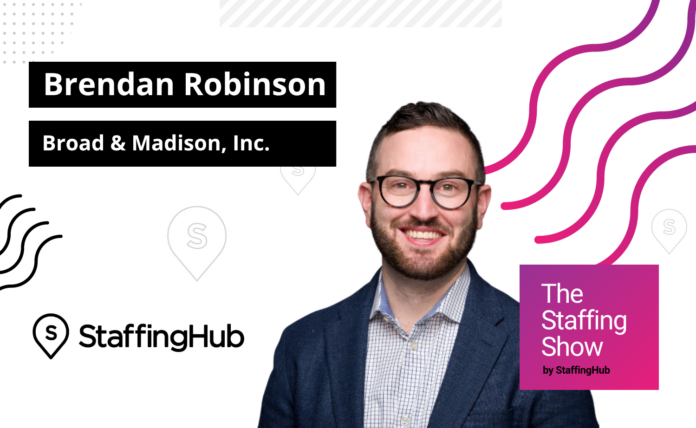
Drawing on his experience at Bullhorn, Brendan Robinson, Founder and CEO of Broad & Madison, joins David Folwell to explain why firms need to move beyond traditional adoption metrics and measure AI through tangible business outcomes.
You’ll hear:
- Why adoption metrics don’t prove whether AI is working
- Where playbooks, digital workers, and automated workflows boost productivity, from candidate screening to business development
- The implementation mistakes firms make most often
- Where staffing technology is headed next
[0:01:14] DF: Hello, everyone. Thank you for joining us for another episode of The Staffing Show. Today, I am extremely excited to be joined by Brendan Robinson. Brendan is the Founder and CEO of Broad & Madison. Brendan in 2016 built the Customer Health Score at Bullhorn. This delighted them so much they rolled it out across their entire portfolio. Then he left, started Broad & Madison, and now he’s telling me the thing he built is measuring the wrong thing. Brendan, you said nobody asked, how are we adopting a new hire? But everybody talks about how they’re adopting AI. What’s changed?
[0:01:50] BR: A lot’s changed. It’s nice to be at a point in my career, I can look back at my younger self and just think I’m a complete hypocrite. The reality is, I think AI is the way it’s being consumed is different than other technology and the expectations of it are different as well. When you look at just regular systems, like when I was working at Bullhorn for 15 years, adoption was measured through a series of interactions, clicks, usage data that you could then analyze and figure out if somebody was really, actually, a power user or not. Whereas now, I think it’s actually easier to measure adoption as it relates to AI, because there should be direct P&L impacts on your performance, similar to if you hire a new sales rep, or if you hire a BDR. I think it’s actually easier to get there.
However, we haven’t caught up yet in terms of how we measure the effectiveness of this technology. Ironically enough, this is often the piece of the tech stack that’s owned by IT, like a legacy IT team who has traditionally owned technology, purchasing and technology management. My argument now is this should live more natively amongst the teams in which it’s serving and how they are viewing it.
Not to say that the robots are here to take our jobs, or anything, but they are, I think, AI as it is currently representing itself needs to almost mimic like you’re hiring an employee, and you’re measuring through that lens how effective they’re being, versus the traditional SaaS approach for measuring effectiveness.
[0:03:21] DF: Yeah. It is interesting to talk about adoption in AI and also see how people are using it, and we are going to jump into that in a deep way and talk about what matters, what doesn’t, and, Brendan, how you’re thinking about adoption in different ways of measuring it. Before we do that, I would love for you to give a little bit of a background on who you are, how you got into the industry. You just mentioned you were at Bullhorn. But I’d love to know a little bit about Broad & Madison as well.
[0:03:45] BR: Absolutely. We’ll get into the industry. I feel like I have a very similar journey in the sense that as a little boy, I wasn’t dreaming of growing up being in the recruitment industry. You find yourself here and then next thing you know, 15, 20 years have gone by and you’re still liking what you do every day. I started back in 2010 at Bullhorn and spent pretty much from 2010 through the duration of 24 in and amongst their teams. I was lucky enough to have a solid career there, where I ended up being their SVP of Professional Services and Customer Success. Left at the end of ‘24 to start Broad & Madison.
I think Bullhorn has great products. I’ve been in amongst their ecosystem pretty much the majority of my career. But always wanted and had an itch to start my own thing and saw an opportunity within the ecosystem to build out an organization that can really help staffing firms manage their tech challenges more effectively than they currently are doing today. We launched Broad & Madison in January of ‘25. My partner, Stu Morgan, an ex-founder of Kyloe, another guy who’s been in the space for a long time, we launched it on this thesis and we flashed forward to it was 20 months into this.
We’ve taken off decently. I mean, we were upwards of 60, 70 customers onboard and growing rapidly with new product lines amongst, we call it embedded successes, what we launched with, which is effectively how we help customers manage their technology. We launched Clean, our product for hooking up and cleaning databases and making sure you’re getting the most out of your data performance. Then we just recently were the first AI partner announced by Bullhorn, now selling Dispatch, which is a managed service that sits around Bullhorn’s AI offering Amplify to help customers get the most out of that system.
[0:05:25] DF: You learned professional services, helped customers get to success, get more out of Bullhorn, deliver a better ROI. Now you’re doing that externally through Broad & Madison. What are some of the things that have changed for you and how are you measuring the impact you’re having on the companies you’re working with?
[0:05:41] BR: Yeah. I think there’s been this historic, like the traditional services model has been: a problem comes up with a customer, a consultant gets involved, they solve that problem, and they detach themselves and go find the next problem to solve somewhere else. We look at a more of a longer journey with that thinking, that there’s always going to be a problem to solve. How do we embed ourselves within your organization and almost become that office of the CTO, so to speak, where we can handle all of those technology challenges and build out an actionable roadmap with these firms that allows us to stay engaged with them from a 30, 40, 60 days, all the way to a year-plus, helping them solve their tech challenges.
I think with the rate, which is the first time in human history, the product is the fastest evolving organization in the tech firm, right? You need people that know what they’re doing to help you keep up. The challenges are only going to get harder, not easier as AI becomes more ubiquitous. We’re really helping these firms manage their intake and take this office. At the end of the day, I don’t mean this in a negative way, it is not the core competency of a staffing firm to be technologists. That is not what – They need to go focus on the selling, the recruitment aspects, filling the job orders that they already had and let other firms like us who can focus on the technology do what we do best. I think that symbiotic relationship has really helped our customers accelerate their growth plans, because even looking at the SIA did, it just came out recently, the name of the game next year is going to be, how do you improve your margin without adding headcount, right?
Figuring out ways to use technology as that forced multiplier to get away from the old days of staffing, which were when times are good, I hire people. When times are bad, I fire people. We have a really good opportunity now to bring some stabilization along via technology to ensure that we don’t have that upward-downward momentum we’ve had over the past X number of years.
[0:07:47] DF: Yeah. I mean, things are moving and evolving faster than I ever have in such a significant way. I feel like the expertise needed to get value out of AI is high, and the bar to get there, if you’re a staffing firm, not everybody has them on staff, despite what AI might tell you.
[0:08:02] BR: Yeah, right.
[0:08:03] DF: They’ll tell you, “Yes. Yes, you can. You can figure it all out.” What are some of the specific use cases in terms of how you’re helping companies? You mentioned Clean, Dispatch. Any stories of customers that you’ve worked with, or any exact projects that you’re able to share, or talk about?
[0:08:18] BR: Yes. We’ve been doing a lot of work around companies using Amplify. I think what we’ve seen is there’s still a gap between the capabilities of Amplify, which are massive and how customers actually consume the technology. The big thing that we’ve done across the board is develop an opinion that can be implementable by the customer. They’re used to expressing their challenges to a third party. Then that third party reacts and says, “Yes, we can help you. What do you want to do?” The customer is not in a position where they actually have the right answer, but they feel compelled to give you an answer, because it’s like, “Oh, now I have to come up with a plan here.”
We’re not actually solving their problem, which is either we lack the internal direction. We do not have the internal capacity to execute on our vision. We want to come to them and say, the days of the white sheet of paper consulting, which is like, tell me your hopes and dreams and I’ll write them down in a statement of work, execute, and then screw off are gone. We are building playbooks to all the technology that we manage. When we come in the door, we say, it’s not, what do you want to do? We still think that’s an important question. It’s good to have alignment. But it’s more of a, this is what we think you should be doing. Let’s have a debate to how this fits in with you.
All of our engagement starts that way, whether it’s Clean, whether it’s Dispatch, whether it’s our embedded success model. What we’re doing is skipping those first three months of a typical engagement, where a customer is paying somebody else just to write down the problems. Getting in there and executing against like, here’s what we could be doing. We’re really trying to short circuit that. Our time, the value, so to speak, is in month one, right? Whereas, previously, it’s like, let me spend all this time to make sure I nailed the scope here of this work.
[0:10:06] DF: Yeah. Let’s have 10 hours of conversations and then we write the –
[0:10:08] BR: Correct.
[0:10:09] DF: – then the proposal.
[0:10:12] BR: Right. It’s treated as well as far. I mean, it’s definitely picking on something now. Really, those two things that I mentioned, the we don’t have a – it sounds bad when we say it that way, but we don’t have a vision, or we don’t have capacity. Nine out of 10 times, it is one of those two things. We feel like we are hitting on something that has been pervasive in the market and frankly, has not been challenged, or approached this way from the consulting side.
[0:10:37] DF: Well, I also feel like everybody I know, I mean, two years ago, people are literally just coming to me saying, “What should I be doing with AI? I need to be doing something with AI. What should I be doing?” I think people have a little bit more of an opinion about what to do now, but how to do it is still a gap for many. Then how to do it in a way that gets an ROI, I think is where the gap gets even bigger.
We started this conversation by talking a little bit about adoption. I know you have strong opinions about that. How do you think adoption should be measured today when it comes to AI? How do you look at ROI on AI?
[0:11:11] BR: We’re trying to get away from adoption, because I think that’s a misnomer. That leads back to like, are people clicking in the system and is it part of their workflow? We’re trying to focus on impact. If you’re bringing an AI to your firm, you should be looking at what the expected impact of that is. What we have seen historically is that with the customers that we’re engaged with, AI is absolutely a part of their workflow. But they’re picking and choosing little pieces of the workflow to effectively, it’s actually closer to automation than it is to AI and how they’re deploying it. I do this one task and it’s great, but they’re not adding time back in their day. They’re not setting up AI in a way where it carries the process through.
I know talking to you separately, you have all these – you’ve offloaded, I think, with anybody I’ve ever talked to, some of your own internal tasks. How will you pass things through? Because it’s important when you’re doing it, like the way you thought about it is exactly right. It’s not just doing something in isolation. It’s thinking about how do I solve this problem, soup to nuts, and how does AI carry through each of those things? When it does and when it’s dialed, I’m going to get 20, 30, 40 minutes back to my day, which I can then use on something else.
Right now, it’s still like I bought a piece of tech. I threw tech at my people and they’re using it, happy days, versus a, all right, let me really lock in on something. This is a conversation you and I had, and I was blown away with – that you were doing with –. That’s the exact right way to think about it. Let me dial in on one really, really, really specific thing that I think I can carry through. What we’re doing is building the playbooks around those specific items. How do we build you an AI screener that does the entire screening process? That should put time back in your day, or alleviate the screeners you already have there separately. Thinking in that way is really how we triangulate our thought process and getting away from adoption and focusing on impact.
[0:13:08] DF: Yeah. I think adoption can frequently lead people down the wrong direction. I hear often, “It’s like we’re not adopting this tool. We need to adopt this tool.” It’s like, well, what’s the actual outcome? What is the impact that is having on your business? What does adoption actually mean? Because I’ve had people with Staffing Referrals, with other products go like, “Oh, the recruiters aren’t logging in.” It’s like, do they need to?
[0:13:28] BR: Correct.
[0:13:29] DF: Is that the value of it? If the value is placements, or referrals, then maybe it’s not. In AI’s instance, I think we have the same thing. It’s like, “Oh, recruiters aren’t really going in and using the AI.” It’s like, well, do they need to? If the process is off their plate and the time is back in their hands, that’s a win.
[0:13:46] BR: Exactly right. I think your point, Starring Referrals is great, too. It’s measuring the effectiveness of your technology, should be like, are we a better firm because we have Staffing Referrals? Yes or no? Versus the, I’m happy that I have all hundred of my people logging into the system, but nobody likes it. Right. Right. That’s exactly right.
[0:14:08] DF: What are some of the, and I know you’ve gone through a handful of different use cases. Are there any specific AI use cases today that you’re seeing have the highest impact, or playbooks that you’re like, everybody should be running these one, two, or three playbooks? Not a question. Everybody should be doing it. Do we have anything on that front?
[0:14:30] BR: We’re eating our own dog food on this one. But the one that I probably evangelize the most is what we call signal monitoring, which is you thinking about the business development component of any organization, right? The grunt work that it requires to go out and research to, like identify your ICP, research the customers that fit in there, look for good fits and take in new market information for the movers and shakers that now fall into the, I should contact these people bucket. We’ve been doing a lot of that ourselves internally and setting our customers up with this signal monitoring, which is effectively building a process to cultivate that business development motion in a way where once a week, we can pull down using AI a full list of people that meet our requirements for what we think is a great fit for us, all the way through to the, here’s the information you need to know about XYZ people as the decision makers of this organization, how you should be reaching out to them.
I would say, a decent size – I mean, this industry is so tightly knit. Obviously, referrals will always probably be the number one source of how you expand. For us, at least 20% of our business has come through signal monitoring, which is you go out there once a week and we look at everybody that hits a signal that we care about and reach out to them. It’s not the typical LinkedIn sequence of like, “Oh, I saw you post fill in the blank thing, like it’s a mad lib last week. I really like it. We can help you out.” It’s rooted in, “Hey, I actually saw the article you recorded in last week, and you guys mentioned that you acquired this company. With those acquisitions, you’re going to have data convergence issues. We have a product called Clean. We’d love to talk to you about how we can help you rationalize those two data bases.”
That is a materially better conversation that is more than just, “Hey, I noticed you. Will you talk to me?” Which is most of the outreach that people do. And it makes it easier for those customers to say yes or no. A lot of what our thinking has been in AI is take like, if you put decision makers in the position where you’re only asking them to say yes or no, because that’s a much easier way to get communication back for them, versus go through a whole thought process and all these just questions and make it easy for them to say yes or no, and it’s really helped us thus far.
[0:16:50] DF: That’s amazing. I mean, I think cold, dumb outreach is dying.
[0:16:57] BR: Correct. Correct.
[0:16:58] DF: Solely, because if you don’t have the context and if you aren’t doing it at the right time, we’re all getting hit with the having AI is making us – everybody’s getting hit with hundreds of messages a day. At this point, if you aren’t relevant and context aware. So you’re building that also for your customers and you’re building the sales motion, using Amplify through that, too?
[0:17:20] BR: Helping them get off the ground using those motions to identify those customers and look for that data. Bullhorn has even better data than you would think, because there’s all that metadata that exists within interactions that usually isn’t synthesized, right? Somebody sends a note, or adds an innocuous note over here, or somebody updates their information. It’s all reportable now in a way where it’s like, oh, I didn’t realize this person moved from Dallas to Austin. My role was an onsite Austin role. They’re now a great fit, right? How do I get in touch with them now?
It’s really, I think the ability now to process large sums of data has never been better at a desk level, right? It’s not like we need to go hire a data engineer, or data scientist to do it. It’s really been distilled down to like, everybody has this power at their fingertips. How do you go use it in a way that is going to be meaningful?
[0:18:12] DF: Yeah. It’s funny. I always think about, we have a signal product on the candidate side as well. I’ve used HubSpot sales for years, which was a signal not at the level that you’re talking about it as well. The thing that I always say is fishing with the bobber. You throw the line out there and you’re just like, maybe something’s going to happen. Or you can sit there and be like, “Oh, the bobber’s moving. Now take action.” I feel like, it’s just a way better way to do it, which is, it’s amazing that you get to build that out on the sales front.
What are some of the mistakes that you’re seeing people make when it comes to AI? What are the – they’re bringing you in, they’ve launched Amplify, maybe things aren’t going, they’re not seeing the value out of it. What is that they’ve done that’s making sure they’re not seeing the value?
[0:18:52] BR: Well, this is like the campaign that we’re launching now about nobody asks about Dave was the joke. We got to think where, it’s almost like, people are, again, I go back to what I said originally around treating AI almost more, it’s like an employee than it is a piece of technology. It’s, they’re hiring somebody and shoving them into a room with no direction and wondering why they’re not getting something they want. It’s the buy, no plan, but expect results, right? The underpants gnomes from South Park. Right? That’s what it feels like.
[0:19:25] DF: I remember that. I haven’t heard that reference in a long time.
[0:19:27] BR: Yeah. That’s the case, if I buy AI, I don’t know, huge profits on the end result. It’s like, all right, we – I think it’s, you wouldn’t hire a person without a job description, or goals, or anything like that. Take that same level of effort with – it’s not massive, but I think having goals around what you want AI to do is important. I think what we’re seeing is there’s just so much pressure to keep up with the Joneses and say that I’m doing something. Frankly, over the past couple of years, AI’s been the only thing that a lot of private equity firms have been open to green lighting in terms of the top spend. There’s a lot of either poorly deployed, or not deployed at all AI technology out there that there isn’t really a plan to go from inaction, which the nice thing about AI is the day of long implementations are gone. You can turn it on pretty quickly. To getting those actual results is that connected tissue doesn’t exist most times.
[0:20:26] DF: Yeah. It is funny. And so, we bought AI and we’re not getting an ROI. Well, how are you using it? Well, I gave it to my recruiters.
[0:20:32] BR: Correct. Exact point.
[0:20:36] DF: And what was the plan? What was the strategy? How are you? Yeah. Yeah. What was the use case? When you’re working with customers, so you’re giving them playbooks, are you doing trainings with the recruiters? How does that – Explain a little bit more there.
[0:20:48] BR: All the above. We’re really focused on Bullhorn’s Amplify as the one system where active conversations to expand the AI technology that we manage for them. Bullhorn in the way they set up, it really allows you to set up a series of prompts within each of the modules that can pull from different skills that are available to a recruiter. We are effectively giving them playbooks around what I just said. Bullhorn gives you skills. We take those skills and turn them into actual digital workers, or the persona of a digital worker, I should say, where it does fill in that entire block of work you would expect.
We’ll give you a screener. We’ll go build you a business development representative. We’ll build you an onboarding specialist, right? It’s effectively configuring the systems in a way that we can copy those configurations pretty quickly and get you set up with the end result of an already configured Amplify instance that will drive the results. Then we’re having a separate conversation of are these the results that my organization, as the customer wants and how do we fine tune it? It’s going back to that theme of like, we’re not going to say that we’ve productized Amplify and then just go buy it from us, it’s off the shelf. It takes fine tuning. But what we’re not doing is walking in and being like, “What are your hopes and dreams? What do you want this to do as our starting point?”
We’re walking in, being like, boom, we’re going to deploy these digital workers on your behalf. We’re going to measure their effectiveness and make sure it’s driving the results. It’s early days, we launched in August, but it’s been really positive feedback thus far.
[0:22:22] DF: That’s great. Somebody on the podcast, at one point, the way you were talking about the AI and the digital worker. They said it’s like hiring the smartest intern who has zero experience. It’s like, this person can do anything, but if you’re not there training them, helping them figure it out, good luck.
[0:22:39] BR: Correct.
[0:22:39] DF: I do think that it’s not a set it and forget it day one type of thing.
[0:22:43] BR: Exactly right. Exactly right.
[0:22:45] DF: I know you’ve said adoption of like, “Oh, do we adopt Dave?” That’s one way to – kind of funny way to think about it, but are there numbers that you’re consistently putting in place as the metrics, or the outcomes? Do they vary by customer? Any consistent dashboard items?
[0:23:02] BR: There are. I mean, it goes by, what we’re effectively doing is building a job description with goals as you would any hiring person off the street. Look at those for each of the roles that we produce. We want to be able to say in every instance, we deploy this as your worker. This is their job description, and this is their goal. Let’s measure against it. If we’re hiring a screener, that screener should be able to get through 1,000 screens a month based on the current volumes that we’re having here, and it should have extra number of quality with those screens, when it’s passing to the next people.
Again, it’s not trying to create this new category. It’s taking the human level results you would expect if that person was a real person and applying it to the AI in the same way. We’re not trying to over-complicate, or introduce these new, crazy, conceptually ideas. It’s taking what has existed forever and apply that to technology in a way that it hasn’t been done before.
[0:24:00] DF: This is a little bit deeper maybe in the weeds, but I’m curious when it comes to the recruiter outreach, the sales outreach and the different components of this, are you guys helping to train and to actually have the voice of the brand and making sure that it’s lined up on that front? Is that an area that you guys are digging in as well?
[0:24:15] BR: We are. We are. That’s what we do early days, because the nice thing is, since we’re deploying these digital workers with the prompts that are already constructed, that becomes the first thing that we’re doing with the customer. Instead of like, I said, six months to get it set up in the old days of implementation, the first thing we’re doing is actually saying, “All right, what’s this like from a voice of the customer standpoint? What do you want this to sound like, so it’s representing your brand?” We’re going as far as people are naming the workers we’re putting in touch with them.
We have customers that have named these digital workers. It starts with that, because usually, that name holds a special place in their culture for some reason. We deploy it that way and then start giving them that, I don’t want to call it personality. It’s not the right thing. But that interacting with their customers in the way that they would expect everybody to work.
[0:25:08] DF: Wow, that’s great. That’s great. Shifting the gears a little bit on AI usage, I always like understanding how people are using it personally, especially people that are deep into the game. I say personally, through work and your day to day, what are some of the biggest changes it’s had on you and your workflow in the day to day?
[0:25:28] BR: For us, it’s incalculable how much of an impact it’s had on us, because it’s [inaudible 0:25:32]. Meaning, from an execution standpoint, to go from where we are, you can own the block. A lot of incumbents out there, for us to be able to grow to where we have been, where January last year, there was two of us, October this year, there’s 20 of us with more joining on Friday.
[0:25:48] DF: Wow. That’s amazing.
[0:25:49] BR: Yeah. It’s because our AI has been the small team of interns we’ve been able to task with. We’re not looking for AI to be the transformational fault leader for our business, but very early on, it was – I mean, it’s easier to add AI when you’re starting a company for the first time, because you just say these things. I think we have a little bit of advantage there. Versus trying to change years of the ways of it used to be working. We’ve just been a very AI-forward shop since day one, and we look at things like, developing compliance, developing financial models for where we want to go, and then reverse engineering that and to go to market plans. Figuring out the signal monitoring I mentioned earlier. Developing a lot of our outreach cadences to customers. Developing ROI reporting that we can automatically generate based on interactions, as well as looking at our own internal signal monitoring, we read our emails, to parse out potential escalations. It’s been a huge piece of our identity from the start. It’s super ingrained in what we’re doing day-to-day. It’s hard to, again, quantify. It’s been a major, major impact on us.
[0:26:53] DF: Yeah. It is funny, as it feels like, for the first time in a long time, and there’s advantages to being small, which are speed, and that’s always been one of them. I feel like, AI has made it so that that advantage is 10 times more impactful, because the speed is truly – you can leverage it and harness it in a way that’s never been able to be done before.
[0:27:12] BR: It’s 100% and a force multiplier. I think if you go back to the old days when it was like, Stu and I starting the company together –
[0:27:19] DF: Yeah. You’ve got to build your handbook.
[0:27:21] BR: You’ve got to build. I mean, even things like that, we want to deal. They made us fill out a questionnaire to be one of their suppliers. One of the things was like, “Share with us your employee handbook.” I was like, “What?” This is day eight for us. What employee handbook?” We spun up in two seconds, right?
[0:27:39] DF: Yeah, I’ll have it to you in 30 minutes.
[0:27:41] BR: Correct. We won the deal. It’s allowed, the smaller organizations like us to have a much more of a fighting chance, but also present ourselves in a much more polished way, because even the things it’s doing with branding and presentations really allow you to up your game in ways where before you get to hire a design team to make it look the way that it’s looking. It allows us to get a lot of credibility throughout the institution.
[0:28:10] DF: What tools or training do you give to your team when they join?
[0:28:15] BR: We’ve experimented with everything. We start with a bunch of tools, and I can see our tool list is like, as Claude releases more, we’re like, how about winding it down a little bit? But we’re very heavy on Claude as a shop internally. We did start with ChatGPT. We made a decision, I thought instead of us half and one half in the other. I’m not advocating one over the other, but with those guys, you have to pick a lane a little bit and just roll with the other one. We picked Claude, mostly because of the Claude Code at the time and a development standpoint allowing us to build things quickly.
We use Gamma a lot. A lot of our Gamma early days is building a presentation. But again, Claude has come in a really long way in terms of its ability to do that. Gemini internally for, we’re a Google shop. Using Gemini to help plan meetings, look at emails, it’s been huge. We’ve actually done a lot of work with ElevenLabs, which is –
[0:29:05] DF: Oh, yeah.
[0:29:05] BR: Yeah. A lot of our marketing has been through them. We’ve done a lot of marketing videos through them.
[0:29:12] DF: I’m like, is this you? Are we talking to a [inaudible 0:29:14].
[0:29:15] BR: Yeah, it’s really pricey. We’ll see later on when I start teaching.
[0:29:19] DF: I’ve replicated my voice recently. I sent it to my mom and she’s like, “I can’t tell.”
[0:29:26] BR: It’s crazy also. Yeah, it’s crazy times we’re living. But from a training perspective, we really are focusing on a bunch of the processes that we can run upfront. Again, it comes down to knowing the tools and knowing what you need to ask if your people is going to be important. You go back to the same question about, you mentioned with Staffing Referrals, you care if the technology is having an impact on the company, or do you care that everybody’s logging in? We’ve made that decision that we care about that it’s having an impact on the company. Things like Claude skills, if we can automate some of the things our team needs, we’ll just build a skill for them. We’re not asking them to continue to go and learn more about the technology. We encourage it and a lot of them do, but we’re not just saying – Even training, it’s like, do I need to train somebody on this, or can this entire process be automated? We just brought the automations through skills and we get the same end result.
[0:30:24] DF: I’m doing the exact same thing and I keep thinking about the first time I heard human in the loop. I was like, “Ha, ha. Such a funny idea.” Now I’m like, honestly, that’s being in the loop means your judgment still matters.
[0:30:36] BR: Correct.
[0:30:37] DF: You’re either going to be building the loop, or you’re going to be in the loop. The more that I think about it is just like manufacturing, right? It’s like, you’re building a process in manufacturing lines, you’re building the process, or you’re working in the other side of it. What you’re talking about is a great approach to it.
[0:30:51] BR: There’s still drawbacks to it, right? We’re still seeing it on ours. I think there’s going to be an over rotation here when there’s going to be a heavy reliance on AI, and then you get the AI slot that comes out, which is like, it looks good, but nobody actually read it. When you read it, you’re like, “What the hell is this?” That’s why, I think your point of human in the loop is like, you still need that quality check in there to make sure you’re not being the people that are sending out the em dash to death type equation.
[0:31:19] DF: They killed. The em dash was such a – it was good, and now it’s just that. Now I see an em dash, and I’m like, I don’t trust it.
[0:31:25] BR: That was a big bummer for me, because I was like, I stole – I’m an em dash dude. I write in broken English, so the em dash was a good way for me to be like, a new thought. It was devastating for my personal writing life.
[0:31:40] DF: Yeah. Talking about the future a little bit, what do you think is coming in the next 18 months when it comes to AI? If you’re a staffing CEO, what type of preparation would you be doing today?
[0:31:52] BR: Two different answers. Maybe two different. But the first answer to what I think is going to happen, I think you’re going to start seeing a lot of these chat interfaces become the way that people interact with technology in general, and you’re going to start to see a lot of not old technology. But if you look at Bullhorn. I think Bullhorn’s been a system of record. They’ve been the system of record in staffing for a long period of time. Does a recruiter need to log in to get the value out of it? Or can they interface with it through an AI agent separately?
I think you’ll start to see a lot of the running together of these technologies happens through an MCP that interacts with a chat agent who talks to the user. Then the factory itself becomes the behind-the-scenes thing, versus the on the end result user, I’m going in there and moving this candidate from this stage to that stage. I think that will all become parts of the cog in the wheel, so to speak. That can happen behind the scenes and can allow the recruiter a more streamlined interface where they still have the same level of information, the same level of insight, but way more power to get that information out of the systems in the way that they want to see it than they have ever before.
It’s exciting, but that’s also going to present a whole other host of challenges. I think some of the throttling that has happened here is you’re going to see a lot of different names, or feelings to their brand because people are able to move very quickly and produce their own stuff very quickly. As a staffing CEO, thinking about ways to say, how do I create an environment where I can accept the fact that the next 18 months are going to be chaotic, but I can create an arena where I can control that chaos to the best of my ability?
[0:33:32] DF: Well said.
[0:33:33] BR: Yeah. I joke that people are still having the debate of, do I, or don’t I give my team access to AI? It’s actually the wrong question. It’s, do I, or don’t I want to be in control of that? Because it’s already happening. It’s already done. I need a decision. The genie doesn’t come back in the lamp, right? I think figuring out ways to create an environment that you can power, or harness this power that’s going to be at your fingertips is the most important thing you can be doing over the next 18 months.
[0:33:59] DF: It’s actually really funny. It’s just like, “Oh. Well, should you allow them to use Google, or not?” I don’t know. Google. It’s like, we’re all good. Everybody’s using that. And also controlling its heart. I think that’s one of the things that’s going to be difficult. I’ve seen examples recently of recruiters that are like, “Well, now I can make my own little flyers,” and they’re completely off brand.
[0:34:21] BR: Correct.
[0:34:22] DF: I think that’s the part that’s going to be interesting to see how that’s all scoped and where that ends up. One of the other things that I think is interesting to think about is some of the trends that are happening with software, ATSs, CRMs. Salesforce is going, has their headless approach. I use HubSpot. I don’t log into HubSpot anymore, but I use HubSpot daily. I very rarely actually go to the app. I’m doing more than I’ve ever done. Do you see that happening in the – Is that what you mean when you’re talking about this with Bullhorn, or the ATSs? Do you think that’s the path?
[0:34:57] BR: I think it is. I think you’re going to see these systems will be the systems of action, now the systems with that. Again, it comes down to the, I don’t care if all hundreds of my licensed users are logging in. I care that this system is providing the impact that I would expect it to, given that it’s our system of record. I feel like the adoption conversation kept people employed, because they could just be like, this person’s in charge of making sure that you log in and do your job. It’s just going to be a new world order. It’s going to be different. You’ll see, this is a Brendan thought, not a another thought, but does per user pricing go the way of dinosaurs? Yes, probably, if not already. Consumption based out like –
It’s going to be a lot of things that are interesting and happening. I almost think, you look at a net suite for those financial technologies that charge you a percentages of the assets they manage. Could that be the world? Like, hey, you’re pumping 10 million dollars a month through my system. Your price should be 0.1% of that, right? There’s a lot of things that are happening up here that are going to be really interesting. I don’t have all the answers. But I just know that the only answer that I know for certain is that yesterday’s way is not the one.
[0:36:12] DF: Yeah. Three months from now, it’ll be – I mean, the pace of change right now is mind-boggling, is what my part is.
[0:36:19] BR: It’s crazy. The thing that I have in the back of my head at all times is that legislation lags.
[0:36:27] DF: Oh, yeah. Not even close.
[0:36:29] BR: Correct. The whole hoopla of GDPR, when that came out, how many of those firms over there have their people taking customer information and putting it into their own Claude instance, like that’s not a problem, right? How are you safeguarding yourself against that to think about like, I’m all about believing in positive intent. But legislation is going to come at us furiously when it does. Being prepared for that is important as we scope the next couple of months and years.
[0:37:00] DF: Yeah, I completely agree. One last take here is that I think you’ve talked about at the beginning as the future is doing more with less. People are going to be growing the productivity. I’m at a spot where I think in the next, I don’t know, if it’s six months, a year, or two years, but recruiters are going to be doing five to 10X. If they’re not doing that on placements per recruiter, this is going to be challenging, even that’s, yeah.
[0:37:24] BR: Yeah, it’s getting hard to ignore the impact here. I think once people start getting a couple – If you’re a recruiter, this is probably the best time in human history to be a recruiter if you embraced it out. Because it’s still forming right now, right? There’s nobody has raced ahead and there’s not like, this is Bob over here and Bob is the gold standard for AI recruitment. I still think we’re in that forming phase. When the dust settles a little bit, you’re going to start to see a number of people who become the gold standard. This is a copycat industry. If it works somewhere else, I’ll copy that same thing and rinse, repeat.
[0:38:03] DF: Yeah. Yeah, it’s pretty incredible times. Well, Brendan, this has been an awesome conversation. Do you have any closing comments for the audience?
[0:38:10] BR: No, I appreciate you giving me the audience here. I love being able to wax poetic on this stuff.
[0:38:17] DF: I love it. Well, what you guys are doing at Broad & Madison is pretty incredible. Where should people find you if they want to reach out to you?
[0:38:23] BR: Absolutely. [email protected], B-R-E-N-D-A-N, or broadandmadison.com, more website perspective. Highly active in both those places. I’d love to hear from folks across the board.
[0:38:35] DF: Awesome. All right. Well, thank you so much for joining. Great conversation. Have a great day.
[0:38:39] DF: Thanks, David. Appreciate it.