

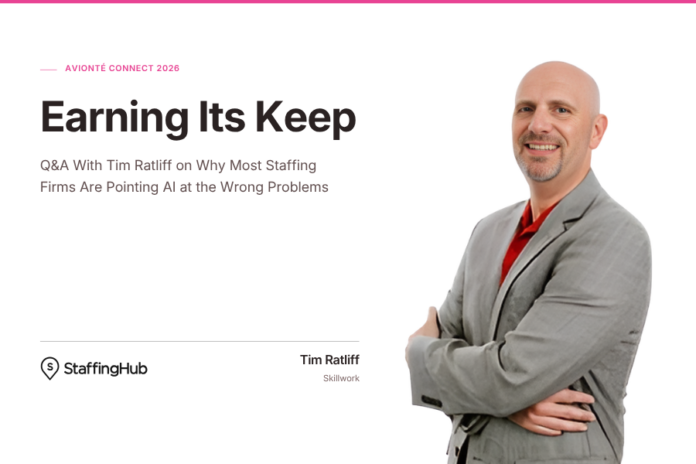
Every staffing firm is buying AI tools right now. Tim Ratliff wants to know if any of them are actually earning their keep.
As the technology and innovation lead at Skillwork, Tim Ratliff sits at the intersection every staffing executive claims to manage well: building for where the company is going without neglecting what it needs today. AI has helped at the edges so far, faster resume builds, faster searches through call recordings and email, but he says the real payoff hasn’t shown up yet. That happens, in his view, only once AI is wired into the data, systems, and processes across the whole organization, not bolted onto one task to speed it up.
At Avionté CONNECT 2026, Tim Ratliff sat down with StaffingHub to talk about how he weighs today’s execution against tomorrow’s bets, why security and compliance will never be fully solved, and why the firms that pull ahead over the next year will be the ones that treat hospitality, not tech stack, as the real differentiator.
Q. How do you make sure the technology you’re using at Skillwork is ready for where the company wants to go, without getting ahead of what the business actually needs right now?
Tim Ratliff: That’s a key part of what I do, because it’s easy to get pulled toward where the company is going and spend all your time building, positioning, and researching for that, while ignoring what the business needs today.
I balance it by staying aligned with leadership on strategy and where they want to be, then asking: what do we have today that can get us there, and what are we lacking? But the other piece is just as important. If we don’t execute today, we won’t get there at all. So it becomes a matter of what we need today to execute, and how that prioritizes against the work of positioning for the future.
Sometimes it’s about finding something we already have that can fill a gap quickly, without much investment. And investment isn’t always money. Often it’s time. I have to protect enough time to keep researching and watching what’s coming, without pouring every resource into today’s fires.
Q. How do you find that balance in practice?
TR: Part of it is my team. I ask them point blank: are we spending too much time on one thing? Do you feel like we’re overinvesting here? Part of it is writing out an actual plan and building a priority list: here’s the room we have for this, here’s the room we have for that.
It’s similar to software development. You’re constantly maintaining what you have while building for the future, and figuring out how to do both well. My software background is what I lean on most for that. If something breaks today, we pivot hard to fix it. Otherwise, it comes down to properly allocating time between sustainment and future build. Having a couple extra people lets me dedicate some to today’s work and free others for the future. It is a luxury if you’re able to have additional people to help, but there are resources available to help provide additional insights while you’re managing today’s fires.
Q. You mentioned AI. Have you found pointing AI at today’s problems helpful, or is that not how you’re approaching it?
TR: That’s not how I’m approaching it. To answer directly, yes, a few things have been helpful. But where I’m really pointed is the foundational work of getting AI into our data, our systems, and our processes. That’s what’s really going to unlock value for us.
Right now, AI has helped us generate logic to back-harvest faster, things like that, but it’s small. The real advantage shows up once AI is integrated across the platform and across our processes. We’ve seen a few day-to-day wins. We haven’t seen it open up the enterprise yet.
Q. Where are you seeing AI really start to earn its keep?
TR: For us, it comes down to measuring time. We build branded resume packets, and one of the LLM models turned out to be very good at building those accurately, creatively, and repeatedly. That’s saved us time.
Another one is searching across our ecosystem, documents, emails, call recordings, for data. That’s been a genuine time saver too.
Where I really expect AI to earn its keep is when it starts prompting our people before they think to ask. Right now, our team thinks, “I need to find this,” and goes to AI for help. What I want is AI saying, “Have you thought about this?” or “Maybe you should do that,” and having our people go, “Oh, I hadn’t thought of that.” That’s when it moves past saving time and into driving productivity.
Q. How is AI changing the way your team recruits?
TR: Honestly, today it hasn’t changed it much. Where I expect it to change things is as we move into AI prescreening and AI calling capabilities. That will definitely change how we recruit.
The other piece is AI surfacing things about a candidate that we hadn’t considered, things that came up in a phone call, an email, or a text that we didn’t catch but should factor in.
Q. What’s a challenge a lot of agencies are facing right now that you think is close to getting solved?
TR: Data is on everybody’s radar: how to get it, how to display it well, how to make it accessible and flexible as the organization’s needs shift. One month you need to see one thing, and three months later it’s something else entirely.
The other massive one is software tool integration. There are so many tools out there now. How do you decide which one to use? Do you integrate it yourself? That decision weighs heavily on people’s minds.
Q. What’s a challenge in staffing that you think will persist and get more stubborn, not less?
TR: Security, and everything that comes with it, is always changing. Every risk you solve today, five more open up tomorrow. As you make data more accessible, you make it more exposed, so figuring out how to do that well while keeping strong security is a constant fight.
Alongside security comes the legal side. More states and municipalities are passing privacy and security laws every year, and staffing firms have to keep adapting. I’d lump all of that together as security and governance. I don’t know that it ever gets fully solved, especially as more data opens up. It’s only going to get more complicated.
Q. What’s a piece of advice you’d give a staffing leader who wants to be well positioned on compliance right now?
TR: Find somebody, a person or an organization, who can keep you current on the changing legal landscape around compliance. That environment shifts fast. A year ago, scoring candidates with AI was fine, nobody blinked. Now it’s turning into a taboo, because people are asking who scored it and how.
That compliance risk isn’t going away. If I were talking to a staffing leader, I’d tell them to make sure they have someone on their side who understands the legal and compliance environment as it changes, and who can guide them on how to manage that risk.
Q. What are you most excited about in the conversations you’ve had here at CONNECT?
TR: A lot of the conversations I’ve enjoyed have been around data access and how we’re helping staffing companies get results, and how we’re helping recruiters and internal teams work better or get more time back. It’s been fun hearing the ideas and seeing the solutions.
Another thing I’ve enjoyed is the encouragement to just call each other and solve problems together. That collaboration has been one of the best parts of being here.
Q. A year from now, what will the staffing agencies that are pulling ahead be doing differently than they are today?
TR: I think the ones pulling ahead will be the ones whose software tools and processes let them offer the greatest hospitality to their talent and their clients. Hospitality is a broad word, and it covers a lot of ground, but it comes down to understanding what your talent needs, what your clients need, and delivering that in a way that’s meaningful to them.
The firms that understand that and can serve both sides at the highest level are the ones that are going to win.