

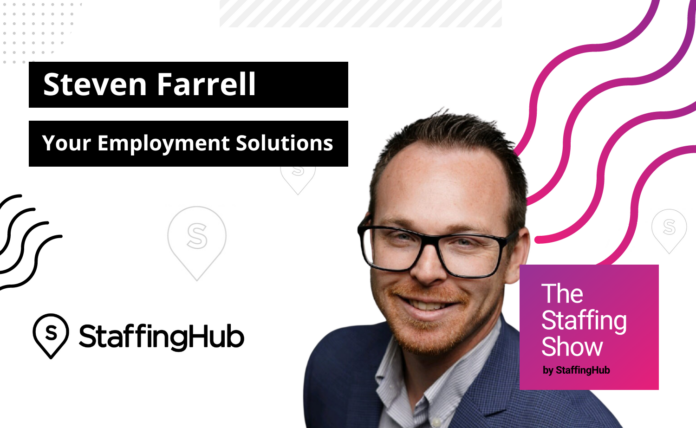
How can AI help staffing agencies move beyond simply filling roles to becoming true employment partners for their clients? Steve Farrell, COO of Your Employment Solutions and the host of The Staffing Playbook Podcast, joins us to explore how AI and emerging technologies are reshaping the staffing industry and helping agencies deliver long-term value for their clients. Steve begins by sharing the story behind Your Employment Solutions and how his interest in AI evolved into a key part of the business strategy. He then walks us through the early stages of implementing AI; revealing how those efforts ultimately led to more than 1,000 new placements. We also unpack Steve’s practical TCLD framework: a simple, memorable system for identifying where technology can drive meaningful change within staffing businesses. Along the way, he discusses how the role of the recruiter is evolving, what skills will become increasingly valuable, and where he believes the industry is headed next. Tune in for a practical, forward-looking conversation on how staffing agencies can embrace AI to work smarter, strengthen client relationships, and build lasting competitive advantage.
[0:01:13] DF: Hello, everyone. Thank you for joining us for another episode of The Staffing Show. Today I am super excited to be joined by Steve Farrell, who’s the COO of Your Employment Solutions and the host of The Staffing Playbook. Steve, super excited to have you on the show today. Always enjoy our conversations. And today is going to be a good one. We’re going to be digging into AI productivity, talking about how AI is being used in staffing firms. And Steve is one of the most technical early adopters deep in the AI game and has some pretty incredible use cases that we’re going to jump into. So super excited to have you on the show today.
[0:01:54] SF: Well, thanks for having me back on, Dave. This is a pleasure. I always enjoy our conversations on and off the air. I think you give me too much credit for the AI stuff, but I am well practiced in it, we’ll say that.
[0:02:09] DF: I feel like when you showed me your – a lot of people show me their vibe-coded projects. And most of the time I’m like, “Okay, cool. That’s not really going to do much.” And yours, I was like, “Oh, you’ve built an entire data dashboard system that could go to market as like an enterprise product.”
[0:02:27] SF: Well, I do have an advantage, and that is I coded back in middle school and high school. I started with binary in middle school. I was writing love letters. Never got a date out of it or a girlfriend. But I dropped out of my CS degree 6 weeks in when I was 18. I’m like, “I do not want to do this as a job.” This was fun building video games. But this was when PHP was like a buzzword, the new coding platform. And that’s when I stopped. It wasn’t until these agentic models were released end of 2025, that’s where I just went into the deep end, just learning everything I could.
[0:03:03] DF: Well, it shows that you’ve got the capabilities. Before we hop in, just so everybody has a little bit of context, can you tell us a little bit about who Your Employment Solutions is? And then we’re going to jump right into some of the AI use cases and the ways that you’re using it in your day-to-day.
[0:03:18] SF: You got it. So, I’m with Your Employment Solutions. I’m the COO. We’re a Utah-based staffing firm. Been in business for over 30 years. And we’ve got incredible leadership and owners here that embrace technology. Very forward thinking. Part of my success, Dave, is really thanks to our leadership that has a mandate to find inefficiencies in our business that we could solve with software. So, love it. Appreciate it. And also, as you mentioned, host of The Staffing Playbook podcast. And we’re going on almost our second year. We’re about 90 episodes in. So, it’s been a blast.
[0:03:57] DF: That’s amazing. Well, and I know you recently had a webinar just a couple of days ago about the cost savings that you’ve been focused on delivering from AI. And it sounds like that’s been a big part of your guys’ approach is like where can we drive real impact to the business to the bottom line, which is I think something a lot of people in the industry are looking for and trying to figure out. Continually hear conversations on, “Yeah, we’ve adopted all the AI but I don’t know if it’s really helping. Or we’re paying for all this new AI software, but where’s the real impact?” I think maybe a starting point, could you tell us a little bit about what that journey’s been like and the impact to your business? And then we’ll go into some of the specific use cases from there.
[0:04:38] SF: Yeah, absolutely. So, I was given a mandate by ownership. I needed to increase EBITDA. So, there’s two ways of doing that, right? You can cut expenses. Nobody likes that. Who wants to pack in their own toilet paper and pack it back out to save expenses? Or you can grow, right? You can grow revenue. But you can’t grow revenue and grow your expense line with it. You have to maintain that expense line as you grow revenue. That was the mandate.
The other piece of that, the other side of the coin is we had the candidate experience that our candidate experienced every day was the same like every other staffing firm, right? You would apply online, you’d wait a couple days for a recruiter to reach out to you, you then interview, and then hopefully you get offered a job and onboard, and you’re on your way.
Well, we would post a job, we get 100 applicants that would apply within 24 hours. And it would quite literally take us 48 hours to reach out to all 100 applicants. And because of the delay, we could only get a hold of about 17% that we could screen. Simple math. 100 applicants, 17%. That’s 17 we were able to get a hold of. The rest were gone. Someone else got a hold of them. So that was a huge problem.
Then we had our phone system. We’d get 500, 600 calls a day per branch, “Hey, what job do you have?” “Hey, how many hours are on my paycheck?” “Hey, I’m calling out on my on my shift.” Or, “Hey, I don’t like my supervisor.” Just everyday calls that we were missing about 75%. I didn’t like those service failures, but I couldn’t hire my way out of it because now I’m increasing my EBITDA in the wrong way.
And so both of those together, we went down this path of how do we find pieces of our recruiter’s job and our operations team job that can be replaced by AI. Not replace the recruiter, but building a workforce of AI employees that can do the phone screening, that can talk to candidates calling in on a receptionist line.
And so we looked at our entire candidate journey. We mapped it out and then we started plugging in our current tech. And then we had to go outbound to find tech that we were missing to complete this process. So vetted several vendors and kept hearing about Whippy, and reached out to them and we met. And so long story short, we tested Whippy in one market, one agent. This was the phone screener agent.
And so now every applicant has been given an opportunity to interview. So, we went from interviewing 17% to on average 80% of our applicants that applied received an initial phone screening. And we no longer needed someone to screen applicants, someone that was farming them. We didn’t have to hire a receptionist for the front. And we didn’t have to hire another recruiter to help with all of the hires that we were netting. So, that was the first step in our phase.
We then moved to the receptionist line which was a gamechanger. Every call got answered. Nearly 80% were successfully handled by the agent. Whatever reason they were calling, right? It completed that. And then did a live transfer on the calls that it could not handle successfully. That was one market. Phenomenal. Saw instant results over a couple months. Then we moved into another market where we had a client that asked for an increase of a thousand heads. Now, we’re talking, David, a thousand heads.
[0:08:05] DF: It’s amazing.
[0:08:06] SF: Well, I was given a mandate. I cannot hire internally. Normally, you’d hire two or three recruiters for that, right?
[0:08:13] DF: Yeah.
[0:08:13] SF: Because you have your customer base that you’ve planned your staffing program around to be able to staff successfully. You throw in a thousand new long-term positions, you have to hire more recruiters. So, I took this wild bet. I gambled on implementing these AI agents into this new market. Fast forward, a thousand placements, didn’t have to increase our internal staff, and it was a resounding success. So that was just the beginning of our journey into these AI tools.
[0:08:43] DF: And so it sounds like you’ve been looking at where are the – how can you grow? Because you guys I know are on a pretty good growth streak again this year which is amazing. Congrats on that. Then you’re looking at like how do we do that without scaling cost? Actually, drive higher EBITDA. How did you prioritize what to work on first? Did you look at any process for that?
[0:09:03] SF: Well, obviously the real human side of it, the labor expense, that’s what we prioritize first. But obviously the quality needs to be there. The agent has to be an effective screening agent. The receptionist has to be really good and patient and be able to call in different tools to help the person calling in.
And so the experience overall was our top priority. And so we would listen to calls, we NPS scored every single call with our agents. We’d send a text to the associate, like, “Scale to one to five, how would you rate your overall experience?” And we were getting really good feedback. 4.5 out of 5 on our NPS, which by the way, we NPS our recruiters pre-AI. And because of how long it took to reach our candidates, we scored 2.5 out of 5. Massive upgrade in our NPS. That was the broad picture here is we’ve got to make sure it’s a good experience for our candidates.
On the administrative side, we needed our recruiters to enjoy this system and to trust the system, to trust the analysis and the rollup and recommendations from the AI interview. That took some time, right? We had to get to a point where, Dave, you’re my co-worker, you’re my recruiter. When you hand me a candidate’s file and your interview notes and recommendations, we want to treat the AI the same as our co-worker sitting across the desk. We need to trust what’s been sent to us and then make our final assessment. And that took some time for adoption.
But as we were seeing that our placements were not only increasing, our time to fill not only was increasing, but our time on assignment increased. We had better retention. 30% increase in retention on our AI screen candidates that were selected –
[0:10:47] DF: Wow. That’s wild.
[0:10:49] SF: Massive.
[0:10:50] DF: What do you think’s behind that?
[0:10:52] SF: Well, I’ll tell you it’s nothing sexy. It’s actually quite simple. A recruiter is doing 10 to 15 interviews per day. By the time you reach that 9th interview, you’re just exhausted. You’re just checking the boxes. You’re not taking the time to evaluate the answers. You’re not taking the time to really dig in and ask follow-up questions because you’re tired, right? You’re hungry.
And so, our agents don’t get tired. And they’re very reactive to responses. If the agent asks an open-ended question and you give a closed answer, it’s going to probe. It’s going to get that open-ended answer from you. Something a real recruiter should do. But when you’re doing 15 interviews a day, sometimes you don’t. So, just better selection process.
[0:11:37] DF: And so, you’re using it for all incoming web submissions for the quick – are you doing call –
[0:11:43] SF: Apply, Indeed. You name it. From your platform, Staffing Referrals. When they apply on the job board that you guys published, they immediately get a text inviting them to call the agent for an initial phone screening.
[0:11:54] DF: Awesome. You’re giving them the text of saying, “Hey, here’s who to call. We’d like to have a quick conversation.” AI agent has that. At which point – or is there a point where you do have a human handoff? Or what’s that process look like?
[0:12:06] SF: Yeah, the human always has the final say. So this really moves into some of the work has been automated and replaced by AI with our recruiters, which is what we want, but we don’t want to replace the recruiter. The recruiter needs that judgment to now – I mean, think about recruiters today. They should be really good at analyzing all of the information coming in from your agents and being able to make a decision on if this candidate is a good candidate to move forward or not. So, the human always has the final say.
And we’ll do a follow-up call sometimes if we’re like, “Yeah, I have two questions that are unanswered. I need to get more information on it.” And so, they schedule that. The automation does it all for them with the click of a button. And then they have that follow-up call and then they make the decision from there. But that’s the gate is the human makes the final decision. And that’s what we want. That’s the durable part of this role as a recruiter is the judgment. Making that judgment call.
[0:13:00] DF: Yeah. And you mentioned with me in a conversation earlier about your frame. Kind of like the framework about how you think about where AI applies. I think that’d be great if you’d share that with the audience in terms of how and where to apply AI.
[0:13:14] SF: All right. I call it the TCLD. Each of these letters represent a word. The first one is T, theater. This is what companies perform. Think about a performance where there really isn’t any true value. Think about the reoccurring meetings that no decisions are made. Reports nobody reads carefully. The check-ins that produce no information. Man, AI is really good at replacing that. Just have your AI bot join the meeting if there’s no decisions that need to be made. Have your AI like create the report on Monday that your boss never reads. Use AI for that. It’s really good at that.
The next one is C. That’s for commodity. This is real work. Think about the years and decades our industry has really worked hard at their craft and parsing resumes, skill matching, just teasing out the red flags in an interview, like the really good stuff that takes time to learn. Think about your standard payroll runs, like invoice generation, looking at background checks. That commodity work is real, but it no longer needs you specifically. AI is replacing that. It’s been commoditized. I’m sorry. I’m sorry for those. This is maybe a news flash, but your resume parsing skills, AI can actually do that a lot better than you can.
[0:14:44] DF: Yeah, that’s a skill that’s no longer needed.
[0:14:47] SF: You know, and I’m sorry for payroll. You’re looking for payroll errors and markup discrepancies. I’m really sorry, but AI does that better now. And so, we need to embrace that. So, that’s commodity. AI is getting really good at replacing that.
Then you have L which is on the line. These are structural patterns, like pay discrepancies, garnishment edge cases, exceptions that don’t fit the rule where it still needs a human, but at some point it’s probably going to go to that C line, the commodity, and be done really well by AI.
Right now, we have a lot of people that are on that L where it’s like needs a little judgment, but AI is getting really good at it. Eventually it’s going to move over to AI. When you’re doing an honest assessment, you need to ask yourself, “Is this a T? Is it theater? Is it C? Is it a commodity? Is it L on the line?”
And then the last one, this is where the rubber meets the road. This is D is for durable. Output depends on judgment you can’t fully describe. So, if you can put your judgment on an SOP and your most junior recruiter can follow it, that’s not durable. That’s a commodity, right?
Think about when a client calls, puts in an order for 10 people, and you go, “Great, we’re on it. We’ll get them by Friday.” And that happens every other week. Well, you need to ask yourself why. Why am I backfilling these 10 every other week? Is it our recruiting? We’re not qualifying people properly? Or is there something going on in the client facility with maybe a specific supervisor or their onboarding and training program? Right? So, that’s the judgment that AI is not making because it doesn’t have the context. It doesn’t have the relationship that you have with that client.
The judgment call, the error in payroll that AI didn’t catch but you did, maybe it’s a fraud case, right? I mean, these are the things that we must lean into as an industry. Things that require judgment and cannot be replaced by AI. Things that can’t be placed in an SOP that a junior can just get up and running. It’s the stuff that’s in here, not necessarily on paper. That’s the durable. That’s the D.
[0:16:55] DF: Yeah. And I think that’s a great framework to think about. And then the judgment of obviously the anything that can be commoditized right now if like AI is coming towards it. If it hasn’t done it yet, it’s trying. Even the judgment. There’s a funny one as I took a AI literacy test online the other day, and I was like, “Oh, you have –”
[0:17:11] SF: You did?
[0:17:12] DF: Yeah. It was a guy I follow, Nate Jones. Has all kinds of great AI content. And I was like, “You know, let’s just see what this does.” And scored relatively well on it. But the part that he’s like, “Your next phase is figuring out how to codify your judgment.” And I was like, “Whoa, whoa, whoa, whoa. Isn’t that our part?” I was like, it is funny to think about is like what parts will remain human versus not. Obviously, the conversations are I think one of the key components of that.
As you’re rolling out AI, I know a lot of people are looking at what AI to roll out and how to do it and how to make sure that they have the ROI on it. What are some of the lessons that you learned along the way? And what are some of the mistakes that you made that you would have done differently?
[0:17:55] SF: You know, we didn’t make a lot of mistakes, but we did. I’ll share some of those. You have to be really clear on the outcome. What is it that you’re trying to achieve before you start with any AI tool? If you’re chasing the shiny object on the vendor floor, there’s hundreds of them, man, your CFO is not going to like you. And your team won’t like you either because you’re throwing a million different tools at them and none of them are talking to each other. And so, you have to be really clear on what you’re trying to solve.
For us, we are trying to solve for efficiencies. We are trying to solve for profitability and then scale on top of that. In addition, we wanted to make sure the candidate experience was best of class and the administrative side was best of class. We didn’t want to burn out our recruiters.
And so, we looked at the expected outcome, the end goal in mind, and then we reverse engineered it. So, anybody out there that’s looking at all this tech. Look, I know it’s sexy. The dashboards are cool, the widgets, everything that’s there. But what is that actually doing for you? What are you trying to solve for? So, answer that question first.
Now, mistakes that we made along the way is we probably – in fact, we did move too fast, right? Because we had our north star. We knew exactly what we needed to do to get there to implement it. But where I failed is I just threw it on my team too fast. Didn’t spend enough time with them.
I mean, we got caught up. It wasn’t detrimental. It didn’t hurt the business. But it was frustrating for the team because it’s just so much new information being thrown at them that they have to learn. And so if I could go back in time, I would have slowed it down a month or two on adoption.
[0:19:35] DF: I tend to have that same problem of, “Hey guys, here’s what we’re doing now.” On that front, what are some of the things that your team needed to know that you think was helpful in terms of their adoption of it to get them engaged, bought in, feel like they understand what to do? And maybe that digs a little bit deeper into like how did their day-to-day process change? Is this completely off their plate now in terms of like following up with web submissions? Or do they still have to do it as – yeah.
[0:20:02] SF: Well, this is difficult with large organizations. For me, what would have been probably an ideal scenario is I bring them along in this discovery process of how AI could solve for our challenges and help us reach our goal. Yes, we had conversations around that, but then it was lights off. I’m out finding the tools and getting them, building. And then two months later, it’s like, “Here you go. Start right today.” So, if I could have brought them along with me through the rest of the journey, I think there would have been a lot more buy in.
And then probably setting that aside, just getting the buy in, but just being a little bit more firm on like this is how it’s going to help your job. Not firm, but more direct. This is how it’s going to help you save 10 to 15 hours a week on recruiting. This is how we stop burnout. Do you really love interviewing 15 people a day? No, you don’t. There’s a couple interviews throughout the day you really love, and they’re fun. But let me help you see the bigger picture of how you can spend more time with your candidates after the screening, how you can spend more time with your talent that’s deployed, how you can spend more time with your clients. Being able to have those conversations and help them see that early on would have been a big help.
[0:21:14] DF: Yeah, it makes a ton of sense. I feel like adoption, even when it’s improving a job or taking things off the plate, change is change, right? And there always can be a lot of push back on that or hesitation on it. One of the other things I’d love to dig into is I know with your staffing playbook podcast, which is excellent, and I know you guys always dig into the tools and techniques and what the best people are doing. What are some of the trends that you’re seeing related to AI? Or even just in the stacking industry right now, what are some of the things that you’re seeing work really well to drive growth, productivity? I know you are one of the more dialed in people for understanding the pulse of the market.
[0:21:56] SF: We could go on for a long time on this one. Unfortunately, as an industry, we have the shiny object syndrome. And so some of the trends I’m seeing is people are just buying all these AI tools, trying to solve a problem, not really defining what that problem is. Not looking at their existing tech stack to see if there’s already some stuff there to help them. I’m seeing a lot of that.
I’m also seeing the firms that were being very thoughtful about this two, three years ago are the ones that are growing. They’re the ones winning because they’re the early adopters, right? Now, that doesn’t say you can’t start today. If you haven’t started, start today because you will be left behind. You have a small window left, but it’s still there. So, get after it.
I’m seeing a lot of shiny object syndrome as a trend. I’m seeing the ones that were thoughtful and early adopters are winning and they’re growing. They’re taking market share. And I’m not talking like, “Okay, I want an account here and I want an account there.” You’re literally seeing these companies that are just gobbling up clients of their competitors at scale because they’re just better. They can get to the talent faster. Their talent are staying longer. Their account managers are spending more time with their clients. It’s just overall a really big improvement on their service. And so if you are an early adopter, you are absolutely winning the market right now.
I’m seeing another trend, and that is executives. They all have this little icon on the bottom of their computer and it says Claude. Executives are using Claude. They’re using Codex. Executives are high adopters. I mean, you go to an SIA executive conference and you just walk by, everybody at the table has their computer open. They’ve got Claude open.
Executives are using it, which is fantastic. I’m sure the technology department doesn’t love it. But what I see has been really missing in this trend is although the executives are using it, and they’re having fun, and they’re probably doing good and doing damage at the same time, the frontline team, your boots on the ground, your on-premise managers, your recruiters, your branch managers, account managers, your area managers, they are not being developed to use these tools effectively to find inefficiencies in their business. They’re just using it for email outreach. They’re using it for PowerPoint presentations. They’re using it for Excel. But they’re not using it like the executives are. They’re not being taught. They’re not being promoted to use it, encouraged to use it. I am not seeing that as a trend across the industry.
[0:24:30] DF: Yeah, it’s actually crazy. I’ve had a couple conversations this week about AI adoption kind of at the front line with the recruiters, and I’ve been shocked at how many relatively large companies have no – they’re like, “Oh. Well, we tell them they can use their personal – or we don’t have a policy at all.”
[0:24:48] SF: Or they’re banning it from their network.
[0:24:50] DF: Yeah. Or they’re trying to ban it from their network. I mean, even if you’re banning it from your network, I’m like it’s impactful enough that I wouldn’t be surprised if some of them are using their personal one to get some of the games. And so it’s almost like better to lean in and give them access to something to do their job, because I think the impact can be pretty significant overall. That’s good insights.
I guess in terms of like your sourcing strategy as a whole. You talked a little bit about the operational side of taking the intake. What are some of the things that you guys are doing uniquely to drive talent in? I know that you are a bit of a marketing guru in terms of the branding and how you approach things. What are some of the things you’re running today that have been effective at keeping your job board cost down?
[0:25:31] SF: Well, I’m not the marketing guru. I just play one on TV. We have a phenomenal marketing team that they come up with all this stuff, and I just get to benefit from it.
[0:25:42] DF: I mean, I can see your little Yeti. You’ve got the staffing – everything’s branded. I’ve got your box that I got to come home from after your conference. You’ve got it dialed in.
[0:25:48] SF: Oh, yeah, yeah. Okay. Back to your question. Say it again.
[0:25:55] DF: Well, I’m curious to know when it comes to your sourcing strategy.
[0:25:59] SF: Sourcing strategies.
[0:26:00] DF: Yeah. What are some of the things that you’re doing that are unique or even not unique? And I think the thing you just talked about, which I can see how it would have a huge impact because you’re like, “All right, we have all these web submissions. How do we qualify those faster?” Just wondering about how you’re approaching sourcing, if there’s anything else on that front.
And obviously, I know you and I have worked together, and I’m always intrigued by what you’re doing on the referral front. You’re one of the very few agencies. Your ROI on the referral program is pretty significant because you’re running a help a friend out, zero-dollar bonus program, which is amazing. And you have a good enough reputation. That’s one area.
[0:26:36] SF: Yeah. Let’s talk about that in a little bit. My strategy is to make Indeed hate me. And I think I’m getting there. I respect Indeed, but we want to get rid of that spend. Take it down to zero if we can if all possible. And so, obviously, any company, we have our own internal database of candidates that we’ve sourced in the past. Already paid for. But the really neat thing about these AI tools is bringing the automation into all of your sourcing.
For example, we use staffing referrals. And you guys have done a great job with gamifying it, having a leaderboard, make it really easy to share jobs, have recruiter profiles with their jobs and so on. And so we’re leaning in heavily into referrals, where if you start an assignment, a text goes out, “Hey, how would you rate your experience?” “Great.” We get that instant feedback. And then, “Hey, would you recommend a friend?” “Yes.” “Okay, here’s a link to do so.” Now you have a leaderboard. So that’s been a huge help in our business is just the referral side because we’ve got the candidate we’ve already paid for. Now they’re referring their friends.
And to your point, we don’t incentivize referrals. It’s just because we have a great reputation, it’s been such a good experience that they want to refer their friends. And so that’s a big part of our sourcing strategy. But we can’t do any of this sourcing effectively without the automation that we’ve built into all these processes. Everything’s connected from the first text message, to rate your experience, to referring someone, to that person now clicking on the job link and applying and then going through the voice screening, to then placement, and they’re getting their own referral link. All of it’s talking to each other. And we can’t do this without everything being integrated into our ATS, which we use Avionte. And so tools like Staffing Referrals and others, we have everything talking, everything’s automated. It’s just a push of a button instead of logging into 15 different systems.
[0:28:34] DF: One of the things that as you’re adopting all this technology, I know you’ve got it centralized in the ATS. What is the role of a recruiter look like today? How is that evolving? And kind of where do you see that going over the next few years?
[0:28:47] SF: One of the best questions today that I’ve been asked. The recruiter of a year ago looks completely different today. I mentioned earlier about the work that’s been commoditized that we used to be really good at as recruiters that AI is much better. And so the recruiter today has to be really good at just analyzing data and making a good judgment call on that. And that’s very different from just interviewing and screening candidates and sending text messages. All that’s now being done for them with this technology. Now, they’ve got to be really good at analyzing and making that decision. So, that’s the recruiter of today.
The second thing of the recruiter of today is they have to have great communication skills. They got to be great with people because now they’re spending more time with our talent that’s placed, developing them, helping them reach their long-term goals. Now, they’re spending a lot more time with our customers and partnering on their employment strategy.
And so our customers, they may treat us like a commodity because we’ve earned that, but they want a true partner in their employment strategy. Now we get to do that. The recruiter of today gets to do that because of this technology. It’s taken away 10, 15, 20 hours for some a week away from the commodity work. And now they’re focused on their clients. Now they’re focused on their talent.
And I think the recruiter of tomorrow, you’re going to continue to see work that’s commoditized and now it’s about that experience. How can they make the best experience possible at all ends, right? From the talent base, from their own internal colleagues and to our clients on site. The experience is how can we create that world-class experience? How do we create long-term solutions for our clients and our talent? And technology is going to help us accomplish that.
[0:30:35] DF: On that front, when it comes to the candidate experience, are you deliberately not automating or adding AI to certain elements because you want to protect that experience for the candidates or the recruiters?
[0:30:45] SF: Well, for the candidates, most of that’s been automated by AI. But when they step foot into our office, there is scheduled dedicated time now instead of like, “Oh, you’re one of 20. Get in line. Sit in the lobby. Grab a drink.” Right? Now we have dedicated scheduled time with our talent coming in uninterrupted, which is phenomenal.
[0:31:05] DF: That’s amazing. Are you using scheduling tools for that?
[0:31:09] SF: Scheduling tools for that. That’s right.
[0:31:12] DF: That’s great.
[0:31:12] SF: But yeah, face time is not going to be replaced. And we don’t want it to be replaced.
[0:31:17] DF: Yeah. That’s amazing. What are some of the other – or are there any other areas of AI automation processes that you’ve put in place that you’ve kind of been surprised by that have either worked exceptionally well and done better internally than you expected, or on the opposite of there have been any other areas where you’re like, “Well, we tried this, and we’ve learned this is not the places to be putting AI into the process.”
[0:31:41] SF: Yeah, luckily we haven’t made a big enough mistake of putting AI somewhere where it doesn’t belong. What we’ve learned instead is just making iterations of where the AI is at and how it’s being used and utilized. For example, we found that if you start a conversation on a phone screening in English, instead of saying like, “Hey, I speak English, or Spanish, or 100 different languages.” If I just start in English, you normally would when you pick up the phone as a recruiter, the candidate will naturally go Español. And then it just switches automatically.
And so that was something we learned early on. We wanted to say, “Hey, thanks for calling Your Employment Solutions. My name’s Carl. I’m your AI assistant. Don’t worry, I don’t bite. I speak English, or Spanish, or 100 different languages.” And we had this huge call drop off. People just clicked. So now we shortened the intro and didn’t say anything about English or Spanish, and they just interrupt us with whatever language they speak. That was cool.
[0:32:37] DF: That’s great.
[0:32:39] SF: And then we, not just from the – I want to go beyond the recruiter. Just our internal processes, we’ve replaced a lot of the commodity work with AI. Like payroll, now we can take a 16-hour payroll process and do it in 30 seconds. It’s that dramatic. We’re finding those types of inefficiencies in our business. We’re using these AI tools to build out platforms to give our clients more visibility into their staffing program, stuff that they would email every day about that you get from your clients. Conversion hours, terms, starts, new requests, all of that. That’s all been automated into a platform where now they can just go in the platform and get the information they need or use their own agent to call in the API and get what they need.
[0:33:23] DF: So, you’re building out the client portal, but from a data perspective where they have visibility into what’s going on.
[0:33:30] SF: Full visibility. Yeah.
[0:33:31] DF: Yeah. And that’s great. And are you doing that for every client? There’s a certain tier that gets that. How are you approaching that?
[0:33:38] SF: Every client, they all deserve access to their staffing program.
[0:33:41] DF: And I know we talked about the role of the recruiter evolving. And you were talking about some of the different use cases for how you are implementing AI. Where do you see the evolution on the staffing side as the staffing agency and how we create value in the industry? What are some of the things that you see changing in a fundamental way in the next few years?
[0:33:59] SF: I think it’s going to be fundamental. If you are gating any of your data, if you’re gating any of your processes, if you’re gating who got accepted and who got declined in the interview process and so on and so forth. If you’re gating that, you’re going to lose. People want transparency. Your clients want transparency. You know how it is.
When you have an order for 20 and you can only get 10, you don’t want to make that call. You don’t want to send that email. You’re waiting till the very last minute to send it because you’re so scared of the feedback you’re going to get. And for us, we’re like, “Yeah, now you can plan around our shortage. We’re really sorry, but you have full access to see if we’re going to hit those 20, if we’re only going to be able to send you 10.” Transparency is the name of the game in our industry.
The agencies that are going to win tomorrow are going to be the ones that are fully transparent with their staffing program. Think about it, that’s how you build trust. That’s how you build a true partnership with your clients is being transparent and honest with them.
[0:35:02] DF: I mean, one of the things that has been a theme in all of the conversations we’ve had, including your previous times on the podcast, is looking at your customers as a partnership and getting out of that transactional approach. And this seems like just another way that you’re moving in that direction.
Steve, this has been an awesome conversation. Are there any other closing comments that you have for the audience?
[0:35:23] SF: Yeah, it has been a great conversation. And we could just keep going on for hours. I’m looking at the industry, and we have so much bloat. Think about – I don’t know what the number is. 25,000, 27,000, 28,000 US-based staffing firms. Who knows what the real number is? But what we do know is over the last 100 years, 40% of that growth of new agencies, popping up shop, happened in the last 10 years. Big part of that was right there during COVID. It was really easy to get in, right? It’s really easy to start up a staffing firm.
And so we created all this bloat. Now we have this race on margins because, “Hey, I need my business. I’m going to lower my margin. I need placements. And maybe it’ll get better down the road.” Well, what we’ve done now is we’ve made our services a commodity as an industry, which is not something we should be proud of, but we need to acknowledge it.
And so over the next 5 years, you’re going to see this massive consolidation, because we can’t live off these margins forever. And so as we see this consolidation, you have to ask yourself is how do you make yourself relevant? How do you survive this? And not only survive but thrive in this consolidation? And if you want to be purchased by someone, you have to be tech enabled, you have to have some sort of value proposition. You can’t just be doing staffing the way you used to do.
That’s me saying, Dave, embrace these AI tools. Make it about your customer, not about yourself. Give them full transparency to your staffing program. Be fully transparent with your candidates, especially when you decline them. You’re going to win when things start consolidating, which they will. This market is going to massively be consolidated over the next five years. And don’t be part of that consolidation. Be part of the growth.
[0:37:15] DF: Well, great insight, Steve. I really enjoyed the conversation. And for those of, you if you haven’t listened to his podcast, highly recommend it. Some great insights from there as well. But thanks so much for joining and have a great day.
[0:37:27] SF: Thanks, everybody.