

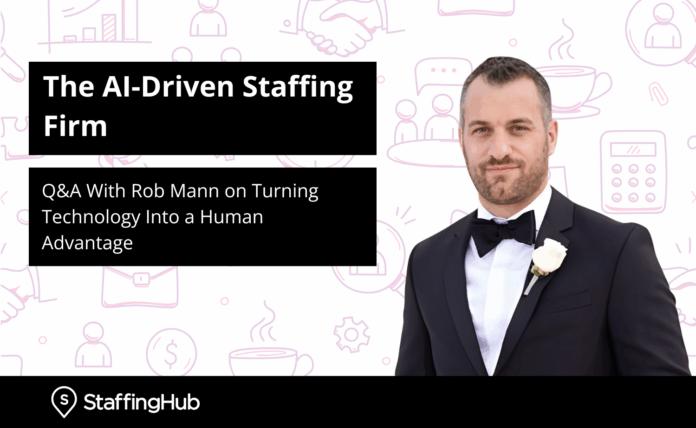
AI hype is everywhere in staffing right now, but the real shift Rob Mann is watching isn’t about tools, but intent.
After years of chasing rate-driven demand and bolting on point solutions, healthcare staffing firms are finally asking harder questions: How does this actually improve the candidate experience? Where does it shrink our middle- and back-office costs? And what will it take culturally for our teams to adopt any of it?
As Head of Sales & Partnerships at Leap Advisory Partners, Rob sits in that messy middle where people, process, and platforms collide. He and the Leap team help firms stop throwing humans at copy-and-paste work, put real AI policies and training in place, and modernize tech stacks in ways that enhance (rather than erode) the recruiter–clinician relationship. For him, AI isn’t a magic agent that replaces recruiters; it’s a lever to scale the right work, clean up bloated cost centers, and give leaders better visibility so they can make smarter decisions faster.
In this conversation at Healthcare Staffing Summit, Rob talks about why the candidate experience is becoming the real battleground, how AI will hit the middle and back office first, what “learning organizations” do differently, how to avoid shiny-object syndrome, and why the best recruiters of the future will look more like career advisors — with AI doing the research in the background.
Q. To start, what’s the biggest shift you’re seeing right now in how healthcare staffing firms think about technology?
Rob Mann: The first big shift is that firms are finally looking at technology through the lens of candidate experience.
During the pandemic, especially in travel and allied, everything became about rate. That’s how you differentiated. Now we have to get back to actually selling as recruiters — back to enhancing the experience overall, whether that’s through a platform or through things like Atlas MedStaff’s Atlas Rewards. Whatever your differentiator is, technology should be there to support and improve that experience.
Q. How are you seeing firms pass that value on to their client base?
RM: On the client side, the value shows up in economics.
Margins are under pressure — MSPs, shrinking spreads, all of it. We were just listening to the SIA healthcare researchers talk about days sales outstanding (DSO). The average in travel and allied is in the 70s, which is insane. Someone next to me was at 45, which is closer to the overall median.
Where I think AI and automation really change the game is the middle and back office. That’s where you still see bloated cost centers — 12 people in credentialing, 12 in payroll — doing work that should be automated. As AI gets better at moving data and doing the admin work, the cost of those functions should shrink.
First, that creates better margins for the staffing company, and then it allows you to pass more value back to customers — through pricing, through faster turnaround, through cleaner processes.
Q. Leap is a partner for firms that want to scale through smarter systems. What does that look like on the ground — what problems are you solving most often for staffing executives?
RM: Stop throwing humans at copy-and-paste work between systems. If you’re paying people to move data from Platform A to Platform B all day, that’s a red flag. We’re doing a lot around using AI and automation to handle that movement so people can focus on higher-value work.
The second area is education and governance. For AI specifically, we’re doing a lot of CYA work — helping executives put real policies and training in place. Most firms don’t realize that 80-90% of their employees are already using AI in some form, whether it’s a public LLM, a paid tool, or something you’ve provided.
Yesterday I ran two roundtables — 10 to 14 people in each — and there was nowhere near a majority of hands up when I asked who had both an AI policy and AI training. That gap is huge.
Coming from locums, I grew up in an environment where training was constant. We had weekly sessions, even if it was just 5-10 minutes. Systems were being trained on, new policies were being trained on. Monthly revenue updates, quarterly business reviews — there was a cadence.
If you’re not a training and learning organization, are you really a sales organization? That’s the question we’re putting in front of leaders now. And when you show them what AI can do — like synthesizing 200 rows of data for 400 recruiters and building an executive-ready PowerPoint in 30 minutes instead of a full weekend — that’s when the “aha” moments happen.
Q. You’ve said before that tech should enhance the human side of staffing, not replace it. How do you see AI and automation actually strengthening relationships between recruiters, clinicians, and clients?
RM: I think it all comes back to scale.
There was a great example in radiology recently. Demand for radiologists has gone up. Their pay has gone up. At the same time, the amount of AI being used to read scans has drastically increased, and the cost per scan has gone down. Hospitals are using those tools more frequently.
So the efficiency of AI actually made radiologists more in demand, not less. That’s a lesson about what happens when you get scale right.
It’s the same in staffing. We’re doing all these great things with AI — messaging more people, reaching better audiences — but that doesn’t mean we don’t need humans. It means we can free humans up to show up in the moments that matter.
We’re here at Healthcare Staffing Summit. Most physicians are not going to fall in love with a platform — unless it’s for picking up per diem shifts, and even then they’re often doing that through their hospital. Other specialties are more tolerant of platforms, but at the end of the day everybody wants to talk to a person at some point.
When you have ratios like 60 providers to one recruiter — someone said that in a session — that’s insane. NATHO’s benchmark is more like 14:1. If you’ve got one recruiter serving 60 clinicians, that person better be paid really well, because the experience is at risk.
AI and automation should be the thing that handles scale — so that recruiter can still have real, human conversations, not just drown in admin work.
Q. In healthcare staffing, speed and compliance are everything — but empathy builds trust and retention. How can leaders design systems that do both?
RM: I think that’s the nirvana everyone’s chasing right now. I don’t know that we’ve seen the perfect answer yet.
We’re still early in AI. People expect it to immediately solve all their problems and be perfect out of the gate. In reality, we’re practicing AI usage. We’re practicing automation usage. You have to expect it not to be perfect.
What I have seen is that the firms who’ve been investing since, say, 2015 — into automation, better data practices, and the fundamentals of running a tech-enabled business — are a lot closer. They’re speeding up credentialing because they have cleaner data and better workflows. They’re speeding up the experience while also making it more personal.
Those fundamentals are also why you’re going to see M&A ramp up. About half the healthcare firms I talk to say they’re open to M&A, half say they’re not. That’s a big split. The ones who have been investing in the underlying systems and culture are going to accelerate away from the ones who haven’t.
So the “speed + empathy” answer is: get the fundamentals right early, accept that AI is a practice, and build from there.
Q. Most staffing firms want the benefits of automation but struggle with adoption. From your experience advising leaders, what separates the firms that truly transform from those that stall out?
RM: The biggest separator is leadership culture. Things flow one way in life. The importance of leadership in how people adopt technology is massive, and I don’t think enough firms pay attention to it.
The leaders who are good at this are the ones asking questions, getting into the technology themselves, learning. And it has never been easier to learn. You can literally go into an LLM and ask, “What don’t I know about being a leader of a locums company?” or “What are the next five challenges for a healthcare staffing executive?”
If you have a culture of learning at the leadership level, you see smoother transitions. When we talk to those organizations, they’re either gradually making consistent progress or they’re making real leaps.
Size does add friction — the more layers of leadership you have, the more opportunity there is for someone to create resistance. Flatter organizations usually have less friction. But I’ve seen 300-500-recruiter shops with very strong leadership cultures do this really well, because they promote and hire people who embody the behaviors they want.
Q. What’s one mistake you see firms make when introducing AI or automation — and how can they avoid it?
RM: Buying technology without a plan or a scorecard.
Firms will say, “I’m going to buy Staffing Referrals” (shout-out — it’s an incredible platform, by the way), but they don’t have a referral program in place yet. You shouldn’t buy a platform to automate something you’re not already doing.
You need to know:
- What’s our baseline today?
- What value are we getting from this area now?
- What does success look like with this tool?
- How often will the vendor show us progress against those benchmarks?
- How do we compare to peers?
Whether it’s your ATS, your marketing platform, Leap, Staffing Referrals — whoever — you have to benchmark and scorecard your vendors. Have a plan. Don’t just buy technology.
Q. There’s an explosion of AI tools claiming to “fix staffing.” For a CEO evaluating new tech, what’s the right framework for deciding where to invest?
RM: You’ve already made hypotheses about your business. You’ve had leadership meetings, you’ve looked at the data, you know where the pain is. Where is our biggest problem? Can it actually be solved with AI or automation, or is it a training gap or process issue? Is this a band-aid buy or a strategic buy? How does this fit with the roadmap of the tech we already own?
You also need some benchmark data so you know where you could be, not just where you are. And then you’ve got to be honest about overlap. Right now, for example, every ATS has some kind of interview AI tool. There are dozens of video and audio interviewing tools on the market.
At Leap we try to look at new technology every day, but if you call me with “yet another” interviewing agent, I’m going to ask: What else does it do? Why is it important to the actual workflow of a recruiter or candidate? Is it frictionless for them to adopt?
Because today, you and I could ask ChatGPT to help us build a basic video or audio interviewing agent and have it up in a couple of hours. The bar for “we have an AI interview bot” is low.
Q. How does Leap help clients get past shiny-object syndrome and focus on what actually matters?
RM: You have to ground everything in fundamentals. Does it solve a real problem? Is it as frictionless as possible to adopt? Does it remove admin work from humans rather than creating more?
If I have to do a bunch of manual admin to make my data more valuable in your platform, you’re not adding much value.
Q. When you talk to executives about AI, what’s the right way to measure success? What metrics actually prove technology is driving results?
RM: It depends where the AI is being used.
For generative AI, the KPI is speed. That one’s straightforward: How much time did we save creating content, analyzing data, building presentations?
For middle and back office, it’s headcount and efficiency. Are we doing the right thing 99.9% of the time? How many FTEs have we freed up or avoided hiring because the system is doing the work?
On the sales and recruiting side — where you have these orchestrations of agents doing research, writing, outreach — the metrics get trickier, but you’re still looking at deals in process, candidates in process, and email deliverability and spam rates.
Ultimately, you pick your KPIs and then zoom out to the big picture. Are we preserving or increasing revenue? What are we doing to the P&L? Are we improving COGS or just increasing them and hoping revenue rises proportionally?
Q. With AI moving faster than regulation, how should staffing leaders think about data ethics, bias, and compliance?
RM: We can’t wait for government to sort it out. Congress is dysfunctional; states are doing more than the federal level right now.
So you have to recognize both the power and the danger of AI. There is inherent bias. People are going to use these tools whether you sanction them or not.
You need human monitoring. If you have a screening agent and it keeps returning only a bunch of guys, and the total applicant pool is heavily female, that’s a signal you need to go back and inspect the model or the prompts.
I like what one provider I consult with does: if their AI says, “We don’t think you’re going to move forward in the process,” they explain why — and then there’s a button a candidate can click to request human review. That keeps a human in the loop and gives the agency an out: “We didn’t just let the AI boot you; a human looked at it too.”
The point is: be proactive. Don’t sit on the sidelines with your hands under you and hope it all rides out. Learn. Ask your own AI tools what ethical safeguards you should have. Build policies, train people, and keep humans involved.
Q. Fast-forward five years — how do you see the role of the healthcare staffing firm evolving? Are we heading toward recruiters as “talent advisors” supported by AI copilots?
RM: I think the best recruiters have always been talent advisors.
One of the best recruiters I ever worked with was a former mortgage broker. When he talked to physicians, it was pure career advice. It wasn’t just, “Here’s a job, do you want it?”
It was, “If you want to be a full-time locums physician, let’s look at states where licenses minimize your malpractice exposure but maximize your pay and your time with family.” That’s consultative.
With AI, you probably shouldn’t be giving literal financial advice, but you can absolutely be more consultative because the research has become so easy. You can quickly understand what a healthy career path looks like in a given specialty, what someone needs to be earning, what they might need to be saving, and how different markets and settings impact their lifestyle.
Q. If you were sitting across from a CEO of a healthcare staffing firm, what one decision should they make this year to stay ahead of the curve?
RM: They should step back and look big picture at their systems and their data.
Where is your data going? How many boxes is it trapped in? And how do you start to build an environment where you can use more directive AI?