

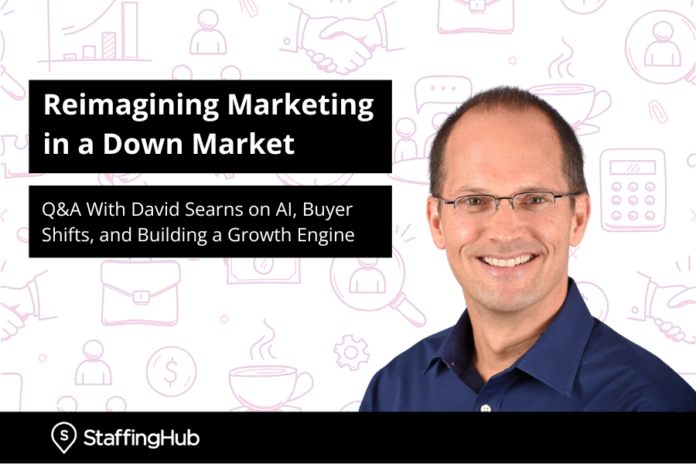
David Searns has had a front-row seat to nearly every major shift in the staffing industry. As co-CEO of Haley Marketing, he’s watched job boards replace newspaper ads, LinkedIn reshape sourcing, and ATS systems go from differentiator to table stakes. He’s not just watching what AI is doing to the industry. He’s building products around it.
At the Staffing Sales Summit, David presented on AI and marketing. We pulled him aside to talk about what’s actually working right now, why so many firms are stuck, and what it takes to build a real growth engine heading into 2026.
Q. You work with hundreds of staffing firms. What’s actually changing in how they’re marketing and selling today?
David Searns: There’s no shortage of variables — the economy, political instability, the pace of technological change. Employers are sitting on the sidelines. But I think there are two things really shifting.
The first is who the customer is. It used to be: sell to HR, or get to the hiring manager. Now I’m walking into a room with HR, finance, operations, and sometimes purchasing, all with different definitions of value. The companies that are winning are helping their salespeople and their marketing speak to all of those buyers, with the right message for each.
The second is technology. AI has already eaten copywriting. Now it’s hitting recruiting. But a lot of people feel overwhelmed and aren’t actually integrating it into their marketing or their sales process. The companies that are winning are using AI to do better research on who they’re targeting, better personalization of content, and arming their salespeople with tools that challenge the buyer’s thinking, not just another brochure.
I’ve been on a soapbox this year about The Challenger Sale. Most buyers of staffing have preconceived notions. If you want someone to change vendors in a tight economy, you have to get them to think differently. I was just talking with a client in Atlanta whose prospects kept pushing back on markup. His response: “Do you find that you get the same level of quality and retention with their people?” They admitted that workforce reliability had become a bigger issue. That’s the story he needed to be telling all along, that his markup is actually a lower total cost of service when you factor in productivity and turnover. Successful companies are building their marketing around how they sell and around who’s buying.
Q. For agencies that are stuck — feeling that hamster wheel — is the gap more about strategy, technology, or willingness to change?
DS: Yes, yes, and yes.
In smaller companies especially, I don’t see the strategy that needs to exist. The old adage of “anybody willing to hire is a good customer” makes it really hard to differentiate, and your salespeople don’t know who to focus on.
Then there’s technology. Are salespeople using the new features in your ATS? Do you have a CRM? Are you doing automation? We do a ton of automation work, and the key is doing it intelligently so it feels human, not the garbage that lands in your inbox where it’s obvious an AI just scraped your LinkedIn profile.
But the willingness piece is real, too. A lot of companies are struggling to get salespeople to make calls. Telling them to pick up the phone more isn’t a strategy. Give them a better process. Give them better tools. Integrate marketing with their sales activities so they can show up more disruptive, in a positive way, and they’ll be more successful.
Q. You’ve made the case that staffing firms need to fundamentally reimagine how they operate, not just tweak around the edges. What does that actually look like for a firm that’s been doing things the same way for 20 years?
DS: Uber reimagined taxis. Airbnb reimagined hotels. Everyone asks, “Who’s going to be the Uber of staffing?” But you don’t have to be. The question is: what does your client actually need, and is there a different way to deliver it?
Technology companies are already coming into staffing at lower markups because they’ve eliminated sales and recruiting costs and passed the savings on. They’ve rethought the business model entirely.
I think about it through the marketing mix — the four Ps. In staffing, almost everyone takes the product for granted: I provide people, I charge a markup on hours worked. But then came statement of work. Then MSP. Those were product changes. Now, with AI changing the cost to operate, I’d be asking: how can I be faster? More reliable? Provide better quality talent? Improve communication and lower my cost? That’s what reimagining the business model looks like.
Q. How many of the firms you work with are actually using AI in a meaningful way — not just experimenting, but built into how they operate?
DS: Very few. They’ve used it to write emails or blogs, then they stop. It’s still work to get good output from AI. We actually had clients take marketing in-house to use AI and reduce costs, but when we checked back months later, most of what they started they’d already quit doing.
That’s part of why we launched a new product called RogIQ, an AI platform that handles blogs, SEO, social, and full marketing strategy, start to finish. We had to be willing to completely disrupt our own 30-year business model to build it.
But for a staffing company thinking about their own marketing: the most basic use cases are Q&A and writing. Most people never get past those. The more powerful uses are deep research, thought partnership, and strategic feedback. We built what we call an AI Board of Directors — a synthetic board of people we’d love to have but can never get — and we run all of our strategic plans through them. After you’ve trained the AI to think like certain people, the feedback is remarkable. It’s just challenging your own thinking back at you.
Flip the script. Instead of asking AI questions, have AI interview you. That’s been incredibly powerful for getting much better marketing. And I use AI personas of marketers I admire — Alex Hormozi for offers, Dan Kennedy for direct response. The AI has read everything they’ve written. Is it really them? No. But the output is close enough to be genuinely useful.
One more thing: you need a paid account. Free accounts are running old models. If you feel behind, you’re not, because the percentage of people doing the deep work we’re describing is tiny. But you need the paid tier to get there.
Q. A lot of firms are also starting to think about showing up in AI search results, not just Google. What’s your take on that shift?
DS: It’s a big part of our business right now — AIO, AEO, GEO, pick your acronym. But practically, what it means is: provide content that transparently and in-depth answers questions that buyers of staffing services are actually asking.
The reason most companies won’t do it is that you often have to talk about competitors. You have to divulge pricing. All the stuff we’ve historically held back and assumed sales would handle. But here’s the reality: buyers are doing research before they ever talk to you — the same way you research a car before you walk into the dealership. If you’re not showing up in that research, you’re not even in the first half of the game.
For recruiting specifically, I think the stakes are even higher. A job seeker who doesn’t know what a staffing company does (or why they’d trust one) is going to form that opinion online first, before they ever speak to a recruiter. Staffing has always been relationship sales. But now the relationship starts online.
Q. You’ve watched this industry through job boards, LinkedIn, social media, ATS adoption. How does AI compare to those cycles? Is this actually bigger, or is it following the same pattern?
DS: AI is advancing faster than organizations can absorb it, which means there’s a real window right now for companies to change how they deliver service, using AI to eliminate low-value work, provide AI-enabled talent, and get more value for less cost.
There was a concept back in the ’90s called economic value added, looking at every task and asking: am I getting the most out of this, or can I deliver the same value for less? AI is just an evolution of that idea.
But here’s where I see people get stuck: if you don’t know your own process, you can’t automate it. I was just in a session next door where someone who was asked to teach onboarding said, “I have no idea how we do it.” That’s where you start. Map what you’re doing. Then figure out what could be done differently.
Q. For staffing leaders trying to grow in 2026, what’s the one thing you’d tell them to focus on first?
DS: It’s hard for me to pick one. There are seven steps in the growth engine I talk about. But if I had to pick one, it’s the foundation: positioning.
Are you going to take the default — I’m a staffing agency, I look like every other staffing agency — or are you going to change that? Think about a grocery store. If I asked you to find a box of Cheerios, you’d know exactly which aisle and what color the box is. But do you want to be in the cereal aisle with every other staffing company? Or do you want to be in a different aisle?
The second thing I’d look at is your website. Most staffing companies now have good-looking websites. But if you look at the percentage of visitors who leave without ever taking an action, you’re probably losing 90% of them, even after spending all that money on awareness, advertising, and sales activity. There’s enormous opportunity in improving website conversion before anything else in the growth engine kicks in.