


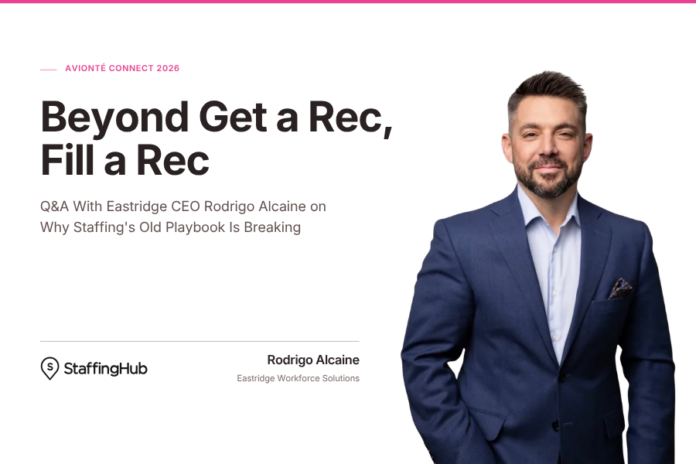
Rodrigo Alcaine has run staffing from both sides of the table, as a tech vendor and now as CEO of Eastridge Workforce Solutions, and he says the old growth playbook is broken on both ends. Adding more recruiters to handle more orders doesn’t work anymore under today’s margin pressure. Neither does the generic outreach and generic value proposition (“great talent, great service, we move fast”) that customers have learned to ignore.
Eastridge made SIA’s Staffing 100 for North America this year, and Alcaine continues to lead the company through what he candidly calls an unfinished transformation. He’s rebuilt how Eastridge evaluates technology (a hard no to anything that doesn’t move gross profit, save time, or improve EBITDA efficiency, no matter how good the demo looks) and reoriented the business around redeploying and re-engaging existing talent rather than chasing an endless supply of new candidates.
At Avionté CONNECT, where he moderated a panel on the shift, Alcaine sat down with StaffingHub to talk about why buying the shiny penny leaves you unprofitable, what a labor economist’s demographic argument changed about his next few years, and why he thinks staffing firms are about to become something closer to a Swiss Army knife than a rec-filling machine.
Q. You’re moderating a panel here about how the agencies pulling ahead have changed the way they think about the business itself, not just added more tools to the stack. What piece of the old playbook do you think staffing firms are holding onto for too long?
Rodrigo Alcaine: It’s a great question. A lot of the firms moving ahead are thinking about how customers are procuring talent today, and how drastically the world of work has changed in just the last couple of years. What people still hold onto is the idea that adding headcount is the way to get ahead: more orders, add more recruiters. With the margin compression and pressure this industry is facing, you just can’t do it that way anymore.
The second thing is how we sell to our customers. That’s morphed completely. COVID created what I’d call the great ignore: automated outreach with no value add, getting ignored over and over, and we keep doing it anyway. Customers are buying very differently now. Staffing is still local, but the decision-maker is national and further removed from the actual pain point. We have to upskill how we sell, and we can’t hold onto the old way anymore.
Q. What does that shift look like inside your firm specifically?
RA: It’s an omnichannel approach. There’s still real opportunity in the relational side of what we do. We have people internally who are still on the phones, still going to networking events, still talking to the end customer at a relational, local level, and that’s really important.
We pair that with direct, intentional outreach, and we align marketing to sales very deliberately in our messaging and value proposition. But the value proposition can’t be “we’ve got great talent, great service, we move fast,” because everyone says that. We have to get specific about what the customer actually needs and what pain we’re solving for them, backed by real case studies, not generic claims.
Q. You’ve led Eastridge through a major transformation, and any big change comes with trade-offs. How do you decide what gets your attention first versus what waits?
RA: I’d say I’m still leading Eastridge through that transformation. We haven’t arrived, but we’re a step closer. For me, it’s simple: anything that touches gross profit, revenue, or cash gets my attention first, especially given the turnaround we’re in. Second, anything I keep pushing down the road that’s getting harder over time needs my attention before it compounds. Sequencing is just as important as speed. Those two areas take up most of my time.
Q. What’s been your biggest challenge this year?
RA: How to keep innovating, transforming, and moving forward while also reducing the cost to serve our customers, and reducing cost internally. Those can feel like two competing priorities. You want to invest, move into new markets or verticals, add headcount. But the pressure on the customer side makes that very difficult.
Really, it comes down to knowing what’s signal versus noise. This market is so crowded right now that saying yes to everything gets incredibly expensive. Staying focused has been our discipline and our differentiator.
Q. You’ve led on both the tech vendor side and the staffing agency side. From that vantage point, what separates technology that’s fundamentally changing how staffing firms operate from technology that just looks good on a demo?
RA: Having sat on both sides of that fence has taught me a lot, not just about what matters to customers, but how they want value delivered and the ROI that comes with it. First, you have to move beyond the demo. Demos run on clean data in perfect environments. Our data is messy, our environments aren’t perfect, and things change constantly. You have to pressure-test a tool with a partner who’s willing to go through that with you.
Second, you have to know your clear ROI going in. If someone’s job doesn’t look different 90 days after implementing a piece of software, why did you buy it? If it doesn’t bring hard dollar or soft dollar value, whether that’s higher gross profit, freeing people up for the human parts of the work, or letting you offer new services, you’re just wasting money.
Q. How have you been measuring ROI on your tech investments this year at Eastridge?
RA: That’s been a journey. Moving into the CEO seat, there’s real pressure to do something with technology, or you’ll get left behind. But the truth is you’ll get left behind unprofitable if you just keep buying the shiny penny. I got caught in that trap myself early on: yes to this, yes to that. Then we pulled back and asked, what problem is this really solving?
Now, before we procure anything, we identify the problem it’s solving first. If it doesn’t tie to gross profit, making work simpler, or automating a workflow, it’s a hard no, or a not right now. Then we decide how we’re going to track it: time saved, gross profit improvement, or EBITDA efficiency. If it can’t move one of those, it’s a vanity metric, and we don’t need it.
Q. Time saved can be a tricky metric, since you save the time but then have to figure out where it goes. How do you approach that?
RA: Right, it’s “okay, now what do I do with this time?” You have to teach people what to do with it. A lot of the time, it’s simply doing more of what they’re already doing. A year ago, a healthy gross profit per producer might have been one number. Now it could be two, three, four, 10 times that, because people can do more without adding headcount or capital, as long as you don’t burn them out. Engagement still has to stay high.
With time saved, you have to ask: what’s the core function of this role? It’s probably not digging through data or building spreadsheets. If the time saved isn’t freeing someone up to do more of the core function of their job, we have to figure out why, or have them take on more responsibility instead.
Q. You recently had a conversation with labor economist Ron Hetrick, who argues the current talent shortage isn’t cyclical, it’s tied to a longer-term demographic shift. How did that change how you’re thinking about the next few years?
RA: My thinking on it is still evolving, because it’s a genuinely interesting concept. So much of what this industry has gone through has been cyclical. You just wait it out. You can’t wait this one out.
Two things shifted for me. First, you have to put real intention into upskilling and reskilling. You can’t magically create more people, so we have to educate our customers on closing the skills gap, including not defaulting to a college degree requirement to fill open roles. Second, stop trying to force the top of the funnel. Post-and-pray, hoping for more candidates, doesn’t work anymore. You have to invest in redeployment and re-engagement, and think about the lifetime value of the associate. If you keep redeploying and re-engaging talent throughout their whole journey, that’s where the value is, instead of hoping new candidates keep showing up, because they won’t.
Q. What does a staffing firm have to get really good at to focus on that redeployment piece?
RA: A few things, very intentionally. Where I see a lot of agencies struggle is trying to be all things to all people. You have to get good at saying no and staying within your core competencies, because that’s the only way you can keep redeploying and re-engaging talent across five or six skill sets instead of spreading yourself across everything. We’ve narrowed our focus considerably: these are the things we’re going to be great at, and we’re investing deeply in them. That’s what I think everyone needs to do.
Q. It sounds like you’ve gotten good at the art of saying no to the wrong things.
RA: I tell my teams this constantly: every time you say yes to something, you’re inadvertently saying no to something else. You have to be intentional about where you say yes and where you say no. It’s discipline. It’s not rocket science, it’s simple, but it’s not easy. You need rigor and discipline to do it.
Q. What are you most excited about in the conversations you’re having here at CONNECT?
RA: One of my favorite things about CONNECT is being surrounded by people who are in it with you: similar size, similar challenges, similar point in the industry’s evolution. It makes for deep, honest conversations about how you got through something, how you’re handling it now, and whether someone else is going through it too. The community is willing to open up their whole playbook: here’s how we did it, here’s how we failed. That’s rare, and it’s incredible. And of course, Avionté and their integration partners keep showing us what’s possible next, which is exciting to watch.
Q. A year from now, what will staffing firms be doing differently than they are today?
RA: I hope it doesn’t take a year, honestly. We have to keep being bullish about the value we add beyond get a rec, fill a rec. Talk to a million customers, and none of them are asking you to just fill a hard role. They want data, they want analysts, they want different services. There are so many ways people are hiring today outside of straight W-2 labor. I think we’re going to have to become something closer to a Swiss Army knife, helping customers hit their goals through great talent in whatever form that takes. It’s going to look very different.