


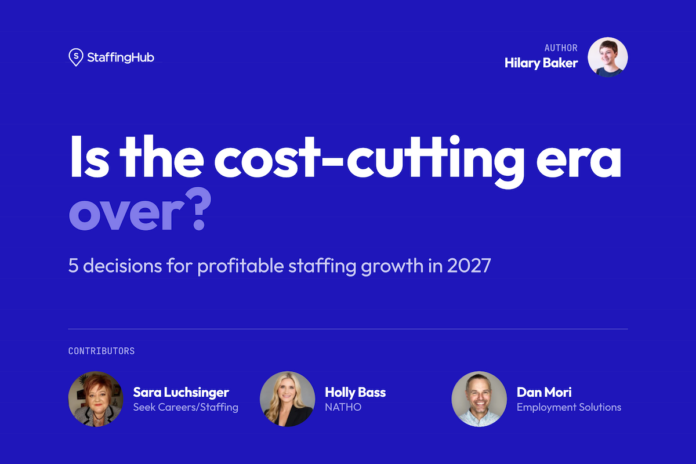
Every month, StaffingHub hosts a private roundtable of staffing executives spanning light industrial, healthcare, and construction.
Last week’s conversation focused on one question:
What happened in 2026 that should change how staffing companies plan for 2027?
The discussion surfaced five decisions involving capital allocation, recruiter productivity, sourcing economics, leadership focus, and market share.
This session’s contributors: Sara Luchsinger, SVP of Operations at Seek Careers/Staffing; Holly Bass, Executive Director of NATHO; and Dan Mori, owner of Employment Solutions.
1. Move from cost-cutting to gross profit growth
After several consecutive years of disciplined cost-cutting to achieve leaner operations, the leaders in this room agree that the focus should be on bringing in more revenue.
“There’s no more to cut,” Bass said of the healthcare staffing companies she works with. “They can’t continue to cut their way into profitability. They actually need to bring in revenue, and we’ve got to get everybody profitable again.”
But revenue generation alone is not a sound objective. A solid 2027 plan must identify exactly where profitable growth will come from and how each initiative is expected to ladder up to your goals.
What to try: Expanding profitable accounts, entering stronger specialties, increasing production per recruiter, displacing competitors, or acquiring a company
What to measure: Gross profit and EBITDA contribution by initiative
2. Increase recruiter ramp speed to achieve a clear AI win
“You don’t go to any conference, any meeting, anything without talking about AI,” Bass said. “But it’s not really about AI anymore. Now it’s really about what are you doing to get ROI.”
Getting a return on AI investments often leads to conversations about headcount reduction, time savings, or ill-defined productivity gains. Our participants noted it’s better to ask whether AI helps recruiters make their first placement faster and produce more once they’re fully ramped.
Getting recruiters up to speed faster and enabling them to place more candidates with AI-assisted workflows is a gain that can be felt organization-wide. Bass put it in perspective: “If every recruiter just had one more [traveler on assignment] each, what a difference that would make to the individual companies, the industry.”
What to try: Pull the average time to first placement for your newest recruiter cohort, hand the next cohort one AI-assisted ramp workflow, and compare time to first placement at 90 days.
Measure: Time first placement, placements per recruiter, redeployment rate, and gross profit per recruiter.
3. Lean on owned sourcing channels
“In my almost 30 years of being in staffing, I think it was about three months where we had the same amount of people as the same amount of job orders that we needed,” Luchsinger said. “Otherwise, it’s all people, no job orders, or all job orders, no people.”
Her diagnosis: “The talent pool is constricting. Our population has not grown at the same levels it did 50 years ago, and we’re also competing with opportunities that didn’t exist 30 years ago. There wasn’t an opportunity for anyone to go on YouTube and make a living talking to a camera.”
The most effective sourcing strategies described by our participants include referrals and reactivated past employees as primary channels, measuring every channel’s performance down to the placement. One member’s database analysis found referral-sourced candidates disproportionately ahead on length of assignment, conversion rate, and gross margin.
And if there are truly no more candidates to source from?
Here’s Mori’s advice: “If you’re constrained by the market, the only way to grow is by taking market share. I would go map my entire competitive market and run very targeted campaigns: I want their candidates, I want their clients. And if it was a really well-run competitor, but smaller, honestly, I would approach them to buy.”
What to try: Reallocate sourcing investment based on placements, gross profit, assignment duration, redeployment, and cost per successful placement by source.
Measure: Gross profit per source, percentage of placements generated from owned channels
4. Align the leadership team before you commit to your goals
The most candid thread of the session had nothing to do with AI or sourcing. Mori named leadership alignment, not talent, as a top challenge from the year.
“We grew into silos, like a lot of companies do,” he said. “People weren’t communicating. They weren’t even using the same language within the organization.” The fix meant changing reporting lines, clarifying decisions, and accepting that not every leader’s preferred initiative would move forward. “Getting leaders aligned on the vision, and understanding that sometimes some people might have to make short-term sacrifices to get us all where we want to go. Not everybody’s idea might be the one that’s selected.”
Bass experienced the same problem as an operator and brought in outside help to drive their competing functions toward shared ownership: “We came out on the other side, and it was really worth the investment. It became ‘we.’ It wasn’t one team or the other team, it wasn’t sales versus customer service.”
The room’s consensus was to do the alignment work before committing to the growth number, or the plan is at risk. Mori’s version of the discipline applies to projects too: “I’ve had to kill off a lot of darlings and things that are near and dear to my heart. I had to kill the good for the great.”
What to try: Select no more than three company-level priorities for 2027. Give each one a single accountable executive, a measurable outcome, and an explicit list of work the company will stop.
What to measure: Progress against the shared priorities (not activity volume)
5. Build a market share plan as consolidation accelerates
Mergers are already happening among smaller firms, and this group sees that as market repair and a huge opportunity moving forward.
“There’s too many suppliers, too much competition, and that actually creates this commoditization,” Mori said. “It gives our clients and prospects more options to drive our prices down. I do actually think consolidation would eliminate a lot of bad actors, and the laggards that are not providing the quality of service that’s going to be needed in the next wave of staffing.”
Mori believes companies facing constrained markets must become more deliberate about where they can take share.
Your market share strategy should be more specific than a list of competitors. Leadership must determine which markets offer the most attractive economics, where competitors are vulnerable, and whether the best path is organic growth, partnership, talent acquisition, or company acquisition.
What to try: Map the firms in each priority market and decide which ones to out-execute, recruit from, partner with, or acquire.
What to measure: Gross profit share within priority markets and the expected return from each market share initiative
Interested in becoming a StaffingHub contributor or join an executive roundtable? Email [email protected] to learn more.