

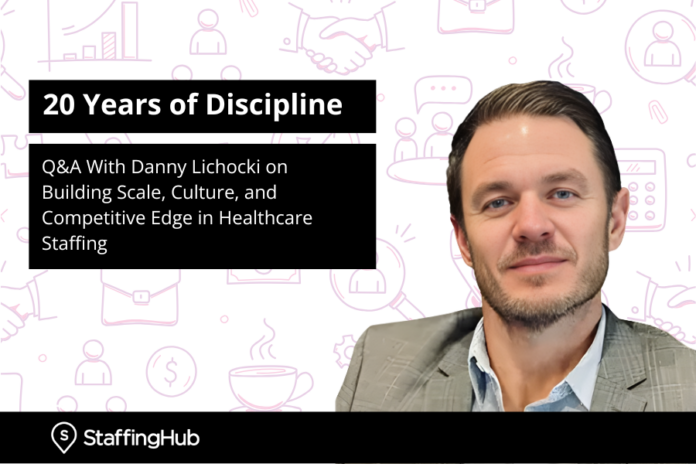
Twenty years ago, Danny Lichocki and his father started A-Line Staffing Solutions out of a basement in Warren, Michigan. Two people, two cell phones, two laptops. Today, A-Line operates across healthcare, pharma, and IT staffing in nearly 50 states with Joint Commission Gold Seal certification and an internal team that averages seven to eight years of tenure, in an industry where the norm is months.
The growth didn’t come from motivation or luck. It came from discipline, Lichocki says, the kind that pushes you to shake up what’s working before it becomes a rut. As owner of A-Line, he’s navigated the COVID-era healthcare staffing boom and the brutal corrections that followed. He’s learned what separates firms that scale from firms that stall, and why compliance is a competitive moat.
In this conversation from Staffing Sales Summit, Lichocki talks about the early sales lessons that still hold, why data became transformational, how compliance became A-Line’s competitive differentiator, what he looks for when hiring salespeople now versus five years ago, and why discipline matters more than motivation when building a sales-driven culture.
Q. A-Line started in 2004 — you and your dad working out of a basement. What did the first year of selling look like when nobody knew who A-Line Staffing was?
Danny Lichocki: The first year was exciting. I was young, aggressive, hungry, and just knocking on a lot of doors, making a lot of calls. We started with a couple of cell phones, a couple of laptops, and made lots of phone calls.
Three to six months in, we got our first big hospital system. They needed us to staff 10 or 12 radiology techs. That was the moment that put us on the map.
Q. What’s the hardest sales lesson you learned in those early years that still holds true?
No two deals are the same. Each client is different. Each prospect is different. You have to go about the sales process in a unique way in each conversation.
It’s relationship driven, but I believe that to be successful, you have to have systems. You have to have process. You have to have everyone selling the same thing so you can repeat it every time.
Q. You’ve scaled over the years into different verticals with a strong team. What had to change about the way you were selling as the company grew?
DL: Data. That was a hard lesson for us to learn. At first, we didn’t have our data structured well. As you grow, you realize how important data is — how you separate it, manage it, and manage with it. That was another transformational point when we had that “aha” moment: this data is more important than just writing it down in a notebook. Even more so now with AI and automation built into the process.
Q. You built the business primarily in healthcare. That market’s been through the ringer — the pandemic boom and quick corrections. What are your healthcare clients asking for now that they weren’t demanding three years ago?
DL: The barrier to entry in staffing is so minimal that companies popped up overnight during COVID. Everybody wanted to be a healthcare expert. But hospital systems figured out quickly that they’re not. The compliance piece of healthcare staffing is massive. A lot of companies failed because they couldn’t keep up.
Q. You got Joint Commission Gold Seal certification in 2024. How has that helped your business?
DL: We operated on TJC standards — if not better — for years. Getting the certification reinforced the level of compliance we were already operating at. For clients, it validates that A-Line takes credentialing, quality, and risk management seriously.
Q. When you’re competing against larger firms for a healthcare system contract, what does a firm your size offer that they can’t?
DL: Tenure. The industry average is 18 months to two years for someone to stay at a company. We’re at seven or eight years. That’s the culture we built. The level of white glove service we give our clients. We do as much heavy lifting as we possibly can for them.
Q. Where do you see the biggest opportunity in healthcare staffing over the next two to three years?
DL: Compliance. Showing clients that there’s credentialing, but also the compliance piece — keeping up with ever-changing laws by state, reporting requirements, sick time laws. It’s hard for companies to keep up, but we’re specialists at it.
We have a compliance team that keeps their finger on the pulse. We’re in almost 50 states. It’s a lot to manage, but we’ve got a great team — compliance, operations, HR, care, admins.
Q. Sounds like you’ve invested in this area to stay ahead rather than scramble.
DL: Absolutely. I’ve always had the mindset that you have to keep pushing forward. I’ve told my staff hundreds of times: we’ve got a good thing going, we’re in our groove. But then I think — what’s another word for a groove? It’s a rut. Every time I think we’re in our groove, I want to shake things up and push harder.
Q. You can’t grow without people who can sell. What have you learned about building a sales-driven culture inside a staffing firm?
DL: It’s not easy. It’s hard to retain your business when hundreds of others are coming for it. You have to protect your own piece while you’re still trying to develop new business. You’re juggling a lot.
Q. What do you look for when hiring salespeople?
DL: That’s changed over the last five years. Before, I wanted personality, excitement, engagement — someone who can talk to anybody. I still want that. But now it’s almost as important to make sure they have technical skills. Can they adapt to AI? Will they use the tools we provide? We try to give our people the best tools out there so they’re equipped.
Salespeople can sell themselves in an interview. But sometimes it stops there. They don’t have the discipline to keep going. That’s the most important piece — discipline. Motivation can go up and down, but if you’re disciplined, you will be successful. Discipline is like going to the gym. Go once or twice a week, maybe you’ll see some results. Go five or six days a week with discipline, you’re going to see results.
Q. How are you handling technology changing so quickly?
DL: We talk to a lot of vendors. I go to trade shows, talk to other business owners, see what’s working. The hard part is we invest in a lot of tools, but the hardest part is firing one. It’s very hard to cut ties, and I need to get better at that.
Usually when contracts come up for renewal, I look at the data, look at the numbers, then have a conversation with my leaders. I’ll say, “What does your gut say about this tool?” Sometimes I trust that more than the data. Leaders’ opinions matter. I listen if somebody’s passionate and says, “I need this, this is working.”
And data is only as good as what you put in, and, let’s be honest, we’re all guilty of not putting the notes in about where leads are coming from.
Q. You run a president’s club trip for top performers. Incentive trips work for some people, not everyone. What have you learned?
DL: People are motivated by different things. We try to figure out what motivates them — money, paid time off, vacations, trophies. We have a plethora of rewards. But the president’s club trip is awesome. It’s a few days of hanging out, not talking business. Just connecting, bonding, having fun.
Q. For staffing leaders trying to grow in 2026, what’s the one thing you’d tell them to focus on first?
DL: Discipline. That’s truly what helped me and our company grow — staying focused and staying disciplined. You have to be open to not doing things the same way because what worked yesterday might not work tomorrow.
We’re big believers in adapting to new technologies. I try to be an early adopter, on committees that help develop the tools. That keeps us out in the forefront. Talk to your vendors, talk to your staff, talk to your clients, and make sure you’re taking advantage of that technology.