


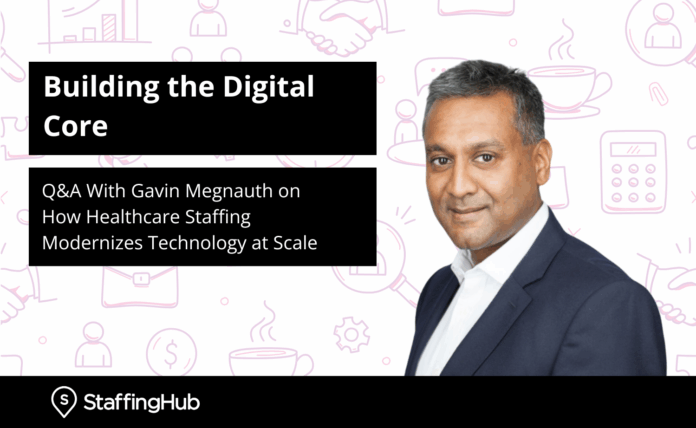
Every staffing firm is feeling it: clinicians expect consumer-grade experiences, clients want speed and transparency, and the tech stack that “worked fine for years” is suddenly the constraint. For healthcare staffing, modernization is about building a digital core that can handle credentialing complexity, data security, and 24/7 workflows without burning out recruiters or clinicians.
As Chief Information Officer at CoreMedical Group, Gavin Megnauth is responsible for the systems that power recruitment, credentialing, pay, and everything in between. From his seat, the real work isn’t chasing shiny objects but instead fixing the broken and sub-optimal parts of the process, wiring systems into a unified data backbone, and making sure automation frees people up to do the high-value, human parts of staffing.
In this conversation from Healthcare Staffing Summit, Gavin talks candidly about why credentialing is the “sore thumb” of the tech stack, how he thinks about “true” digital transformation versus automating chaos, where AI and co-pilot tools will reshape recruiter workflows, and why user experience (for both staff and clinicians) is the technology decision executives can’t afford to postpone.
Q. Every staffing firm is racing to modernize — faster systems, cleaner data, better clinician experiences. From your seat as CIO, what part of the tech stack is under the most pressure right now?
Gavin Megnauth: I’d say credentialing is under the most pressure right now, across the industry. It’s one of the most fragmented areas in healthcare staffing — multiple platforms, inconsistent workflows, and state license websites that haven’t kept up with modern standards. Nothing integrates cleanly, which creates friction for clinicians and slows down time to start.
As we modernize other parts of the tech stack, credentialing sticks out like a sore thumb.
The good news is that this pressure is driving innovation. We’re focused on simplifying workflows, improving data flow, and reducing manual touchpoints so that credentialing can keep pace with the rest of our digital ecosystem.
Q. Where do you see firms investing in the wrong fixes?
GM: It’s very easy right now to make small bets on tactical solutions. There’s an array of point tech solutions hitting the market, and I’m seeing peers look at things that appear quite sexy and shiny without really thinking about the long-term impact on the rest of the business processes and whether these solutions will actually have longevity and most importantly, adoption.
People get attracted by shiny things, and I’m seeing a lot of folks make buying decisions they may ultimately have to walk back from.
Q. How do you talk people at the board level out of shiny object syndrome?
GM: At CoreMed, we have a very established leadership team that works well cross-functionally. We all dive into a decision together. We strive for robust business cases, really assessing the long-term return on investment and whether our staff actually want these tools.
Getting buy-in from all the stakeholders at the outset is key before we make any investment.
Q. In healthcare staffing, what does digital transformation look like when it’s actually working — and how can leaders tell if they’re just automating chaos?
GM: It’s been a much-overused term in the last few years, and I’ve seen it attached to what I’d consider incremental improvements.
Digital transformation for me means a significant overhaul to many steps in the recruitment process. The purchase of one or two tech tools alone doesn’t constitute digital transformation — not at CoreMed, and not anywhere in healthcare staffing. What earns that label is systematic change in processes that yields a double-digit return, an increased bottom line, or a clearly improved efficiency.
If you’re laying automation on top of outdated workflows, you are just accelerating inefficiency. True transformation rethinks the process first — asking, “Why do we do it this way” — and then applies technology to scale what actually works.
The telltale sign of digital transformation success: recruiters are spending more time with people, not fighting technology.
Q. What early wins tell you a transformation is on track?
GM: Quick adoption and real excitement from recruiters. Recruiters are an interesting bunch — if you can get them genuinely excited by a technology, and they can see the link to their commission and their pay packet, that’s a strong signal you’re on the right track.
Q. You’ve driven major technology upgrades across recruitment, engagement, and data workflows. Looking back, which single initiative delivered the largest performance gain — and how did you determine the business outcome of that change?
GM: In an international recruitment firm, we hired talent from more than 150 countries into the U.S. and other Western countries.
One of the most impactful initiatives we implemented was a really smart video recruiting system that helped us better understand candidate engagement and readiness throughout the process.
When someone is considering moving their entire life to another country, the decision is complex and deeply personal. Historically, about 40% of candidates who started the process ultimately decided not to move forward, which created significant operational strain and delayed placements.
The enhanced video interviewing platform gave us clearer visibility into candidate engagement signals and drop-off risks much earlier in the journey. By identifying where candidates needed more support, clarification, or time, we were able to adjust our workflows, improve the candidate experience, and focus our team’s efforts on individuals who were truly ready to proceed.
This shift resulted in major performance gains: better forecasting, more efficient recruiter time allocation, and smoother international transitions for candidates who chose to advance.
Q. Recruiters are the heartbeat of staffing. What does effective recruiter-enablement technology look like to you — tools that make them faster and more human?
GM: It’s technology that nudges a recruiter when they should be making that human connection with a clinician — for example, prompting them when a credential is about to run out, or predicting when a clinician might be looking for their next move.
It’s technology that’s more predictive and tools where recruiters aren’t fighting with systems or stuck doing menial work. The goal is to let recruiters do what they’re best at: building that human connection and helping people find the right jobs.
We’re already starting to see what were once traditional CRMs and ATSs — just systems of record where people typed things in — move to much more prompt-based platforms. They’re still large data repositories, but they use predictive AI tools that act more like a co-pilot or an assistant to the recruiter, telling them what they need to do and automatically updating the system on their behalf.
There are a few I’ve seen recently in the UK and in next-generation versions of Salesforce, where the AI agents are effectively doing the work of ensuring high levels of data integrity in the CRM through prompt-based engagement with the recruiter.
Q. How are you approaching data security, compliance, and system connectivity without slowing down the experience for recruiters and clinicians?
GM: Security and speed can coexist. It’s about design, not trade-offs.
We’re adopting a “secure by architecture” model where encryption, least-privilege access, and audit-trailing of everything are embedded into workflows rather than bolted on as an afterthought. Our goal is to make compliance and security somewhat invisible — fully automating checks and proactive alerts instead of relying on manual policing.
We do annual penetration tests where our systems and perimeter infrastructure are ethically tested for vulnerabilities. We’re very proud that we’ve attained a government-backed cyber security accreditation which is becoming increasingly an imperative from our clients. It’s an important and often overlooked area.
Banks have historically led the charge in investing in best-in-class perimeter security. I think we’re in an industry that’s going to be increasingly targeted by bad actors because we hold a goldmine of private sensitive information that, particularly in small and mid-market sized recruitment agencies, have historically lacked the necessary focus and expertise in this arena.
Q. Security-wise, do you think we’ll have to simplify before being able to tighten things up?
GM: I think the next generation of tools will help simplify. There are really good AI-driven tools looking at anomalous behavior of your data as it moves throughout your organization and outside of it. Next-gen data loss protection tooling can sit on the endpoints of all our recruiters, see data being stolen, and stop threats before they come in.
I think that we’re going to rely on the tech industry to bring us tools that safeguard us in the organization from accidental risk or from the cyber threat entering our infrastructure in the first place.
These products have existed for large enterprises for a while; now they’re being right-sized and made affordable for the mid-market and for staffing.
Q. The hardest part of technology change usually isn’t the tech — it’s the adoption. How do you drive buy-in across teams who’ve “always done it this way”?
GM: That’s an interesting one, especially at an organization like ours. We’re Bullhorn’s first-ever customer in healthcare staffing, and we have a very tenured leadership team.
You have to win hearts and minds before you deploy anything. The key is co-creation. It’s about bringing recruiters, staff, and managers into the design process early so they can see their fingerprints on the end solution.
It’s important that, as an IT team, we’re talking in their language — not in technical jargon. We talk about outcomes for them: how their lives are made better, how their paychecks look better.
Change management isn’t about pushing new technology. It’s about enrolling people into a shared vision of what “better” looks like.
Q. AI and automation are reshaping recruiter workflows and back-office processes. What’s your philosophy on where automation adds value versus where human judgment still matters most?
GM: Automation should handle precision at scale and at volume.
Something I’ve done over the last seven or eight years is go into businesses and ask people: “What’s the bottom 25% of your job that you hate the most — that you wish you could get rid of?” More often than not, those tasks lend themselves to automation: mundane, repeatable, repetitive work.
It’s a good way of driving technological change without people fearing they’ll become obsolete. You’re moving them into higher-value parts of their role that they enjoy more. You improve employee engagement and lower attrition, while also removing data-entry errors, fatigue, and churn from people doing the boring parts of their job. It’s been a really successful recipe for me in healthcare staffing.
Q. Where will you never fully automate?
GM: It’s really interesting to see the tech disruption at the top of the funnel, but we’re in the people business. It’s about building trust. If we’re going to build a relationship that goes beyond one placement with a clinician, we’ve got to build long-term trust and relationships.
We’re very discerning about which parts of that relationship-building, onboarding, and “getting to know you” process are automated versus what has to remain human.
Q. As CoreMedical grows, how do you build scalable technology infrastructure that supports different business lines and use cases — without creating silos or duplication of effort?
GM: Scalability starts with a modular architecture and a shared data backbone. That’s imperative.
We’ve invested in a highly skilled internal development team, and every system — recruitment, payroll, credentialing — plugs into a unified data fabric. That ensures we can spin up, in a very agile way, different business lines or brands as things change, without reinventing the wheel or creating silos.
Q. Fast-forward five years: how do you see the role of the healthcare staffing firm evolving as technology, automation, and talent expectations continue to accelerate?
GM: It’s hard to predict, but I think the future is less about placement and more about partnership.
We’ll evolve from reactive sourcing to more predictive workforce orchestration — knowing where demand will spike before the hospitals do. Clinicians are going to expect high, consumer-grade digital experiences, just like they do from all their other apps. Firms that deliver frictionless journeys from onboarding to credentialing to pay will win the loyalty game.
In five years, I believe the most successful recruitment companies will be data companies that are also great at managing human relationships.
Q. What’s one decision a healthcare staffing executive should make right now to future-proof their business from a technology and systems standpoint?
GM: I’d say: think long and hard and prioritize user experience.
That’s true for your own staff. We have millennials and Gen Z coming into the workplace who’ve grown up with smart devices. If your CRM looks like something from the dark ages, it’s friction, which doesn’t contribute to a great employee experience.
The same is true for candidates and clinicians. We need to be thinking about the 24-hour life we all now lead. A lot of the systems that have been built by suppliers — and the wider healthcare ecosystem — were not built with that mindset. They were built around the internal recruitment agency that worked 9-5.
We should be building high, consumer-grade platforms for clinicians that let them know exactly where they are, and progress through the recruitment life cycle with ease. That’s where we need to prioritize technology dollars if you want to future-proof the business.