

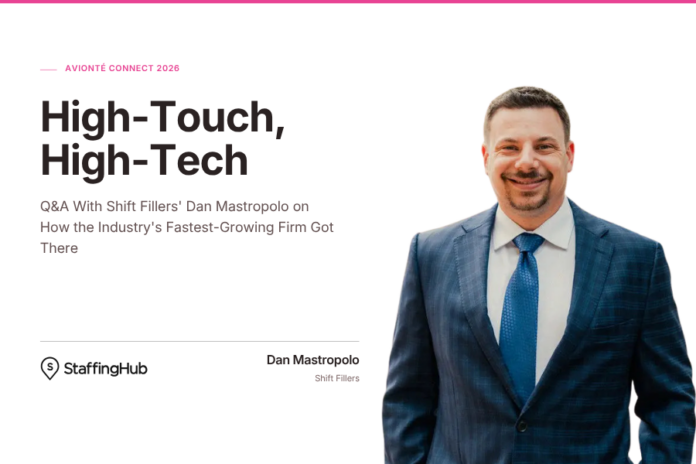
Dan Mastropolo has a quick answer for how Shift Fillers hit No. 1 on SIA’s list of the fastest-growing staffing firms in a brutal market: high-touch, high-tech. Getting there took building the tech infrastructure first, from day one, and refusing to let go of it even as competitors reached for whatever AI vendor showed up with the flashiest pitch.
As Chief Vision Officer at Shift Fillers, Mastropolo has spent years arguing that technology alone doesn’t drive adoption, people and tech have to move together. That philosophy runs through everything from how Shift Fillers built an 80% to 90% technical hiring process without sacrificing compliance, to how the company staffs its high-volume, low-skill industrial placements without losing the human touchpoints that keep candidates and clients comfortable.
At this year’s Avionté CONNECT, where Mastropolo also moderated a tech leadership roundtable, he sat down with StaffingHub to talk about what’s really driving Shift Fillers’ growth, the one question every staffing leader should be asking AI vendors before signing anything, and why he thinks brick-and-mortar staffing offices are on borrowed time.
Q. You just landed at No. 1 on SIA’s fastest-growing staffing firms list, in what’s been a challenging market overall. What do you attribute Shift Fillers’ growth to?
Dan Mastropolo: There isn’t one single thing, but a lot of it comes down to staying consistent. We haven’t shifted from the model we believed in on day one: strong tech infrastructure built to support high-volume recruiting, with very limited brick-and-mortar. That let us handle high-volume situations better than companies still carrying all the overhead that comes with physical branches.
We’ve always focused on building a large pool of qualified candidates. Staffing Referrals has been a partner of ours from day one, and we get a high volume of placements just from the communities we’ve built. But mostly, it’s been about limiting the friction that sits between fragmented systems and constantly tweaking how we deliver.
This past year, we leveled up a lot of our operational infrastructure and our client-facing leadership, and we got our partners to really understand how we need to operate. What you’re seeing now is the compounding effect of years of refinement.
Q. When you’re building your leadership team, is a tech-first mindset a top hiring priority, or is that something you can teach?
DM: That’s a great question. It depends on the layer of the organization. Our biggest focus has always been our on-sites and our funnel teams. We try to make our on-sites the superheroes, but we’ve always believed that getting technology adopted requires people and technology working together. So yes, it’s a factor. We need people who understand we’re high-touch and high-tech, and that shapes how we interview.
But the bigger piece has been keeping our funnel teams offshore to handle volume, since we’re driving mostly low-skill, high-volume placements. For those roles, we’re looking for people who’ll make the best match at client sites and interface well with our client base, supported through our onsite channel.
Higher up the chain, we’ve iterated our leadership team a lot. We’ve improved our back-office operations significantly, and what it’s boiled down to is hiring people who’ve been there and done that at the scale we’re operating at. We’re not afraid to make changes fast, and if someone isn’t the right fit, we make that call quickly. At the revenue trajectory we’ve had, you need people who’ve really lived at that pace before, because you can’t learn how to drive the car while you’re also trying to put gas in it.
Q. You’ve said the whole game is getting tech and people to work together, that tech alone won’t drive adoption. In high-volume, industrial staffing where you’re filling hundreds of orders at a time, what does that tech-human connection actually look like on the ground?
DM: There are a couple of things that go into it. Everybody understands the attract, engage, hire framework, and for years the industry has focused on getting through that process as fast as possible. The old brick-and-mortar model had you posting a job order, sourcing and screening, then bringing people into an office to finish the process. COVID took a lot of that out of the equation and got people comfortable with remote hiring. Being in a low-skill, high-volume world makes that comfort easier for us, since we don’t carry the complexity of a skilled trade, professional, or healthcare placement.
But you can’t just throw darts at it. We’ve been systematic about where technology sits in our sourcing and screening. We’ve evolved to the point where about 80% to 90% of the hire process is technical, right up to the I-9, without jeopardizing compliance. Believe it or not, plenty of brick-and-mortar operations still have people doing this on paper, in filing cabinets or spreadsheets. That carries real risk today. I’d argue we have the highest level of compliance in our onboarding. I know exactly what’s happening, when it’s happening, and who’s touching it.
Having a remote I-9 process doesn’t mean we don’t see our people. These are real people who’ve gotten through our paperwork before they ever reach a client site. Our HR teams are involved at certain points, our onsites are involved at others, and that keeps the human approach intact. People aren’t walking into our facilities blind. They know who we are, they’ve interacted with us, and our onsites act as a last line of defense at orientation and on day one.
Q. You moderated a tech leadership roundtable this morning built around what’s working, what’s adding complexity, and what tech leaders are prioritizing. Which of those three sparked the most conversation?
DM: It was a great conversation, and I’ve been advocating for tech leaders specifically for years now. I built the session around 12 open-ended questions covering roadmap, AI strategy, integrations, adoption, and what keeps people up at night.
AI strategy and governance framework dominated, unsurprisingly. What I was really trying to gauge was where people are in that journey. The gap was interesting: some said they’ve adopted something, some way, shape, or form, and others said they’re all in. The ones who’ve gone all in are seeing solid returns in some areas and are still hopeful about others. Almost everyone has AI in their sourcing and screening phase. We’ve seen more than 200 AI companies come into this market in the last couple of years, mostly focused on the top of the funnel. The more advanced ones have moved into sales, and front, middle, and back office. Back office is where everyone is still waiting to see what happens.
The recurring theme is massive time savings. Problems you used to have to bring to a leadership team, get prioritized, and wait three weeks, four weeks, six months, or maybe never, now get solved in minutes or an hour and are off the docket. In an industry as fragmented as ours, that’s definitely exciting.
The other thing everyone agreed on: governance, security, and AI framework keep them up at night. Our industry runs heavy on vendor products rather than building in-house, which makes vendor selection and accountability difficult. If something breaks in a split responsibility situation, who owns it? States are regulating AI differently, and you need people in your corner who know what questions to ask and what you need from vendors to cover yourself. There’s a lot of opportunity for SIA and ASA to lead on lobbying and education here, because this industry still has a big gap in tech leadership, and too many owners who chase shiny objects without being ready for what’s sitting on top of them.
Q. If tech leaders want to start wrapping their heads around responsible AI use, where should they start?
DM: There are a handful of things. Strong industry technology consultants are one resource, but the bigger piece is understanding the right questions to ask. When you’re going through vendor selection, you need one question in your back pocket for every vendor: have you gone through a bias assessment? Given that everything has been top-of-funnel driven, you’ll get all kinds of answers. If a vendor looks at you and says, “What do you mean, a bias assessment?”, that’s a red flag. Walk away.
If they say they’re in process, find out who’s doing the assessment and whether they’re willing to share the results. That’s becoming a requirement in states like New York, California, and Minnesota, among others.
Your insurance company or legal firm can also help, since they see the patterns of where class actions are coming from. I spoke at Marsh McLennan’s Staffing Edge conference earlier this year, and one thing we discussed was the rise in litigation tied to wiretapping fraud, because people aren’t getting consent before recording meetings. Most people don’t even have their Teams or Zoom settings configured to confirm consent before hitting record. You have to slow down and really think about what you’re doing and how you’re doing it. Compliance is complicated and constantly changing, and you need the right resources in place so you’re not carrying exposure you shouldn’t be.
Q. Where do you think AI is going to change the economics of high-volume staffing?
DM: A couple of places. First, it’s already driving candidate conversion costs down substantially. For years, everyone had their eggs in the job board basket. Job boards still matter, but firms with mature database cycles get a much better return by redeploying candidates and reaching viable candidates faster. Every time I can redeploy someone or keep them on assignment longer, I’m extending their lifetime value.
Second, curation models and talent communities are giving us much longer assignment lengths, because engagement can happen far faster than it used to. I remember pulling databases and shoving them into email templates, and half of it would bounce because people’s emails were never clean in the system. Now we can clean up data and keep candidate records accurate without having to make every single call ourselves, and we’re seeing higher engagement rates because of it.
Third, as AI moves into middle and back office and data aggregation, I can take a raw file from a VMS, compare it against payroll and assignment data, and catch mismatches in milliseconds. That used to be hours and hours of internal auditing. There’s real margin showing up in a lot of areas, even as we’re also seeing margin compression on the operations side.
Q. Are there any AI capabilities or promises out there that you don’t think have been fully realized yet?
DM: Voice AI is one category. Some of it has evolved further than I expected, and some of it is really bad. It’s obvious you’re talking to an AI agent: it cuts you off mid-sentence, asks strange questions. That has an impact on the user experience. I see transcripts all the time, not just from Shift Fillers, where people start messing with the AI because they know what it is. They’ll ask it bizarre questions just to see what it says back.
That’s why I keep saying certain things can be fully automated, and probably agentized eventually, but we can’t forget we’re in the world of work. People still crave human-to-human interaction, and they want to know they’re talking to a real person. Consumers are learning just as fast as the AI is, and they know when they’re being put into those situations.
Q. What are you most excited about in the conversations you’re having here at CONNECT?
DM: A couple of things. First, congratulations to Avionté on finally landing their long-term CEO. I’ve talked with Dirk one-on-one quite a bit these last few days, and I think him coming from outside the industry will be an advantage. He can look at things impartially, without the baggage of industry assumptions. I’ve said this before: our industry has sat too stagnant when it comes to technology and evolving our operating systems.
The other thing that’s exciting is how much order volume companies are starting to see. I’m talking to plenty of firms seeing double-digit growth, six, eight, even 10%, similar to what Shift Fillers has seen. We’re on the upper end of that. Some of that comes down to consumer spending and confidence in the market, but like every cycle this industry has gone through, you’re seeing new markets emerge as the growth drivers. Skilled trade companies I’ve talked to this week are absolutely riding the AI boom right now. AI is creating efficiency, but it’s also creating a massive amount of job growth in parallel. It’s exciting to watch those two things play out together. And finally. hearing people diving into technology, after decades of saying we need to catch up, is its own kind of horizon.
Q. A year from now, what will staffing firms be doing differently than they are today?
DM: You’re going to see a lot of brick-and-mortar downsizing across the industry. I understand people still like having teams in the field and getting together in person, but it’s expensive. It shows up in your SG&A. There are so many ways now to bring people together collectively, whether that’s a company conference or a quarterly onsite event, without needing permanent physical space. I know there are cases where high compliance requirements or wanting to vet someone in person still matter. But the reality is, the industry has evolved to the point where carrying that cost structure is a hindrance for firms that haven’t figured out how to operate with a leaner workforce and lower overhead. The gap between the companies that have and haven’t figured that out is already showing up in EBITDA and margin dollars, especially in segments of this industry that have historically run on thin margins.