

Healthcare staffing is in one of its most demanding eras: bill rates are higher, there are more travelers and locums in the market than before the pandemic, and yet it feels harder than ever to fill a job. Clinicians are wading through a wall of spam calls and mass texts. CFOs are now in every staffing conversation. And at the same time, rural hospitals and long-term care facilities are struggling to keep doors open and shifts covered.
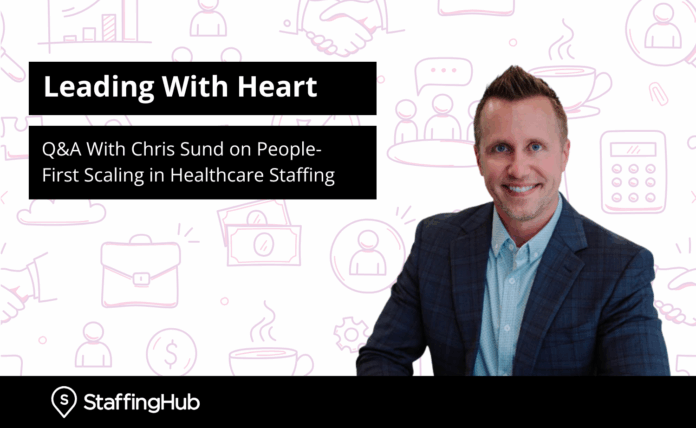
That’s the landscape Chris Sund is navigating as President and COO of Uniti Med and GQR Healthcare. His focus isn’t just growth for growth’s sake — it’s “heart-led” growth: building a business that does the right thing for clinicians and clients even when it isn’t the most profitable choice in the moment. From rethinking how agencies show up in a pay-transparent market to leaning into rural communities that bigger players overlook, he sees staffing firms as private emergency services that also have a responsibility to help clients think more preventively about workforce health.
In this conversation at Healthcare Staffing Summit, Chris talks about the shift from transactional recruiting to experience-led relationships, why true partnership sometimes means helping clients hire more internal staff, how Uniti Med uses values and “stars, not vacuums” to scale culture, and why purpose-driven clinicians are the key to serving rural America well.
Q. Healthcare staffing has evolved dramatically — travel, allied, locum, and long-term care all shifting at once. What’s the biggest change you’ve seen in how firms need to operate today?
Chris Sund: The biggest change is that firms today really need to focus on the experience they’re giving their candidates. Times have changed.
The amount of text messages, emails, robotic spam calls that are out there makes it even harder for somebody to even want to pick up the phone or respond to a message. So we’ve really had to shift into higher-quality touch points — making sure we’re meeting them where they are, caring about them, putting the human side first to block out all the noise that’s happening.
Q. Are leaders underestimating the pace of change?
CS: Absolutely. If you look at the market pre-pandemic, we have higher bill rates now — not drastically, but they are higher — and there are more travelers working today than there were then. There are more locums working today. You ask anybody in healthcare staffing right now and they’re going to go, “It sure doesn’t feel like there’s more out there. It feels harder than ever.”
The reason for that is, one, there’s been more people entering the space. But also, there are more submissions to placements. You’re having to do almost double the work to find somebody a job than you used to. The requirements that clients want us to meet just to send somebody for a job are higher than ever. It’s a lot of work, and people don’t always realize you’ve got to work harder to do that.
We’ve also added pay transparency. It’s been out now for a handful of years, but it really shifted the old healthcare staffing model where someone would talk to you, you’d say, “Here are some jobs,” and they’d go, “Okay, those sound good.”
Now you go on the internet and you can see everything. That’s fantastic in terms of ease of use, but the hard part is not every job is equal. What they don’t know is that job that just got posted may already have 50 applications and they’re not going to get it. The next one that sounds really cool is in the same boat.
So we have to evolve. We have to make sure we’re having the conversation, setting realistic expectations: letting them know, “You and everyone else wants to go to Hawaii, so the chance of landing the one job in Hawaii that just opened up is probably slim to none.”
Q. How have the expectations of health care professionals changed?
CS: There’s a lot more choices out there now.
There was a great survey put out a couple of years back. Some of the most important things were pay transparency, knowing their contracts were firm (less fear of being canceled, even for a shift), and support around burnout.
I don’t think that’s changed. With more choices out there today, candidates are leaning in more. They’re looking for a company they can trust — that if something goes wrong, they know they can get help, that their pay is good, their benefits are good, and there are intangibles like great insurance that offers EPA or therapy as part of the package.
Q. What’s the most impactful way agencies can build trust today?
CS: Trust comes from doing what you say you’re going to do.
Reviews are more important than ever. When I go shopping or I’m looking to make a purchase, I use the reviews. If I’m looking for a place to stay, I’m likely going to start with brands of hotels I’ve had a good experience with or that have a really high rating. If there’s not a name I recognize, then I’m going off that rating.
Ratings only come if you’re performing well. So you have to lean into the experience so hard that you’re creating raving fans — people who want to take the time to tell others, “I’ve had a great experience here; if you’re looking, I highly recommend it.”
Right now, with a hundred options showing the same job, you want to be the one with the best reputation.
Q. Hospitals and staffing firms are re-evaluating how to balance cost, care quality, and workforce stability. From your vantage point, what does a healthy staffing ecosystem look like?
CS: I serve on the NATHO board, and back in, I want to say 2017, they worked with KPMG to put out a report on the true cost of nursing in-house versus travel nursing. By the time you offer sign-on bonuses, the cost of benefits — everything — versus using a traveler, the numbers can look different from what people assume.
We (NATHO) recently made another huge investment to put out a similar report again with KPMG. They surveyed hospitals all over the country to take that data and start comparing. The reason I bring that up is I think sometimes clients might not know that information.
What’s happened over the last few years is they’ve spent more money than ever. Now, in the past, most of your client conversations were with your head of nursing. Now the CFO is in almost every single conversation.
A lot of times what we hear — not always, but often — is that hospitals and even long-term care facilities are being very reactive: “I’ve tried everything. I have nowhere else to go. We need help. Can you help us?”
Which is fine — in a lot of ways we’re a kind of private emergency service. You do want them to try everything else first because of the price, and maybe just use us where truly needed.
But what we’ve been focusing on is preventative care. I like that term. It’s: how do we get data analytics in there? How do we work with them through technology to show what their total spend is? Where are they using it, so they can maybe start a student program, do career fairs, put in incentives to help find more internal staff?
I get that part of that sounds like, “Isn’t that pushing you guys out?” And it might be, in a sense. But we might be providing a different workforce solution than we were a couple of years ago — and that’s okay. Right now, it’s about meeting the clients where they need to be.
Q. Uniti Med has built its reputation around “heart-led” growth. What does that philosophy look like in action when you’re making tough business decisions?
CS: For us, it’s one of the leading compasses when we’re making decisions. It’s asking: what’s the right thing to do right now, and what’s best for that person?
What we didn’t want to be when we said “heart-led” was transactional. We really want to be centered around our relationships — building a community with our travelers, with our clients, with our vendor partners. We’re all in this together.
It meant a lot more to us to not be the company that just says, “Click a button here and do this.” We want them to know we completely care about them.
When there’s an issue — and issues do come up — we make mistakes. You never want somebody to work an assignment and then check their paycheck and it isn’t what it should have been because something was missing. Or they’re going through the onboarding process and it’s been a struggle to get into a clinic.
In those situations, not only does our recruitment team and everyone in our back office understand that their role is so important — making sure we’re apologizing, that we care — our leadership will do it. I’ve asked that any time a client, a traveler, anyone needs a phone call and an apology, I’ll pick up the phone myself.
Because it doesn’t matter; if you’re part of our community in one shape, form, or another, we care about you and we want to make sure you understand that.
Q. Has that philosophy led us to say no to things that might have been profitable?
CS: Absolutely. The heart side will definitely sometimes lead you to say, “This isn’t the profitable decision here.” That comes with doing the right thing. There are times when you say, “We’re not going to get paid for this, but it’s the right thing to do.” This person is in this situation, and we’re part of the blame for that situation. So let’s not worry about the money side right now. Let’s do the right thing from a human level.
That’s the philosophy. It doesn’t always, in that moment, equate to profit or the bottom line. But we still use it as the compass: take the bigger approach, do what’s right, and trust that in the long run it will pay off.
Q. How do you make sure that human-centered approach scales alongside your team?
CS: It’s about bringing it into everything you do with your team.
When we hire, we look at experience and talent — but we also focus on characteristics. What are the elements that people have that will make them great in the different types of roles we hire for? We’re looking for those traits early on.
Then, as we evaluate or reward our team, we’re very intentional about what we recognize. It might be a stand-up meeting where we take time to highlight employees and what they’ve done that really shows those traits.
When you get somebody in front of the whole company and say, “Here’s what they did and why we’re recognizing them,” people see, “Wow, they’re getting recognition because of that thing they did.” I think it incentivizes that behavior. It signals, “This is really what we care about. If they’re going to highlight that, I should probably be focusing on it.”
Q. Culture’s easy to talk about but hard to scale. What have you learned about keeping it alive as the company grows — and how do you know it’s working?
CS: It can be hard to scale culture, because it has to go throughout the whole company. You’re relying on everyone owning a piece of it. Company culture is very much a leadership responsibility and everyone’s responsibility.
As you get bigger, that becomes harder to manage. You have to make sure everyone understands: we’re all making the company better.
I like to use the term “vacuums and stars.” If we have an employee who’s being a vacuum — sucking other people down and sucking the energy out of them — that’s somebody we hope we can help change. But if we can’t change that behavior, they’re probably not going to stay on the team.
We’re looking for stars: the type of person — it doesn’t matter what the role is — who, when you work around them, pushes you to want to be a better person and do better things with your life.
So part of keeping culture alive is recognizing that: bringing stars in, rewarding stars, and dealing honestly with the vacuums.
When it’s working, you see it in performance. It might sound weird, but when things are working and teams are collaborating and things are going well, it trickles throughout the work. On the flip side, one “rotten apple” really can ruin the bunch. That person can make people think about things they shouldn’t be focusing on, drag energy down, and you see it in results.
So I’ve seen it both ways: the wrong person dragging a team down, and the right person lifting it up.
Q. Is there any single practice that you’ve stayed consistent with since day one?
CS: Some things have changed, especially with us being acquired by GQR. GQR has a great set of values and a vision, and Uniti Med had its own. So now you have two companies with different vision and values.
We actually just spent a lot of time with some of our leadership in a room asking, “What values are still important? Are they even the ones we originally had?”
When we think of values, we’re saying, “This is how we want to behave. This is what we look for in the people we hire. These are the traits we look for when we do reviews. And if we’re going to hand out an award at the end of the year, this is what we want to say you represent.”
Understanding the importance of values has stayed true from the beginning. The specifics can change as your mission and vision evolve, and you have to be willing to adapt them. You might realize what you thought were your strongest values aren’t the ones you lean on most today, and you need to add or elevate others.
But we still use them as a compass — from hiring, to retention, to reviews, all the way up to awards.
Q. You’ve prioritized serving rural and underserved communities, a part of the market many overlook. What have you learned about what it really takes to support those facilities and the clinicians who work there?
CS: I absolutely love serving rural.
I live in a small town called Fremont, Nebraska — no one’s probably ever heard of it. I was born and raised there. My wife has worked in the hospital since she graduated college. It’s home for us, and our community has used travel staffing for some time.
I remember when my wife’s grandma was passing around COVID time. We were sitting in the hospital lobby while the cousins and family members were getting a chance to say their goodbyes. I still remember looking over and realizing that the nurse taking care of her was somebody I had met in our office — someone who worked for us and was there to support that community. When you see that effect firsthand, you think, “I don’t know what type of care we would get if we weren’t doing this.”
And that’s just my own backyard. We service the whole country. These rural hospitals and long-term care facilities — any of the rural health facilities you talk to — there are a lot of great people in these communities who really care. They usually know everyone in town. But sometimes it’s just not the place someone picks to work.
So it’s been a passion for us to lean into that. It’s where the need is.
Once again, we put all the jobs on the website. People want to pick Hawaii, and I get Miami, and maybe Boston and Austin. But the reality is there are a bunch of rural communities that have a lot to offer and need the help. We’ve leaned really heavily into that space to do everything we can to support them when they need it.
Q. What are you doing to motivate clinicians to take on those assignments?
CS: I think there are two parts. First, you have to find the clinician who cares about it — someone purpose-driven. That starts with asking the right questions.
Yes, you need to ask, “How many years have you had?” and “What did you do?” But if that’s all you ask, it’s like interviewing your internal staff purely on a résumé. You need to ask, “Why did you get into nursing? What caused you to choose this? What’s been your favorite part of it?”
When you ask those questions, you start to figure out the ones who are purposeful — the clinicians who will see a rural assignment not just as a job, but as a chance to make a real impact in a community that needs them. Those are the people who will thrive there, and our job is to connect them with those opportunities and support them all the way through.
I sometimes compare it to going shopping. You walk into a store thinking, “I’m going to buy this one shirt,” or you go into Costco for a couple of things — and you walk out with a cart full of stuff you didn’t even know you wanted because you didn’t know it existed until you saw it.
It’s the same with travel. When you ask, “Where do you want to go?” people usually name a major airport or a big tourist destination. They don’t necessarily know about all these wonderful places across our 50 states. So a lot of it is finding out what they love to do in their free time and what matters to them, then relating that back to the jobs we have.
There are mountains all over this country, but if you ask somebody where to go for mountains, they’ll probably name one or two states. Our job is to connect the dots and show them the hidden gems.
Q. You’re known for being very people-forward, but Uniti Med is also super tech-forward. How do you decide what to automate and where to keep the human connection front and center?
CS: I always joke that our tech stack is a bit like Iron Man. Iron Man is a regular person with a heart and a brain. But with the suit, he can do some really amazing things.
That’s what we want for our recruiters. We’re not looking to replace them. We want the human aspect of our recruiters, but we want to take what they do and make them more efficient so they can get to things faster.
When we evaluate technology, that’s a big part of it. The other piece is experience. We look at everything for what I like to call friction points. From the time you hit our website, all the way through working for us, getting payrolled, benefits — every little aspect is part of the experience. We’re constantly asking: Where is there friction? What do people not like about this step? How do we make it better? Sometimes technology is the best way to solve that friction.
And then there’s ROI. The hard part — which AI companies probably don’t love me saying — is there’s a lot of noise out there. I just read a stat that 85-90% of AI tech startups fail within the first couple of years. Compare that to restaurants, which everyone thinks are risky, and their failure rate is more like 15-30%.
Right now it feels like the gold rush: everyone’s running around grabbing shovels hoping to hit it rich. The reality is most won’t.
So you really have to sift through it. Take the time to look at a tool, see what it does, and then ask: Is this the best use of our money? Is it really going to improve the candidate or client experience? Is this ROI better than other investments we could make?
Q. Is there one thing you’ve automated or brought technology into that really reduced friction and turned into a big win?
CS: We’ve had a lot of wins, so it’s hard to pick just one, but I’d say automation journeys have been one of the biggest.
It’s just really hard for a human to hit every single touch point you might want in a perfect world. The ability to create automations that remember the little things so they don’t slip through the cracks — that’s been huge for us.
Our referral program is another good example. I wish referrals were our number-one lead source; they’re our second. But the technology behind it has made a big difference. I can’t always rely on our recruiters to remember to ask. We partner with Staffing Referrals, and they do a great job of, after we’ve had a really great phone call, inviting that clinician to be an ambassador: “Would you be open to telling other people about our company?”
Before that, I could put all the incentives, contests, and focus in the world on “make sure you’re asking for a referral,” and if I went back and listened to calls, it still wouldn’t happen 100% of the time. Having technology that makes sure that ask happens 100% of the time has been a game changer.
Q. When Uniti Med joined GQR Healthcare, how did you approach integration? How are you maintaining your mission and culture while leveraging the scale of a larger organization?
CS: As brands, GQR Healthcare and Uniti Med are two separate names on the outside. But behind the scenes, we’ve combined a lot: back office, marketing, how we do things operationally.
We have clients we’ve worked with on both sides for a really long time, and we didn’t want to disrupt those relationships. We saw value in both brands and both ways of doing things.
Anytime you bring companies together, you’ve got different visions, missions, and values. For us, it’s been a lot of conversation: What does that look like together? Where do we align? Where do we need to merge or rethink?
It’s a lot of work, but it’s also a really great opportunity to go through everything you do. You start digging into every little piece of how you look at things, and you learn different ways of doing it.
There’s always going to be someone who says, “I created that,” or “I built that,” and now you’re talking about changing it. That’s hard. But if you take the time to understand why it was built in the first place, and then say, “Okay, I get why we did it that way — but this is the direction we’re going now,” you can get to a better place.
Sometimes the best answer isn’t “your way” or “my way” — it’s a third way you discover together. That’s the real merging of the minds, and it can be extremely powerful.
Q. Rapid growth always tests leadership teams. What’s a lesson or pivot that has most shaped the way you lead today?
CS: I’ve learned a lot of lessons over the last few years. I’d say the biggest ones are less about growth itself and more about market changes.
We had well over a decade of growth in healthcare staffing. A lot of people in the industry only knew that world — lots of opportunity to promote, lots of upside.
The last few years, we’ve had contractions. That’s a different type of leadership. You might have to decide what’s most important. You might have to go through a layoff.
One big lesson is understanding that you need different leaders for different moments. Some leaders are great at developing and managing a team. Others are better at building something from the ground up. You have to recognize, in this moment, for where we are right now, what type of leadership we need.
The other lesson is about work ethic at the top. For a lot of companies, the last few years have been a “roll up your sleeves and do whatever it takes” environment. You really learn who’s willing to do that — who has the grit and drive to do whatever it takes to win and succeed.
Sometimes people see leadership as the point where you kick back and say, “I earned this.” In reality, leaders should be some of the hardest-working people in the company.
Q. Looking ahead five years, how do you see the role of the healthcare staffing firm evolving as culture, technology, and consolidation continue to reshape the landscape?
CS: Five years from now, I think we’ll still be talking about a lot of the same fundamentals. You have to be able to adapt to your environment and lean into where the demand is.
But I really come back to reviews and quality of service. If you look at some of the best brands out there in any industry, sometimes they’re the new ones. They didn’t just enter a growing space — they disrupted it. A great restaurant, a great store — they did something right and did it consistently well.
I think we’ll see more consolidation, and we’ll also see some new companies emerge. The ones that continue to have a lot of success will be the ones that really lean into the candidate experience and the clients they serve, and who do everything they can to separate themselves by providing a great experience.
Q. What do you think will be most different about the clinician experience five years from now?
CS: I think we’re just going to keep making it easier for them to do this.
I’m really excited about where we’re taking our own website. We’re updating it to give even more information, and the reason is simple: If someone’s working a night shift, gets off at 2 a.m., and starts browsing our jobs, what are all the questions they’re going to have that they can’t get answered until someone’s back in the office? “I don’t have that license — how long does it take to get?” Or “What’s there to do in that area?” Or “What does housing look like?”
We’re building our job cards to answer as many of those questions as possible up front.
We all know, for the most part, what an ER nurse does. That’s not what they’re going to ask. It’s going to be: Outside of pay, what does housing look like? What are the fun things to do within a couple of hours on my days off? How do I get the license if I need it? What’s the process, cost, and timeline?
We want that built into the experience so it’s much more self-service at the beginning. That might sound backwards from a human-centric perspective, but really it’s about reducing friction between “I found a job” and “I’m ready to have a real conversation with you.”
Reducing friction is 100% the focus. My hope is that five years from now, we’ve removed a lot more of it than we have today.
Q. Lastly, what’s a decision a healthcare staffing CEO should be making right now to future-proof their business?
CS: I don’t know if there’s one thing that future-proofs a business. There are too many variables — margins, deal structures, market shifts. There are landmines everywhere.
For me, the biggest thing is: continuously look for opportunities and give yourself harsh feedback. Find the areas where people aren’t enjoying the experience, or where a part of the business isn’t operating as well as it should. Those weak spots affect the whole picture. And recognize that what needs attention can change weekly, even daily. When there’s an issue or an area that’s struggling, address it.
If everybody in the company focused on getting just a little bit better, constantly, in all departments and all aspects of the business, I think you’ll be just fine.