

Staffing firms have never had access to more technology. They’ve also never been more confused about what to do with it.
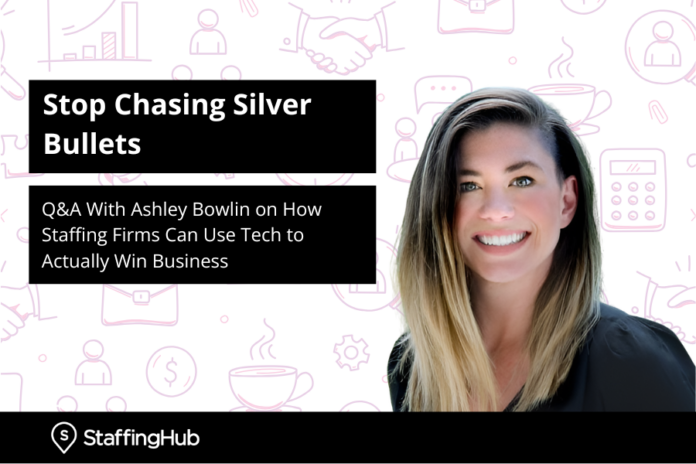
Ashley Bowlin has watched this play out from both sides. As VP of Marketing at Top Echelon Software, she’s spent her career in and around the staffing industry, much of it on the tech vendor side, observing how agencies of every size and digital maturity approach their stacks. She believes the problem isn’t the tools. It’s that firms keep solving for problems they don’t actually have.
At the Staffing Sales Summit, we sat down with Bowlin to talk about where the sales side of the tech stack gets neglected, what high-performing firms actually do with their CRMs, and why AI adoption is starting to look a lot like the automation craze that came before it.
Q. You see how agencies use their tech stacks every day, across firms of varying size and digital maturity. Where are staffing firms getting it wrong when it comes to using tech to drive business development?
Ashley Bowlin: I don’t think this is a new thing, but it continues to be a problem: the shiny objects. People get too excited about solving for one problem, or solving for a problem they don’t actually have.
What I’ve been preaching and trying to drive home is: take a look at what processes you have, document them, figure out what’s actually working. We were in a roundtable yesterday and someone brought up a referral action that drove a ton of new business. That is not technology, but use technology to amplify that. There are tons of tools out there, even free ones. Take advantage of ChatGPT and Gemini. Ask them: what do you think about my company based on what you can find on the internet? Here are my competitors — how can I be more visible and discoverable? You can do that today.
What people are doing wrong is the analysis paralysis. I know I need to do this, but it’s a really big thing and I don’t know where to start. Staffing firms get overwhelmed and then stop, or they pick one thing and call it the silver bullet. Especially since everything is changing so fast. The things that used to be leading indicators for what’s working from a sales and marketing standpoint — website traffic, outreach volume — it just doesn’t matter in the same way anymore. We have to dig in, do the research, and think about how our customers want to discover information. That’s the starting point.
Q. A lot of the tech conversation in staffing is about recruiting. Where has the industry underinvested on the sales side of the stack?
AB: You didn’t really used to have to do too much. The first ten years I was in staffing and recruiting, it was 80/20, with the heavy lift was on the recruiting side. Ninety percent of marketing efforts were candidate-driven. That’s just not the case anymore.
Sales in staffing isn’t a one-and-done. You’ve got to sell the relationship, get the contract, get the order, get more orders, make the placement. There’s so much technology we use on the candidate side that also applies to business development and client nurturing. Keeping that steady pulse of why they’re going to want to work with you, what your differentiator is.
Don’t put all of your brand presence on the candidate side. Make sure your ICP knows how to find you, understands how you’re going to be a partner, and how you’ll continue to support them. And marketing and sales need to talk to each other. What are you hearing in the marketplace? There’s a lot of opportunity for better interconnectivity between those groups, and I don’t see it often enough.
Q. When you see a firm actually using their CRM and existing database to drive business, what are they doing that others aren’t?
AB: First of all, having a CRM. That’s the first part. Having it and actually using it, not just letting it be a graveyard of contacts from twenty years ago.
The CRM should be your best friend. That is your source of truth. It’s going to make you look smarter, help you collect and inform your conversations. And your conversations are your biggest asset in those relationships. Whether that’s a Zoom call, an in-person meeting, a phone call — those are the things that add value to your business and to your customer.
Q. What’s the capability sitting inside most CRMs right now that firms are ignoring and could move the needle if they used it?
AB: Sequencing. So many teams are still doing this manually, and it does not have to be hard to nurture a lead or follow up. A lead comes in, the conversation starts, and then it just falls off and gets forgotten.
Whether you’re using an ATS/CRM, HubSpot, or Salesforce — they’re all going to have some sort of sequencing capability. Start there. What is the ideal framework for how you’re going to follow up on someone who’s raised their hand, or someone you’ve identified as a strong ICP fit? What are your triggers? Build that out.
Being able to listen for signals at scale and act in a way that’s not going to get held up by manual steps.
Q. You watch what agency owners say they need versus what they actually do once they have it. Why is there such a gap?
AB: People hear something, they think, “yeah, obviously that makes sense, I want to do that.” And then putting it into action is a different story. I’ve done it myself.
A lot of it comes down to rollout. You hand a sales team a new tool or process and say “go” — and they’re like, “What do you want me to do?” They’ll try it half-heartedly, decide it didn’t work in two weeks, and drop it.
Okay, well, let’s talk about it. What didn’t work? What part of it? What would you do to make it better? If you could amplify what you’ve done over the last five years that drove success, what would that look like? How can I help you build that into something programmatic?
Q. Is there a pattern to what actually gets agencies to change behavior — not just buy a tool, but use it?
AB: You need to understand what problem you’re solving. But beyond that, it’s the conversations happening across the whole organization. Not just sales manager to sales team, but between sales and recruiting. Those groups need to be super aligned, and that has to come from management and from the culture of the business.
A lot of times recruiters still won’t say that a job order isn’t working. They don’t feel like they can. Meanwhile, sales believes it’s the best job order ever. How do we make that relationship more functional and collaborative, so teams don’t feel uncomfortable bringing up issues?
Q. A lot of people are coming around to the idea that AI is becoming a necessity. Is that urgency worsening the trend of firms chasing AI without knowing what problem it’s solving?
AB: 100%. And it reminds me of when automation started becoming a thing. People would come in saying “we need automation now,” and you’d ask, “great, what are you trying to solve or amplify?” Same thing is happening with AI. Answering that question first, before you start building toward anything, is important.
That said, AI is everywhere and it’s changing how people expect to get information. They want natural language search. And you need to be able to come up in that search.
We highlighted this in the roundtable yesterday: right place, right time. We have got to get away from just push, push, push; call, call, call; and email, email, email. People are so overwhelmed. There’s so much digital noise. They’re all on LinkedIn, but LinkedIn’s algorithm is changing. So how do you present your solution, your business, and your brand in a way that it’s going to be top of mind or come up when someone’s doing the research?
When they need to hire thirty engineers yesterday, they’re not going to go back to the email you sent them six weeks ago. They’re not going to say, “Oh, you called at just the right time.” They’re going to get on their computer and research. They might not even Google — maybe they use Gemini, maybe they go somewhere else — but they’re going to narrow it down to a short list of solutions.
So be discoverable. And that’s marketing and sales.
Q. If you could change one thing about how this industry is approaching technology and sales, what would it be?
AB: People just need to use it. They’re not using what they have.
Calls will continue to be important, but conversations and how we have those conversations is going to evolve. It could be an AI chatbot, it could be a piece of content that shows up when someone’s actively searching.
But start with the same question: what is the core of what’s worked for my business, for growth and for sales? What does that look like today? And how do you amplify it with AI or technology?
Q. For staffing leaders trying to grow in 2026, what’s the one thing you’d tell them to focus on first?
AB: We’ve had three years of flat, at best. So first, don’t give up.
Upskill your people. Help them use the tools they have so they can do more. And I will not say “do more with less.” Do more with more.
AI probably isn’t coming for our jobs. Maybe it takes over the tasks nobody wanted anyway. We don’t have to manually source, we don’t have to manually send ten emails, because we all know it’s seven to ten touches before you even get a meeting. What can it help us do more of that actually adds human value?
Look at your processes, amplify what’s working, and don’t be afraid to learn and just try things.