

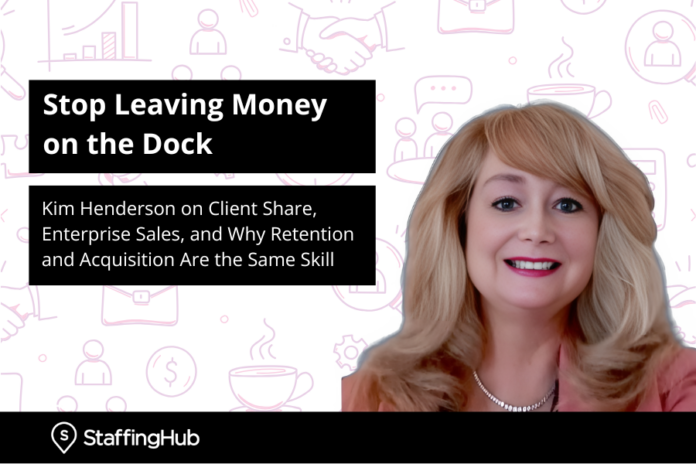
Most staffing firms treat winning clients and keeping clients as two separate problems. Kim Henderson thinks that’s the wrong frame entirely.
As a sales trainer and consultant at Cobalt Compass Solutions, Henderson works with staffing firms ranging from $10 million to $500 million in revenue. She’s been a fixture at the Staffing Sales Summit — one of the highest-rated speakers at last year’s event — and this year she led two sessions: one on client retention and expansion, and one on winning enterprise accounts.
In this conversation from the summit, Henderson breaks down the real reason firms lose clients (it’s not what you think), why most agencies don’t know how small their slice of the pie actually is, and what it takes to crack ( and keep) enterprise accounts. Her closing message for firms looking to grow in 2026: the gold is already in your existing accounts. Stop walking past it.
Q. When a staffing agency comes to you and says, “We are losing clients,” what’s the most common thing you find is broken?
Kim Henderson: There’s usually several things broken, but a lot of it comes down to the basics. Are we actually following up? Are we out in front of clients the way we should be? Are we adding value?
Staffing is a reminder business. You have to stay top of mind. If you’re not doing the calls, the discovery meetings, getting out in front of people — it’s easy for clients to forget you. If you haven’t been on site recently, your competition has.
There are so many ways to add value that let you stay in touch without being a pest: candidate marketing, sharing industry insights, sending a newsletter, inviting them to a webinar, pointing them to a relevant article or podcast. The problem is a lot of us don’t stay in touch because we don’t have anything to say beyond “Hi, it’s me again.” And clients don’t really want to be bothered with that.
Q. You talk about something called client share. What is it, and why does it matter?
KH: I love this topic. Staffing companies are great at bringing in clients — we place ten people on assignment, pat ourselves on the back, and think we’re doing a great job. We compare ourselves to ourselves. Then we start asking questions and find out our competition has 100 people on assignment at that same account.
We never knew because we never asked about the size of the entire pie.
You always want to know: What’s the total number of contractors in the organization and in the department? What’s the total spend for contractors and direct hire through agencies — for the whole organization and for the department? That tells you what you should actually be aiming for. Don’t compare yourself to yourself. Find out the entire size of the staffing spend, and go after that.
Here’s why it matters beyond the obvious. When it’s time to call down a supplier list, the first thing anyone looks at is how many people you have on assignment and how many placements you made. If you’re near the bottom, you’re gone. You’re not significant to their business.
Flip it around: if you’ve got 85 people on billing, you’re doing strong direct hire volume, and you hold a large percentage of their spend, you become relevant. You become embedded across departments and teams. Getting rid of you would hurt their business. That’s how you build real loyalty and retention.
Q. How do agencies react when they realize how small their slice of the pie actually is?
KH: It’s shock and awe. You think you’ve got a real foothold, and then you find out you don’t.
I’ll quote a wise man in the staffing industry, Jay Mattern, who once said that until you own 100% of that account, it’s still really a prospect. That hit me. I realized, okay, I’ve got work to do. I don’t want to be the vendor ranked ninth out of ten, because that’s a slow death. I need to figure out how to penetrate and expand.
Q. A lot of firms know they should be checking in with clients, but they default to “Hey, how’s it going?” calls. What does a high-value client touchpoint actually look like?
KH: Number one is candidate marketing, and I mean with real regularity and consistency. There’s genuine value in calling a client and saying, “I know you look for SAP resources with manufacturing experience. I found someone who’s done exactly that. Here’s why they’re a fit.” That’s a valuable call.
Number two is sharing insights. Lead with information. There’s so much out there through AI, industry publications, and associations. Give them labor data, market information, or industry trends, and give without the ask.
But the biggest differentiator is becoming an expert in their industry. If you’re a generalist calling to say you’ve got an IT candidate, what value are you really bringing? They want to know you understand their business. That you’re the low-risk option because they don’t have to train you. That you can say, “Company X had this exact issue in your industry. Here’s how we helped them solve it.”
You don’t need a PhD. You just need to be fluent enough to have a real conversation, one that goes beyond “How you doing?”
Q. Let’s shift to the other side. When a firm that’s historically worked with small or mid-size businesses decides it’s time to go after enterprise accounts, what’s the first mistake you see them make?
KH: Two things, really. First, they don’t recognize that enterprise organizations have very different buyers, and each one needs a different conversation.
I’d put them into three or four buckets. Client leadership cares about results and outcomes. Managers care about speed and delivery. Then you have the technical buyers — the MSP and procurement — who care about cost, compliance, and process.
The biggest mistake is going in with the same generic pitch to everyone. When you’re in front of MSP and procurement, the conversation is about cost and compliance. When you’re talking to client leadership, it’s a completely different discussion. You have to speak multiple languages and tailor your approach to what that particular audience actually values.
The second mistake is showing up as a generalist. I did quite a bit of work in the DoD federal government space. They had very specific issues, so you had to show up as someone who understood their world. I wasn’t an industry expert. I just went out and educated myself well enough to ask the right questions and hold a real conversation. Going in as a jack-of-all-trades makes you look like every other staffing firm.
Q. You’ve built global and strategic accounts. What do most small and mid-size firms not see until it’s too late when they land one?
KH: After you win the account, now what? It’s a completely different ballgame.
You need to be prepared for onboarding volume and velocity. You need processes for customized reporting and background checks. Things happen fast at enterprise scale, and if you’re winging it, you will fail your client.
The master services agreement is another one. These are complex documents: rebates, volume discounts, prompt payment terms, all kinds of business conditions that can spike you if you’re not prepared. Let’s say you offered a rebate and never tracked it. The customer is not going to be happy.
Some firms don’t realize they’re underprepared until it’s already too late.
Q. You also talk about statement of work as an opportunity. How does SOW change a firm’s position in an enterprise conversation?
KH: I love statement of work. In a large enterprise account where an MSP is on site, there’s probably SOW work happening at least 75% of the time. A lot of firms assume it isn’t, and that assumption costs them.
SOW is a carve-out piece of business, typically project-based. What’s beautiful about it is you don’t have to deal with the MSP structure, their rates, their compliance, or being cut off from hiring managers. You’re working directly with leadership. It’s a great way to gain client share, get into an account, and build a real relationship at the decision-making level.
The pitch can be straightforward: “Your MSP isn’t getting it done on Java resources with a security clearance. Let us do a carve-out SOW and staff this project.” It’s not as hard to sell as people think. I know firms today that have more IT statement of work business than they can handle. So always ask about it. If they ever go outside the MSP process to bring in labor, that’s your springboard.
Q. You led two separate sessions here on winning enterprise clients and retaining clients. Do those actually require different skill sets, or is it the same discipline?
KH: They’re very similar, and I didn’t fully realize how much until I was presenting both sessions at this event.
Industry expertise gets you in the door, and it keeps you there. Value-add is how you open relationships and how you sustain them. Communication and aligned expectations are what close deals, and they’re also what prevents churn. When clients leave, it’s almost always because expectations were never aligned from the start.
Map the client process out from beginning to end: who’s doing what, how you’ll communicate, what they can expect, how you’ll operate within their systems. Do that on the acquisition side and you’ll close more. Do it consistently throughout the engagement and you’ll retain.
There’s a lot of overlap. Gaining client share, being the industry expert, delivering consistent value, all of that helps you get the client and keep the client.
Q. When you’re training a new team, where do you start: the winning side or the keeping side?
KH: You have to do both. But if I’m being honest about where I start, it’s always existing accounts.
We’re always so eager to chase new logos. And new logos are expensive. You have to hire, train, market, and grind through outreach. Meanwhile, there is almost always gold sitting in the accounts you already have.
Firms are often working with one little segment of a client’s organization — application development in IT, say — and they’ve never touched network, database, or the PMO office. They haven’t asked the questions. They haven’t mapped the full account.
The acquisition cost is already paid. You’ve got a reputation. You’ve placed people. Now leverage it. Ask for introductions. Ask about project work. Ask for more volume. Cross-sell, up-sell, pursue exclusivity.
I guarantee you staffing firms are leaving a lot of money washing off the dock in their existing accounts. That’s the easiest and best place to start.
Q. For staffing leaders focused on growth in 2026, what’s the one thing to focus on first?
KH: Go back to your existing base.
You’ve invested real time, money, and effort to win these clients. Now actually work them. Look at your account penetration. Ask the questions about client share. Use my ten-step plan for account expansion, retention, and loyalty. There are ten things you can do, and most of them don’t cost anything. It’s planning and execution.
Cross-sell. Up-sell. Ask for exclusivity. Look for project business. Look for more volume. Do all of that before you go after new logos.
You always need new business — we get that. But don’t squander the opportunity you already worked so hard to get. Work smart, not hard. Start with existing.