

Most staffing firms are running on hustle and hope. They’re making calls, working their contacts, and grinding through a slow market, but they can’t tell you why some quarters hit and others don’t. The results feel random because the system underneath them is.
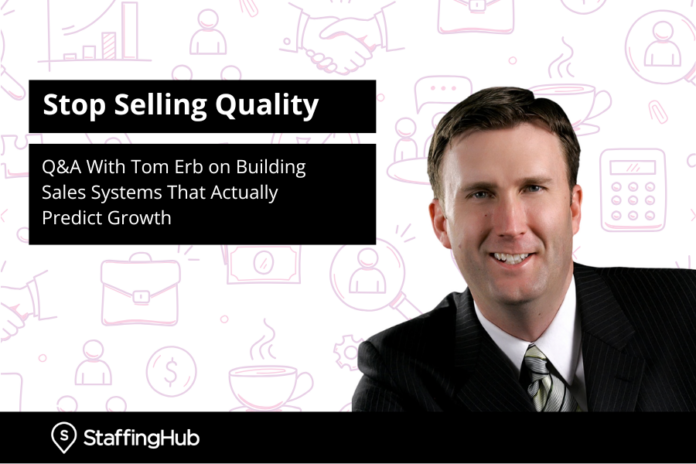
Tom Erb has spent 15 years fixing that. As president of Tallann Resources, he’s consulted and trained well over a thousand staffing firms on sales strategy, and he literally wrote the book on it: Winning the Staffing Sales Game. His work lives at the intersection of differentiation and discipline, helping firms figure out what actually makes them worth calling, then building the operational infrastructure to turn that into consistent, predictable revenue.
At this year’s Staffing Sales Summit, Erb presented on driving predictable sales results. We caught up with him afterward to dig into the “quality” trap that’s still plaguing the industry, what real accountability looks like versus the version most firms think they have, and where to put your energy if growth is the goal in 2026.
Q. You wrote a blog post called “Stop Selling Quality.” You said over 90% of the staffing firms you talk to are still leading with some version of “we provide quality” as their differentiator and that prospects are completely desensitized to it. Why do firms keep falling back on this when it’s not working?
Tom Erb: The biggest reason is they don’t know what else to say. And I do believe that most staffing firms, when they’re selling quality, genuinely think that’s what makes them different. But “quality” is such a nebulous word. There’s no value in it. It’s not specific enough.
You can sell quality, but you probably shouldn’t use the word, because it’s been so overused in our industry that as soon as you say it to a prospect, their eyes glaze over and they’re done.
You have to find other ways to do it. If you have service delivery that’s at a measurably higher level, quantify it. If you have data around your results compared to the industry, lead with that. If your internal team has more tenure and experience, say that specifically. All of those things really are quality — the problem is we’re reaching for this generic word that’s lost its meaning, especially to prospects who’ve heard it hundreds of times.
Q. You laid out five steps to build an actual differentiator: research your competition, analyze what’s actually different, talk to your clients, quantify it, and tie it to a benefit. Where do firms get stuck most often?
TE: The hardest part is truly going through the exercise of determining what really does make you different. Most staffing companies find it difficult. Some describe it as downright painful.
And a lot of times, there’s a fear underneath it: what if we’re not really different? What I tell people is, that’s okay. Because if you go through this and discover you don’t have strong differentiators, or you’re not doing things much differently than everyone else, that starts a conversation. Now you can talk to your clients. Ask them why they like working with you. Ask what you could do better. Ask if other staffing companies do certain things they prefer. Have those honest conversations. Be willing to be vulnerable.
If you’re not where you want to be yet, talk about future state. Work on it. Get there.
Q. Is the fear of going through this exercise and discovering you’re not that different what holds most agencies back?
TE: That’s part of it. But I also hear a lot of owners say, “Well, we aren’t different — nobody’s different, everybody’s the same.” Which becomes self-fulfilling.
There are companies out there doing this better than others. They’re doing things that are unique and that have real value to prospects and clients. You have to identify what you do well and what you could do better.
The other issue is that staffing companies often think they’re different when they’re not, because they’re looking at themselves through the lens of their own firm and making assumptions about competitors that turn out to be wrong. I know mine were when I was in the industry. When I moved into consulting and started working with some of those same competitors as clients, they were completely different from what I’d assumed.
That’s why it sometimes takes a third party — a consultant, or even your own clients — to give you an accurate read on where you actually stand.
Q. You’ve said a differentiator has to be both valuable to the prospect and quantifiable. Can you give an example of a firm that’s nailed that?
TE: Robert Half is the first one that comes to mind. They’ve done an excellent job of building a brand that reduces decision risk for the prospect. “If I go with Robert Half, that’s a safe pick.” You don’t become a safe pick overnight; they worked to earn that. TrueBlue has done similar work over the years.
It’s all about separating yourself in a way that people can easily understand and easily see value in.
Q. You talk about niche specialization as a major lever for standing out. Is that the same thing as differentiation, or do you see them as separate?
TE: Niche specialization is a type of differentiation — to me, it’s the strongest type.
Think about it: if you have a sports car, you’re not taking it to the mechanic at the end of the road. You go to a specialist. Same with medical issues. We value specialists. The more you can position yourself as one, the more value a prospect perceives.
And you can keep drilling down. Not just light industrial, but manufacturing. Not just manufacturing, but food manufacturing. Not just food manufacturing, but specific types of roles within that. Every layer you go deeper increases the perceived value.
It doesn’t mean you’re lying about everything else. You don’t have to be exclusive in a niche to be a specialist. You could have several areas of focus. But when you isolate and really commit to a specialization, you’re more likely to resonate with the right prospects.
Q. Are you seeing high-growth firms deliberately niching down?
TE: You see it even within larger companies — splitting into divisions and subdivisions. IT firms are specializing in cyber and AI. Bigger companies are going narrower, not broader.
When I worked for one of the largest staffing companies in the U.S., I focused on call centers. We were generalists, but I was able to position us as specialists in that space because it was a genuine area of focus. We had a productized delivery process. We grew it like crazy. At one point, we determined we were the largest employer of call center employees in the country.
Q. Your session was about making sales results predictable. When you walk into a firm with chaotic or spiky revenue, what’s usually broken?
TE: It almost always comes down to not being methodical about the sales process, particularly around cold calling.
A lot of companies focus on call volume: make 200 phone calls a week, do a certain number of drop-ins. But they don’t focus on the quality of those interactions. It’s very transactional, pass-fail. “You made 200 calls, got 192 voicemails and 8 live connects.” Nobody stops to think seriously about what happens on those 8 live connects, or how to take them to the next level.
Q. What are the leading indicators most firms still aren’t tracking?
TE: There are four core sales KPIs. Everything else I consider diagnostic, but these four are what predict outcomes.
First: sales activities. And I’m specific about what counts. Emails, LinkedIn outreach, letters — those can be done by others or through automation. A true sales activity requires a skilled salesperson to execute: phone calls, drop-ins, networking events.
Second, appointments. How many per week, in person or remote.
Third is pipeline. How many opportunities, and how much revenue do they represent? Is that number actually sufficient to hit their goals?
Fourth is gross profit dollars on new business.
I call it the path to success: sales activities lead to appointments, appointments build pipeline, pipeline produces new clients and gross profit. If something’s broken, it’s usually visible in that chain.
Q. Owners often say they hold salespeople accountable to metrics. When you get inside a firm, what does that actually look like versus what real accountability looks like?
TE: The most common confusion is mistaking visibility for accountability. There are really three layers of performance management, and almost every staffing company stalls at the third.
Level one is visibility: Can you see the data? Are you tracking the right things? Most ATSs and CRMs handle this reasonably well.
Level two is responsibility: Do people in the role understand what success looks like and what’s expected of them? That’s where KPIs come in. Some firms do this okay, though plenty have 15 different KPIs, which dilutes focus, or they’re tracking metrics that don’t actually predict success.
Level three is accountability, and that’s where almost everyone fails. It’s not just having visibility and defined expectations. It’s actually sitting down and asking: Are you hitting your numbers? If not, why not? What do you need to get there? And what happens if you consistently don’t? That’s where the conversation usually breaks down.
Q. Why do you think accountability breaks down so consistently?
TE: I think we’ve created a false choice between culture and accountability. A lot of leaders believe you either have a good culture or you have high accountability, that they’re in tension. They’re not.
I have clients with genuinely strong cultures and extremely high accountability. Both can coexist if you help people understand the “why” behind the numbers and help them see that being held accountable is actually in their interest.
I use the personal trainer analogy. You can go to the gym for an hour on your own and get some benefit. But if you pay a trainer, you’ll get a lot more. They’ll push you harder. You’ll hate them while it’s happening, and thank them after.
The right people want to be held accountable. They know they can’t always get there on their own. If you start with the right people and frame accountability as something that serves them — not something done to them — you can have both the culture and the performance.
Q. What do you advise clients to look for in new sales hires?
TE: The first thing I tell them: don’t put too much weight on staffing experience. It’s a bonus, not a requirement. This is not rocket science; it’s not something that takes decades to learn. And most staffing companies do little to no actual training, so the “experience” candidates bring is usually just a collection of habits picked up from watching someone else, who picked them up from someone before them.
I always ask clients, “Would you hire this person if they didn’t have staffing experience?” If the answer is no, don’t hire them.
The other thing they’re looking for is goal-oriented people who want to be successful. Former athletes often fit well — they’ve set goals, pursued them with a structured process, and know that consistent effort leads to results. I want someone likable, but likability alone isn’t enough; it’s a baseline, not a differentiator. I want people who are sociable, self-assured without being arrogant — confident enough to call strangers, initiate conversations, push back constructively. And I want resilience. The ability to recover quickly from rejection is non-negotiable in sales.
Q. We’re a few months into 2026. What are you seeing across your client base — recovery, stabilization, or still a grind?
TE: My client base is a limited sample size, but what I’m seeing is consistent with the macro picture. One article says manufacturing is improving; the next says it’s slowing. That’s been the pattern for a couple of years.
There are positive signs. Healthcare is back on the rise. Most people at this conference have seen upticks in their business over the past couple of days. That’s consistent with what I’m hearing from clients and with indicators from SIA, the American Staffing Association, and Bullhorn.
But everybody says the uptick is slow. And the geopolitical uncertainty keeps introducing friction. Companies want to reinvest and hire, but uncertainty makes them hesitate.
Q. For a staffing leader serious about a growth trajectory in 2026, what’s the one thing to focus on first?
TE: I use the three-legged stool analogy. The three legs of growth are new business development, existing client maximization, and fulfillment optimization.
In a slow economy, we tend to focus on new business and client maximization while letting fulfillment slip. In a strong economy, we back off new business because orders are flowing and pour everything into fulfillment because candidates are scarce. We’re always focused on one or two legs instead of all three.
My advice is simple: don’t take your foot off the gas on any of them. Ever.