

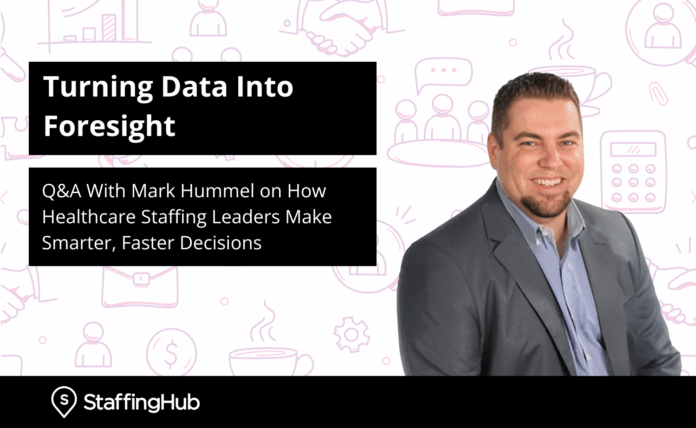
Healthcare staffing leaders are swimming in data but still making far too many decisions on gut. Every day, they’re triaging which orders to prioritize, where to point recruiters, and how to protect margin — often by squinting at reports that describe the past instead of illuminating the next move. Toro’s founder and CEO, Mark Hummel, thinks that has to change: data shouldn’t be a post-game justification, it should be the co-pilot that shapes decisions in the moment.
With Toro, he’s focused on the messy middle of the tech stack — the recruiter notes, texts, and micro-interactions that never show up in dashboards but quietly determine who gets placed, who backs out, and where competitors win. By turning that unstructured exhaust into usable signals, he wants leaders to see risk sooner, coach smarter, and scale the kind of “chair-side” coaching that doesn’t scale in real life.
In this conversation at Healthcare Staffing Summit, Mark talks about the shift from gut feel to evidence-based decision-making, why “effort” metrics are misleading, how AI can act as a private coach instead of a surveillance tool, and what it really looks like when a staffing firm becomes data-driven instead of just report-driven.
Q. Healthcare staffing leaders are making thousands of micro-decisions every week — which job orders to prioritize, where to deploy recruiters, how to manage margin. What makes those decisions so difficult to make with confidence right now?
Mark Hummel: I think what’s crazy is that in staffing, we’ve been an industry of gut feel for so long. We’ve had a lot of leaders who came up through the ranks, and they’re used to looking at one small situation, combining it with their own experience, and extrapolating from there.
Now we have all this data available, and we have to get smarter about how we use it. Data should be what makes the decision, not something we go back to after the fact to justify a decision we already made. That’s the big shift I’m seeing: data moving from the rearview mirror to the thing that actually drives those micro-decisions in real time.
Q. What’s one decision you see leaders hesitate on most often — and what’s usually behind that hesitation?
MH: We’re all staring at end-state KPIs — number of placements, people on assignment — but we’re often missing where to spend coaching time, where to change a process, or which technology problem is actually worth solving.
The hard question is, “Which problem do I prioritize?” That can’t just be a survey of what the team is annoyed by. You have to use your data intelligently to pinpoint, “This is where I’m losing efficiency. This is an opportunity to grow that I’m not capitalizing on.”
Q. Many agencies are data-rich but still struggle to get a clear view of what’s actually happening across their operations. From your experience, where do leaders most often get blindsided — what parts of the business are hardest to see in real time?
MH: We’ve gotten really good at collecting data over the years — so good that it’s turned into analysis paralysis. Leaders and desk-level staff go into the system to make a decision, and they spend so much time researching every little piece that they lose their competitive advantage of speed.
Where people get blindsided is in scale. They want to coach on every text, every call, every interaction. That’s impossible. The question becomes: how do you look across all that data and surface only the interactions that actually deserve coaching time?
If you don’t have an approach that can cut through the noise and highlight those moments, you get buried.
Q. A lot of what drives performance in healthcare staffing lives in unstructured data — recruiter notes, texts, and compliance updates that never make it into dashboards. What do leaders miss when that data stays hidden, and how does surfacing it change the way they manage risk or performance?
MH: In an ideal world, you’d sit chair-side with every recruiter, watch every text and call, and coach in the moment. That doesn’t scale.
All those messages and notes are telling you something about the candidate, the clinician, and the client you’re trying to sell into. When that unstructured data stays hidden, you miss the patterns that show you where a recruiter is consistently dropping the ball, where candidates are raising their hand and not getting a response, or where there’s a repeat risk signal that never gets escalated.
A simple example: a lot of firms don’t realize how many times a candidate has actively engaged — shown clear interest in a job — and then doesn’t hear back for 24 or 48 hours because the recruiter is overwhelmed. Those are placements waiting to happen that just slip through the cracks.
When you surface that data at scale, you can tell a recruiter or manager, “Here are the five conversations you must act on today.” It changes how people prioritize their day and where managers spend coaching time.
On the risk side, we’re seeing a lot of pain around placement back-outs — someone’s booked, but they never start. There are micro-indicators in the conversation history that show that risk early: hesitation, competing offers, compliance dragging.
We look for those patterns and alert staffing companies: “This one is at risk; a manager should check in.” At first, it can feel like a lot of alerts, but every one you dig into is a conversation that probably should have happened and often saves revenue.
Q. When a firm starts connecting and cleaning its data, what are the most meaningful early wins you typically see — the insights that change how leaders run the business?
MH: The early wins are often more straightforward than people expect. Connecting and cleaning data sounds huge, but in practice, some of the biggest gains come from basics like making your existing ATS data actually searchable.
We’ll go back through a year of conversations — recruiter calls, texts, account-manager notes — and extract key details into structured fields in the ATS. Recruiters may not even know we’ve done it, but the next time they run a search, suddenly a lot more qualified candidates show up.
They run the same string they’ve always run, and now there are a hundred extra candidates in the result set because a license, a location, or a skill that lived in a note is now in the right field. You see placements happening that simply wouldn’t have been possible two weeks earlier.
Q. How can better visibility into recruiter activity and engagement data help executives identify what truly drives performance — beyond just output metrics?
MH: Some recruiters hear “more visibility” and immediately think, “I’m going to be micromanaged.” But those same recruiters love sitting next to the top performer during training. They want to know: what do you do every day? What’s different about how you work?
What we’re doing is giving every recruiter a window into that. Your best recruiter has certain patterns: specific activities, ways they respond to risk signals, how quickly they follow up. When you can see those patterns across the data, you can show everyone else, “Here’s what success actually looks like here.”
All of this happens in the background. Recruiters don’t have to change their process or manually log more fields. The system is collecting data and turning it into nudges: “Here’s a risk you should act on,” or “Here’s something you can improve that will increase your paycheck.”
Another piece is how recruiters are already using AI today. They’re going to ChatGPT, Claude, all these public tools, copying confidential data out of your ATS because they want a second opinion or advice on what to do next.
We can take the data that already lives in your system and give them that same coach inside your environment, without the security risk. When they realize they can anonymously ask, “What should I do with this candidate?” and get guidance from a model that actually understands their book of business, they get over the “being watched” piece pretty quickly.
Q. As analytics become part of daily operations, how should leaders think about balancing recruiter intuition with data-driven decision-making? What happens when those instincts and the data don’t agree?
MH: One thing I heard in a panel that really resonated was the idea of starting with the recruiters who want to adopt this stuff and using their success to create FOMO for everyone else. You don’t have to flip a switch and say, “Everybody must use this from day one.” You can roll it out to a pilot group or broadly make it available and let your natural early adopters run with it.
Those are the people who will come back and say, “Here’s what I asked the chatbot. Here’s what it gave me in 30 seconds that would’ve taken me 20 minutes.” When others see that, the intuition vs. data debate changes — it’s not, “Do I trust data or my gut?” It’s, “Can this tool make my gut instincts faster and better informed?”
So the change-management challenge isn’t, “How do we rewrite our culture overnight for AI?” It’s, “How do we pick solutions with low friction, easy adoption, and obvious wins, so we can get quick implementations and build momentum?” As those wins compound, people naturally start to let data inform their intuition more.
Q. For executives leading large healthcare staffing organizations, what types of dashboards or metrics are actually decision-useful — the ones that help steer strategy, not just report history?
MH: The basic KPIs still matter — they’re your macro indicators. But they’re rearview-mirror metrics: submissions, placements, people on assignment. They tell you what happened, not why.
What we haven’t done well as an industry is connect those outcomes back to the activities and interactions that produced them. You see that you missed your submission target last week, but do you know which activities didn’t happen that should have?
The dashboards I get excited about are forward-looking. They tell you, before you miss your submission or placement goals, where you’re leaving money on the table.
One example is a “lost to competitor” view. Candidates tell you a ton about who you’re losing to and why — which competitor, what type of job, what pay, what differentiator. If you capture and analyze that, you get a very specific picture of where you’re struggling against competition in certain markets, and that guides your priorities much better than “submissions were down in Region X.”
Q. What’s a metric that looks important but actually misleads decision-makers?
MH: I think the most misleading metric is the generic effort metric — raw counts of calls, texts, touches. Because we haven’t historically known what was happening inside those conversations, we defaulted to, “Did enough calls get made?”
When placements are down, we jump straight to, “We must need more calls,” instead of asking, “Did we convert the right candidates? Did we move fast enough when they were engaged?” As we get better at seeing context, I expect some of those effort KPIs to fade in importance and be replaced by metrics that reflect actual impact.
Q. What distinguishes leaders who turn data into action from those who stay stuck in reporting mode? Are there specific habits or mindsets that make the difference?
MH: In leadership and strategy meetings, I think the big divider is accountability. If you’re going to raise an issue or propose a strategy, you need to come with some data behind your hypothesis.
I’m not saying everything should be 100% data-driven, but we can’t keep running big decisions on gut alone. The leaders who are evolving look at their gut feel, then go find data that either supports it or debunks it. They hold themselves and their peers to that standard.
Q. Are there cultural shifts inside a firm that signals they’re truly becoming data-driven?
MH: You start to see a snowball effect when a firm is becoming truly data-driven. The first questions people ask of a tool are basic and obvious. As they gain trust, the questions get more complex and more strategic — deeper coaching questions, more nuanced business challenges.
On our side, we see clients bring us bigger, more sophisticated problems over time: “Can you help us spot this specific risk pattern?” or “Can we track this behavior deeper in the process?” That evolution — from simple curiosity to using data and tools on the hardest questions — is a strong signal that the culture is shifting.
Q. Fast-forward five years — how do you see the role of the healthcare staffing firm evolving as data and visibility become core to how the industry runs?
MH: I think everyone will be able to do more with less — not fewer recruiters or managers, but larger teams and books of business supported by the same leadership layer.
What used to require tons of one-to-one coaching and manual research becomes a queued-up set of insights: “Here are the five conversations you need to have with this recruiter,” or, “Here’s what we didn’t do well today.” Managers can have micro-interactions with more people and still deliver individualized coaching.
At the desk level, recruiters will have hyper-personalized relationships with candidates at a much larger scale. You’ll be able to handle more people on assignment and more placements, and to the clinician it will still feel like a high-touch, tailored experience — because you have the data you need at your fingertips.
What won’t change is the core human relationship. I don’t think you replace frontline recruiters at scale in five or even ten years. These are life-changing decisions for clinicians. They still want someone they trust to talk to.
The goal is to give recruiters superpowers: let AI and data handle the parts of the process that don’t add relational value, so the human conversations can be even more personal and impactful.
Q. What’s one decision a healthcare staffing CEO should make right now to future-proof their business?
MH: They have to start. Obviously I think they should look at what we’re building at Toro, but more broadly, they need to pick some solution that will make a measurable impact — probably with AI — in their process today.
If you haven’t done it yet, spend time chair-side with your teams to really understand what’s bogging them down and where the disconnects are. That’s how you prioritize which problems are worth solving first.
Once you have that prioritized list of business challenges, you should be shopping immediately for solutions. The more agile technologies in the space right now can solve real problems and grow with you as you adopt them.