

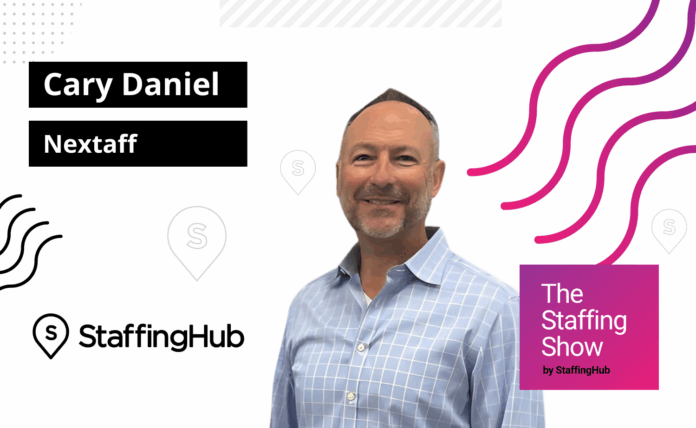
What if you could own a staffing business without signing a long-term lease, hiring a full team on day one, or pouring most of your net worth into the unknown? In this episode of The Staffing Show, we sit down with Cary Daniel, Co-Founder and CEO of NEXTAFF, to explore how the franchise model in staffing is being completely reimagined for the modern market. In our conversation, Cary shares how he was “coerced” into staffing back in the 90s, how he built and sold his first multi-office firm, and how he went on to launch NEXTAFF and grow it into a multi-vertical staffing franchise. He explains how the industry has evolved from traditional territory-based franchising, what’s broken in the classic staffing franchise playbook, and how NEXTAFF’s virtual model dramatically lowers startup costs and risk. We explore why many recruiters and sales pros are now choosing franchising, the gaps in exit opportunities for mid-sized agencies, and how owners can shift into semi-absentee roles while promoting their number-two leaders. We also delve into how NEXTAFF is leveraging AI agents, what Cary thinks is overhyped about AI-driven hiring, and why humanoid robots could become part of the future staffing mix. Tune in now!
[0:01:13] David Folwell: Hello, everyone. Thank you for joining us for another episode of The Staffing Show. Today, I’m super excited to be joined by Cary Daniel, the Co-Founder and CEO of NEXTAFF, one of the more innovative franchise models in staffing, and somebody who’s really trying to reinvent the franchise model and has a handful of new concepts that we’re going to be talking about and exciting things that are going on in staffing. Cary, super excited to have you on the show today.
[0:01:37] Cary Daniel: Thank you. Glad to be here.
[0:01:39] DF: You’ve been on the show before, so there’s some people that already know who you are. But for those that don’t, I always like to start off with a quick background. Tell us a little bit about how you got in staffing and a little bit about NEXTAFF and then we’ll jump into the questions.
[0:01:52] CD: Sure. It’s a long story of how I got in there, so I will try and be as brief as I can. I always tell people I was coerced into getting into this industry. People think they stumble into it. I was coerced. It was back in the mid-90s when Labor Ready had just gone public. I had a few friends working there, and they were trying to get me over. My interview, I was sitting in a plastic chair, and a guy interviewing me, I think had a dip of Skoal in his mouth. I was like, “This is weird. I’m not going to work for this place. This is bizarre.”
They just twisted my arm out and went, “Now you don’t understand. It’s the industry’s growing, this company’s growing, you really got to try it.” I reluctantly got into staffing and been here ever since. I was with Labor Ready for about three years. Moved on to another company, which immediately was SOS Staffing, essentially, when I started. Then after a year of doing that, I decided to get out on my own in about 1999, and something I would never recommend anybody doing, which is open 10 offices in 18 months, and sold that in 2003, and decided to franchise the concept.
We started NEXTAFF in 2004, and we did that for a number of years, ended up buying a PEO and a payroll company during the recession era. Ran that up until about 2015, and exited that. It’s now part of Paychex and began revitalizing the franchise model in 2018. Here, today, we are in 2025, 25 locations in 20-plus states, and we do commercial healthcare and technology verticals.
[0:03:32] DF: Great background. I know we’ve dug into the franchise model and some of the challenges within the exciting things around it, and what you guys are doing, and some of the unique opportunities. You guys have some pretty cool things going on in terms of how you’re looking at franchising. To start, I’d love to know what are some of the things that you think are broken with the traditional model when it comes to a franchise model?
[0:03:56] CD: The easy one that comes to mind is the way that franchises are traditionally sold is by territory. In my opinion, there’s nothing inherently wrong with that. But if you look at some of the older models that have been around for a long time, they mirrored the way the staffing industry was back in the 90s, right? Back in the 90s, everybody came to your office for an application. Back in those days, you had to cut hard checks. So, everybody had to come to your location to get their paycheck. Therefore, in a traditional, let’s say, top 25 city, you might have five, six locations scattered throughout the city, because somebody’s not going to drive 40 minutes every day, or every Friday, to come pick up their check, or 40 minutes to come fill out an application.
You had all these locations scattered throughout a metropolitan area. That’s the way the traditional franchise model and staffing really evolved. When we came on in 2004, it was still somewhat the same. But we decided to expand it. You didn’t need quite as much. We were doing a lot more direct deposit at that time. We started doing stuff by county originally. I’d say, doing it that way, it was a benefit to us, because it brought a lot of people in that thought some of the other concepts might be a little too restrictive.
Then if you fast forward to today, now we start getting into virtual model and no territory restrictions, etc., which is blasphemy, I think, in the franchise world. We can’t comprehend that they’re not getting a protected territory. I say that not from the inquiries we get, but from, we call them brokers, but they like to be called consultants, or coaches, people that help others find a franchise. That’s totally bizarre.
[0:05:52] DF: That’s interesting. The people that are selling it, it’s breaking their models.
[0:05:58] CD: Today, I meet somebody like you, and maybe you’ve worked for T-Mobile for 20 years selling commercial accounts. You want to do something B2B. You want to use your sales, but you’re not going to start your own telecom company. They go to a coach, broker, advisor, whatever, and say, “Hey, I’ve got this skill set. I want to own my business. I want to do a franchise, but I don’t know what I want to do.” They say, well, what about staffing? Probably 50% to 60% of our – maybe even 75% of our leads have no background in staffing.
[0:06:34] DF: That’s amazing. I didn’t realize that.
[0:06:36] CD: Yeah. I’d say, the majority of the broker consultant leads we get do not have that background. Because the thing about it, it makes sense. If you come from staffing and you’re thinking, “I want to go out and open my own business,” staffing would occur to you and you would either reach out to –
[0:06:51] DF: Oh, coming to the broker side of it. Yeah, yeah, yeah. I mean, one of the things that when you and I had this first conversation around it, and the concept, I was just thinking about how many probably, incredible recruiters there are out there that are like, “Oh, I would love to – I have a skill set, but I don’t have the admin, the office manager, the payroll components of this. How do I start my own business?” It sounds like this concept of a virtual franchise solves for that. Is that the idea?
[0:07:25] CD: Yeah, you’ve got it. It evolved post-COVID. Prior to COVID, we were like everybody else. You had a protected territory. However, ours were typically much larger. Health care, technology. I mean, we would give you the entire MSA for those verticals. Commercial is typically the county. Post-COVID, the number of inquiries that we started receiving that were asking about a virtual model or a home-based model, really increased. For probably a couple of years, we were in the same mindset that everybody else in the industry was ended, that no, that’s not the way that franchising works. We don’t do it that way. After a couple of years of turning people away, and I’m talking super talented people. We had one in technology that, I mean, to this day, I wish I could go back in time, because she was a superstar. She’s like, “You know what? That’s not going to work in technology. I can’t be restricted to this MSA. I understand it’s a big MSA, but I can’t be restricted with my clients. I mean, I have stuff all over the country.” Where like, “Sorry, that’s just not the way the franchise model works.”
After hearing yourself say that over and over, you’re like, wait a minute. Why? Why is it not, especially in technology, and even so in healthcare? We sat down at one of our – we’re big EOS guys, and so, we sat down at our annual offsite, and we just picked it apart and said, what are the reasons why we should? What are the reasons why we can’t? That list on the can’ts were really never done before. Not impossible, but it’s just that we’ve just never done before. We were able to roll out that virtual model in the healthcare and in the technology space about June of this year. It reduces that, the big concern of somebody starting their own thing is a lot of these folks they have the confidence from their previous experience, but they’re getting into something new, and it’s that fear of, am I going to flush 10%, 90% of my net worth down the toilet, getting into something new? It’s a big fear component. What a virtual model does is it removes, essentially, most of the top objections we would get.
[0:09:51] DF: That’s amazing.
[0:09:53] CD: You don’t have to sign a long-term lease. You don’t have to hire full-time people, day one. We cut your startup costs from entry level from 124,000 down to 61,000.
[0:10:03] DF: Wow.
[0:10:06] CD: And so, all the initial objections we would get in that space have now been eliminated. Now, what that’s done on our side is – we talk about squeezing the balloon, right? You squeeze this in, okay, we just got rid of all those issues, but what did it create over here? Well, we get a lot of part-time. “Hey, I want to do this part-time. I want to do this at night.” It’s like, oh, no.
[0:10:34] DF: Yeah, the commitment levels are, yeah.
[0:10:36] CD: Yeah. Part-time effort is going to get your part-time results. I would say in this industry, it feels like part-time effort is going to get you a fraction of the results that you’re getting full-time. I just don’t know if you can work two hours a night and –
[0:10:54] DF: And run a successful staffing. Yeah.
[0:10:57] CD: Replace your income. Could you make a good part-time income doing that? Probably. But could you replace your income and get to that point where everybody, it’s the purple squirrel, or the unicorn out there, which is, I want to start part-time. As soon as my part-time income replaces my full-time income, then I’ll quit my full-time job.
[0:11:16] DF: Yeah.
[0:11:16] CD: Okay, great. That sounds awesome in theory, but the likelihood of that happening, unless you have somebody in the industry, or you have a great contact that says, “Hey, you go start your own thing and I’ll throw orders at you,” which does happen. I think it’s hard for somebody to think that they’ll put in a couple of hours a night and replace the six-figure income.
[0:11:37] DF: The economics change from the entry point. How do the economics change in terms of scaling it? Have you guys, any experiences or results, things that are different? People are listening to this thinking, “Oh, that’s a cool idea. Maybe I want to participate in that.” What does that look like?
[0:11:54] CD: You’re talking about entry-level costs?
[0:11:57] DF: Yeah. I think you talked about what the startup costs are, but what do you – what are some of the outcomes you expect to see from this type of model, and how does it impact the overall economic model for you guys from a franchise perspective?
[0:12:11] CD: What our theory is, is if you look at the industry and you look at – let’s say, you look at a healthcare office and let’s say, a healthcare office, on average, produces a million dollars in revenue per one FTE. Five FTEs, you’re doing five million, seven, etc., etc. What we would hope to see from that is if you’re running a single office, a single virtual office, by yourself, then maybe you should be able to produce at that same level, because you have our backup. You’re not having to worry about – it’d be one thing if you try to do it on your own, and then you also manage the payroll and the work comp and the insurances and the financing and all those other components. Honestly, somebody could come in here that, let’s say, they’ve been doing recruiting for five years, 10 years, 20 years, and they’re the top performer where they’re at today. All they did was move over to us, and what would the difference be? Why couldn’t they replicate that same amount of productivity out of their home?
[0:13:16] DF: If they don’t have to worry about any of the – it’s the same job, same recruiting job. They’re not having to take on the other – I mean, there’s probably some other elements, but maybe not of the scale that it is when you’re committing to a full-time office and scaling that up as well.
[0:13:29] CD: Right.
[0:13:29] DF: Really cool. It’s an innovative concept. Do you know of anybody else in the franchise space doing anything like this? I have not seen or heard of it.
[0:13:38] CD: Not on the contractor temporary side. You have the direct hire folks. There’s a handful of those people out there that allow for virtual models, but it’s executive searches, direct hire. Nobody that I’m aware on the contractor temporary side.
[0:13:55] DF: That’s awesome. I love it. I know we’re digging deep into some of the innovative areas of the franchise model that you guys are touching, dipping your toes into. One of the other concepts that we talked about that was exciting to talk about on the show is the idea of this N>EXIT. Can you walk us through what that is and how that works?
[0:14:15] CD: Yeah. I don’t know. It’s just in our DNA over here of always looking at what’s working and what’s not, or what gaps in the industry itself. One for us that’s been around for the day that we sold ours 20 years ago was the exit possibilities in this industry. Now, I have seen, including myself, I have seen people come in and start with minimal funds and exit with seven figures in a matter of four or five years. I have personally done that. I’ve had franchisees that have done that. I know friends that have done that. It is absolutely possible to do that.
When you look at a large sector of the industry and where they lie in terms of revenue and where they lie in terms of EBITDA, you end up getting them into this no man’s land, where they’re too small for professional buyers. They’re too small for private equity. They’re too small for – and they may be even too small for a strategic buyer, unless you’re fulfilling some niche. If you’re like, I do commercial staffing and I do 3 million dollars a year, and I’m making $250,000 on EBITDA. That’s a lot different than saying, I do oncology staffing. Some niche that somebody goes, “That would be a great add on.” Anyway, they fall into this no man’s land, where just they’re not real desirable from –
[0:15:56] DF: From another perspective, yeah.
[0:15:58] CD: – a buyer standpoint. And so, they end up going out – I’ve talked to a lot of the brokers in our industry about this concept prior to launching it. There’s a handful of them that if you don’t have an enterprise value of a million dollars or more, they’re going to refer you on to BizBuySell, or something like that. It’s not worth the time and energy, and money it takes. It’s actually harder to sell those than it is to sell larger ones, right?
Anyway, so you get somebody, let’s say, they’re doing $250 on EBITDA. Somebody puts a 3X multiple on it, you got $750,000 of enterprise value. They go try and put it on BizBuySell, or even a strategic buyer. They’re offered 50% cash, 50% earn-out. You deduct taxes, any fees that you have to pay, legal fees, broker fees, etc., and capital gains. What are you left with? If you’re used to making $250,000 a year, that’s not going to replace your income. That’s not enough to retire. I hope you have other investments outside of your business. But we all know a lot of people that don’t have a lot outside their business. Now they’re stuck.
You see this aging demographic in staffing, where some of these folks are sticking around a long time, and they’re not keeping up with technology. They’re not keeping up with the industry itself. They just start to gradually decline. My old mentor used to say, “You can only coast one way and that’s downhill.”
[0:17:36] DF: I love that.
[0:17:37] CD: What we thought was, okay, there’s a lot of value here. But the risk in – think about the risk from a strategic buyer. I got fall well staffing and you got two full-time employees. I’m going to buy your business. My biggest risk is that when you go off and retire, all your clients leave, or they don’t like me, like they used to like you, etc. It’s a big risk. That’s why I’m going to offer you 50% cash. The rest is going to be an earn-out. I have to protect myself. But if you could convert your operation to a franchise concept and start to back out of the day-to-day and maybe become semi-absentee and maybe eventually, fully remote, which could be possible, but really, the way we target it, and then we want people to think about it as a semi-absentee. We have done quite a few comparisons over the last six months, and we see companies that are looking to this fall into one of three buckets.
Coming over to us would be, it’s not feasible. Well, they managed their receivables well. They managed their back office well. They have a really tight run ship, and it’s just cost-prohibitive to move over as a franchise. Not going to work. The second bucket is, wow, you know what? Actually, if I get rid of my full-time payroll person, and I get rid of my factoring, and I get out of the state pools, and I do this and I do this and come over to you guys, it’s about the same cost as I was doing it on myself, and you guys are going to do all the work. Then the third bucket is probably not as common, but we have seen them, is they are mismanaging their business so poorly that we actually gave them money by coming back.
I had a business in Missouri that we had looked at. That was doing about 350 in EBITDA and when we got done with it. I was like, “Okay, I need to run this again. I don’t think this is right.” They were doing 350, 400 in EBITDA. I get done on the numbers, and they’re projected even, it’s going to be 700 grand.
[0:19:47] DF: Oh, my God.
[0:19:49] CD: Because they had so much –
[0:19:50] DF: Waste.
[0:19:51] CD: – waste and getting absolutely destroyed by their factoring company, getting destroyed by their work comp care, getting destroyed by their GL. They were spending almost as much in GL on their little 5-million-dollar office as we do ours. They were getting that still.
[0:20:06] DF: Wow. That’s crazy. It sounds like, there’s a few different paths where the conversion to a franchise can make sense with the idea of the N>EXIT, or the slower exit. What does that conversion process look like? What’s that operationally look like?
[0:20:24] CD: It’s just about getting your payroll over to us. If you’re in Avionte, that can be quite easy. If you’re not in Avionte, then it’s just a matter of onboarding. But you have really two aspects of it. You get the temporary side that needs to move over. That’s just a matter of, no different if you said, “Hey, we’re going to just stop doing payroll at our own back office. We’re going to use ADP, or paychecks to do it.” It’s the same process, right? We’re just going to do your onboarding paperwork, fill out your forms. You’re off and running.
[0:20:54] DF: Then they get the standardization of all of your processes, implied, trained, etc.
[0:21:00] CD: Yup, exactly. That’s the second component is the back office and the operational piece, and the sales and marketing, and conversion over to the brand itself. That’s another thing that a lot of people are struggling to do, especially if they’re older generation. Might not be keeping up with the social media, the blog, the website, maintenance, all the stuff that I tell our offices, this is not going to catapult your business into a 10-million-dollar office, because you have the best blogs and you have the best social posts. But I think it absolutely could hurt you from a credibility standpoint, if somebody looks you up and your website is 20-years-old, and you don’t have a social presence, you don’t have any content out there. I think it doesn’t help you at all to be lacking in that and not keeping up.
[0:21:49] DF: I mean, like base-level requirements these days. It’s like, you have to have a modern look, feel. The digital presence matters. You’ve mentioned this as the not only a way to exit, I think you call this kind of is shifting the agency into an annuity. How does that work out financially?
[0:22:08] CD: We have to be careful with the word. I wanted to use that word so bad, because it’s essentially what we’re trying to do, but I don’t think –
[0:22:18] DF: Not the correct word for it.
[0:22:19] CD: – we can say that. We want to basically show you how to exit without selling. Again, what we strive to do is we strive for it to be hopefully, within the first year. If you don’t come on board and there’s a savings or a break-even proposition, what we would strive to do is, within that first year, bridge you to that through growth.
[0:22:43] DF: Got it.
[0:22:45] CD: I don’t think I’ve ever run a scenario where it’s even – I’ll try to think of the word, insurmountable. Always something so super small. Like, “Okay, David, here’s the delta between what you’re paying now and what you would pay if you converted. You need to add two people on assignment a month for that to pay with each other.”
[0:23:11] DF: Good to go. Okay.
[0:23:12] CD: It’s always something like that. It’s never like, “Here, as long as you have 47 people on assignment in the next couple months, it’ll break it.” It’s always some really, really small number. Because when you start adding up the GM over 52 weeks, our costs are not astronomical. You’re already paying a lot. But my goal would be to see people get in here that really, maybe they’ve tried, they’ve looked to exit, and they just keep getting these numbers that don’t make sense. We have a calculator and exit calculator, and we’ll run for them. I’d love to see some people take their number two person, or, I guess, their number one person, that says, “You know what? Yeah, I’ll give them a raise. Let them start taking over, and I’ll become semi-absentee.”
Because a lot of these folks, this is their identity, right? Especially the ones who follow us. That sets our identity, who they are. They might not want to disappear completely off the planet. They just don’t want to come in every day and collect AR and banking requirements, what have you. They don’t want to do it anymore. But could they get reenergized and be excited about not having to do that, and come in a couple of hours a day, or a couple of days a week, to keep the ball moving and train their person in charge? I would love to see an opportunity where we create a massive group of semi-absentee owners and a bunch of number twos that became the number ones, and now these people are succeeding as well, and it’s this generational baton handoff.
[0:24:42] DF: Handoff. Yeah, that’s great.
[0:24:44] CD: It’d be really cool. It’d be really cool.
[0:24:46] DF: You’ll do the math for them. Say, here’s what the model looks like. This doesn’t make sense. This does make sense. Or, this makes a ton of sense, and why aren’t you doing this immediately, based off those three buckets?
[0:24:59] CD: Yeah. Yeah. We’ve done two of those this year. We have a third we’re talking to right now. What’s ironic is the whole mentality of the conversion to us was going to be targeting these folks that wanted to exit, or semi-exit, etc. The two converters we’ve done and the one that we’re looking at want to go 100 miles an hour. They didn’t even look at it from an exit standpoint, which I thought was interesting, that we’re picking up conversions going after. They just want to tap into –
[0:25:33] DF: I didn’t think about that.
[0:25:35] CD: They want to tap into the market. They want to tap into a healthcare vertical. Maybe they weren’t doing healthcare at all. They want to tap into that.
[0:25:42] DF: Also, bigger brand. I mean, I think that, and the technology plays, too. I mean, the value of being part of a large org right now, I think that the – it can be hard going on the smaller side right now.
[0:25:53] CD: We talk about that with our offices. Sometimes if you come in this industry and you’re coming from the corporate world, you don’t know what you don’t know. When they get their technology bill every month, I’m sure they’re like, “Oh, my God. Look at what we’re spending on technology.” We like to reiterate to them that if you were to try and go out and replicate this on your own.
[0:26:15] DF: Oh, gosh.
[0:26:17] CD: We did the math for them one time. You couldn’t do it. It would be financially impossible to replicate it. But it only works, because we can spread those costs over a number of offices. You get the best of both worlds. You get that Fortune 500 back-office engine, but you’re only paying your little tiny share of it.
[0:26:37] DF: That’s great. Two years from now, what’s success look like for the N>EXIT opportunity?
[0:26:44] CD: For me, success would be having an – army’s too big of a word. Having a core group of evangelists that are like, “Cary, you get anybody interested, you have them called me. I will tell them they absolutely need to do this, because before I came to you guys, here’s what my life looked like. After I came with you guys. Now here’s what my life looks like. You have them call me, and I’ll explain it to them.” Having 10 or 12 of those folks. Not only that, then to see that after they stepped away and reenergized their second, to see –
[0:27:25] DF: The growth.
[0:27:27] CD: – and have them go, “Dude, what do you want? Testimonial video, testimonial speech. I’ll get it. This saved my life.”
[0:27:37] DF: Success for the people that are taking the leap and joining the brand, which is great.
[0:27:41] CD: Absolutely.
[0:27:42] DF: One of the category, I want to shift gears here and talk about the category you have talked about on almost every podcast. I think I’ve had maybe had one this year where we haven’t touched on it, but I always like talking about it with the people who are in the weeds and doing cool things. We’re going to AI. I know you have been as when we talk, I think you’re about as hands-on as I am, and also jumping into what’s next and trying to figure out where to use it, and you’ve started implementing some things. Tell me a little bit about what you’re doing with AI today.
[0:28:13] CD: Where it’s at for us today right now is, give you a couple of examples. We use AI as our intro to franchising. They’ll say, Google staffing franchise, they see NEXTAFF, they fill out a form, it says, send me information. They get an automated text from Michael, and then they get a phone call from Michael, our AI franchise assistant. This thing can answer every question you can throw at it.
[0:28:47] DF: Love it.
[0:28:48] CD: It blows my mind how it works. The old days of, “For franchising, press one. For support, press two.” This is not any of that. This is, “I’m Michael. I’m your AI franchise assistant. I’m here to answer your questions. What can I help you with today?” What are your startup costs? He can tell you. What can I expect to make? Tell me about your virtual model. Once you upload all that information, Michael does not forget any of the answers you gave it, right? He can answer all of your questions. Then it’s programmed to ask you a couple of qualifying questions, and then decide whether or not you want to book a one-on-one call with our franchise development team.
Because in franchising, this is franchising in general, I think the contact rate is under 50% of leads that come through. Because it’s no different. Think about somebody looking for franchising. It’s like somebody looking for a job today, where 25 years, 30 years ago, you had to type out your resume, type out a cover letter, put it in an envelope, and mail it off. It was very cumbersome to do that. Today, you can go on Ziprecruiter and Indeed and go apply, apply, apply, apply, apply, apply, apply. Same concept in franchising.
Ooh, franchising.com. Ooh, hamburgers, lawn care, staffing, ding, ding, ding. We get this lead. “Hey, David. It’s Crry with NEXTAFF. I saw you fill out a lead for our franchise.” “Who? What? I didn’t fill that up.” We’ll need it to follow, all right? “Here’s your phone number. You live at 123 Main,” and da, da, da. “I didn’t fill that out, though.” “From franchising.com?” “Oh. Oh, maybe I did. Nah, not ever.” Just hit apply.
[0:30:43] DF: It’s like the quick apply of franchise.
[0:30:44] CD: Exactly. So, 50% of people never call you back and never reply to anything. In franchising, you spend an enormous amount of time on that very first step of the funnel, which is just getting a hold of people. Michael, just keep going. Answer your text messages, call you. That’s one use case that we’re putting it in place right now. A second use case. Obviously, the stuff with Avionte and on the recruiting side, we’re working toward that. Another, and I’m sure you get guys to talk about the normal stuff all the time. I’ll talk about some funky stuff, maybe people aren’t doing. We all know the stuff that everybody else is doing.
Another one that we just rolled out last week was for our salespeople. Now, Michael does our franchise development inquiries. Steven is our staffing sales coach. We have programmed Steven to act as a prospect. We have given him probably a dozen objections, what to say, what the salesperson should respond to and make the jeopardy, etc. Now, our sales staff can call 24 hours a day, 365 days a year, call a phone number. Steven answers and says, “Hi, I’m your sales prospecting coach. First of all, how difficult do you want me to be on you today, from a scale from one to 10?” “Five.” “Great. Here’s what I’m going to do. I’m going to give you some objections. You’re going to overcome those objections. At any time, you can start, stop, say, try again, say, do that again, say, give me another. Talk to me like you would talk to a human being, or any other coach. Give me your opening pitch, whenever you’re ready.”
It will sit there and tell you what you’re doing right, what you’re doing wrong, based on all the stuff that we’ve programmed for it. It’s fun. I’ve literally done this at parties before. We’ll sit around some place, talking AI. They’re like, “What do you guys do with AI?” I said, you want to see something fun? I’ll call it, put it on speaker, and just do a demo of it, just because it’s so cool.
[0:33:00] DF: That’s amazing. I know that some of this is probably secret sauce, but for what you’re able to share when it comes to your tech stack and the how you build it, any advice for those listening that you’re open to divulging in terms of how you put these things together?
[0:33:17] CD: Don’t do any of it. Buy a franchise. I’m just kidding.
[0:33:23] DF: Buy a franchise that has all the skill. We’ve already got it.
[0:33:26] CD: Yeah. It’s tough. I’m in one of the ASA peer groups, and that was one of our topics last month, was tech stack and where does it stop? Just using stuff, because it’s a shiny new lure, versus what problem is this solving for me and what’s my investment, instead of, ooh, it’s really neat. For us, I would say, we are trying. We had this conversation right before we jumped on. We were trying very diligently not to just constantly throw stuff in the mix. We have a lot of stuff that’s on the bench. Sitting on the bench, we can only have so many players on the field. That idea has to sit on the bench until either this one is fully implemented and everybody’s good, to where we don’t have to talk about it anywhere, or we pull somebody off the field so somebody else can come in.
We have, I would say, what you would consider most staffing offices have in terms of their tech stack. Your ATS with Avionte, your messaging, you guys, Staffing Referrals, HubSpot’s our CRM for sales and marketing side of it. I’d say those are our big ones, and then you’ve got a bunch of other little ones that sprinkle in, but core technologies.
[0:34:46] DF: Yeah. You guys have the mobile app, too, right? That’s one of the benefits. I think that’s one of the – those are expensive to have as a SMB, so that’s a big add-on as well. What are some of the surprises that you’ve experienced? Any fun learning moments in terms of rolling this out?
[0:35:04] CD: On the AI side, since we’re using the same company, somewhere along the line, the two AI agents, or the sales AI agent got blended in with the franchise agent. When we were doing a demo, when we first started this, and it would say, “Give me your opening script.” I’ll tell you, I’d give my opening script, they’d give an objection. I would overcome that objection. They’d give me another objection. We couldn’t figure out if it was a word, if it was a phrase, but something would trigger it to move to franchise mode. It would start asking us in franchise mode. “If you were to invest in a franchise, do you think your startup costs do it?” We’re like, “Wait a minute. What?”
The great part about it is, is that you can say, “Hey, Steven. You know what? You got off track. Let’s start over.” We’ll repeat another thing. That was one where it took as a couple iterations with the team to say, hey, why is this crossing over? I don’t know if it was the word NEXTAFF. Then it went, “Oh, wait. I got to do franchising.” It was bizarre to catch that. Then every once in a while, and we don’t know how it happens, is a franchise candidate will get our sales phone number. It’s not published.
[0:36:27] DF: By the end of it, they’re working with their customer.
[0:36:32] CD: We can go on the dashboard, and we can hear the calls, because it records along. He’ll hear you saying, “What? I don’t understand why I’m asking – What questions are you asking me?” I’m like, “Oh, no. How did this happen?” It’s without a little bit of consequence, but our goal is all technology, right? You hope the good far outweighs the bad. Those issues are few and far between.
[0:36:57] DF: Yeah, it is crazy the precision you need to have when you get into agentic workflows and large system prompts, the detail to avoid the hallucinations, to avoid the problem areas. I’m months and months into it, and I’m just always amazed at how far you have to go into it. It’s fun stuff to dig into, but it’s definitely, it’s not a one-and-done type of build.
[0:37:25] CD: Sure. We fully expect no different than if I were training a brand-new franchise sales guy tomorrow, and I just dumped eight hours of information in his head, a week later, he’s going to retain 15% of it. I’m going to have to retrain him. I have to get that. I’m going to listen to one of his calls, and he’s going to say, the startup costs are between 22 and 72,000. I’m like, “Where did you get that?” That would happen with a human being. To think that I could just upload AI and be done forever, we don’t have that fantasy. We just hope it’s less than that. You just got to keep an eye on it. We go in and monitor calls and listen for that kind of stuff. I do frequent call-ins, and I try and stump it. I try to ask just weird questions, and I think I’ll throw it off, just to see if something crazy comes out.
Because it’s one thing for our salespeople to call. If it freaks out, hoping it does more, that’s one thing. It’s another thing if a franchise candidate calls, and it says, “Hey, well, how much can I make in this business?” “Oh, you can make up to 1 million dollars a year this year.” “What are my startup costs?” “Oh, startup cost, they’re free.” That could cause you a lot of problems.
[0:38:45] DF: Unlimited annuity.
[0:38:48] CD: I could get in a lot of trouble from the FTC from that. The penalty for failure on that one is much higher.
[0:38:56] DF: Yeah, yeah, yeah. Yeah.
[0:38:59] CD: As part of the underwriting and the prompting, have very, very clear, do not say, do not – very clear, cannot answer these questions, or here is the exact wording. Do not vary from the script whatsoever, if somebody says, “How much can I make?” Or any of that stuff. You can’t vary from that script.
[0:39:19] DF: That’s great. That’s great. That’s fun to hear, the unique use cases. On that, do you have any perspective on the most overhyped AI and/or the most underhyped AI use cases in terms of where it’s going and what you think it will replace, whether in staffing or outside staffing.
[0:39:40] CD: Let’s see. Overhyped, I would say, believing that AI will take over the recruiting, screening, and hiring component of companies. I mean, it’s just to think that someday all you’re going to do is just have an AI and screen candidates, interview candidates, and then say, “Here’s our two recommendations.” I don’t think that’s not – at least anywhere near the future. Because at some point, you’re also going to have the other side of the equation, which is the candidates, they’re using AI as well. So, having your AI talking to your AI, and who are you really getting? You’re not going to uncover that, I don’t believe, at least the way it sits right now.
I do think very, very much so, on the recruiting side, the very front end of that funnel, we get 500 applications a week. That’s a lot of people to try and get in touch with. They’re at work, and so they can’t call you back until the evening. That’s where, I think, you can really benefit and use AI to your advantage. But having it select and all that stuff, I don’t think that’s going to be the case. I would say, from an overhype of, oh, my God, AI is going to end up doing all the hiring, I don’t think that’s going to be the case.
[0:41:09] DF: All right.
[0:41:10] CD: Underhyped, I’ll just pick one that I’m working on. Then I said, I think, well, should I talk about this or not? I am following the Optimus rollout closely, because I don’t see why in my staffing model that somebody couldn’t call up and say, “Hey, this is what I’m looking for.” And we say, “Would you like a person, or would you like a humanoid? Which would you like?” Well, really? Well, what’s the difference? Tell me about either. Well, you’re obviously going to get a person, and here’s where this would be more beneficial for you. Humanoid, if you have mundane tasks, not in the stuff, dangerous stuff, that might be a better fit. I don’t know why our industry won’t be at the forefront of that. If Optimus let me sign up for a thousand of those today, I’d probably sign up for a thousand of them.
[0:42:11] DF: I love it. I mean, it sounds like far-fetched, like the future when you talk about it, because it doesn’t exist today. But then you look, I mean, I don’t know if you’ve ridden in a Waymo, but I was in San Francisco a few weeks ago and getting picked up in a car, driven in a car, nobody’s in it, just me. Your phone turns on immediately. It’s an amazing experience. Some incredible experience. They’re coming to Denver here in January. Years ago, that wasn’t – I was like, “Oh, that’s never going to happen.” Now we have Teslas, supposedly, build a rent your own car out, and monetize your car at some point. We’ll see if that – when, or how that pans out, but we are moving in that direction. The Optimus, actually, I’m not familiar with that robot specifically. Is that the leading one right now?
[0:42:56] CD: That’s the Tesla.
[0:42:57] DF: Oh, that’s the Tesla. Okay.
[0:42:59] CD: Yup. I think 26 is when they will begin full-scale production. When you could actually get a volume of them, maybe 27. But I watched Tesla closely. I watched the shareholder annual meeting last week. I want to hear where Elon’s head is and where he’s going. He believes Optimus will be something that you’ve never seen before in terms of talking about having a billion, a billion of these in the market. He goes, everybody will have it. He goes, I think everyone will have it.
It’ll be very inexpensive, $25,000. Everybody have one. He even went so far as he said, “I don’t see why. You know what? You have two choices. You can go to jail, or we can put you on parole, and we’re going to assign an Optimus to you to make sure you don’t violate that.” That’s why I like listening to Elon. I mean, he’s thinking of stuff like that, where it’s just like, “Well, I never would have thought of that.”
[0:44:06] DF: That’s wild.
[0:44:09] CD: I mean, think about it, even in your household. If you could call up and rent an Optimus for a day for 150 bucks, and it could clean your house, mow your lawn, walk your dog, do all the stuff for you for a fraction of the cost of going out and finding all these other people that could clean up. I think in industry, especially some of the – I see the warehouses that they can’t do the full automation. They’re doing widgets in a box, and they could automate for a quarter million dollars or half a million dollars. You know what? Why don’t I try with Optimus thing? I’ll do five of them for 90 days on a temporary assignment. If it works, then I’ll buy my own.
[0:44:59] DF: Rent to own. Staff to own. That path is, it’s crazy to think about. I know, I always have friends asking like, do you think the – they’re just assuming, AI is overhyped. We might be in a financially hyped bubble. I also think that the impact is likely underestimated in the long run. I think it’s hard to fathom what is going to happen with this, similar to the Internet had, somebody I was talking the other day, and now, like, the Internet had the bubble, but it also had a whole bunch of products out there that had no revenue. They had no revenue offer.
[0:45:36] CD: No revenue, no earnings.
[0:45:37] DF: No earnings at all. That’s problematic. A lot of the things that are happening right now, they’re tied to revenue. They’ve got to look at OpenAI and Claude; they’re making a lot. They’re just investing that simultaneously. Definitely interesting times.
[0:45:55] CD: I think our industry will be very interesting in 2030. I mean, the level of AI and its sophistication and its capacity is going to blow people’s minds.
[0:46:10] DF: Yes.
[0:46:11] CD: Then, when you start looking at the Tesla semis that’ll be on the road, you’re going to see fleets of these things going down the road, but nobody in them, and are 10 times safer than the average driver. You’re going to have cars that have no steering wheels. I mean, it is literally going to be like the future. Then you’re going to have staffing offices here, where I’ve got candidates walking in the door, filed applications and I’ve got 10 Optimus standing in a closet being charged. It’s going to be the Jetsons. It’s going to be the Jetsons. Yeah. That absolutely could be. That could be your friend’s desk person. They’ll hire you in the next job. Come on in. Here’s where you sit down, or whatever.
It’s an exciting time to be in business, because I think you’re going to see some major transformations in the next five years that are just going to actually blow people’s minds. You’re going to see some industries that I think we don’t even know yet. We haven’t even thought of yet. That five years from now, we’ll be employing hundreds of thousands of people that we were like, that wasn’t even an industry five years ago.
[0:47:16] DF: I know. It is wild. Any near-term forecasts for the staffing industry, AI, or non-AI? I know we’ve talked about a lot of the futuristic things. What are some of the things if you’re an agency owner listening to this? What do you think is going to happen? What do you think should be top of mind for them over the next few years?
[0:47:38] CD: I am optimistic. I think staffing people in general are this way. I’m optimistic for 2026. I think what we started seeing about August on the commercial side and a little bit of uptick. Finally, some interest rates are coming down. Hopefully, we can just check the tariff box once and for all, and let’s stop messing around with that. Hopefully, near and close to the end of the year, we can put all that stuff to bed and have 2026 really be a boom for the industry, I think, more on the commercial side. Health care is health care, right? It’s the need is there. It’s not going away. The shortages are here to stay for a while.
Technology is the one that’s going to be intriguing to me, because I think you’re going to see this weird shift in, oh, we need programmers. We need programmers. I mean, AI is going to solve that in a hurry. But now, you’re going to need a bunch of other people that stuff they’re doing with data, these massive data warehouses, the energy sector. I think if I were trying to place a bet in staffing right now, I think I would be anywhere in energy infrastructure, engineering, construction, whatever. I think you could not go wrong in the foreseeable future, anything around energy infrastructure.
[0:49:10] DF: Absolutely.
[0:49:13] CD: I would think health care will maintain, hopefully grow in 26. Commercial, I’m very optimistic commercial will grow significantly in 26. I think technology will grow, but it may grow; it may offset, where you may see a big reduction in some of these AI-filled stuff, but an increase over here. Some of that increase may drip over into the engineering sector, if you lump that in there. I would expect that to just absolutely go crazy next year.
[0:49:45] DF: Yeah, absolutely. Jumping over to the speed round, what is the best piece of business advice you’ve ever received, and who gave it to you?
[0:49:55] CD: Do what you said you were going to do, were my early mentors in the finance business.
[0:50:01] DF: Love it.
[0:50:02] CD: But we were involved in a transaction here recently that I think we want to modify that, to do what you said you were going to do, when you said you were going to do it.
[0:50:13] DF: Ooh. All right.
[0:50:15] CD: You could argue that do what you said you were going to do encapsulates that. If I said I’m going to call you on Friday, do what you said you were going to do. I don’t know if we’re going to extend or not. That is a mantra. I don’t know what it was about that that stuck with me. I have lived by that. I have drilled that into my kids’ heads, and anybody else around me is like, just do what you said you were going to do. That will take care of not only to other people, but for yourself. I mean, if you said you were going to lose weight, then do it. If you said you were going to get healthy, then do it. If you said you were going to start going to the gym at 6.00am, then do it. Just do what you said you were going to do. That will take care of a lot of stuff in your life.
[0:50:58] DF: One of my leaders at GE Lighting, it’s a say-do ratio. That was what he measured you on. That was it. The same thing. I love it. If you could go back and give advice to yourself when you first started in staffing, what would it be?
[0:51:12] CD: Well, for me, like we talked about is don’t open 10 offices in 18 months. That would be something I would not replicate. I would say, don’t diversify too quickly. Meaning, it’s so easy that you get one leg of your business going, and it’s so easy to say, “Oh, now that we got this going, let’s jump into tech. Let’s jump into this, and let’s buy a direct higher business, and let’s do all that stuff. Let’s open another location.” All of a sudden, five years later, you’ve got a bunch of other people, places, everything, and not a lot more to the bottom line, or the top line, because you didn’t get it to the point where it was self-sustaining. You got it to the point where it was making money, and it was good, but it wasn’t impenetrable.
We went over here, and while this one was going up, this one came down a little bit. Then you went over here. This one came up, and these two went down a little bit. That would probably be my best advice is find a niche and stick to it, and just be the biggest, baddest SOB in the country, to where somebody looks at you and goes, “What? You’re doing 25 million dollars in that little niche with 30% margins?” Yeah. I do it out of a 500-square-foot office with two people. Boom.
[0:52:34] DF: Perfect. Perfect. Awesome. Any closing comments for the audience?
[0:52:40] CD: I would say, you’d better keep up. Not in a bad way, not meaning go throw money at a bunch of crap. But, I mean, I sit there and I talk to business leaders like you every week in different segments of the market, and to see some of the thoughts that are going on and where people’s heads are at and what they’re doing, I think you could age yourself really quickly in this industry in the next five years. You could be somebody that you’re not, even valuable anymore, because you’re so far behind to bring you into NEXTAFF, or some strategic buyer, they’re going to look at you and go, “It’d be easier for us to just do it ourselves.” You’re far behind, I don’t know. Or, I’m going to discount you very heavily, because I have a lot of lifting to do to get you up to where we’re at.
[0:53:34] DF: I second that. I asked the other day for a salary range on a job and said, “Well, are they using AI or not?” I was like, if they’re advanced in AI, worth it. If not, a 30% haircut.
[0:53:50] CD: My stepson is a senior at Arkansas. We were down there about a month ago, and we were talking about AI. The kids, I was blown away. They’re really not that into it. I figured they’d be using it to do homework and everything. They’re like, “Well, no. We really can’t, because they can tell.” But we’re like, but just other things, and giving you some ideas on what to write. I said, man, you better get on it, because the older people are feet first in it right now.
[0:54:22] DF: Yeah, absolutely. Last question, where can people find you? Where can they learn about NEXTAFF, N>EXIT, Home Base?
[0:54:30] CD: Yeah, when it comes to the franchise model, we have nextstaff-franchise.com. NEXTAFF is N-E-X-T-A-F-F, and our client and talent site is NEXTAFF.com.
[0:54:43] DF: Awesome. Cary, thanks so much for joining today. I really enjoyed the conversation, as always.
[0:54:47] CD: Absolutely, David. It’s always fun to talk to you.