


In healthcare staffing, “retention strategy” used to mean pay rates, shift flexibility, and maybe a basic health plan bolted on for compliance. That world is disappearing. Clinicians have more choice, contracts turn over faster, and agencies are being judged not just on how quickly they fill roles, but on how well they care for the people doing the work. Benefits are suddenly right in the middle of that conversation — not as a line item, but as a lever for trust, loyalty, and redeployment.
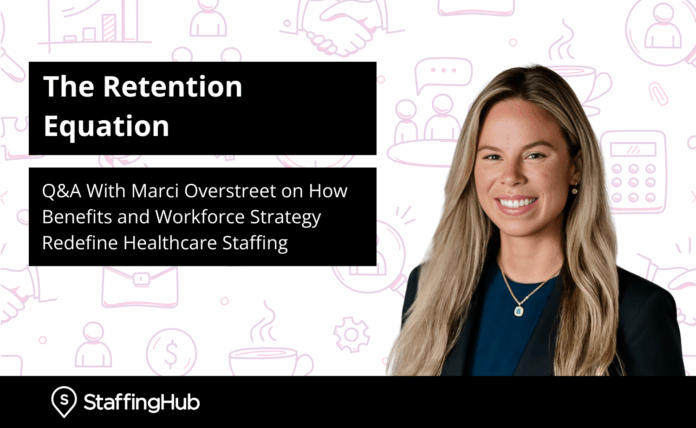
Marci Overstreet, who oversees Strategic Partnerships at Benefits in a Card, works with staffing firms that are tired of seeing talent bounce between agencies and want benefits that actually match the realities of contract work: day-one coverage, weekly eligibility, flexible options, real humans answering the phone, and secure integrations with the systems they already use. Her perspective is simple but sharp: if you’re still treating benefits purely as a cost, you’re missing one of the few genuine differentiators left in a highly competitive market.
In this conversation from Healthcare Staffing Summit, Marci talks about why “health insurance that works” is one of the strongest loyalty drivers she sees, how smarter communication and modular plans are meeting clinicians where they are, why security and integrations matter just as much as plan design, and what it will take for healthcare staffing firms to evolve from job-fillers to true career partners.
Q. From your seat working with agencies nationwide, what feels fundamentally different about how firms are approaching talent and retention today?
Marci Overstreet: You know, I think a lot of us lose sight of the fact that, yes, it is about margins and hitting goals and who’s fastest to get the deal. But I’m seeing a shift in the environment.
At dinner the other night at another conference, an executive stood up and said, “They run you through the sales process, but it’s never what they promised.” And it hit like a headline in my head. We get so focused on the margins, and what it really comes back to is trust in the industry.
Why does someone return to the same staffing firm? Because they’ve used them previously and they trust that firm. That’s something that has always been traditional about this industry, and I think it needs to become a modern advantage that we leverage a lot more.
Q. Staffing firms are being asked to do more with less — faster fills, tighter margins, higher expectations. What pain points are you hearing most often from leaders trying to keep healthcare professionals engaged?
MO: I think it’s mostly: what do we offer outside of a job for that person? And what that comes down to is benefits.
What kind of benefits? Health insurance. Benefits that give that worker flexibility. I think that’s the extra advantage most leaders are focused on, but they still tend to look at it as more of a cost. To me, it shouldn’t be a cost. It should be part of the growth strategy, because that’s ultimately what’s going to keep someone with the staffing firm: benefits outside of what they already get and expect to get, which is the job.
Q. What used to work that just doesn’t anymore?
MO: The traditional health insurance plans — what we all think of as, “I have a card, I go to the doctor, my services are covered to some extent.” I think that expectation is still there, but the reality has changed.
Now, benefits outside of that typical model are huge — things like, “Can I be met by a doctor today?” Virtual urgent care, for example. Those kinds of benefits really increase the value to the worker, because they actually fit how people live and work right now.
Q. As healthcare professionals gain more flexibility and choice, what actually builds loyalty now? Beyond pay, what makes someone want to stay with one firm versus another?
MO: Health insurance that works. I’ve seen that nine times out of ten.
It’s the firms that put together plans that are specific to the worker they hire. They’re not only thinking about themselves as a staffing firm offering the benefit; they’re thinking about the worker who’s going to be using it. Again, they’re not looking at it as a cost, but as part of their growth strategy to keep and retain their current talent.
Q. Many firms still view benefits as a cost or compliance issue. Why do you think benefits belong at the center of a firm’s retention and recruiting strategy?
MO: I always come back to a simple question: why do we do what we do? There are benefits to what I do because I like it and because I feel like I’m valued. I think that’s the core, center mentality behind health insurance and benefits — it’s one of the top values for the person who comes to a staffing firm, and that’s ultimately what’s going to retain them.
Q. How do you connect benefits decisions to measurable outcomes like redeployment or reduced churn?
MO: A lot of workers have doctors’ visits lined up well into the future, so they have to have health insurance. A firm with no health insurance versus a firm with health insurance — that’s going to be the ultimate differentiator. And then you see other firms building out things like 401(k)s and PTO — benefits that actually work. It all comes back to that for me.
Q. Healthcare professionals expect more transparency, choice, and wellbeing support. How are agencies rethinking their benefits offerings — or the way they communicate them — to meet those expectations?
MO: We recently had a client where we were trying to convey that the better your employees understand what they’re getting enrolled in, the more enrollments you’re going to have. Not for the sake of cost or money, but because the more educated they are about what they’re being offered, the better the fit.
At Benefits in a Card, our CEO, Carl Stecker, has strategically built out benefits that are available on a weekly basis to the employee and are deducted directly from their paycheck. If I work one week, I have active benefits. If I go off assignment, I can continue to have active benefits for four weeks out.
That kind of coverage — where you have a doctor’s visit two weeks down the line and your benefits are still active even if you’re between assignments — is not something you see in typical benefits. That’s where the flexibility piece comes into play: these benefits are working with me as I’m working, and they stay with me as life moves.
Q. Culture and communication have become major retention drivers. How can staffing leaders use benefits and related programs to reinforce trust, belonging, and long-term loyalty?
MO: We all want things immediately, and that’s built into our plans — day-one coverage, for example, is something Carl built in specifically because these plans are designed for the staffing industry, to work with people as they’re working.
An offering like freerx.com, which Carl created, is a great example. It’s for people who might only want virtual urgent care appointments with a board certified physician. With freerx.com, I can get on immediately with a board-certified physician, on my schedule. I can walk through my common condition symptoms and then be prescribed a medication right away, go pick it up at my local pharmacy, and be on my way.
That’s what “meeting me where I’m at” looks like.
Q. Any examples of firms getting this right in a meaningful way?
MO: ATC Healthcare comes to mind. Gina Spencer there is wonderful. They offer freerx.com, and they have a lot of nurses on staff. Those nurses already know the healthcare system inside and out. They’re not looking for benefits that get them in front of a doctor — they’ve probably already seen a doctor during their day at work. What they need is access to medications when they need them.
freerx.com has extremely high enrollment across that client because of how it’s communicated and because it gives those nurses exactly what they need.
On communication, we keep it simple and direct. The brand is the URL — freerx.com. We communicate that through enrollment materials. During open enrollment, we also send texts right when someone starts an assignment: “Welcome to ATC Healthcare. We’re so happy you’re here. Call this number today or click this link to begin enrolling in your health insurance.”
That kind of immediate, human communication — plus the fact that our call center reps are on-site at Benefits in a Card, not outsourced to somewhere you can’t reach — reduces friction and builds trust. It shouldn’t be hard to get a human on the phone about your benefits. Keeping it simple and human is still incredibly powerful.
Q. For firms ready to modernize how they deliver benefits, what’s the smartest first step — and what’s one pitfall to avoid?
MO: The smartest first step is getting educated on what you actually offer your employees.
A lot of staffing firm leaders don’t even know who their provider is — and that’s not something to be ashamed of, it’s just the reality. Start with: what’s being offered to your staff? Who is the carrier? How are staff paying for those benefits? Are they actually seeing value?
We all want to increase retention, but do we really know if there’s even value in the plans being offered? That’s step one.
The biggest pitfall is focusing only on cost. Just because it’s the cheapest — or it saves you money as a staffing firm leader — doesn’t mean it’s the best. Sometimes when there’s no cost to the employer at all, that can actually be a red flag. People expect some level of investment when something truly has value.
The firms that execute well are the ones where you can tell, even on an initial discovery call, that they’re genuinely focused on the people they’re hiring. They talk about benefits differently. It’s not about how many workers they have on contract; it’s about knowing the skill sets they hire for, the categories of workers, and what kinds of benefits those workers actually need. That mindset stands out immediately.
Q. How are integrations with staffing or payroll systems improving both operational efficiency and the healthcare professional’s experience?
MO: Integrations come up probably nine times out of ten in my conversations. One of Carl’s big initiatives this year was: we’re going to get integrated with as many partners as possible. We now have over 200 integrated partners.
The way this simplifies things is huge. The prior week’s payroll file for all those contractors on staff comes over through an API integration. I like to think of it as a water hose — it’s just one connected hose. It’s not broken up into separate systems where we’re uploading here, downloading there. It’s automatically done, so we know who’s on and off assignment based on that payroll file. That has been a huge shift in how we use technology and integrations.
Q. Any trends in automation or real-time data that stand out?
MO: AI comes up in almost every conversation. But my question is: do we know what we have in place for security to reduce threats and make sure we’re doing things securely?
If we’re still manually downloading and uploading payroll files, or sending them as email attachments, that’s not secure. That’s why we built the Benefit Sync API — because we can’t be sending these files back and forth via email when they contain so much employee data.
So before anything else with AI, I think security has to come first. What governance do we have in place? Are employees educated about how data should be handled every single time? We’ve all seen headlines where big health insurance firms have incidents. A lot of it comes down to someone acting as if they’re part of the organization and getting in because safeguards and education weren’t where they needed to be.
Q. As personalization becomes standard in other industries, how do you see flexible or modular benefits shaping the future of healthcare staffing?
MO: I always go back to my own experience in staffing — first as a recruiter, and later as a worker on a six-month contract through a staffing firm. And in both roles, I remember wanting one thing desperately: options.
Options in health insurance that let me choose only what I actually needed, at a price I could afford. At that point in my life, my priority was simply getting the hours so I could get paid. I didn’t need — or have the budget for — a fully built-out insurance plan. What I did want was the ability to enroll in just dental, or another single benefit that fit my situation. But that choice didn’t exist.
Instead, I was offered a plan with a very short enrollment window and one requirement: take everything at a high price or decline everything entirely. When I saw how much would come out of my paycheck for benefits I didn’t need, I declined the whole package — and so do a lot of workers today.
For me, that experience brings the conversation full circle: flexibility is the future. Giving workers the freedom to choose only what they want — and only what fits their budget — isn’t just a “nice to have.” It’s the key to increasing participation, raising the standard of personalization and flexibility of health benefits that shape the future of healthcare staffing.
Q. What innovation excites you most in that space?
MO: It’s freedom. I think we all love freedom. With modular benefits, workers can be offered 28 different plans, and if I only want one of those, I can select just that one. I have the liberty and freedom to choose one or none. That’s liberating for the worker.
Q. Fast-forward five years — how do you see the role of the healthcare staffing firm evolving as benefits, technology, and workforce expectations converge?
MO: Going back to the core again: we’re all human, and what we really want is connection and relationship.
Am I being checked in on by that staffing firm, or am I just a number? We used to call it “recontacting,” but it’s really just touching base with that person each week.
For example, if they’re not enrolled in benefits, someone from our team reaches out directly and lets them know they’re within the last ten days of their open enrollment period. Little touchpoints like that — reminders, check-ins — bring back the human connection and keep it human. That’s a big part of how I see things converging.
I also think staffing firms have a real advantage in becoming true career advisors. What we do is exciting, not just because we’re placing people in jobs — which is huge — but because we’re giving people opportunities to grow and expand their skill sets.
Contracts might be shorter in duration and we’re focused on redeployment, but those contracts give someone a ton of experience in a short time: a new environment, new coworkers, new personalities. You gain so much in six months that might have taken three years otherwise.
High-performing firms will be the ones that recognize that human aspect and lean into it — using technology and benefits to support relationships, not replace them. It’s all about relationships.
Q. What’s one decision a healthcare staffing CEO should make right now to future-proof their business?
MO: They should think about their benefits. Really think about their benefits and what’s actually being offered. Who is the provider? Who is the carrier that underwrites those plans? Who are you actually working with? Who is the vendor?
After you’ve asked yourself those questions, then you go into: does this actually provide value for my workers? Because if the answer is yes or no, that’s where the next decision comes from — what you need to do to put something better in place.