

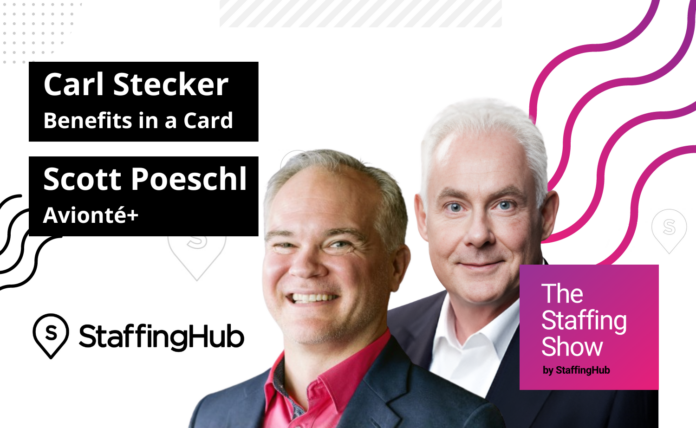
In an industry where margins are razor-thin and the average data breach costs over $10 million, staffing leaders are moving beyond “good enough” solutions to transform benefits and data security from mandatory requirements into a powerful strategic advantage. Today on The Staffing Show, David Folwell is joined by Carl Stecker, Founder and President of Benefits in a Card, and Scott Poeschl, Senior Vice President of Avionté+, to examine how staffing firms can rethink employee benefits as a strategic lever rather than a fixed expense. They discuss the risks of manual data transfers and why real-time API integration is crucial for protecting sensitive employee information. They explain how good data hygiene supports the use of AI tools while improving security and compliance. The conversation also covers why participation rates matter for staffing owners, the difference between bundled and unbundled benefit plans, and how firms that leverage benefits strategically differ from those that do not. Finally, they share practical steps firms can take to optimize benefits, reduce risk, and improve overall outcomes.
[0:00:55] DF: Hello, everyone. Thank you for joining us for another episode of The Staffing Show. Today I am super excited to be joined by Carl Stecker, who’s the Founder and President of Benefits in a Card, and Scott Poeschl, who’s the senior vice president of Avionté+. Thank you, guys, so much for being here with us today. Very excited to jump into a couple of different topics that are top of mind for a lot of the customers in the market today. We’re going to be talking about risk. We’re going to be talking about missed opportunity, and some of those key elements that tie back to the security and the data that is tied into your ATS.
To kick things off, Carl and Scott, I’d love it if you guys could just go ahead and give a little bit of background on who you are and a little bit about who you’re with as well. Carl, why don’t you go ahead and kick it off?
[0:01:40] CS: Hi, I’m Carl Stecker. I’m the Founder and CEO of Benefits in a Card. And my real position is I run the help desk at the company.
[0:01:49] DF: I was going to chat to you right now.
[0:01:51] CS: Yeah. There you go. I’ll be on the other end. We specialize in ensuring the staffing industry, and that’s truly our focus.
[0:01:59] DF: Awesome.
[0:02:00] SP: How about you, Scott?
[0:02:01] SP: Yep. Scott Poeschl, Senior Vice President of Avionté+. Avionté+ is everything beyond the Avionté core platform. So people think about us as integrations, partners, use of the API. I’ve been in the HR tech industry for 20 years. I’ve been with Avionté for over six years. I have the best role of my life right now. While working for Avionté+ is great, it’s my role as a husband and father of four little ones who are 8, 10, 12, and 14 that, at this time of the year, are helping me with my sweet hobby of making maple syrup.
[0:02:29] DF: I love it. I love it. Well, thank you guys both for being on today. To kind of set the stage, I wanted to share a couple of data points that I think are interesting. One, the average US data breach now costs over $10 million, and fewer than 10% of temp workers actually enroll in employer-sponsored health benefits. One number is about risk, the other is about some of the missed opportunity in terms of delivering benefits to your employees.
Today, we’re going to be talking about how some of the winning staffing firms are solving both. To start things off, we’re going to be talking about the data layer. And Scott, I know you see workforce data across well over thousands of staffing firms. And what’s something that owners are completely blind to within their own data?
[0:03:17] SP: Yeah, there’s two things that I’d say that owners might not see because they’re not just in the day-to-day trenches. One is the data hygiene that they have within the platform, that they have a lot of mismatched data, data is not completely updated. And definitely with the introduction of AI, that has become an item because lots of AI bots can actually get in there and clean it up. But AI agents can actually work on that data if the hygiene isn’t done, right?
My answer is up to today, maybe in the next six months, owners are now going to see that because they’re going to try to deploy more and more AI agents and realize that the hygiene of the data is just not there. That actually then leads to where is my data? Because if you’re taking your data to other systems or trying to get data in from other systems, you’re going to have data mismatches, which leads to the data hygiene. Because you may have the first name, last name, email address, maybe postal address on the talent in your system, but then the other system has jobs and skills and other items on it that didn’t get brought into your ATS. So now your hygiene isn’t there. Or they updated on your other system, but they didn’t update it here. Knowing where their data is and how it transfers is another part of that.
I have another partner who talks about talent data that their recruiters are finding outside of Avionté. And 80% of what they’re finding outside of Avionté is not making it into Avionté. So the owners are paying for records, they’re paying for updates, they’re paying for data that never makes it into the system of record. And so you’d be surprised by where your data actually lives and how much of it is not making it either updating or just making it in the first place in Avionté.
[0:04:43] DF: It’s critical especially in the age of AI. And we talked about data cleanliness mattered with automations when you’re telling somebody happy birthday and you got the wrong day. But now you got AI operating off of your data layer intelligently and eventually without oversight. I think the security of it and also the cleanliness of it is paramount these days.
One of the other things that I think we see in the market frequently is that everybody talks about how they’re integrated with different platforms. Avionté and Avionté+ program, you guys are rigorous might be the right word. You guys care about who gets into the marketplace. And I’m very curious about what does a real integration look like versus the duct taped approach to integrating with an ATS?
[0:05:26] SP: Yeah. My whole title, Avionté+, what is that? How are you a senior vice president of that? It’s because it’s a program like you were saying, David, is everything beyond the core platform. Because for our whole history, we’ve wanted staffing firms to be able to work with other technologies. And so you’ll hear from a technology, “Do you work with Avionté+?” And the answer is yes, because we want to work with everybody. We want staffing firms to have what they want.
The question you should be asking is do you have an integration? And a couple years back, I trademarked a couple of logos that say Avionté+ Certified. And when you’re shopping for technology, you should look at that, because then you know that it’s hooked up via API. And they’ve gone through the steps of writing down how the integration actually works, what data elements actually transfer, which direction do they transfer. We ask about a security program.
When you’re talking about rigor, yeah, structure is the way I’d probably say it. Because as a staffing firm, I want you to have the technology that you need to run your staffing firms. You can have that secret sauce that makes you a little bit different. You can run just a little bit differently, but you will know how it works. I don’t want you to hope that it works this way and hope that it works that way only to not have documentation, not to have that badge that says Avionté+ Certified. When you’re looking at it, you should look for the Avionté+ Certified to know that that’s a documented, scalable integration.
[0:06:41] DF: Yeah. And you guys are – as I said, the rigor that you guys put into that, it means something, and it’s because you care about people not accidentally having their data go to the wrong place. What are some of the hidden costs of the “good enough” integrations?
[0:06:53] SP: You’re wasting a lot of money when you have it at just good enough, and you’re having people doing context switching. So, you’d be surprised – if a recruiter has to not be able to have data transfer between the two systems, how likely are they going to use the other system, or how likely is it going to be abandoned in one system or the other? So, you’re going to be paying for data that you’re not able to utilize. You’re going to repay for that same data the next week or the next month.
I’m not going to go as far as the boogeyman of data is now floating around where somebody can intercept it because you don’t know where it is and it’s not integrated, but that’s a cost of doing business is I know of that happening in our industry. And if you secure it, you’re not going to have to worry about that large cost.
[0:07:35] DF: Yeah, absolutely. And there’s a lot of agencies that are still moving payroll and benefits data via FLAT files, email, FTP. I know we kind of touched on a little bit on the last conversation or that last question as well, but what are they actually risking when they do this?
[0:07:54] SP: Yeah. From an Avionté perspective, we want customers to move away from using FLAT files or Excel files. A lot of people might know it. In any way you can do that, if you can move away from it, you want to move away. That’s why we have the Avionté+ program with the ability to do a certified integration. And if you go to avionte.com/integrations, any third party can apply to utilize the API there because we can get you away from moving that file back and forth. That could save you time.
But when you start moving a file back and forth, just walking through a couple of those, one, it’s on somebody’s local machine. Some recruiter’s local machine, some office person’s local machine that’s probably not secured, probably not encrypted. That laptop, if it makes it out your office, in somebody’s back seat, it’s taken. So you can start to go down that road just on the local machine.
The next one is if they’re sending it via email, that’s what you mentioned, emails aren’t encrypted. So, people think automation is great because you can send it via email, then the other system can sweep and pick it up. If we’re talking 10, 15 years ago, FTP file drops were awesome. They were the cat’s meow. It was what we did as an industry, and it worked great.
And then we moved to SFTP, which is a Secure File Transfer Protocol, which was awesome because then you had the client key and client secret, and you could decrypt the file once it reached there, but you didn’t have it encrypted in transit and at rest. I’m just running through generations of 15 years of how we start security things. So now that’s where you want to be using the API because it moves away from those files being intercepted in transit, those files being intercepted at rest. And you know that they’re only getting the data they want because you can start to be more surgical with an API. Versus when you’re moving a file is usually a huge data dump that you’re doing.
And do you need to be moving all that data? Does the person who is doing the file download upload? Does that user need to actually be exposed to all that data? Does your firm need to be exposing yourself to all that data being removed and moved around? That’s a data security piece.
But if I didn’t come back to data integrity at this moment. When I started here, there was an integration that was file download, file upload that I automated, right? Again, putting it in the API. And it increased the results that customers were getting. So this was cash in their pocket on average of 15%. And it was because people were forgetting to move the file on a regular basis. And time matters.
When we were moving that file on a weekly basis or moving the data on a weekly basis for the customers, it actually increased the money in their pocket. And that was the same partner, same staffing firms, same activity. Just taking the human element out of it, you increased your effectiveness.
[0:10:25] DF: Yeah, that’s incredible. And when it comes to the back office, one of the things that Avionté has been long and well known as one of the leaders in that space for a very long time. It’s kind of the area that you guys pop up as like a specialty. For the owners who are listening and are looking at their tech stack, thinking about, “We’re fine. Our integrations are fine. Our tech stack is where it needs to be,” what are some questions that they could be asking themselves tonight to kind of help them audit their stack and make sure they’re doing things correctly?
[0:10:57] CS: Scott brought up a really good point when we were chatting earlier before we got on, and that is when an executive is thinking about their firm and how to make sure that their firm’s secure, the first place you need to go, because no matter what you’re doing internally, it doesn’t matter if your vendors aren’t handling your data correctly. The first place you need to check is what are my internal operations? What do they look like? How secure are we here in-house? And then you need to audit all your vendors. And that could be just a simple form that you put together asking, “Are you transferring our data in an API format?” If your platform’s Avionté, are you Avionté certified? Avionté+ certified?” Those kind of questions. Because is your company integrated with my platform? That’s not the right question.
I got to share this with you. I ignored integrations for 15 years. One of the first phone calls I made was Scott, and I said, “Hey, we’d really like to integrate with you guys, but I got to do it in an API format.” And he said, “I’m so glad to hear you say that.” And we started a conversation. This is when I learned that all these integrations with not just Avionté, but all of them. TempWorks, Greenshades, all the players, Acor. You name it, they were all flat files. Until we started this API initiative, and it freaked me out. I couldn’t believe how insecure it was.
[0:12:22] DF: That’s great.
[0:12:24] CS: Thank you, Scott.
[0:12:24] SP: No problem. Talking about what Carl’s saying. And I’ll give you my background. Prior to this, I’m working with Fortune 100, Fortune 10 organizations, and I was not allowed to do a discovery call, not allowed to see does my solution actually fit without first passing a few questions about security. Do I have a security program? My SOC 2 Type II. Just a couple of service-level questions.
What I would say to owners that are listening is that’d be the first thing I do is ask for the security program from all of your vendors. That’d be the first level. Because about 30% of what comes actually to me – they go to avionte.com/integrations, and they go to the bottom, they fill out that form. About a third of the people that fill out that form don’t have a security program. When I ask them, “Can you provide me your security documentation, security program?” And that simple things like who is your security officer, where’s your data backed up at? What’s your failover rate? What is your position if you were to have an incident? What’s your response time? What’s your notification of third parties? All of these little questions that would happen, they don’t have a disaster recovery, they don’t have a security program. I would start there. With that being question number two to any vendor. One is do you fit my need? And then two is do you have a security program? If so, please provide them.
[0:13:36] DF: Carl, Scott just laid out the security risk. I know you built BenefitSync specifically to eliminate this risk. What happens to a firm when they turn off those flat files and shift to an integrated approach?
[0:13:52] CS: Well, their security goes way up by about 95% to 98% when they move to an API. And the other thing that goes way down is your team’s workload. They’re not loading those files. All of that is happening behind the scenes. Avionté’s systems are communicating directly with our systems. And it just takes – one is the speed. It speeds up profitability. It speeds up the transaction. It brings down the cost of the transaction and brings down the workload for your team.
I don’t want to take too much time here, but a couple additional things that we did with BenefitSync API is when we connected with – we started working on the integration with Avionté+. They were our first API integration. Then we started on many more after that. But as we got through this, we were kind of running down this integration trail with blinders on, if you will. And one night, I just kind of stopped, and I’m like, “What about our clients that have internal payroll? What about them?”
And so then we built an app, an application where they can drop and drag their payroll. It converts it to API, sends it back to us, and then we then put their deduction feed in, sends it back to them API. So it creates a totally secure transaction that the client can use. Any client can use those tools as well. We’ve got that API integration whether you’re with an integrated provider. I wanted to make sure that we protected all of our clients.
And then the second thing that we started to think about and kick around, and we did, is we wanted to put in a security module for our clients to help them train their people. And so we partnered with NINJIO, which is one of the biggest cybersecurity training companies in the country. We partnered with them. We put them on our platform. And now our clients can download the training. They can send it out to their staff. They see who clicked on the phishing training, ransomware, what have you. But basically, what we’ve done is we’ve created a portal where the clients can train their staff, and there’s no charge for it. This is all covered by Benefits in a Card for our clients so they can train their people.
The third thing that we did, this happened in a conversation I was having with the CEO of The Hartford. They’re the largest carrier of cybersecurity policies. And I said, “Well, what if we prove out that we’re API transferring this payroll data?” And he said, “Well, Carl, you could certify that these companies are transferring their data through API, and they can actually get up to a 20% discount on their cybersecurity policy.” That’s really kind of the pillars behind BenefitSync and what we bring to the client at no additional cost that helps them secure their company, helps them leverage up their assets, cut their costs, and deliver more value, and train their people.
[0:16:50] DF: That’s really great. Also, I mean, you think about it as security side, but that there can be some huge savings. One of the other areas that I think is interesting when you start thinking about the talent side of it, the average temp assignment lasts about 9 to 10 weeks. Most traditional benefits have a 30-day waiting period. I think you guys have designed this quite a bit differently to kind of match the needs of the market. Could you tell me how you designed the system and designed it in a way that isn’t just simply another benefits program?
[0:17:21] CS: Sure. We were built by the staffing industry. That’s really who founded us, who sat down at the table and said, “We need you to figure this out.” So, one of the biggest concerns, this was back in ’99, 2000, was what companies were able to avail themselves of was your major medical type plans that had the 90-day weight.
Really, the first thing out of the gate that I got the demand from these executives was we need a day. We need day one coverage. We need something that’s effective right away. And so when we designed these plans in our platform, we designed them for if a deduction’s taken on a Friday, their coverage is effective the following Monday. It’s immediate. And FreeRX is effective immediately. They get their card as soon as that thing’s paid at 2 minutes, it flies through. But it’s data transmission to the carriers and all that we can’t quite be there just right then. I mean, it’s two days, right? That’s a lot better than 90.
[0:18:22] DF: That’s great. And Scott, I know you’re not a benefits provider, but what have you seen in terms of trends in the market? What actually matters when it comes to benefits in the industry specifically for staffing?
[0:18:33] SP: Yeah. When you’re looking at benefits, unfortunately, the ACA kind of took away the ability for us to compete by saying we’re offering benefits, and this is what you should work for me. It kind of made everybody do it. So, now how do you become unique with something that everybody has to be putting out there?
What I’m finding that staffing firms that are competing well and being able to showcase their benefits is something that’s geared toward staffing. Carl just laid out a few things like the FreeRX program that they have. And he’ll talk about the way that you can actually show it on the page when they go to make the choices of what they can elect for that actually the display of it matters.
When you’re working with a partner who can offer a benefit that they’ll actually take when they can see that how it actually benefits them. We could talk about redeployment rate or actually take rate of people who are actually taking it is actually higher when you’re doing that. And it’s a cost that you must bear anyways because the government is telling you you must bear that.
With the changes in ACA recently, that also creates a whole another market of like who’s going to be actually taking this. And why are they taking it? What are they looking at? To break it down to just one simple sentence is it has to be a benefit that the staffing talent would see as a benefit to them such that they would work for you. Not just that you’re offering the minimal essential care.
[0:19:44] DF: Yeah, that’s great. It’s an important choice for people when they’re going to work. For a lot of people, they’re looking at what type of benefits come along with this. Or some of my friends loosely call them the bennies. Whenever you’re joining the company, the bennies that come along with it.
Carl, one of your focuses has been on participation rate, not enrollment rate. Why is that metric something that staffing owners should actually think about?
[0:20:05] CS: It’s a true driver of profitability. Benefits, I hear it tossed around out there, but done right, benefits are a driver of not only your firm’s reputation, the quality of benefits you provide and how your provider provides them, but it’s also the right plans that meet people where they are, as we discussed a bit ago. It’s critical.
But people that come on benefits, all the work that we’ve done with our data internally and the payroll of the people, we get it all, we have all the payroll. So we can see how long people are staying on assignment, how long they’re not. And all of our studies show that people on benefits stay typically four to five weeks longer. That’s a big profitability driver when you start looking at that.
And these integrations and being API integrated, you’re catching everybody that’s coming through the door. So, you need to be looking at, “Am I getting a participation rate of at least 20%?” I think that’s a really fair benchmark. And if you’re not, you need to start looking around. Or talk to your provider even. What’s going on? What can we make better? Right? Because something’s not performing correctly.
[0:21:11] DF: Well, that’s great. That’s an amazing participation rate. And then, also, you brought up the time on contract. And that’s something that I’ve talked about non-stop. A lifetime value. And I think that looking at how long somebody’s staying on contract and then what are the things that tie back to driving a longer-term contract are so critical right now in our industry. When you’re looking at lower order volume, you’re looking at like how do I increase profitability, it’s like, “What are the things that I can do that are within my control to drive longer, higher quality contracts?”
And if you’re seeing higher time on contract tied to benefit adoption, it should be something that you’re actually really trying to push and making sure that everybody is on that knowing that there’s a stickiness factor to it. That’s really great data.
[0:21:58] CS: Absolutely.
[0:21:59] DF: When it comes to the options that you provide, there’s a lot that kind of think let’s give everybody every option. You’ve argued that sometimes a large benefit menu can actually reduce participation for hourly workers. Tell me why.
[0:22:14] CS: Yeah, we started about three years ago in this AI – call it the wild wild west of AI. We started to work on a call center platform that would be more interactive and analytical in the benefits process enrolling people. Not that we’re never going to get rid of our bilingual call center. We were trying to look for how do we handle the mundane calls. They’re not mundane, they’re needs. But I need an ID card. Voom. We want to be able to fly that right to their phone. It’s things like that that are real simple, but they’re real convenience orientated. So, we want to make sure they’re getting that right away. So, that’s what we were looking at this system for.
But in going through it and going through how we actually propose benefits. And because of working with the different carriers, and then you got the insurance companies, they’ve got all their compliance language. Our brochures are literally 22 pages. And what I noticed is they started off with the mech plans. We used AI to go in and start looking at all this, and then we’re comparing it with our data. What do people need in the age brackets? Whether a male, female, what have you. What are they buying? What do they need? What are they migrating toward? And what we noticed is that there was a big uptick on – not an uptick, but participation in our mech plans was really, really high.
Well, in that 22-page brochure, that mech plan was the first thing that was up there, right? The mech plan was the first thing that they could elect. And even though our margins are higher on those mech plans, I disagree that the mech plan is the right benefit for the temporary staffing worker. I think that our HI products that are first-dollar coverage, when they show up at the doctor, are really what they need, and that’s what our data shows us.
We pushed the mech plans all the way to the bottom of the offering and started offering that this is what they need more, or FreeRX, or primary virtual care, or those things. We’re really helping people to get just what they need and what they want. We don’t want to oversell them. Because when somebody’s happy with their purchase, and they’ve got the benefits that they need and the coverage they need, they’re happy, they’re comfortable, they know they’re insured. It’s a good feeling. We don’t want to oversell them. Anyhow, we’ll talk about the bundled/unbundled. And that’s when you get into that whole thing, right?
[0:24:38] DF: Yeah. It kind of reminds you of the paradox of choice, right? It’s like if you go over – and I think there’s a couple different psychological elements to this. But the idea of it’s like over three options. And all of a sudden, you start to see the actual decision making go down because people are just kind of stalled.
But I think there’s actually more here beyond just that because it sounds like – I think you’ve talked about the difference between bundled and unbundled, and some of the data on their partners. And what type of coverage they currently have? Maybe you could explain a little more on that.
[0:25:10] CS: Yeah. We noticed this beginning of last year when we started to get a lot of proposals come through. We had a real large vendor in the space that went out of business. And we’d never really analyzed their plans. But when all these requests for proposal – and we were trying to match pricing. And we were trying to figure out the best way to roll all these people over. And everything had to be done in a hurry. It was an interesting time.
But the one thing that we noticed is that the way the majority of these plans are set up in the marketplace. And I want to preface this with 40%. And I’m going to use the number 40% of the people that come through your door. It’s a conservative number. It’s more like 50. But 40% of the people that come through your door are going to be on spousal coverage or household coverage. They already have medical care through their husband, their wife, their mom or their dad. And so they don’t need medical coverage.
And they come through the staffing office, and they’re applying for a job, and they see all these benefits, and they say, “Oh, wow. I can get medications for my entire family, virtual urgent care, 70,000+ pharmacies that I can go to pick up my meds all for $6.99 a week through FreeRX.” But they can’t buy that FreeRX product in that competitor’s model. They can’t buy the FreeRX product unless they buy a medical benefit. Either the mech plan or the hospital indemnity plan.
So now that $6.99 benefit for their whole family that would have been incredibly affordable and very sticky for the client, they now have to pay $30 or $35 for because they’ve got to pick up a medical plan as well. And so that prices the product out of the market. The value proposition is lost, and that person leaves with not getting what they wanted.
What we did in our own data was we got really curious, and we’ve done this a couple times now in the last year, is running our data and looking at the people that just elect one product. Okay? How many people just elect one product? And it’s about 10%. That 10% is 25% of your 40%. You see where I’m going? It’s a massive impact. If it’s 10%, that’s capturing 10% out of the 40 that don’t need medical. They’re buying life, or they’re buying dental, or they’re buying vision, or they’re buying another product.
The other thing with this kind of plan design – and it proliferates the staffing marketplace. The other thing about this model, the bundled model is that let’s say you want health insurance for you and you’re – I’m a single mom. I want health insurance for me and my two-year-old. I check the box, employee plus one. Well, guess what? My toddler doesn’t need glasses, but I do. So, my two-year-old doesn’t need glasses. I need glasses. I now can’t just check vision for me. I have to buy vision for the toddler, too.
It continuously drives up costs and drives people away from the plan design. When people come into my clients, I want them to look at the benefits. Even if they don’t want anything, I want them to say, “Wow, that’s a good offer.” I really do. I want them to say, “Wow, this company cares.” That’s what we’re here for.
[0:28:30] DF: That’s great. That’s great. I mean, I think that’s one of the – and I know everybody’s required to offer benefits, but I think that the type of benefits you offer, the way that they’re offered, and the approach to it. I’m curious to know, when a recruiter is saying you get $0 prescription and virtual care on day one, do you think that’s changing the conversation and potentially helping to drive placements?
[0:28:52] CS: Absolutely. And we’ve got the virtual primary care offering where a lot of these younger folks – if you’re in staffing, I think our average age is like 32 to 38. A lot of people coming into the workforce, they don’t have a doctor, right? So, being able to pick up the phone and get somebody to call in a medication for you. Maybe you moved away from your parents house and now you’re in another state, don’t have a doc. All of those things. It’s about meeting people right where they are.
[0:29:17] DF: I don’t know if I should admit this on here, but I’m 43 and just decided that I should get out of virtual care and get a real doctor. It’s easy. It’s just like, “Oh, virtual care works, you know.”
[0:29:29] SP: Hey, David, we’re men, and we can use that as an excuse.
[0:29:34] DF: Have you seen any connection to – I don’t know if you have data on this yet or not, but I think this would be something to dig into or just even think about is placement rates versus the offering that – I think about this staffing, you’re offering a job to somebody. You’re offering a product to them. What is the benefits that come along with that product? How are you offering it? What’s the packaging of it? I don’t know if you have data behind it, but I would be curious to know how placement rates change when you have the different types of offerings put in place. I would imagine that there’s some sort of impact on that, especially when you’re saying $0 prescriptions, virtual care, day one. Scott, from Avionté’s side, can you see any retention or redeployment differences between firms and anything that you’re seeing when it comes to implementing and integrating, using benefits versus not?
[0:30:23] SP: This is a couple years in the making. It’s in just north of 40%, seeing that they’re doing a redeployment of those that are taking the benefits. If you start to think about that, government mandates, you have to do this, right? So you’re going to be spending the money anyways. It will then decrease your cost because you’re offering the right thing. Carl’s talked about the way it’s displayed on the screen even matters. You’re offering the right benefit to them where they come back to work for you again. And that is then saving you on your talent acquisition cost because you don’t have to go find 40% more talent. Because we always hear, “I need more applications, more applications.”
Well, use what you’re already told you have to do. Display in the right way. Carl walked through how the data integrity matters because we put it right on the screen next to the I-9, W-4. Then they enroll benefits. They see it displayed the way Carl was just talking about. It automatically enters into the back office for deduction updates. So now your firm realizes synergies of automation, synergies of less work they have to do, data integrity, and the talent then redeploy. There’s a whole lot in this story that talks about just north of 40% redeployment rate is good in lots of different aspects.
[0:31:30] DF: Yeah, that’s amazing. It’s always interesting when you look at these things and you can zoom out a little bit and go, “Is this a cost center? Or is this actually driving ROI?” And I think sometimes you have to actually look at it through a little bit more of a strategic lens. One of the things, counterintuitive things, we hear sometimes of people like, “Oh, I don’t want to pay $100 referral bonus.” And it’s like, “Well, have you looked at what happens when you do?” When you actually do pay that, it means that you’re getting like an extra 40% of hours. So it’s a similar concept here, where it’s like this is a good thing. This is going to actually drive retention and reduce the actual overall talent acquisition cost, which is great.
[0:32:07] SP: I love what you’re saying there, David, is this was a cost center. People are looking at it as a cost center. How can I turn cost centers into profit drivers or recouping my cost drivers? This is my industry for the last 20 years. The government only makes it harder and harder for us to run our jobs. If we can do what we’re told we have to do and turn around to make it more beneficial for us, that’s great.
[0:32:28] DF: Yeah. And you can. That’s the cool part. When it comes to implementation, Scott, on your side, how long until a worker actually gets benefits from a program? You’re getting the program set up, integrated, and live. What does that look like from your perspective?
[0:32:45] SP: Yes. So the Benefits in a Card integration is a scalable commercialized integration. So you’re setting up in a couple of days. The long pole in the tent of that is actually setting up the deductions, which you’d have to do regardless of it being integrated or not.
For me, the answer is real quick. Hours to a couple of days. But I have the easy side of it. This is the same integration. Just turn it on and literally toggling the button on. Easy for me. But I’ll let Carl talk about his side.
[0:33:11] CS: Yeah, I’m trying to get our team where Scott’s is. But I’ve got a few other. I’ve got the carriers. And so for our team, proposal comes in, request comes in, RFP’s turned around, we’ve got to get the numbers back and all that. So, it’s probably about 30 days. But as Scott mentioned, Avionté is a commercial integration, and they’re ready to just flip on. We just got to get the right data loaded in their system to make sure we avoid any client issues, and we’ll be good.
[0:33:39] DF: Awesome. Awesome. And to kind of close things out, I want to make sure that we leave owners with one thing that’s concrete that they can walk away with. Carl, what’s one step a staffing firm can take this week on benefits?
[0:33:51] CS: We just had an email go out to the industry, and one of the things attached to that, it talks about the bundled/unbundled plans. But we have an AI form in the back that’ll actually help you, ask you some questions, and then it analyzes your provider. But it’ll give you some really good stuff to think about. Or simply call us, and we’ll send it to you. But we’ll do anything we can to help you, and that’s what we’re here for. Whether it’s with us or a way to tweak the current program you have, we’re here to help the industry.
[0:34:20] DF: Awesome. And Scott, what’s one thing they can check inside of Avionté this week to kind of reduce that risk exposure?
[0:34:27] SP: Yeah, mine is that the Avionté+ program is everything beyond the core platform. So, the owner should look at what technologies are they using today. Are they listed as one of the partners that we have and you didn’t turn the integration on? That’s an easy win. Just turn the integration on. Right?
The next layer down is if you have a technology provider in an area that we have a partnership, is it a low switching cost for you to move over? Because what you don’t want to do is live with the seven most expensive words in business, “We have always done it this way.” I’ve been using this provider forever. But why? Because we’ve always been using them. But why? Because we have. Well, wouldn’t an integration be better? No, but we’ve always used them. Take the next step. Get an integration in place to do the data integrity, data security, automations, all of the wins that you would get. I guess what I’m saying too is turn partner integrations on, and look at where’s the low-switching cost to turn an integration on.
[0:35:22] DF: Awesome. That’s great. Carl and Scott, I really appreciate you guys both being on the podcast today. Are there any closing comments? Anything that you’d like to share with the audience before we wrap up?
[0:35:30] CS: I just wish everyone a great day and a prosperous 2026. I think this year is going to be a bull market in staffing.
[0:35:36] DF: It’s going to be a good year. And I appreciate you guys very much. Scott?
[0:35:40] CS: Thank you, David. Take care.