


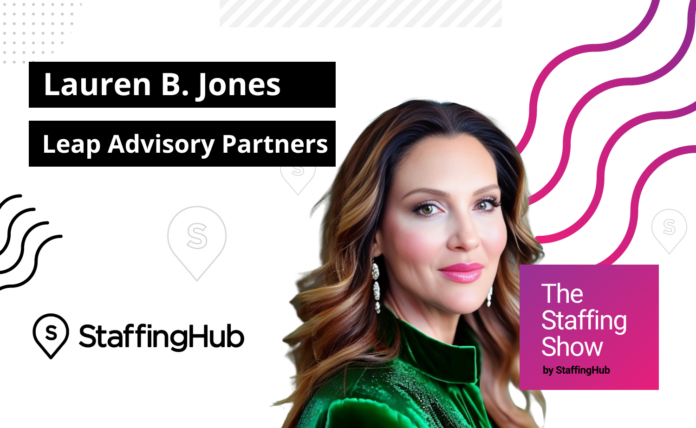
AI is making it easier than ever to build custom tools, but does that mean the traditional staffing tech stack is becoming obsolete? In this episode of The Staffing Show, David Folwell is joined by Lauren B. Jones, Founder of Leap Advisory Partners and The Real AI Agency, to explore what AI really means for staffing firms and why success depends on building the right habits, not just adopting new tools. Lauren explains why many AI projects fail, how operators should approach building and managing AI agents, and why clear KPIs, strong operating systems, and thoughtful implementation matter more than chasing the latest technology. They also discuss the importance of CEO involvement, AI governance, data protection, continuous learning, and the mindset staffing leaders need to thrive as AI evolves. Listen in for practical guidance on using AI to create real value without losing sight of the fundamentals!
[0:01:14] DF: Hello, everyone. Thank you for joining us for another episode of The Staffing show. Today, I am joined by Lauren Jones, who’s the founder of Leap Advisory Partners. Has three decades in staffing technology on the vendor and implementation side. Is now running The Real AI Agency, a membership teaching staffing operators to do real work with AI. She runs live master classes where she opens Claude on screen and does an actual day’s staffing work in front of the audience. And she publishes hands-on guides like record a skill. She is one of the few people in the industry teaching operators to build and not just buy. Lauren, always love having you on the show. Enjoy your energy and what you’re doing with your AI classes right now. I think it’s really amazing. And I’m excited to dig in.
[0:01:59] LJ: I am super excited to be here. Always appreciate you having me. So, thank you. I’m excited for today’s conversation, too.
[0:02:05] DF: We’re going to hop in with a controversial topic.
[0:02:08] LJ: Love it.
[0:02:10] DF: And I’m open to you claiming that this is correct, incorrect. But one thing I think I’ve heard you say is that the staffing tech stack as we know it is dead. And if a recruiter with Claude and your skill library can do what five of your point solutions did previously, most of the vendor landscape is walking around without a pulse. Agree or disagree?
[0:02:31] LJ: Both. I agree and disagree. I think a lot of point solutions are going to go away. And you can look at some of the platforms as evidentiary support of that. They’ve got AI too. And so they’re working to incorporate those point solution skills into their overarching platform. I think that in and of itself is a risk to point solutions. But the but is am I going to go build Opus Pro?
[0:03:06] DF: Maybe when Mythos comes out.
[0:03:10] LJ: Maybe. But I mean, am I going to be responsible for the upkeep, the security, all the legislative changes that happen, the GDPR, CCPA, I mean, ASAC 2, T2. Am I going to do all of that? I think the one thing that when people make those claims – and I myself have said what do I need a CRM or an ATS for. But there are regulatory things in our industry in particular given the sensitive nature of the information that we deal with that I think a lot of people dismiss and shouldn’t dismiss.
[0:03:46] DF: Yeah, I also agree and disagree. I have to disagree a little bit fundamentally with the software that I have. Simultaneously, I think that the reason I – I think the point if point solutions aren’t expanding their surface area or going much, much deeper into the solution in a way that is either solving a regulatory issue, solving something that’s just really complicated and really takes deep engineering expertise. If you’re building a new marketing dashboard and that’s the pitch, that type of solution, there’s a whole bunch of them that I think it’s amazing to see every time there’s a new Claude release. It’s like how many startups were killed on every single new Claude release.
[0:04:30] LJ: How many startups does Fable kill?
[0:04:34] DF: Yeah. Yeah. Yeah. Literally, I mean, it’s hundreds. And it’s going to continue to happen. If you’re a surface level product, AI is coming after it. It’s allowing you to build it quickly. I just got off a call with another person in the staffing industry, staffing leader, and they were like, “I can’t believe all the stuff we can build. We’re building all of these portals and all these other things.” And the initial stages of that – and this is also on the disagree side of it, which is I think the part that people don’t realize in the build versus buy is the maintenance component.
And I personally am learning that because I was like, “Oh, I can build an agent for that. Oh, I can build an agent for that.” And now I have eight agents. And then I was like, “Oh, well this one’s not working and it’s kind of overlapping with this one.” And the maintenance, making sure it’s all working seamlessly. I think that that operational cost can be higher than people expect. But the basic software point solutions, watch out.
[0:05:30] LJ: Yeah, precisely. We have what’s called the multiplier org. We have 10 humans and 38 agents that work for Leap Advisory Partners. But those 38 agents, I’ve already gone through and eliminated three agents. We’re in a consumption environment now. So, is that agent taking more tokens than it’s generating revenue? That’s the other thing that people don’t do or operators don’t do is they don’t put any KPIs in place for the agents. Why would you hire somebody and not have a KPI? You wouldn’t. Why would you not have a KPI for your agent?
[0:06:06] DF: It’s funny. It’s one of the first use cases. Because everybody feels it’s so painful. I’ve read this as the everybody wants to fix their email and calendars. And then you build an agent around it that updates you on everything that you have going on in your day. And then you have more noise and wasted spend, and it’s just another thing unless it’s done right. I think it is funny to think about doing that without putting the KPIs behind it.
What are some of the best use cases or ways that you are seeing people do that successfully? And maybe you’re training on it in your classes as well. But how are you looking at when somebody builds an agent, what are the KPIs they put around it? How are you seeing people actually do that successfully and manage it? And a lot of questions here, but what is the time and effort behind that as well?
[0:06:53] LJ: There’s a couple things that I think people are missing. A lot of people just jump right into it and start talking to Claude, or ChatGPT, or what have you without setting up their operating system, right? You need to have an about me, my voice, my standard operating procedures. It needs all of that context. And I can’t tell you how many times we’ll go in – we have a program called the connected agency, which is our Copilot program. And we’ll go into an agency to help them get Copilot adopted, because over 80% of staffing and recruiting firms are Microsoft shops. And inevitably, I can tell you 1 out of 10 of the people, agencies that we’ve trained, 1 out of 10, 10% have their memories turned on, have their preferences set up. And it’s bananas to see that they’re jump – and that’s such waste from a token perspective because you’ve got to start from ground zero every time you engage with your model.
And as a matter of fact, our class today was all on your operating system and how to set it up, and the things to turn on in Claude, like the privacy settings. Most people don’t know that the default setting for Claude for Teams on whether or not Anthropic can learn from your data, the default setting is off. But for the personal, it’s on. It’s going through that with a fine tooth comb and setting it up appropriately.
And then I think the other is building agents for the sake of building agents as opposed to, what gets in my way every day” What do I not get done in a day? What do I do on repeat every day? If money was no object, who would I hire and what would I do? And what would they do? And writing complete job – if you can write a job description, you can write an agent. But there’s no thought that goes into what problem am I trying to solve for? It’s just doing AI for the sake of doing AI. That’s where a lot of waste – and there’s a pretty jarring statistic that 65% of AI projects will be abandoned due to lack of adoption and lack of clarity of purpose.
[0:09:13] DF: It makes sense. It makes sense because I don’t think people are prioritizing. I mean it’s the same rules as hiring and growing a business, right? It’s like what are our priorities? What are the top things we need to solve? What are the top challenges? Who are we going to hire? What’s the ROI on the hire? How long is it going to take to get an ROI on the hire? How many weeks or months?
I also think the people like, “Oh, I built the agent and it didn’t work. Or I went and put it in ChatGPT or Claude and I didn’t get the answers that I wanted. I don’t really think it works.” And it’s like you brought up I think one of the most important components of AI is the operating system, the context engineering, whether it’s the Claude.md projects, having all of those components together. Could you explain a little bit more about what you mean by that and how impactful that is in terms of your day-to-day use with AI?
[0:09:59] LJ: Yeah. In tools like Claude, Copilot, ChatGPT, you can go to your settings in your global settings, set up who you are, what you do. And then if you’re going to use projects, right? We keep our projects pretty narrow. Your AI hallucinates less when you can keep them more singular.
I have a project called LJ’s real voice. It has my entire taste interview. That’s where we generate content that I would distribute, right? That changes over time, right? I change over time. It’s not something that remains static. Setting up your settings and then re-evaluating those settings on a maybe monthly or quarterly basis to make sure that everything’s still up to date. I just had to update my global Cowork settings instructions because we had some SOP changes in the organization.
And so I think that yeah, there are settings and global settings in all of these tools that you can set up. Turn on your memories. Do your privacy settings. If there’s nothing else that you do, make a folder called “safe,” right? And that’s the one folder you give AI access to, right? As opposed to go ahead and carte blanche with my entire VM, my entire virtual machine, or my entire terminal. When you can get really focused, not only do you set it up the right way and get better performance and less token utilization, but it keeps kind of your AI hygiene, data hygiene going. And then you have so much more clarity around, “Okay, money is no object because I pay – I have 38 agents that work for me every month.” David, we spend about $300 a month on Claude.
[0:11:51] DF: You’ve got yours running more efficiently than mine.
[0:11:53] LJ: They’re generating $177,000 annually of savings for people that I would have to hire. Now, here’s how we track. So, we have four teams, four AI teams. We have the prep team. Those are the agents that help us prep our day and do things like here are all the emails that you didn’t respond to yesterday. Here are all the calls from Grain and the tasks that you committed to doing. Here’s all the Slack activity and things that went undone or unanswered, right? Those types of things. So, that’s the prep team.
And then we have the parallel team. So, that’s the team that works in parallel with us throughout the day. Then, we have the close team that helps us close out our day. And then we have what we call the night shift. And those are the agents that work while we’re sleeping. And we take each one of those agents and we have KPIs for them. We used salary.com and Claude and a bunch of others to say, “What would I hire a person? What’s the hourly rate for that person that I would hire? How long would it typically take that human to do that task?” And then we make sure on a daily, weekly, monthly basis that that agent is performing and always in the black as far as savings.
I’ve had to terminate three agents that’s like, “Ugh, the problem wasn’t as big as I thought it was.” And so my token expenditure is going to be bigger than managing that agent. There’s another list of things that we can experiment with having those agents do. And so I think it’s kind of that constant iteration.
I have an agent called the ruthless SDR agent. I have built her over a year’s time. And she scrapes my email every single day to find sales conversations that haven’t come to close. And she stays on top of me like white on rice and make sure I follow up ruthlessly. And she’s ruthless about, “Hey, this wasn’t a great email. Too casual, or you weren’t closing.” Gives me all sorts of feedback. But that took a lot of iteration and a lot of time. And so there are really great use cases. Find your own weaknesses. I have lots of them.
[0:14:18] DF: That’s one of my favorite use cases for it. Also, I built a – I call it the bullshit auditor. I know any project that I have, if I’ve sat there with Claude or any tool, the sickofancy of it. You’re sitting there, and it’s like, “Yes, this is amazing idea.” And at the end, if I throw it in there, if I get a 9 out of 10, I’m golden. But half the time it’s six. And here’s why this is dumb. But you need that. You need to have other tools to kind of audit as well. That’s amazing that you’re doing that.
It sounds like you have a pretty thorough methodical way of measuring the ROI. Are you looking at this on a monthly basis? Do you have an operating rhythm around it? Or do you kind of like once they’re up and running, you’re kind of letting them run and moving on to whatever the next process is?
[0:15:00] LJ: We have an entire site dedicated to it where we’re watching it every single day. Yeah, you can hit the play button and watch the agents work and watch the tasks that they were doing to ensure that the tasks that they were either autonomously doing or that they were asked to do to ensure again that they’re in the black as far as paying for themselves, helping me save money so I don’t necessarily have to hire. I want my people talking to people. That’s everything that we’re trying to do. I mean, it would be really nice to have a human being go through every single discovery call that we’ve ever done and pull out the best questions, but I don’t have to do that anymore. I have an agent that does that.
[0:15:38] DF: Yeah, it is amazing. It’s so cool what it can do. How are you managing all of the different agents? I think that’s a problem that if you’re out there building agents, eventually you’ll run into. That’s about two months into that where I was like, “Oh, I have too many. How do I keep track of them? And what are they doing?”
[0:15:53] LJ: We are a teaching firm, right? So we have ChatGPT, we have Copilot, we have Claude, we have Abacus. We’ve been on Poe desktop, Perplexity desktop just to experiment. As a business, we use two primarily, and that’s Claude and Abacus. Now Abby has been with me for since the beginning, three and a half years. I can’t get rid of her. She know she has so much institutional knowledge. She’s like that employee that has been here forever, knows everything, knows where everything is, where all the bodies are buried. I feel like I can’t live without Abby.
And Abacus is such an amazing tool because it will allow you to experiment with every single LLM. You can hit the drop down and get Kimi or some of the more less known to see what works, what doesn’t. I’m constantly trying to find the better of the better of the better. And Abacus has swarms. There’s some really cool features that Abacus has. You can host directly. You can host an app directly from Abacus. There are just some benefits if you have to get some things done fast. Abacus is great for us. And then Claude, the connectivity is like the connectors, the plugins. They’re so far ahead of Copilot, and ChatGPT, and Gemini, and it’s bonkers. Those are our two primary platforms. My advice to an agency that’s not a teaching agency like mine, pick one.
[0:17:28] DF: Yeah, absolutely. Absolutely. Pick one and have everybody use it.
[0:17:31] LJ: Pick one and everybody use it.
[0:17:32] DF: Yeah. We tried straddling too, and it was not a good idea. Some of the conversations that you think CEOs should be having with their recruiters about either how they should be using AI and/or what the future of their job looks like. Recruiters are kind of scared about what the future looks like in some instances, and it’s obviously changing. I think our whole world is changing in every industry. What are those hard conversations you think they should be having or easy conversations?
[0:18:01] LJ: The hard conversation I’m having right now is with CEOs themselves. I was doing a CEO round table, and there was this, “Well, I’m going to have my people do this AI stuff.” And I said, “You set the vision for the organization.” How can you set a vision when you have no idea of capability? Right? At the bare minimum, as a C-level person who sets the vision for the organization, you should at the bare minimum understand capability and best practice. And so CEOs that are just signing this off to somebody else, I do not think this is a delegation exercise. And I would argue with any CEO that says otherwise.
[0:18:41] DF: I’m going to second that as well because I think it’s impossible to know what’s possible until you dig in to this. You can’t be like, “I’ve read about AI. Here’s our AI strategy.” It’s like get in there and figure out what you –
[0:18:55] LJ: The internet all over again, right? I mean, I open every keynote with how many of you know how to use the internet? Inevitably, everybody raised their hands. I’m like, “That’s how many people need to know how to use AI.” You got to get involved, CEOs. You’re not the exception here.
[0:19:09] DF: And if you were recommending that they get involved, what would you suggest they start? I’ve talked to plenty of CEOs. They’re like, “I don’t really do that. I let the team handle that.” And granted, you shouldn’t be in all the processes, but you should be digging into AI and trying things, and exploring, and asking it questions about what’s possible. What are some of the things that you would recommend as maybe a starting point or like a one-hour a day?
[0:19:33] LJ: I’m not asking CEOs to build agents. I’m just asking you to understand how an agent works. And so, fundamentally, I want CEOs to understand how to ask the right questions for application of AI. I want CEOs to know how to protect their data. And so, that’s either having a person – you should have a personal AI policy and a business AI policy. The personal AI policy being safety for yourself and your family. Delete your voicemail. Make sure you have a safe word for your family. An online safe word.
There have been mothers who have been tricked into giving tens of thousands of dollars away because they hear their child’s voice on the other line, and it’s AI. And there’s just so much. The 39 billion dollar scam industry or fraud industry, thanks to AI. And so, personally, you got to have that personal safety policy. And then you must have an organizational AI policy.
It’s the wild wild west still right now with AI. And so, legislatively, you’ve got to make sure that you are working with vendors that are reputable and know how to protect your data, know how to mitigate bias, right? So, you’re asking the right questions. I want CEOs to know how to ask the right questions. Understanding capability doesn’t mean you have to do all the things, but you do have to educate yourself. I’m not asking CEOs to take action in the tool. I’m asking them to take action in learning. That’s where I am.
[0:21:04] DF: Great insights there. And what are some of the one impressive thing or some of the more impressive things you’ve seen staffing operators actually build or do with AI?
[0:21:15] LJ: I think that it’s amazing that they are looking at this as an opportunity to do some of the things that they’ve always wanted to do and never had a vendor that could fulfill that. And some of them are true cultural differenti – such a good representation of their differentiator. And so I think that being able to take the things that are really important to them sort of organically, culturally in their mission, vision and values and put a sort of functional face to that, that to me is everything. But you have to do it safely.
And there are some tools that are making it really easy to do those things. And there are other tools that are making it more difficult. Core tools that are making it more difficult. And so I think integration is going to be everything. I would advise against having all these disparate systems. It’s going to be the frankenstack all over again that we’ve been trying to clean up for the last 10 years. If you want to put all your data everywhere – it’s like a leaking boat. If you have all your shit everywhere, you don’t know which hole to plug when there is a vulnerability, right? Choose one tool.
[0:22:26] DF: Choosing one tool also. I mean, I think if you don’t choose one for your company, your employees are going to use something. It’s so impactful.
[0:22:33] LJ: And you’re not going to like the way they use it.
[0:22:35] DF: You’re not going to know how they use it or have any insights how they use it, but they’re going to use something because it’s so valuable. I think that is a key component of that as well. What are some of the – I know you’ve gone through a handful of different agents that you’ve done and how you’re measuring the success of those. What’s an agent that has changed your life the most or an AI use case or been the most impactful for your business?
[0:22:57] LJ: My two agents that probably save the most of my headspace are my brain dump agent and my doom scrolling agent.
[0:23:05] DF: I love it.
[0:23:06] LJ: Every night, inevitably right before I go to bed, everything comes rushing to my head of all the things I have to –
[0:23:13] DF: All the ideas. Yeah.
[0:23:15] LJ: Yeah, the ideas. The things I didn’t do that I should have done, the, “Oh my god, I got to go pick up the dry cleaning.” Things personally and professionally that I’ve got – it all just comes in this barrage, this flood that keeps me up for another two hours. And so now I just go into Claude dispatch and I brain dump into – my husband’s like, “Who are you talking to?” I’m like, “Shh.”
[0:23:38] DF: Just whispering in bed.
[0:23:39] LJ: Yeah. All of that brain dump. And then I have an agent that creates a personal checklist and a professional checklist. It’s waiting for me every morning. And then my doom scrolling agent is actually a project. And I’m not a very good sleeper. My brain is very busy all the time. And so I’ll find myself doom scrolling, and that’s where I get really good ideas. Or I’ll go shopping on GitHub for really good skills or whatever, and find myself –
[0:24:11] DF: I had no idea. I did not know this year. I’d be like on a monthly basis, what is the most popular GitHub repo?
[0:24:19] LJ: Oh my god, there’s so many. I’ll send them to you. There’s so many. My doom scrolling. I love X. There’s the best AI content on X. And so, I had tried a couple different things like with n8n and Dewey to get all my bookmarks in X to do all of that, and it just was not effective. Dewey had a cap of a thousand bookmarks, all of these other little things. I was like, “You know what? I’m going to create a project. And I’ll plug in Apify.” And I just drop screenshots or links into the project. And now I have what’s called – it’s a beautiful dashboard that’s called my swipe file. It’s all aligned to our operating system, our mission, vision, values, our goals, and it creates a swipe file and says this is a priority. This is creative, and you should do this now. Or this is done. And you should move on. Or you already have this. This is the third time you’ve swiped this.
[0:25:22] DF: Yeah. We’re in the same boat over here. What do you think those changes that are happening, the ability to build agents, what you’re doing, $177,000 worth of work getting done from agents? Where do you see staffing the next one to three years? How do you see it evolving?
[0:25:40] LJ: I think there’s this big misnomer out there, right? I’m already too far behind. I can’t tell you – hear it every day. And only 5% of people globally are paying for these tools individually. And so that tells me you’re not behind. You’re exactly where you’re supposed to be. And the hardest part is starting. So just start. I think my biggest frustration is people – this defeatist attitude with AI. It is moving fast. There is no doubt. I do this for a living, and I find myself going, “Holy shit, Anthropic. Could you just slow down on your releases for a hot second?” But you’re not behind. You’re right where you’re supposed to be.
[0:26:23] DF: I saw a thing the other day that I did not see the quote from it, but it said that the founder of Claude Code said he feels like he’s behind. It’s like the wild wild west. And everything is moving so fast. And it’s absolutely impossible to keep up with all of it no matter how dialed in you are. There is no way to be there. That’s a good share there as well. How do you think it will evolve then? What do you think the next one to three years?
[0:26:49] LJ: I think there’s a lot of CEOs, and I’ve heard this secretly saying, “I’m going to sit and wait. I’m going to wait and see how this all shakes out.” There are already vibe coders being sued. I know that there is – we’ve been through this before. Every sort of technology revolution, we’ve been through this before. We’ve always come out as better business owners, and operators, and contributors. And so it’s no different than any other sort of revolution that we’ve been through.
And so my piece of advice again is just get started. Get in there, get your hands dirty. Don’t sign this off to somebody else. And make sure that you do three things. You have a policy, you educate, and you enable your people. This is not a one-hit wonder. It’s moving too fast for you to train them once and then walk away. These tools are continually evolving. So, I’m sorry to tell you, but you will probably have to invest in a training department or a training firm like mine to make sure that you are staying afloat as far as training yourself and training your people.
[0:27:59] DF: Yeah. I think educating. And I’m leaning in on all fronts of where you can educate. And it’s funny, I was like, “You can’t even buy a book.” By the time you go to buy a book to educate yourself on AI, it feels like three years in the past. And so I think that the live learning. I think what you’re doing with your classes is smart. It’s the type of thing I’m looking for with my team as well because you need to know what’s happening today. What’s happening with the latest model? Every model release changes the game. Honestly, what’s possible can change every time something else comes out. And so I think having that real time and continuous education is possibly the most important it’s been in our industry in a very, very long time.
[0:28:41] LJ: Agree. Anthropic comes out with Fable, and then Codex comes in and you’re like, “Holy crap.” I wrote a book. No sooner did I publish the book that I updated the version of the book less than a month into it. Now I have a second book coming out, and it’ll be The Real Girls Roadmap to Mastering Claude.
[0:29:02] DF: I love that. I love that.
[0:29:03] LJ: That will be more of our – we’ve got a million handbooks on Claude, like Claude 101, setting Claude up appropriately, understanding the difference between Chat, Cowork, Code, Design, Dispatch, all of the functionality in Claude. But I think fundamentally, there are some things with Claude that are okay in a static handbook.
[0:29:22] DF: There are. And actually the foundational things you talked about earlier are kind of sticking, right? The context engineering, the project management, the organization of it. It’s like the foundations of engineering best practices and also business operations are kind of lining up pretty well on that front.
Well, this has been an awesome conversation. Super excited about what you’re doing with the master classes. Do you have any closing comments? Anything else you’d like to share with the audience?
[0:29:46] LJ: Well, The Real AI Agency. You can go to – it’s laurenjones.ai/real-ai-agency. But long story short, it’s a year-long curriculum, which no curriculum is a year-long. You can look at The Uncommon Business, Allie K. Miller, all of the other programs. We’ve done them all. And I think our biggest differentiator, it’s a year-long program. It’s priced for staffing because I know that staffing is very price conscious.
We’ll start our first large group tomorrow and then we’ll do another one. In six weeks, we’ll start another one and another large group. And The Real AI Agency has been a gamechanger for us just from a content and engagement perspective. If you want to get involved, come join us. I have free master classes almost every week leading up to the launch of a new class size or class group, and come join a free webinar. I give away free agents, skills, teach you so many things for free. So just get started would be – get started. Come join us. Come play. Come play AI with me.
[0:30:57] DF: Come play AI and level up, because it’s time. I think we’re all going to be the 10X recruiters. That’s amazing. Well, super excited about what you’re doing. And I’d second that I think your classes, if you guys are listening to this and thinking about when to get started, now is the time. Go visit her site, join the master classes, get your team scaled up. And Lauren, thanks so much for having you on the show. Enjoyed the conversation.
[0:31:16] LJ: Yeah, and I enjoyed it immensely. Thank you for having me, David.