

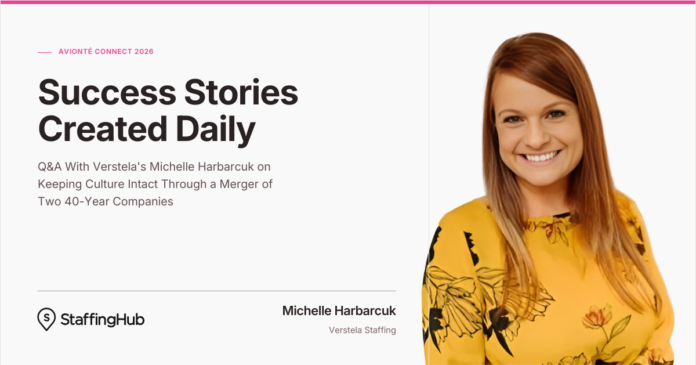
Merge two 40-year-old staffing companies, rebrand the whole thing, roll out a new ATS, and you’d expect culture to be the first casualty. Michelle Harbarcuk made it the priority instead.
Harbarcuk is President of the Western Division and EVP of Operations at Verstela, one of the largest industrial staffing firms in the country. But she spent over a decade running branches before stepping into that seat, which means she’s lived through the merger from both the front line and the top. She credits keeping the company’s mission (success stories created daily) at the center of every decision with holding the culture together while everything else around it changed.
At this year’s Avionté CONNECT, Harbarcuk sat down with StaffingHub to talk about what made the merger work, how she decides which new tools her recruiters will really adopt versus which ones will stall out, and something every staffing leader is likely dealing with right now: tech fatigue.
Q. Verstela has gone through enormous change in a short amount of time. As the person leading operations through it, what’s been the hardest part of keeping everything running smoothly?
Michelle Harbarcuk: It’s been a lot of change: bringing two large, 40-year companies together, rebranding to Verstela. We both had our own brand identities for a long time. New technology, new ATS, that’s why I’m here at Avionté CONNECT. Lots and lots of change.
The hardest part for me was making sure we kept a stable, consistent culture while bringing in all that innovation and change. That meant really looking at the decisions we were making, when we made them, and how we implemented them, so our staff felt like the company was taking care of them and giving them something of value, not just more change for its own sake.
Q. What were the specific challenges that made you realize culture was going to be the glue holding everything together?
MH: Any time you’re merging two different cultures, two companies, that tension is front and center. But when we dissected our culture, it came back to our mission statement: success stories created daily. We fed that through the whole organization to make sure we were taking care of talent, taking care of clients, and taking care of our internal staff. Once we kept that at the forefront, our team got more inspired. They started asking, how can I take these changes and still help my community, help my talent, help each other?
Q. Now that you’re at that scale, what are you able to offer clients that you couldn’t before, and what are you most excited about there?
MH: For years, clients would ask, can Verstela help me in this state? And we didn’t want to commit to something we couldn’t truly deliver on. Now we get to say yes. We built out our enterprise accounts team and our national accounts team so we can serve clients across the country. Watching those partnerships expand, seeing how excited clients are to bring us into new facilities, has been one of the most fun parts of this, and it’s had a real impact on both our clients and the organization as a whole.
Q. You came up through the ranks running branches, so you know what lands with a recruiter versus what just sounds good in a demo. When a new tool rolls out, what separates the ones your recruiters actually adopt from the ones that stall?
MH: Two things. First, does it add value? If it’s not going to help them get results, deliver for their talent, or deliver for their clients, they’re not interested. And if it does add value but only briefly, they lose interest fast too.
Second is ease of use. We try to make sure any new technology or process is embedded into their daily workflow, so they’re not logging into another platform, doing redundant work, or double-clicking through extra steps. That’s where I’ve seen the most value: technology that’s embedded in the workflow they already have and gets them faster, better results for clients and talent.
Q. In industrial staffing, you’re placing fast at very high volume. Where does AI genuinely help with that, and where does it start getting in the way of the human side of the work?
MH: I’ll admit, I was skeptical with all the AI buzz. We’re in a people industry, we need the human touch, and I still believe that 100%. But what I’ve seen is that AI creates so much reach and efficiency that it lets us lean into the human touch even more. The ability to communicate with talent at scale, to push workflows out all at once instead of one or two at a time.
Where it can hurt the human side is when a recruiter decides to let the tech run start to finish without spot-checking or actually talking to the talent. Those conversations with talent are where we learn everything: what’s happening at the client site, what needs to adjust, what trends are showing up, what people want. You can’t automate that away.
Q. What’s been your biggest challenge adopting the AI tools now embedded in your workflows?
MH: I call it tech fatigue. It’s the pace of change more than the change itself. Even when we’ve made sure something is easy and fully embedded in a workflow, every time we announce something new, it feels new to people. That’s probably been the biggest challenge: pacing ourselves as an organization, and keeping people open and excited instead of hitting that wall where they think, great, another new thing.
Q. What are you most excited about in the conversations you’re having here at CONNECT?
MH: It might not sound exciting, but honestly, just hearing all the different ways people are using AI. It’s evolving overnight. We’ve been early adopters, we test a lot of Avionté’s features early, but hearing how other companies are combining tools and building new workflows out of them has already been really interesting, and I know there’s a lot more coming.
Q. Has anything you’ve heard here been mind-blowing, something you can’t wait to bring back to your leadership team on Monday?
MH: I was at a dinner last night with Whippy, and we’re a Whippy client, so full disclosure there. But seeing some of their product innovation and the new features they’re rolling out, I was already thinking, okay, I need to start that, I need to start that, I need to start that. I’m ready to get back and get moving on some of it.
Q. A year from now, what do you think staffing firms will be doing differently than they are today?
MH: It’s kind of crazy. I’ve been in this industry for 20 years, and I always talk about how much more sophisticated our clients and our talent have gotten, and how much the product we deliver has evolved with them. A year from now, that’s going to be miles ahead of where it is today: compliance, quality, retention. These tools are helping us source, generate, and screen, but client expectations are only going to keep climbing. We’re going to need both the tools and the human touch to deliver on that.