

You bought the AI tools. But your recruiters are still drowning in clicks.
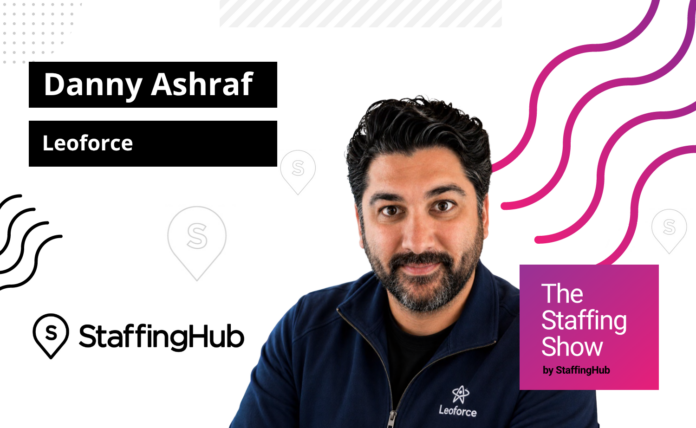
In this episode of The Staffing Show, Hilary Baker sits down with Danny Ashraf, Chief Revenue Officer at Leoforce, to explore where the staffing industry is on the Gartner Hype Cycle. They also discuss what separates the firms climbing the slope of enlightenment from those still stuck in the trough.
You’ll hear:
- Why recruiters still want control over search, and what that means for adoption
- How to keep a human in the loop without slowing the process
- How to identify your true workflow needs before you buy or build
- What candidate quality and rising job ad costs mean for your tech decisions
- How to choose recruitment tech partners more deliberately
[0:01:14] HB: Hello, everyone. Welcome back to The Staffing Show. My name is Hilary Baker, Managing Director at StaffingHub, and I’m filling in for Dave Folwell today. My guest today is Danny Ashraf, Chief Revenue Officer at Leoforce. Danny has spent almost two decades in recruitment technology, so we have tons and tons to dig into today. Danny, thank you so much for joining us.
[0:01:36] DA: Thanks for having me.
[0:01:38] HB: When we talked last week, you were talking about a model to describe where the industry is right now, and you used the technology hype cycle as the frame, and I haven’t stopped thinking about it since we had that conversation. Can you just explain exactly what the hype cycle is for people who might not be familiar with it, and then tell me where you think that most people in the staffing industry are on the curve right now?
[0:02:07] DA: Sure. Similarly, to you, the first time that I heard it, I couldn’t get it out of my head, first, because I thought it was really funny, and then I realized how appropriate it was for every single new technology launch that happened. Gartner came out with this hype cycle a handful of years ago, and it basically says, whenever a new technology comes out, there’s this trigger, there’s this excitement that proliferates an industry, and it causes everyone to say, “Oh, my gosh. This is going to change my job, my life, my company, everything, and all of the above.” There’s this trigger. So, let’s call it AI in this example.
AI is released to the masses, and all of a sudden, there is this peak of inflated expectations that we think this technology is going to be the best thing since sliced bread, and it’s going to change the way we all work. Everyone starts to think about what are the potential possibilities and applications of using this technology, and we think it’s going to be a game changer. We overestimate our abilities, or the technology’s abilities. What happens is after there’s this peak of inflated expectations, there is this plummet down to the trough disillusionment, where it’s basically the failure of whatever you thought your grand aspirations were going to lead. After you hit this trough of disillusionment that it’s not going to do all the things that people said it was going to do, or they thought it was capable of doing, you start to creep out of this, and there’s this slope of enlightenment that maybe this isn’t as big of a game changer as we thought it was going to be, but it’s still helpful.
Then once you wrap your arms around what it’s actually capable of doing, there’s this plateau of, “Okay I’m smooth sailing now, it is helpful, it is impacting how I work, it is productive, but it maybe isn’t 10X’ing what I thought I was going to get as an output.” That’s the Gartner hype cycle, and you can apply it to almost any technology that’s come out, whether it’s in HR tech, or outside of it over the past couple of years.
[0:04:28] HB: You said, when I was talking to you last week, that you are hearing a lot of frustration, some amount of disappointment and where they are in their AI journeys right now about these AI investments. I guess, first of all, where would you put them on this curve as a whole? Also, just what are our staffing leaders saying on calls right now that they weren’t saying a year ago? How has that conversation changed?
[0:04:55] DA: Yeah. The conversation changed a lot, and that’s because a year ago, they were at this peak, right, where they thought AI was going to replace recruiters, their head count was going to be significantly trimmed down, and AI recruiters were going to totally change profitability of companies and the efficiency of companies. That was a year ago. Where we are now is most people that I speak to, whether they’re in staffing and in charge of technology, or delivery, or the direct employer side and in charge of TA, or HR tech, they’re in this trough of dissolution right now, or they’re tiptoeing out of it. They’re approaching this slope of enlightenment and they’re resetting their expectations in terms of how it’s going to impact recruiters in their day-to-day lives, how it’s going to impact candidates. Some people are stuck in this trough of disillusionment right now, because technology companies were promising that this was going to totally replace recruiters, or impact their day-to-day.
Even Perplexity’s CEO a year ago said that recruiting would be done as an industry in six months. Well, guess what? Here we are six months after that, and we’re still thriving. We’re starting to see job req volume creep off month to month now. Recruiting is certainly not impacted in a way that technologists thought it would be in the past year.
[0:06:25] HB: Can you tell me a little bit about how you envision the firms who are starting to, like you said, tiptoe onto the slope of enlightenment? They’re starting to see a little bit of light at the end of this trough, or I guess, I should say, at the top of the trough, I suppose, versus those who are going to be stuck in the trough for maybe the long term, or even worse, fall off the curve altogether and abandon all of their initiatives, all of their AI initiatives, which I hope is not the case, but can you tell me a little bit about those two different scenarios, what those agencies might look like next to each other?
[0:07:04] DA: Yeah, absolutely. I actually attended a roundtable earlier this week, to plug a friend of mine, Daniel, who runs a company called Volante, and they held a roundtable around AI and the overwhelming feedback from the three panelists and 60 members that were attending the event were that ultimately, change management is what makes the difference. They cited a case study where a major AI company deployed their technology to two very similar organizations, two financial institutions, let’s say. Both of them were in the same industry, had the same use case for the technology. When you look at the results six months later, both organizations have two entirely different outcomes that they’re tracking. One that had a complete failure, and then the other one made a significant impact to their business.
What they figured out was that they deduced it down to change management being really the differentiator between both organizations. I think those organizations that thought that AI alone was going to solve all of their problems are still on this trough of disillusionment. Maybe these are the people that are constantly finding themselves in the trough of disillusionment every time a new technology comes out, whether it’s AI recruiting agents, or a few years ago, digital staffing platforms, or staffing platforms as a service. That was the big buzzword, I think, before this. I think a lot of those companies that did not have a change management plan are the ones that are finding themselves in that trough. The ones that are in that slope of enlightenment are the ones that took a slower approach to implementing AI and had a more reasonable set of expectations, and that ultimately, they weren’t looking to replace recruiters completely, or get a 10X improvement of output from the recruiters. They set measurable outcomes that were realistic, and they created processes and training road maps to make sure that the recruiters that were being tapped on the shoulder to come along this journey actually came on that journey with them.
[0:09:11] HB: It’s almost like you’re saying like, the higher the expectations, the further it was to fall to the trough. The more, I guess, for lack of a better word, painful it can be to be in that spot. I do think that there is still a lot to be learned in that process and so much opportunity to climb back on the other side.
[0:09:31] DA: A 100%.
[0:09:32] HB: Let’s talk about what happens inside of these firms that are setting new AI tools in front of recruiters. What is one specific thing that makes recruiters shut down to AI tools when they land on their desk?
[0:09:49] DA: I think the first one is here’s another login and password. I know it sounds silly to say that, but recruiters are being put in front of a bunch of different tools, a bunch of different screens. You’ll hear this term come up every now and again, swivel chair recruiting, because you have recruiters that have multiple monitors now. They have their ATS open in one window. They have a AI recruiter agent in another window. They have LinkedIn open, Indeed open, and all these screens and all these usernames and passwords to remember when they get a tap on the shoulder from their technology, or leadership team saying, “Hey, by the way, here’s another tool that we have that we want you to use.” As silly as it sounds, that’s the first thing that causes recruiters to pause. It’s just something else that they have to do.
[0:10:37] HB: When you are working with these recruiting teams who have a new tool in front of them, what tasks are you surprised that they hand off to agents without much of a fuss, versus the ones that they want to hold on to? Has any of that surprised you?
[0:10:55] DA: Yes. To date myself here, although I do call myself an elder Millennial, when I was in college, my senior year, I remember I took a class called LIS101, and it was library information skills. You’ll laugh when I make the connection to library information skills to recruiting. But they taught us about Boolean searching. I remember using tools like LexisNexis and these other databases. I learned all about Boolean operators and for all of the people that are tuning in and listening to this, you’re all probably fairly familiar with parentheses, and/or is not near the asterisk, all that stuff. Never in a million years after I graduated college did I think that we would actually, or I would actually be using this technology on a day-to-day basis. Little did I know that I’d spend the next 20 years of my life working in databases using Boolean operators.
The reason why I bring this up is recruiting for a long time has been based off of how well a recruiter could run a search on a job board, or in their own database. I would have thought in this day and age, when we’re all spoiled by how accurate Google search results are, or on the other search engine, that’s your primary search tool, that you would actually want to go back to Boolean searching, as opposed to a semantic search that Google offers you on a day-to-day basis, or even an audio-based search, when you’re talking to Siri, or Gemini, or something like that.
That was the first learning that I had was that recruiters have been burned by these automated searching technologies over the past few years. I don’t blame them, because with all of these automation tools that have come out that do automated texting and emailing and calling, that’s great if you can automate all of those activities. But if you’re automating activity to the wrong candidates, so ultimately, if you’re searching for the wrong people, everything else is going to be off track. If you’re an inch off at the beginning of the race, you’re going to be a mile off at the end of the race.
I was very surprised early on to hear the feedback from recruiters that they didn’t trust search technology. It wasn’t even the AI agents that they weren’t trusting, it was just that first step. That was a big learning for Leoforce that humans wanted to stay in the loop, even at the beginning of the process when it comes to searching.
People aren’t saying they’re expert searchers. I remember at the time there was a class that was run by Shally Steckerl and you got your Boolean black belt for Boolean searching. I think everyone’s pretty confident in saying that they’re not black belts in Boolean searching nowadays, but they’re not willing to give it all up to an AI agent, or an automated searching platform. That’s a big aha moment that we had at Leoforce over the past year was how do you keep the recruiter in the loop at the beginning of the search, so that they feel more comfortable with AI agents taking over in the middle of the funnel, or further to the bottom of the funnel.
[0:13:56] HB: You said that nobody is claiming to be an expert at searching. Why do you think that that is something that they still want that control over?
[0:14:07] DA: I think it’s because a lot of these search technologies over the past handful of years that we’ve all used, and some of them are household names and they’re recruiting an HR tech space, so I don’t want to throw any of them under the bus here, but they’ve left a lot to be desired for. You could type in, “I don’t want a sales person.” Because my resume has the word sales in it 10 times, I would pop up in that search. These systems, for lack of a better term, are kind of dumb. They’re jaded now that they have to use these tools. If they’re forced into logging into and using a tool like this, they’re just not going to do it. They’re going to abandon it. I hear that time and time and again, when we’re on site with clients, you walk up behind a recruiter and see what they’re doing, and they’re not leveraging any of these automated functionalities that exist in the system, because it’s either all autonomous, or it’s completely manual. There’s no happy medium in the middle there.
[0:15:03] HB: That makes a lot of sense. I do think that many people have been burned by some of these, what are supposed to be very autonomous processes that have the best possible outcomes every single time, 100% guaranteed. Some people have been burned to the point of wanting to build these tools themselves, because they can do it better, they can do it faster. It’s relatively cheap to build with AI right now. When does that approach stop being cheaper?
[0:15:35] DA: I think with AI today and tools like Claude and others out there right now that people are getting – they think they’re better at building things than they actually are. A client once told me that took over as the head of a staffing firm a few years ago, she said, “Danny, at a staffing firm, you’re either a builder, or you’re a buyer.” I said, “Explain. What do you mean by that?” She said, “If your core capabilities of a company is to recruit talent and not to build technology, stay in your swim lane. Let the people that build technology build technology and you just license it from them.”
I think right now, the challenge is that a lot of people feel empowered with AI to build things on their own. The reality is it is easier to build things with tools. There is low code, or no code offerings out there, where you can build things that are way better than that person could have built a year ago, or two years ago, or 10 years ago. The challenge ultimately is you can build a tool that looks pretty, that maybe accomplishes some of the goals in terms of checking a box of a workflow, or an outcome that you want, but, this is a big but, you need data to power all of these tools. This is not me tooting Leoforce’s horn, but we’ve been in business for over a decade. We’ve had 16,000 recruiters use our platform. We’ve learned in our early days that if a recruiter says they want X, they might really want Y in the end, because that’s the candidate they want. If they type in, “I want a salesperson” as a search, what they really want is somebody that has gone to President’s Club, because they’re really good at selling. They’re not afraid to make 100 phone calls a day and all these other types of skill sets, or things that may or may not show up in the resume.
If you’re building a search tool on your own, where do you get that data? You don’t sit on top of that data, right? You didn’t have the force 10 years ago to start tracking every keystroke you had. You need data to power, or you need machine learning to power all of these tools. I think that’s what a lot of people forget is that it’s not just, can I build something? What is the data behind powering the accuracy of this tool? I think that gets a lot of people into trouble right now.
[0:17:58] HB: Before a staffing operator decides to either A, start evaluating new recruitment technology, or B, start building something themselves, how do you recommend they dig into their recruiter’s day to day, the recruiters workflow to actually identify what that core need is and what the recruiters might be willing to adopt from day one?
[0:18:23] DA: Yeah, so this is interesting, because there is not a single staffing firm that I’ve worked with in my 20 years of being in the industry that doesn’t have an SOP, or some type of guideline for when a recruiter starts on day one of their job, this is how you do it. The irony is that despite there being documentation around, this is what a recruiter should do the second a job opens up, there is a disconnect between that document and reality. There’s often an argument that happens between the CIO, COO, Chief Strategy Officer that helped create that document and then the recruitment leaders that are supposed to be enforcing those processes and best practices.
I think the first thing is to level set that what you’ve set up as being best practices for your recruitment team and delivery team often isn’t actually what’s happening in day-to-day life. It makes it even more challenging when you have leadership sitting in New York and all of the delivery teams in 50 different locations across the country. It’s hard to keep tabs on that. Oftentimes, what happens is recruiters that start on September 17th are mentored by the branch leading recruiter that’s been around for a year, or five years, 10 years, and they just mimic whatever that recruiter does. Whether that means totally not following the SOPs, because that’s what the best recruiter is doing.
I think the first thing to do is sit down at the desk level with a recruiter and have a candid conversation about, what do you really do during the day, right? Do you have the ATS up? Do you have job boards up? Where are you starting? Then monitoring where the gaps are, or potentials are to either take away clicks.
The former CEO of Integrity Staffing Solutions in Delaware, Todd Bavol said something a few years ago on a panel we were on together and he said, “I want to take away clicks and turn handwork into heartwork.” That blew my mind. I still remember it almost verbatim three, four, five years later. I think that’s what people need to be thinking about is how do we reduce the amount of clicks that recruiters go through on a daily basis? If you tally them up, it’s a lot, in the thousands. How do we give them time back to spend more time doing what they were probably hired for, which is to establish relationships with either candidates, or customers?
I don’t know any or many recruiters personally that love data hygiene and putting in their notes from their phone calls and scheduling follow-ups, right? They just love interpersonal communication and connecting with somebody. I often think of it from that lens is how do we take away clicks, so that they can spend more time doing what they love and what you hired them for? Because fundamentally, there is a disconnect in what you hired a recruiter for, or a sales person for and then what their job expectations are. You hired that recruiter because they were gregarious, that they were a people pleaser, they were enjoyable to talk to, and then you’re asking them to do things that are outside of their personality type, which is manual repetitive monotonous tasks, which is totally opposite of what their personality type is. I would say, in the recruiting space, think about that. Think about recruiting from that lens, or technology from that lens is how do you remove clicks from the process?
[0:21:49] HB: As you’ve gone through this whole identification process of, okay, we can remove clicks here and here and here and here, how do you recommend this process champion communicating that back up the chain, so maybe those SOPs do change for good?
[0:22:06] DA: Yeah, you need leadership support. Oftentimes, you have recruiters saying that they dislike current processes and it just ends there, right? It falls on deaf ears. You really need a champion at the leadership level, or the C-suite to say, “The SOPs that we’ve had for the past five years, we thought they were great, but the feedback from the field is they’re not. How do we augment that?” Oftentimes, the people that are willing to be vocal, maybe don’t have the best reputations and companies. It’s hard. There’s not an easy answer to that, because you’re driving change. Going back to that change management piece, it starts at the level of wanting to change, right? Are we willing to admit that our SOPs and best practices are out of date, or not being practiced in the way that we thought they were?
[0:22:56] HB: Yeah, absolutely. It’s just a really interesting byproduct of this AI and digital transformation is really finding and coming to peace with and fixing some of those inefficiencies that weren’t so obvious to us before.
[0:23:12] DA: It’s a tough pill to swallow. You’re being told your baby’s ugly, and it’s tough to come to terms with that and say, “All right, we need to make a change.” Because what happens after that is a lot of hard work. You need to figure out, are the changes that you want to make incremental and can be configured, or adjusted with your existing technology partners? Or does this require, on the other end, a complete system overhaul that could not just take a lot of time, it could take millions of dollars to complete. A lot of times people say, “We’ll just continue down the path we’re doing,” right? It’s not painful enough to change yet.
[0:23:48] HB: Yeah, absolutely. We could dig into that in a whole different episode.
[0:23:52] DA: Absolutely.
[0:23:54] HB: Something else that we talked about last week is when we talk about recruitment technology, there’s so many different – it takes so many different forms, right? There’s AI recruiters, there’s autonomous screening, there’s voice agents, all these really new, shiny, really cool technologies out there. You had mentioned that firms are asking you for something way simpler than that. Can you describe that to me?
[0:24:17] DA: Yeah. When I joined Leoforce about a year ago, in my due diligence process, I sat through demos of as many competitors in the space as I possibly could, as well as complementary AI technology tools in the space. What I found was these demos were really impressive. It was a lot of sizzle. My favorite one was an AI fraud tool that I sat through a demo on. The person I was speaking to at the end to illustrate the point that how important AI was, or fraud was, or anti-fraud was, they took off a filter and their face changed. They said, “We’ve been using an AI manipulator to change our voice and face. You thought you were talking to this other person, but you’re really talking to me the entire time.” There’s a lot of really cool demos that are happening. But then in the end, what’s the practical application of that?
I thought all of these bells and whistles are what were going to excite people, and they did. I think it got people into this peak of inflated expectations. But then they realized, well, how does that translate into the real world and how my recruiters are either being more efficient, or having better outcomes and higher quality conversations. One of the realizations that we had was that people were just looking for an easy way to attract candidates with their job ads. I was laughing, because I’ve spent the last 20 years at Monster helping companies post jobs. I thought, now that I’m at this cutting-edge AI technology company that we’d be talking about something different. They said, no, that’s still a problem we have, which is wrapping our arms around. We have a thousand jobs open. Where do we post them? Do we need to post to all of them? It’s interesting that as much as I try to run from my past job boards, it keeps sucking me back in.
[0:26:02] HB: That’s so funny. What exactly were firms saying on discovery calls that made you move job advertising to the front of the conversation?
[0:26:11] DA: Yeah, they were talking about how, firstly, their job advertising spend is increasing year over year. They’re not getting any more from it. It’s not like they’re filling more jobs, or increasing their company’s revenues with this increasing advertising spend. They’re just spending more money for the same results. In this next wave of renewals, they’re already being told that they’re going to have to spend even more money on these tools. Luckily, the staffing industry has shown some green shoots of success lately. It looks like there’s a light at the end of the tunnel. But they’re scared and they’re saying, “We need to wrap our arms around our spending. We can’t justify spending 2X this year of what it costs to get an applicant last year.” That was really the common theme and a lot of the conversations that we’re having is costs are getting outlandish. We need to wrap our arms around it.
Then the second piece is the quality of those candidates that we’re getting is going down. We’re getting either the same amount of applicants as we did last year, but the quality is going down. How do we deal with that? A lot of recruiting companies have cut staff over the past few years. They’re dealing with how do we go through and sift through all of these applicants right now? It’s something as simple as making sure you get the right 100 applicants for the job, right? You should have to disposition 90 of the 100 applicants out of the process, saying that, “I’m sorry, Mr. and Mrs. Forklift operator, you’re not the right fit for this dentist job that you applied to,” right? I think there’s some simple things that a lot of staffing firms can do to control their costs and spending on job boards.
[0:27:52] HB: Yeah. Why do you think that? I mean, this problem is decades old at this point. You said, you’ve been dealing with it your whole career in staffing to this point. Why is it still the live one, when everybody seems to be talking about agentic AI and all of these other things, but it just keeps getting brought back to this thing? You mentioned costs. Is that the only reason?
[0:28:16] DA: It’s not the only reason. But I would say, the tools that are available today to help manage your advertising are all centered around monitoring your costs. It’s how can we get your cost per click lower? How can we get your costs per application lower? They’re not talking, or thinking about, how can we just get a quality applicant, right? It’s like they’re throwing that concept totally out the window.
If you ask a 100 companies, would you rather get a hundred applicants and pay a $100 for them and none of them were a good fit, or maybe even one of them was a good fit? Or would you rather pay $50 per applicant and get two of them and have two rockstar candidates, right? There’s a time, a real-time component attached to responding to these candidates that are not the right fit. For many years, almost every company just ignore those people. Out of those 100 applicants, if you got 98 bad ones, we didn’t say anything, right? What ended up happening? These 98 people ended up going to Glassdoor, to Google, to Reddit now and talking smack about your company and how bad the candidate experience is. Even if they were a forklift operator applying to a dentist job, which they obviously left out of the Reddit post, but it still made these companies look bad.
Allegis Group created a name for this and they called it negative wake. They said, “If we can’t respond to every applicant, even if they’re not the right fit, it’s going to cause a negative wake in the industry for us.” There’s no point in spending any more money on advertising, until we can get back to every applicant that we currently have. I think companies are realizing now there’s a cost to high volume of bad applicants and they’re having to respond to every applicant now, even if they’re not the right fit, to make sure that they keep their brand intact online.
[0:30:10] HB: That makes sense. I mean, so now staffing operators are starting to see payoff by solving a super simple problem, like just get me the highest quality applicants and help me respond to them super quickly with the right message at the right time. If somebody hears that simplicity and hears it and sees it as a reason to play it safe with AI and with technology over the next year or two, what do you think that those people will miss out on?
[0:30:40] DA: Yeah. These people that are in this trough of disillusionment now that are, you know, they’re very hesitant to dip their toe back in the water, because they’ve either been burned, or they see other companies that have been burned, I think there’s a benefit now to being the second mouse to the cheese. That you can see either what your company did, or what other companies did poorly. AI and automated outreach isn’t right for every job, or for every candidate. It’s picking and choosing, where do you apply AI? Where can you make it a process more efficient than is currently being done manually by a recruiter, or a salesperson today?
I think the organization has to be very prescriptive about where they apply technology to. AI and technology companies in our space, we’re pretty flexible these days. Don’t be afraid to ask a vendor, which really should be considered a partner to massage what they’re doing a little bit more into what you needed. Chances are they probably can do it. If they can’t do it, then maybe they’re not the right partner for you and your organization.
In the hundreds of conversations my team have had over the past year, very rarely do we have a square peg that’s available on a shelf that’s meant for a square hole. Oftentimes, we have a square peg and the client has a rectangle on them. We’re trying to figure out how to make that square into a rectangle for them. I would say, be very prescriptive with what you want and then choose a partner that is able to accommodate your specific request. And don’t settle, because the ones that settled and fell into the trap of buying features and bells and whistles a year ago are in a worse spot this year than they were when they started a year ago.
[0:32:21] HB: Yeah. I do want to double down on that advice, too. I think that just staying curious about what some of these tools can do will only benefit you in the long run, because A, this technology, AI is just accelerating so fast. What you could do this month is different than what you could do last month. Every request that you make, even if it is just a request and they say, “We can’t do that right now,” that’s probably going to get logged somewhere. Somebody’s probably going to ask for it again. Ultimately, it’s just going to make these products better. When it comes to market, it’s just going to be better for the industry as a whole.
[0:32:55] HB: I agree. Don’t be afraid to walk away, too. I think a lot of times, companies feel they’ve invested so much time into a vendor that they need to go with it. If they’re not the right partner, it’s okay to walk away. I’m saying that even to the people that have spent a ton of time with us. It’s important to find the right partner and not everyone is the right partner for you. I think that’s the mark of a good vendor is one that is willing to walk away from this situation.
[0:33:21] HB: What do you have coming up at Leoforce in the next few months that you are the most excited about?
[0:33:27] DA: There’s one in particular, I would say. Our founder at Leoforce has started many other companies, and somehow, I think has access to this magic eight ball that not many other people do. But he really feels like the way candidates engage with recruiters is broken and that while recruiters have all of these tools at their disposal to manage their interactions with candidates. We offer and many other AI technology companies offer, that there’s not really a way for candidates to manage how they collaborate with recruiters and their job search. Something that we’re working on and we’re not ready to announce it yet is a collaboration platform, where recruiters and candidates can meaningfully connect and share information. That’s something that we’re very excited about.
The fact that there’s not that many tools out there for recruiters, or sorry, for candidates right now blows my mind. Looking for a job is not easy. One of my dear friends is on the job hunt right now and they have a great background of long tenure at companies. They went to NYU, so a great school and they’ve applied to over 100 jobs and they’ve only gotten responses from a couple and they’re managing their applications on their phone, on email, on text message, on voicemails. We really think that there’s an opportunity here from a collaboration perspective to help both parties in the transaction.
[0:35:03] HB: Yeah, I love that. Create a holistically positive experience for everyone.
[0:35:08] DA: 100%. We’re constantly talking about candidate experience these days. But oftentimes, that refers to their experience online and applying to a job on a website. Candidate experience means so much more than that. We’re excited to share more about that in the coming weeks and months and how we think that we’re going to change the world of collaboration.
[0:35:29] HB: Where can people who are listening find more about Leoforce and about you?
[0:35:34] DA: You can check us out on our website, leoforce.com. We’re actually about to launch a new website, any day now, so feel free to stop by there. I’m also a very active participant on LinkedIn, so please feel free to find me on LinkedIn. My name is Danny Ashraf, and I’m looking forward to speak to all of you.
[0:35:51] HB: Awesome. This has been Danny Ashraf, Chief Revenue Officer at Leoforce. Danny, thank you so much for joining us today.
[0:35:56] DA: Of course. Thanks for having me, Hilary.