

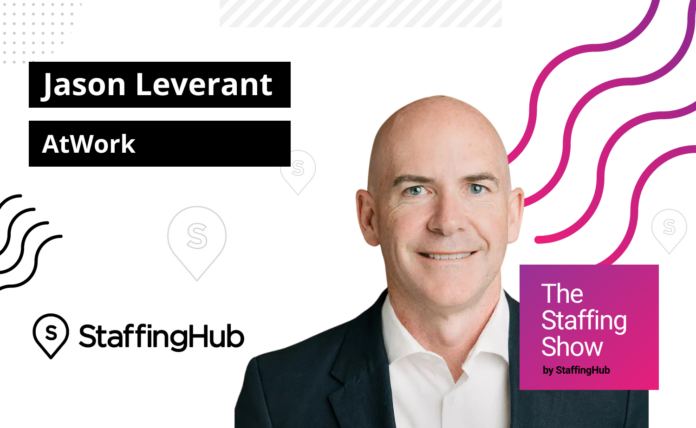
There are so many different recruitment agencies to choose from, but AtWork’s unique franchise model really stands out in this industry. Today on The Staffing Show, President and COO of AtWork, Jason Leverant, joins us to discuss staffing agency differentiation, AI, marketing, and more. Tuning in, you’ll hear all about how Jason got into the staffing industry, what AtWork does, and how AtWork remains unique in this space. We delve into why communication and preparation are key before discussing the power of having physical locations for staffing agencies and why local marketing is so valuable. Jason tells us why he’s such a big fan of looking outside of the industry for new ideas, reminds us why staffing is relationship-based, shares how AtWork’s franchise model differs from other staffing agencies, and touches on how they leverage AI to improve their efficiency. Finally, our guest tells us how he sees the evolution of recruiters/franchise owners in the near future and shares why owners choose AtWork. Thanks for listening in!
[0:01:14] DF: Hello, everyone. Thank you for joining us for another episode of The Staffing Show. Today, I am super excited to be joined by Jason Leverant, who is the President and COO of the AtWork Group. Jason, very excited for the conversation today. Excited to have you on the show.
[0:01:28] JL: Likewise, David. Man, thanks for having me.
[0:01:29] DF: Yeah. This is going to be a good one for all of our listeners. We’re going to be digging into talking about staffing agency differentiation. We’re going to be jumping into AI. Jason’s at the forefront on some of the use cases with AI, talking about marketing, and it’s going to be a good topic, so let’s go ahead and hop in. As always, what I like for our guests to do is learn a little bit about you. If you could just tell us a little bit about how you got into the staffing industry and who is AtWork?
[0:01:52] JL: Yeah, yeah. Appreciate it. It’s funny, just like many probably listening in, I wasn’t planning on joining the staffing industry. When I got into it, I was actually working marketing for a golf manufacturer. I started in that space and was in the recreation world, and it was as fun as what it sounds like it might be, going on a tour with golf pros and doing all that fun stuff, doing marketing for really golf and tennis products. But all good things must come to an end, I guess, right? I found myself out there looking for my next adventure and thought I would be like my father who used this – I didn’t know about them, but basically executive search recruiters, or headhunters. I said, “Oh, I’m going to do the same thing.”
I started searching, and this is 20-something years ago. The Internet was in its very early stages on that side of things. I stumbled across all these employment agencies. I thought, oh, this is the same thing. I went and started knocking on doors, talking with staffing firms, and ended up getting offers from two different firms on literally the same day. It’s like the stars aligned and said, “You should be in the staffing industry.” Ended up starting with Randstad back in 2000, 2003. I’ve been in the industry ever since, man. It’s been a wild ride.
[0:02:59] DF: That’s great. That’s great. One of the conversations, tell us a little bit about AtWork.
[0:03:03] JL: Yeah, yeah, yeah. We’re a different, a little bit different animal than most staffing firms. At the core, at the consumer side out in the field, we have branch locations that are traditional commercial staffing branches. We support industrial primarily, administrative clerical roles, things of that sort, and about 115 pin drops on a map locations across the US. Behind the scenes, in my office here, we have a team of people that work to support and really take this concept and franchise it. We’re one of the few franchise-based staffing concepts. All of our branch locations across the US are locally owned. That’s a unique element, which helps us differentiate when we go to market and really changes a little bit of my day-to-day dynamic and my perspective on the industry, which I feel like helps us drive, be a bit ahead of the curve as compared to most. I’m also a franchise owner, too, where my wife is a franchise owner. I’m a minority owner in one of our franchise locations.
[0:03:59] DF: That’s great. You get to feel both sides of it. You know when you –
[0:04:02] JL: Absolutely.
[0:04:03] DF: – when you make a change, you get to see if it’s going well.
[0:04:06] JL: Yup. I’m drinking my own Kool-Aid, man. That’s what it is.
[0:04:09] DF: How many branches do you guys have today?
[0:04:11] JL: Me and my wife have one branch. She just started. She’s just that venture. She’s considering opening her second location, but she’s doing it very strategically. We’re in Tennessee, East Tennessee, where our headquarters are. She wants to be close to the beach somewhere. She’s being very thoughtful about where we open our next one. If it gives us a nice reason to get to –
[0:04:29] DF: I like that.
[0:04:30] JL: – the beach. We’ll see if that ever transpires.
[0:04:32] DF: Awesome. Awesome. I know that you mentioned that you guys are having some growth this year, which is awesome. One of the things that I was excited to talk to you about is the state of the market and what we’ve seen in the last couple of years. I know that it’s been challenging for the last couple of years for a lot. I think we’re starting to see things pick up at the moment. I’m interested in what your perspective is on how you – I think I heard you at one point saying, sometimes staffing can be our own worst enemy. I’m curious to know, what do you think is going on in the industry right now when it comes to the competitive nature of things?
[0:05:04] JL: Yeah. Well, especially in times like these where there’s this level of uncertainty, we’ve seen top line spend in the industry shrink just a little bit, or showing signs of a potential increase now. But it has not been like the last 15 plus years. Take the COVID years out. But really, this ramp we’ve had since the Great Recession in ’08. We’ve just grown as an industry exponentially. For the last three years, though, we’ve seen a flat line, decline and a very, very slow return. I think everyone said it and we’ve looked at it time and time again as industry leaders, but it’s really focusing on really the driver of this malaise is really uncertainty, both from an economic front, a global, could be war, it could be the stock market. There’s so many different facets and factors. Now we have AI and automation, the future of jobs in the US and globally. What does that really mean for white collar? What does it mean for the levels of automation we see coming? All this uncertainty is really driven a little bit of a slowdown.
When staffing firms start slowing down, they start getting, and I hate to use the term desperate, but it feels very desperate for revenue gains and growth. When that desperation really drives the demand to grow, we start seeing us become our own worst enemy from a price commoditization perspective. I mean, we’re encountering rates in the market that are unbelievably low, unfathomably low. We would never have seen in any times past. It’s difficult. So, yes, we become our, as an industry, our own worst enemy, because these bad actors really poison the well for all of us. Then we have to remain competitive. If we need to keep cash flow moving and keep our staff in our branches with things to do with the job orders to fill, we’re fighting in that we’re being drug down to that space, which is really, really unfortunate.
[0:06:55] DF: Yeah. In competitive times, the pricing pressure can be really intense, and also, it’s interesting to see, and I’ve heard of this more recently in the travel and nursing space, but with the newer startups, where it was like, they’re pricing it in a way that they can’t be profitable. That’s what everybody thinks. After a year goes by, you find out, actually, the model wasn’t profitable. It is that.
[0:07:15] JL: Exactly. It’s too late. You’ve already lost your money.
[0:07:19] DF: Yeah. What are some of the things that in terms of holding on price, but also delivering the value and differentiating your product, how are you guys going to market? What are some of the things that you do to make sure you’re showing up as a differentiated service?
[0:07:33] JL: Yeah. Something, again, I referenced it earlier, but something that’s unique in our model is the fact that we’re a franchisor, so we get this unique benefit as do many others, but we use it as in our minds, a strategic advantage is the fact that we have local ownership close to where the action happens, to where the rubber is meeting the road, where the service is delivered. Inherently, studies have shown, research has shown that service levels are exponentially higher when you have a true vested interest. Not a perceived one, but an actual ownership, a stake at that local level. What we bring to the table is this high-level white-glove service and approach to how we engage with our clients, how we engage with our talent, how we engage with the community.
We’re a part of the community needs, and each and everyone of our branches. I know there’s people out there who work for companies and take ownership in their roles, so I’m not taking it away from them. But in this instance, they truly are owners of the business. They don’t take ownership. They have ownership. It’s something that we found is a really strong piece that we sell. At the same token, everyone says they really service better. You can say it all day long, it’s showing up and actually executing on it. So, we run studies behind our claims, and we consistently see exponentially higher levels of customer satisfaction, talent satisfaction, things of that sort. We’re pretty rabid about our NPS scores. We’re constantly polling and assessing and looking at how we do things, testing change, testing, yes, we can make a change and become more efficient, but what does that do to the client experience? What does that do to the talent experience?
You alluded to it earlier, but we actually have this concept, this requirement that we want to keep a human involved in everything we do all the time, that human in the loop, which we can talk about later. That service, especially in our world, we have to make sure that service is put first and we have to frame our efficiency gains, we have to frame our innovations and change and process around this focus that we can’t drop the ball around that white-glove service.
[0:09:35] DF: It sounds like you are not only focused on making sure you’re delivering the service, but you’re measuring it across multiple angles, like you’re measuring NPS, doing client, talent, and doing all of the above across for measuring the, like how you guys are serving the customers?
[0:09:50] JL: Absolutely. Yeah. Yeah. We service, and we don’t do it – there’s the Best of Staffing Survey that goes out, kind of a national thing. We also look at trigger events that would, for us, are good times to capture, how did we do? End of assignments, beginning of assignments, new customers, conversions, and things of that sort, just to make sure that we’re taking that litmus test, taking the measurements in a science experiment, that we do it regularly and we can adapt to any changes, or any situational components that we just maybe wouldn’t catch if we were only doing it once a year.
[0:10:22] DF: Yeah. How are you bringing that feedback back to the franchise owners, the recruiters? How are you making sure that that happens? Is it something you’re doing consistently in real time? Is it something you’re doing on a quarterly basis?
[0:10:35] JL: Yeah. Yeah. That’s the beautiful thing about the franchise model is we have support teams. Think about them like business coaches assigned to every franchise owner that helps them be an extra set of eyes and ears and they can deliver. We manage all the survey responses and when we get them in, we go hand-to-hand with these franchise owners.
[0:10:51] DF: Oh, that’s great. You’re going out and actually coaching them.
[0:10:54] JL: Oh, absolutely. When we share the data with them and then how do we extract insights from it. In that same token, again, remember, we have an owner who has a vested interest. It hits them where it hurts the most, or the best in their wallets. If there’s an impact, or a positive thing, great, they can high-five, they can reward, they can attaboy, attagirl. If it’s a negative, they can go in and start coaching up to change. It’s really important. It’s interesting the difference in response when you have an owner involved. It’s incredible.
[0:11:19] DF: Yeah. That is incredible. Are you open to sharing any of the things that stand out for high NPS? Any of the attributes that you’d be open to sharing?
[0:11:27] JL: Communication. I mean, is it funny that the basics, is really focus on the basics and really, you win. Everything else just adds flavor, adds elements. At the end of the day, really, clear communication, consistent communication is absolutely critical. Communication with good news and communication with bad news, or just transparent news and letting them know. We found that that one component – that and I would say preparing your talent for a new job, or a new client.
[0:11:57] DF: Oh, that’s great. Yeah.
[0:11:58] JL: I’ll tell you, at the end of the day, we take it for granted. We put people to work all the time and we just think it’s normal course of business. For us, it is. We’ve got David going up to work at XYZ. I know XYZ. I know David. But David doesn’t know XYZ. And so, how are we going to help him be ready to go to work in an overt way? How can we think about every avenue? How can we make him super comfortable? Because you can never really go too far on that front. We can do everything we can, and all we’re doing is preparing them for this new role. That preparedness, that communication – we don’t want any surprises. In our mind, surprises are usually bad. That creates potential risk. There could be even to the point of safety and environmental risk and things like that, where maybe we didn’t communicate a job, or role, or environment, or whatever correctly to an employee and we missed something, and we put them in a position where we’ve created a greater risk for injury, or accident, or whatever the case may be.
Again, communication, transparency, preparedness. And not just on the client end. Yes, they are writing the check, they are placing the order, but the talent are the ones that are actually filling the jobs and they’re the ones who are faced while we’re not there. Making sure that they’re comfortable, they’re prepared, their skills, they’re the right person for the job. That’s really what it comes to. Again, basics. This is like 101 stuff.
[0:13:12] DF: It is.
[0:13:13] JL: You’d be surprised how far it will get you.
[0:13:16] DF: It is. We should actually say that the NPS is the net promoter score, which is a question. I feel like I have that conversation enough times with people where I like, “Go what is NPS?” I think it’s a metric that helps you rate how well you’re doing and it’s one of the core metrics that you can use to identify your reputation out there in the market. It sounds like you’re really putting the candidate experience first and thinking about how they’re doing things.
One part that you mentioned on the communication side of this, I have over the years done NPS for different sales teams. The thing that we consistently saw when we would do the NPS and we just – the entire sales, every individual on the sales team would get, we would tie their customers back to that individual NPS. It was response time was 80% of it. It was not – to your point on good news or bad news. It was the –
[0:14:05] JL: Tell them something.
[0:14:06] DF: We would look at their emails and they’re like, they would just respond on it. Then give them updates on what was going on on a regular basis, and it had a huge impact. That’s really great. One of the other areas that you and I talked about briefly before this call was the impact and importance of having the local setup, which I know you mentioned a little bit about how important it is to have the physical presence, but I had not thought about the marketing elements of that and the value behind that, and I thought you have a unique perspective on how valuable it can be from a handful of ways. I’d love for you to dig into that a little bit.
[0:14:40] JL: Yeah. Yeah. I think that we had shared that in our model, we still have brick-and-mortar branch locations in the markets that we’re in. Again, we’re very avid proponents of having that local presence, being a part of the community, really selling on the fact that you’re part of the community. Having a physical location there creates a rallying point. One, the type of business we do, it’s absolutely critical, industrial talent, entry-level clerical talent. Bringing them in, laying eyes on the talent to screen, to build rapport with the talent, to communicate with them, to a place that they can go if there’s an issue with their check, or an issue with time, or whatever the case may be, it’s a level of comfort that can be had.
There’s a big movement to work from home and go remote, and you don’t need a physical office anymore in the market. I almost laugh at that just a little bit, because at the end of the day, we run P&Ls and we look at our branch locations. The cost of a rented location, let’s just say on average, it’s $2,000 a month, or something like that. What does that give me? In most cases, in most communities, I have a retail-esque location with a sign, with some glass and some opportunities to put some advertising on the glass, if you will. Rarely at times, we’re in buildings, and things like that in larger markets, and that’s less impactful. 90% of the time for us, we have physical locations.
I tell folks, I said, “Listen, this gives you not only the office space, a place to build culture and a rapport with your team to spend time face to face with them, to motivate, engage.” We have whiteboard meetings. We do all the, I hate to say, old school things, but high impact activities that help us thrive in the markets. At the end of the day, so I have all that, but now I just tell people, have you ever looked at the cost of a Lamar billboard on the highway? Even in these small towns. To put a billboard on the highway is $4,000 a month, $3,000, $4,000 a month, you’re committing to four-year contracts. Sometimes you can get it a little bit less, or shorter, but it’s way more expensive. Look at it that way. At minimum, you get a billboard in your community with a sign on it that you can display advertising for the most part. I can put QR. I already do. We put QR codes, apply now on our glass. It becomes a billboard.
I get a billboard and a place where I can be a part of the community, manage my team, build culture with my team, and it’s half the cost of what I would pay for just some graphic on the side of the road. I don’t see the argument. And so, we’ve stayed pretty true to the old bricks and mortar, branch location, have people work, come together. It’s worked really well for us. Like you said earlier, we’re up for the year and fairly substantially over the industry averages. It’s so good for us.
[0:17:09] DF: Yeah, that is amazing. I had not thought about the value of that and then what the actual cost structure is for. You could spend that in Google ads to open up a market on a monthly basis, like you get it.
[0:17:19] JL: But then I would argue, I would still spend some with Google ads, and so on, just to get your word out. That’s a whole different package, so yeah.
[0:17:25] DF: Yeah, do both. Also, just be on Google Maps when somebody types from staffing and all of the elements that – Yeah, tell me a little bit. I mean, we talked about your –
[0:17:34] JL: You’re speaking my language, man, because I am hardcore on Google reviews, having your Google location, asking for reviews. If you look at some of our locations, one in particular I like to brag about is in Raleigh, North Carolina, our owner, Jerry Bland has almost 500, or over 500 five-star reviews now. This is by far, the number one rated staffing firm in North Carolina. Just last week, one of the Raleigh major news stations, I think it was Fox reached out to them, and how did they find them? Well, you’re the top-rated staffing firm. They wanted commentary on the job market and they go to the top-rated staffing firm in the community and Raleigh is a pretty good market, man. That’s to me is major props to Jerry for what he’s doing locally.
I brag about my wife. I think she’s got over 200 five-star reviews. It’s incredible. We have offices all over and we do competitions on who can review. Because at the end of the day, it’s like, we buy products on Amazon, I’m going to buy the one that has the highest review. If I see two products, the same products side by side, and one’s a five-star review and the other one’s a three and a half, I don’t care if it’s a couple dollars more. I’m buying the five-star, because there’s something inherently better about this.
[0:18:39] DF: I can’t imagine purchasing things without reviews. I mean, that’s the world we live in. I mean, the stats behind it are astronomical as well. It’s like, 97% of consumers read reviews online. 41% say they always read reviews when browsing for businesses. It’s up 29% from last year. The impact that it has on your search rankings, on your traffic to your website, and your visibility, it’s a lot. Even with Thumbtack, or doesn’t matter what platform I’m looking at, I’m always looking at the reviews first, trying to filter for the top people. I think that’s a great focus. You’re tying that into, do you have a process of when you ask and how you ask, and is that all dialed in at the branch level as well?
[0:19:18] JL: Yeah, we provide recommendations on when it should occur. I always like to tell people to ask during what I call the honeymoon phase, where you trigger event, when you’ve captured an audience, let’s say, you have talent you’re about to assign, or deploy on assignment. Hey, by the way, if you’ll complete this Google review, it’ll really help me. The recruiters ask that. It’ll really help me out in my role. Obviously, they find great results there.
Other times if we have somebody go permanent, temp to permanent, and they haven’t actually done a Google review, we ask them to do it. We don’t say, “Hey, give us a five-star review.” We said, “Hey, can you go on Google and review?” We try to keep it as straightforward and ethical as possible. You have to be strategic about when you ask. It is a request. But we do ask and I tell people, you have to ask. Because you think about the other side, you talk about recruiting. As humans, we rely on reviews so frequently. If you read a lot of reviews, you’ll realize that there are so many people that will get on. Even a somewhat bad experience, or even a neutral experience, you’ll get a really low review, even if it wasn’t a direct experience with your business. Those are the people who go out and actively go negatively review. We’ve to outweigh negative reviews with positive reviews. That’s where you have to go out and ask for it, because it’s not going to be their natural inclination to go out there and, “Hey, I’m going to review them on Google.” If you nudge them, or ask them, then absolutely. It takes two seconds. They jump on. They do the review. We have QR codes sitting on every recruiter’s desk that brings them straight to the page. We tell them, “Hey, just scan it with your phone and you’re good to go.”
[0:20:44] DF: That’s something you made it part of the culture and the process. You’ve got it dialed in to your focus on all fronts. One of the other moments that you and I had a conversation around is how you look outside of the staffing industry for what works, which is something I believe in so strongly. I always feel like, “Oh, we’re staffing, we’re different,” is a mindset that I don’t always get behind. I always think, not that there are nuances to how things operate, but I think a lot of times, the best ideas come from outside the industry. I would love to know what are some of the ideas you’ve seen outside the industry that you’ve either brought in to AtWork, or what are some of the things that you’re excited about and think are going to be tactics that you use going forward?
[0:21:21] JL: Oh, yeah. I am a huge fan of looking outside of the industry and to retail and to services industries. Personally, I feel like, we can at times, it feels like we’re stuck in maybe the early 2000s. It doesn’t feel like much has changed since when I started with Randstad back in 2003. How do we change the game? Well, it’s a lot of times it means looking outside and seeing what’s working in other industry types. For us, we started – even at the core level, when you walk in one of our branches, it feels a lot different than most staffing branches. I mean, we’re very focused on the talent experience. When they walk in, it needs to feel different. It needs to feel almost like aspirational. It feels very nice when you are very clean, very modern. They’re greeted. We have SLA is where we engage with talent –
[0:22:02] DF: That’s great.
[0:22:03] JL: – and recommendations. That’s critical, critical on the front end. When people drive by, or when clients walk in, they’re like, “Wow, this isn’t what you’re used to.” Again, I’ve been in before. It just feels different. That’s been our goal, and we pulled a lot of that from various other – we mentioned we’re a franchise. And so, we spend a lot of looking at franchise concepts, and we see really cool ideas and concepts that we steal aesthetically in our branches that are replicatable. That’s the beautiful thing is we want to be able to deploy a thing and make sure we can do it systemically across 100-plus branches, and we grow, and it makes sense for somebody to do it.
At the same time, we’re seeing really cutting-edge tech that’s hitting the retail space. Because in the big scheme of things as an industry, we’re still relatively small. If you go to these retail trade shows, or these retail tech conferences, you start seeing some stuff that’s at the bleeding edge of retail, and some of it’s absolutely incredible. One of which, I think we had actually chatted offline about some AI technology that sits as a camera inside the door of your office. Somebody walks into your office, and they immediately can tell based on their phone IP, effectively, or their MAC address, or some other type of technology, and I’m not really sure. I know enough to be dangerous. It basically can tell you really where this person travels, where this person shops. It’s cookie tracking, but in real life with their phones.
Guys, it’s not a creepy thing that staffing is thinking about doing. It’s actively being used in so many retail stores that we go in today. They know, and they’re watching those cameras, what you go and look at, where you spend a little bit of time looking out on a shelf; they know what SKUs are on that shelf. That’s why when you leave, you get those ads that are targeted to say, I was just looking at that thing on the shelf, because it’s tracking literally everything we do in those areas you live in, it’s collecting demographic data. For us as recruiters and people who want to deploy, we have somebody walk in, and it’s using the data and intelligence that it gathers, saying, David lives in this area, eats at these places, likes these different things. Could we see a future where it’s providing job recommendations based on various external demographic data and big sets of data to say, these would probably be of interest, and based on proximity, based on potential median wage information, so on and so forth. It’s incredible, scary, we’re already succumbed to it, that’s the reality. It already exists around us.
That’s very extreme, but that’s the type of technology that we should be looking at, but I think we still are stuck in this rut of looking at some very base-element things that are really challenging for us to implement, and so on. How do we break those chains and start implementing some of this really cool forward-thinking stuff to change the experience for our clients and our talent? That goes back to all that matters is the experience of the clients and the talent. How do we meet them where they want to be met, deliver our services most effectively, and we win market share if we can do that, and that’s the goal. All these things, all they lend to is making it a better experience for clients and talent, and then we win.
[0:24:57] DF: Sounds like, you’re, in a very good way, obsessed about the talent and the client experience and focused on how do we make that better, which is exactly the right place to be. Are there any other things that you’ve implemented over the years that you think that have had a really big impact on something, but the actual aesthetic and the experience of the talent coming in. Where you measure an ROI on that, or are there other tactics that you put in place where you’re like, wow, I don’t think this was happening in staffing until we pulled this in.
[0:25:22] JL: Oh, man. Good question. We explored everything. When I joined AtWork and was really promoted to the position, I started really from the ground up. 2012 is when I was promoted to president. The founder is effectively retired. He said, “Here, I want you to take this organization and go forward.” Really rebuilding it from the ground up. Technology, right now everyone’s looking at technology. I mean, heck, I was talking about technology implementation. But that just really, in my mind, and I think we have to keep drilling into ourselves, that’s augmenting the experience. At the end of the day, this is still very much a relationship-based industry, where it’s a human connection. We’re still impacting people’s lives.
In my mind, I think us driving our underlying mission, maybe it isn’t anything novel, but it’s really this driving focus. Every person that walks through our doors, they know what our mission is. They know our focus to make an impact in our clients and talents lives. We do that through high levels of service. We do it through the experience that they have. Again, it’s not anything novel. It’s just a reaffirmation of some of the basics. Then it’s creating this culture, this unyielding culture of service first and service focus. For us, that’s really what’s driven.
It may not be as exciting, or cool, or innovative as what some of them might think, but it’s funny, because it is fairly rare. In this day and age, we play in our markets, and we find a lot of our competitors aren’t focused on that. They’re focused on purely just scraping by and invoicing a new customer at whatever rate just to get it. Then they usually lose it, and we come in, and we service better, and we win and retain customers.
[0:26:52] DF: On the note of, I mean, it sounds like operational discipline and really good execution and the most recent State of Staffing that we just came back, and we looked at the highest leverage elements that tied and correlated with growth. The most boring one was the highest correlation was operational discipline. It was, do you have meetings holding your team accountable? Do you have processes? Do you have goals? Like the basics.
[0:27:16] JL: Yeah. As a franchisor, what’s a franchise? You think about McDonald’s, you think about Subway, it’s a process, and that’s what we do. We build a consistent process, and we execute, and we hold our coach, our field team, accountable to helping our field execute on the standard processes. We call them playbooks. I have a sales activity playbook. It’s how we execute on sales, and it’s like running plays on a football team. We run the plays, we do the same plays, and they win. If they don’t win, we change the plays, and we try to find the one that wins, and that’s the goal.
[0:27:44] DF: Well, it’s interesting talking about, with you having a franchise model, versus the, a lot of the people are listening to this have their team and their managers that are reporting directly to them, franchise is a little bit different relationship. I would argue maybe even harder to implement change. What are some of the challenges that you’ve learned over the year, or had over the years? Are there any ways that you’ve been able to get people onboard in a more impactful way?
[0:28:08] JL: Yeah. Change is hard, whatever environment you’re in. But yeah, you really call that you would think when change is made in a company-owned environment where we have employees, we just tell them, this is what it is, and this is what we’re doing, and it’s because I said so kind of situation. We know that’s not how it is in life. You need to create buy-in; you need to create engagement. The same in our world. I would say it’s actually more challenging, because we have folks that are very – they’re owners. They’re entrepreneurs. It’s not an employee-employer relationship. This is a partnership that we’re in, and I have to show them why the change. I’m selling really why this change is beneficial for them and for the entire organization.
Then if we can, if we can mandate something, then we try, but we do it very tactfully. It’s challenging, but it’s definitely doable, and we’ve done a number of changes over the years. We’ve attempted to change, and sometimes we pull back. We’re also realistic, and we’re reasonable as well, too. We are willing to adapt, because we know everybody brings a valuable input, experience, and observations. Because again, for the most part, we’re not in the field every single day. We’re not out there talking to clients and talent every single day. They are. They’re our eyes and ears into the realities of that market. Again, now that my wife is an owner, I get to hear about it all the time, man. It’s so good. I don’t ever get away from it. Yeah.
[0:29:23] DF: You’ve got the real-time feedback loop happening at the tightest moment.
[0:29:26] JL: Oh, man. Every night at dinner. Every time.
[0:29:30] DF: This is a bad process. We’re changing it today. I love that. I want to jump into AI. I don’t think you do a podcast today without talking about AI. I will say that our earlier conversations, I think you might be as far out at the forefront as anybody I’ve talked to that’s working on a staffing firm that is not a technical person. What I’d love to know is we’re cutting through some of the hype; where is AI actually delivering value for you today? Do you have any experiences, or things that you put in place where you can see a measurable ROI, or how are you using it AtWork?
[0:30:03] JL: Yeah. Yeah. Just to add some color to what you had mentioned, I have my OpenClaw device sitting at my Mac mini sitting under my desktop and running my fleet of agents, doing various tasks. I know that’s really not the reality for most people, and most people are basically lucky to have you, their Copilot turned on on their MS365 licensing, or maybe they have a ChatGPT, or a Claude account. Personally, I feel like you have to be using it today in order to – even at a base level using it today. Most people are; I saw it. Was it OpenAI just surpassed a billion users, or something like that.
[0:30:40] DF: That’s so crazy.
[0:30:40] JL: Incredible, incredible amount of users. Yeah. Claude just keeps ramping up. They just dropped their new release. There’s this battle back and forth. It’s like Ford-Chevy.
[0:30:50] DF: That’s great.
[0:30:50] JL: Which one do you choose, or whatever? Whichever one you choose, I just recommend use it, but use it responsibly. Use it under a paid account. It’s 20 bucks a month for those that are listening and don’t have a corporate sponsored account. The reality is it creates an opportunity to really expand your ability to do things. I was telling you, the way most people use it today and it feels like a glorified search engine. A lot of people just put it into, basically, they do a Google search and that’s what they’re looking for results. Or, maybe it’s compose this email, or help me write this thing, or whatever the case may be. They’re purely generating some form of content at a base level. I tell so many people, I actually just did a little mentor session with one of our up-and-coming accounting staff, who’s pursuing their minor in Applied AI, is the light bulb will go off when you start seeing autonomous agents doing things on your behalf. For me, that’s when it really clicked that there can be a massive, massive efficiency gain.
We’re actively in the lab playing around with creating autonomous agents and guide and framework to help do certain aspects. Aspirationally, we want to see automated reference checking and automated different components of the business. See, there’s so many things that already exist out there that what I would consider, and I don’t want to knock any vendors out there that are partners of ours or anybody else, but there’s a lot of vendors out there who are selling a feature, a piece, a small piece of the puzzle, which these new tools should be able to create and automate at very low to no cost very, very quickly.
I personally believe that we’re going to see how we, as an industry and as a society, the way we view SaaS software is going to change. I think those that are out there in the SaaS software industry should be taking note. I know they are taking note of how do I start delivering a greater level of value than what somebody can go with together with a Claude code and automate. Despite it not being anywhere as near as eloquent from a code basis with that SaaS platform is it gets the job done, and that’s all they’re really looking to do.
I went the long roundabout way on your question, but we’re actively looking at ways to implement AI. We’re doing it on our business intelligence and our reporting end. We’re doing it in our screening end. We have tools that will screen candidates to a limited extent. We’re being really careful with that. We have presence in a number of states where there’s regulations, so we want to make sure we fall within the guidelines of the various state laws and things of that sort. We’re looking ultimately to deploy at every department within our corporate organization in some form or fashion. What unique way can we install an autonomous agent, or a support agent? That’s our project in the near term is to engage with our department leaders, identify use cases, even if they’re simple use cases, and execute on it and deliver on it at a very base level.
[0:33:40] DF: You’re the first person I think I’ve talked to. I brought up OpenClaw. I also have my Mac mini over here, and I –
[0:33:44] JL: I bring that up with people, and they’re like, “What are you talking about?”
[0:33:47] DF: It’ll open your eyes very quickly. What are some of the use cases for you that have been surprising the most? What are some of the things that you’ve done where you’re like, “Oh. Holy cow, I had no idea”?
[0:33:59] JL: Well for us, and these are really early, so and I’m getting people comfortable from the marketing end of the spectrum, really creating autonomous marketing resources and schedules, where obviously, we need to keep humans in the loop verifying. Eventually, we put enough parameters around our prompting. We won’t need to have as much human. It would be more of just spot checking. It’s like any employee, right? Initially, you don’t trust that they’re going to get it right, but you’d be surprised how fast it starts getting it right very, very quickly. We’re not talking about just basic graphics. We’re talking video campaigns, motion graphics, social media, a holistic approach, to the point where I would dare say, I could probably stand up an entire digital marketing agency with OpenClaw and a couple of add-ins, and we could run this thing humanless. But that’s never going to happen for us. We are way too anal about what we put out there, and we want to make sure we have eyes on everything.
Accounting, accounting are really low-hanging fruit use cases for payroll processing. Again, although for us, just rewinding back as a franchisor, we’re a service company to our franchisees. It’s all about high levels of service. It’s about experience for our franchise owners. Yes, we’ll automate where we can, but we’re not going to take a human out of the equation, a relationship that’s built between an owner and ourselves, because we are a service company and we are really dedicated, committed to keeping a human in the loop there.
[0:35:23] DF: Yeah, it is such a crazy thing to think about how it’s changing work for all of us and how much more – We’re just on the cusp of what it’s about to change. I feel like, the human in the loop thing is going to be something we all get more and more comfortable with as we realize that there’s a lot of our jobs that – it’s like, what I think OpenClaw is the moment where I was like, “Oh, if it can be done on a computer, which is what all of us do all day, it can be done with AI.”
[0:35:47] JL: I came to the exact same conclusion, and that’s where – For me, I was almost a naysayer. I’m like, AI is not going to take jobs away. Then I experienced OpenClaw, and I’m like, oh, my gosh, it has the real potential to do that. If this is in its infancy, just imagine where we are in a decade. I mean, it’s –
[0:36:06] DF: The new Claude Fable is 80% on agentic coding and also can take over your computer and run your computer as well. It is –
[0:36:14] JL: Yeah. Cowork is incredible.
[0:36:16] DF: I feel like so many people are like, “I use it for this. It’s okay.” I’m like, it’s about getting, if you get the context right, if you have the right direction, the right organization, the right harness for it. Then people figure out one of my favorite things with friends is like, “I don’t know where I would use it.” I’m like, what’s your biggest challenge? What are you struggling with right now? Tell it back. Just put that in there.
[0:36:35] JL: Tell it and ask it, hey, how can I automate this, or whatever? Where we’re using it, it sounds almost, it’s like, not cannibalism of code, but we’ll use ChatGPT to draft our prompts, like extensive, huge prompts –
[0:36:46] DF: Oh, yeah. That’s it.
[0:36:47] JL: For Claude Cowork. Because for me, now also the light bulb comes on, because when you start using agentic AI, you have to be – especially one that is intended to be autonomous, you have to be very careful with what your prompting looks like. We’re not talking about two sentence prompts, or even a paragraph prompt. We’re talking pages long prompting to be very granular in that approach. We use ChatGPT to create, if I have to create prompting for Claude. Now Fable. I haven’t really played with Fable that much on that front. It’s too expensive, by the way, and overclock. Really, really expensive.
[0:37:19] DF: I run out of tokens within 30 minutes.
[0:37:21] JL: For real, man. Yeah. Yeah. So, going back around to your original question, I mean, I could tell you, yeah, we’re using chatbots with our talent that does screening and interviews and helps match to take all that. That’s par for the course right now in the reality we live in. Those things to me, you have to be looking at these to stay competitive, to stay from an efficiency standpoint. What we’re talking about, man, this is really the future. If you can bring this. I mean, I was toying around with this idea of creating as a use case, or an experiment, a fully autonomous humanless staffing firm with chat agents that are prompted to focus on service to engage, and I believe there’s some platforms out there.
I haven’t engaged with them yet, but there’s a platform that helps facilitate a fully automated staffing service, where client engage with your robotic agents; we name them and everything. We have a talent pool. We would pick one vertical. We’d probably create a new brand just because it’s a test. We’d create a small brand and focus on – I’m making this up right now, but security guards, or banquet serving, or something like that, and put it out in the market and just test it. Fully autonomous. But focused on service, focused on communication, focused on all the things we talked about. Maybe six months, nine months down the road, we’ll get back on a call like this, and I’ll tell you about it if we end up executing on a plan.
[0:38:35] DF: I mean, one of the previous podcasts I had on had meet DWIGHT, who is maybe that. Is that who you’re talking with?
[0:38:41] JL: No. No, no, no. Actually, the guys at Wolf, but I actually had dinner with the founder and CEO of Dwight. Yeah.
[0:38:46] DF: Yeah. I had not thought of this. I mean, they’re building autonomous agents to do services, like accounting services, and they were actually talking about white labeling those and giving them to staffing agencies for staffing agencies to sell. Yeah.
[0:39:01] JL: Wow. I mean, in the industrial space, man, so it’s the same argument, and this is a whole another worth of podcast is humanoid robots. Now that you put humanoid robots with AI onboard AI that’s holistically aware, we’re seeing that. I mean, I figured that stream. I don’t know if you watched the live stream, where it was sorting packages and basically hit human numbers with zero inaccuracies. It was incredible. Incredible. That’s next.
[0:39:26] DF: It is a weird time to be alive. It’s exciting. It’s one where you’re – I’m just like, well, it’s happening. Let’s lean in, lean in and learn. I know you brought this up quite a few different ways in terms of the human and the loop. I think there’s the way you’re talking about is like, what are the things that we can have this do that maybe aren’t really value-add for a human? It may be something that they wouldn’t want to do. What’s your viewpoint on, this is a hard question, but a few years out, how do you see the role of the franchise owner, or the recruiter changing? What do you think the version of in the loop will look like?
[0:39:59] JL: Yeah. I mean, I think in, as in many industries, we slowly see ourselves less becoming the executor of the action and more becoming the orchestrator of the actions. I actually just sat in an AI session at a local university here and they were talking right at this idea of three variants, you have human, or AI with human in the loop, or human on the loop, or humanless, human out of the loop, which is like, it’s basically levels of involvement. I think we’ll see that where the human out of the loop will be the very base, what I would almost consider traditional matching RPA type automations, like an if this, then that consistent approach.
Where a human on the loop is more of the, we’re just really looking at stuff and making sure we become a true just quality inspector, if you will, of the work of AI and we have to watch it, because it’s happening so fast. We’re looking for exceptions and things like that, where a human in the loop is basically using the AI as a tool to do your job more efficiently, more quickly, or whatever the case may be. I think we’re going to see that be the case. Now with recruiting and human engagement, I think we’ll still see that human in the loop versus on the loop, or out of the loop for most cases where we have. Until at some form of a future as humans, especially in America here, our personal identities are really tied to our jobs, like what we do. I mean, when you meet somebody new, you usually have, “Oh, hey, what’s your name?” I’m going to ask for, “What do you do for a living?” That’s a common. That’s our identity, right? That’s very personal to us.
I still think recruiters, we’re engaging with people talking about that thing that is still innately personal to them. As long as that’s the case in our culture and in our society, I think we’re going to see humans heavily involved in the recruiting and talent engagement side of the process, especially in a position where we’re helping somebody find a role that would be more lasting that has the potential to be a longer-term career. We’re talking about pure transaction type of relationship. Think about an Uber driver requesting a ride, or whatever the case may be and I provide a service as a human. I drive somebody somewhere. That’s very transactional. That can be automated out.
[0:42:10] DF: Yeah. Waymo’s here.
[0:42:12] JL: Yeah. Well, now we’re even talking about another animal, that autonomous piece, but humanoid robots, which again, another discussion. Yeah. I think as long as that stays the case, we’ll have humans in the loop on conversations around longer term employment, things of that sort, non-transactional type employment opportunities, non-gig type employment opportunities, where we use these tools like a skilled tradesman uses the next available tool in their specific trade, the next Dewalt cordless accessory in our toolbelt that we use to do our thing faster and more efficiently, so we can remain competitive. We want to think we can make more money with it, but really, at the end of the day, we remain competitive with our peers, who are also wielding these same tools.
[0:42:54] DF: Yeah. Couldn’t agree more. I feel like, there are tools that we have at our disposal, we should use them and move forward with it. I want to wrap up with, and I know we talked a little bit about AtWork at the beginning of this, but as a franchise, why are staffing owners coming to you guys? Why are they choosing to open up a branch with AtWork?
[0:43:13] JL: Yeah. Yeah. Great question. We are one of a handful of staffing franchisors that exist out there. We’re actually the only one, and I would recommend taking a look at the different options. If you have any interest in entering the staffing industry, or if you’re in the industry, if you had this inkling of, “Hey, you know what? I could do it myself, or I could do it on my own,” come talk to us and we can show you uniquely and how distinctly different AtWork is. Our model creates a much more independent feeling structure than the other models out there, where those might feel more like you’re running a book, a business for the franchise. It’s primarily in the structure and how we’ve created our franchise opportunity.
We’re very efficient. We’re very effective and we’re very forward-thinking. That’s really driven a lot of our interest in our brand. We’ve got phenomenal marketing, amazing leadership team, and we put all the parts and pieces together to create, in my mind, one of the leading staffing companies, not just franchise companies, but franchises and staffing firms in the US.
[0:44:11] DF: That’s great. You’ve got the growth to back it up this year. Beating the industry is a nice place to be.
[0:44:16] JL: Yeah. Shameless plug: we’re offering an incredible opportunity for staffing industry pros. We’re deferring franchise fees. We’re taking requirements down. We’re making it so easy to step into your own branch.
[0:44:27] DF: Awesome. It was great talking to you, and have a great day.