

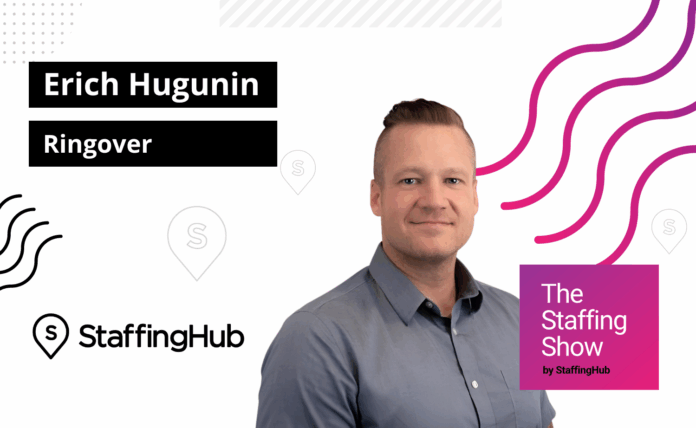
How can you use AI to make your existing teams more productive? Today, we are joined by Erich Hugunin, VP of sales at Ringover, to discuss practical ways to do just that! Tuning in, you’ll hear all about Erich’s career, what they do at Ringover, the importance of using AI in your business, the kinds of specific processes it improves, and so much more. We delve into some common mistakes to avoid when adopting AI in your business before discussing some of the trends Erich is seeing in staffing and where he sees it going in the near future. Finally, our guest shares what he thinks a modern staffing firm should look like. To hear all this, and even be reminded to humanize your AI writing, be sure to press play now!
[0:01:13] DF: Hello, everyone. Thank you for joining us for another episode of The Staffing Show. Today, I am super excited to be joined by Erich Hugunin, who is the VP of sales at Ringover. Erich is a longtime friend. Known him since seventh grade. And actually, the reason I am in the staffing industry. Erich, I am super excited to have this conversation with you today and hear what you’re doing at Ringover and how it’s impacting the staffing industry.
To give you guys a little context on what we’re going to be talking about today, the conversation is going to be all about how you can use AI to get more out of your existing teams. We’ll be discussing how it’s changing recruiter productivity, tightening up workflows, and also creating a better experience for both candidates and clients. And as Erich mentioned right before this, it is also significantly impacting the day-to-day workflows of recruiters by helping to coach and kind of curate better experiences for everybody involved. Thanks so much for joining, Erich. Happy to have you on the show.
[0:02:10] EH: Thanks, David. Yeah, excited to be here. Can’t believe this is the first time.
[0:02:14] DF: I know. It’s wild. It’s wild. To hop right in, why don’t you tell everybody how you got into staffing, and then we’ll jump into a little bit about Ringover.
[0:02:22] EH: I joined staffing a little over 17 years ago during the ’07, ’08 crash, which was a great time to get into staffing. Bartender at the time, got in a company, helped start a first company called Travelers Haven. We did corporate housing and travel for healthcare staffing firms. Kind of a glutton for punishment, jumped in the startup space, was there for almost seven years, and joined TextUs for 10 years. Was a team at RefAssured for a little under two years and joined Ringover earlier this spring. So over the last almost 20 years across four different companies across the industry. I’ve seen a lot has changed throughout the years.
[0:02:55] DF: Awesome. Good background and heavy on the tech side for the staffing industry. Tell us a little bit about what is Ringover and what are you guys excited about and working on?
[0:03:03] EH: Yeah. When I first joined Ringover, it was one of those things when they first reached out to me. I was like, “What was exciting about it?” I called a couple different industry friends and tried to get a good idea. I was like, “Oh, it’s another voice solution. How is it different?” There’s 300 voice platforms throughout North America. And the big reason for joining here is it’s AI-first integrated omnichannel communication platform. What do I mean by that? Our AI is over top of everything that everyone’s doing.
And some of those scary words for everybody, right? Staffing right now is AI. We need to use it. They don’t know how to. And what Ringover really does a great job of is just bringing that so it’s very user-friendly. Kind of works in the background. And that’s what we’re going to talk about today is how can it make your team more productive? And so for us, we’re a voice platform, or WhatsApp, text message, you name it, all directly input right back into your ATS. So the goal is to make it easy for the recruiters to work and do their job, and have the AI do everything in the background for them.
[0:03:56] DF: Yeah, it sounds pretty incredible, and I haven’t actually seen a demo of it, but I know the impact of AI on call transcripts is right. It’s been meaningful for me even in the way I’m using it. One of the areas that you and I have talked about a few different times, but is the industry is going through a bit of a margin squeeze. Everybody’s trying to figure out how can they do more with less. How do they increase recruiter productivity? What are some of the ways that Ringover is having an impact, and/or what are other tools that you’re seeing have an impact from an AI perspective?
[0:04:27] EH: Yeah, I think I was in Omaha earlier last month and was fortunate to meet a couple different large healthcare staffing firms there, and they all talked about how they’re starting to hire right now. And one thing I gave them a pause on is like, “Hey, why are you trying to hire right now? What’s the big reason?” “Oh, we’re going to start getting more jobs again. We want to grow the team.”
And a few of the leaders I’ve been talking to, they use this time, that down period to look at how they can invest in tech. How can they make their existing team more efficient? And that’s a big place where AI can play a role. Actually, you told me beginning of this year, I was using AI for things like help me with a recipe, help me with a fight I got in with my wife, things like that. I wasn’t using it in my business on a day-to-day basis, right? Go plan me a vacation. And you said, if you’re not using AI for at least an hour a day, you’re going to be passed by your peers by the end of this year. And that’s what made me really focus on it. That’s what got me excited about joining Ringover.
And as we look at what leaders should be doing, it should be that. AI should be involved in every part of what your team should be doing. I had a chance to speak on a panel with Avionté back in August, and a fear people have is how is AI not just replacing our recruiters? It will replace bad recruiters. It will replace bad staffing firms. The good staffing firms are going to adopt it. They’re going to use it every day, everything they’re doing. And it’s going to make them more efficient and be the ones that move to the top. And so that’s something I really focus on is how do I use it? How does my team use it?
Long gone are these days of notebooks that we all had on our desk. That’s one of the many ways. I still keep them here just in case. My goal is to throw them all away by the end of the year if I haven’t written them in a year. So that’s one of many ways of how it can help you, from taking notes to helping you proactively, to helping you plan your day. And so that’s what we focus on is – and that’s what I talk to everybody about is just really think of the life cycle of both your candidates’ journey from the minute they come to your website and the chat you have to the very end of how you’re submitting them.
And the same thing for your recruiters. What are they doing when they first show up to the very end of their day? How is it helping them? And so that’s one thing I think when people look at this squeeze is pause that. Don’t just do what you’ve always done and hire. Think about how you can make your existing team more efficient. They make more money, you make more money. That’s the goal, right, with your firm is to do exactly that.
[0:06:52] DF: Yeah. And what are some of the specific use cases that you’re seeing that have the biggest impact when it comes to either recruiters, call transcription? What are some of the processes you’re seeing it improve?
[0:07:04] EH: Yeah, for sure. One of our initial main products we joined, and it’s one that everybody should use, is when you’re doing a phone call, when you’re doing an interview via Zoom, Team, you name it, AI should be sitting in the background. It should be taking your notes. Everybody’s doing recordings now, right? I think the challenge is a lot of people are taking that recording. They push it back into their ATS, whether that’s Bullhorn, Salesforce, you name it, Avionté. But who’s going to go listen to a 40-minute call? I don’t, right? All of my team’s calls are recorded. The whole goal is it’s recorded. Great. You have data security, you have that information. But if you’re not doing anything with it, the data is worthless.
And so, one thing that we really focus on is structured data. That’s one thing I try to talk about a lot. And if you look back in the 2020 boom, structured data, clean data in your ATS or CRM was key to creating automation. It’s no different with AI. If you’re going to go look at using AI agents or any of those tools, you need to have structured data back there. So, what does that mean? Same thing with actual insights. Data that can go automatically update fields in your CRM, in your ATS. Those are what you should be doing when you’re using it. And then that then allows you to do steps after that call. Post analysis, post call, post interview, post teams meeting, you name it. The data is in your system. It lives there. You never have to rely on a person to enter it anymore.
Let’s be real. I’m probably one of the worst sales people I’ve ever worked with at entering data. I love keeping it in my head, right? That’s great for me. But if I’m not in the meeting or somebody else didn’t make it, they don’t have that. And so, it’s really important when you’re using it to make sure it makes it back into your CRM, or it doesn’t exist, right? That’s a rule we hear from every staffing firm we talk to is if it’s not in ATS, it doesn’t matter. It didn’t exist.
And so, something we have to think about with people is how are you using it? First, just to get the data back into your CRM. The next is what can you do with that data? And so, that’s kind of where we think about the life cycle or the process of that. I think about that for ours is that’s where it starts. And we actually should roll it back. It starts before that is what about when they come to your website? What about when somebody calls in? What happens if you miss a call? And so that’s where you think about tools that can help answer that. Are you using AI for your call routing? Can it help pre-qualify those leads?
We have our AIRO Coach product. We have AIRO Chat. It can sit on your website. All these solutions that people can think about. You have to really take a step back and we look at what is the way you’re going to use it. It should be from the beginning to the end of a life cycle.
[0:09:22] DF: Yeah, it is crazy. The use case for call transcripts is something that I know you and I have talked about quite a bit, but it’s something I started using personally, not through Ringover. I don’t have a Ringover account, but I was using it and it has been game changing in terms of the coaching insights that you can get from the one-on-one calls you have with your team to the sales calls, to the success renewal calls, whatever those conversations are. And I feel like the impact of this for those of you that are listening is that I had one of my advisers said, he’s like, “With the ability to have this AI coaching today, you may have a manager to recruiter ratio of 10 to1 or 20 to1.” With coaching tools like what Erich’s talking about, the possibility of going 40 to1 or 60 to 1 and having the coaching happen, I think the efficiency gains from a manager level are immense.
And also, I have my team running their call transcripts through a coaching tool and getting feedback, and the outcomes are the learning cycles are now daily without manager involvement, which is insane. And so the impact is really immense when you think about what happens when you can have real time coaching that doesn’t require a manager to step in. And arguably, a lot of the coaching that I’m getting that my team’s getting is way better than what I would have been able to give to them. It’s way more detailed than what I was going to do and more specific than what I was going to be able to communicate as well.
[0:10:56] EH: Yeah, when I look at the coaching piece, again, a lot of people think, “Oh, it’s going to join my meetings and calls and pull it back into my ATS. That’s great.” But in an industry that’s got 30%, 40% attrition in staffing and recruiting and sales where I’m at, we’re 10% to 20%. Right? Coaching is everything. How quickly can I get someone up to speed and how quickly can I make sure they’re on brand and on par?
There’s small things we all think of. I say “like” a lot. I don’t know if that’s the Iowa Midwest in me. I got a guy on my team. He realized in every 30-minute call, he says “you know” probably about 20 times. It can pull out certain words. Vice versa, one of the women on my team, she’s from New York. She is on point and she is over 250, sometimes 300 words per minute. Every time I get on a call, I’m like, “Jasmine, how much coffee did you have before that call to bring it down a notch?” You can shoot a goal. We had a call with a Bullhorn customer, and she showed that feature, and he laughed. He goes, “We’re in Alabama. If we’re above 200, I’d be surprised.” There’s small things like that about keywords and things you repeat yourself on.
But what’s fun and the direction it’s going for us, for example, we use MEDDIC. You can have it check off all the boxes while you’re on the call. AI Coach can just be there. So if you’re asking all the qualifying calls, or you’re asking certain things. So if you have these profiles or that call structure you want your team to use, that’s the direction where it’s going. To your point of coaching and getting them up to speed, we call it our AIRO Coach. AIRO Coach is going to join a call like this. If you ask me a question I didn’t know how to answer, it’s going to go look in our knowledge center, try to populate it for me. If that doesn’t work, it’s going to go search interwebs and try to find the top five best results.
Imagine a junior recruiter being able to talk about a very technical Ruby on Rails position with somebody where they have no knowledge about that position, but it can use your knowledge hub to inform them. If somebody says, “Hey, I’m a Java developer.” And you say, “Oh, we’re not looking for Java right now. We’re looking for X.” Well, those could be very similar and that recruiter wouldn’t know because they don’t know the difference there.
And so if a solution can say, “Hey, this is very similar to Java and here is how it works.” That’s the direction of where coaching with an AI should be going. Again, you’re just making your recruiter more efficient. You’re making them show up and have that info without having to have their boss listening to their calls or joining it. You’re just helping them feel more confident earlier within that process.
[0:13:22] DF: And so it’s automatically taking the call transcripts, throwing it into a MEDDIC analysis, dropping that into the ATS. Is it doing real-time coaching while they’re on the call?
[0:13:33] EH: That is what we’re releasing this month is real-time coaching. Initially, it’s going to be for Teams meetings, Zoom meetings. What’s coming later this month is even on phone calls, it’ll pop up in your dialer and be there helping you answer those questions. That’s what really excites me when I see the direction where it goes. We always talk about like generative AI, things like that. It’s like agentic. Where can this help me in my day-to-day processes and help me be more efficient? That’s it. That helps it.
Somebody who’s young or new to a new position, maybe they come from a different industry, they don’t know staffing, they don’t know the lingo, right? That’s going to get them up to speed really quickly and make them feel confident, and that’s going to help improve it for you as a company. And you can go back and go see how that call was rated, and you can see those key points and moments where maybe they missed out on that.
[0:14:17] DF: Internally, I’ve created my own gradient system for our calls, and Rachel and I have it. Every time we get down, we put it in there. We’re just like, “Are we ever going to get into this range? Can we ever get an A+, like an A rate –”
[0:14:30] EH: In our product, you create a profile. We have a staffing firm in the UK. They’ve created 370 profiles. For every single specialty they call to, every single person they call to sell to, HR director, you name it. It grades against that. And what’s cool with that –
[0:14:47] DF: They create the specific personas to grade against.
[0:14:49] EH: Exactly. It creates every persona, and it’s going to grade differently. And you just switch the persona, and your score changes. On that exact same call, it’s different.
[0:14:57] DF: You’re giving me ideas on how to improve our platform.
[0:15:00] EH: Exactly. Right. That’s the direction of where I think it should be going, right? Is it’s not just bringing the data back in. It’s helping you live in the moment, feel more confident in what you’re doing. The more confident you feel, the better you’re going to be at sales.
[0:15:13] DF: Yeah. One other area that I think you touched on there, which is extremely impactful in terms of AI ROI, having AI be part of your existing workflow. All of the data that I’m seeing, all of the anecdotal conversations I’m having, the most impactful AI is the stuff that doesn’t require a ton of behavior change. So, being able to loop it into what you’re already doing can be pretty meaningful. With that, I was curious if you have any common mistakes that you’ve seen when it comes to adopting AI, different approaches, things that people should avoid when it comes to AI.
[0:15:48] EH: Yeah, it’s funny. So, taking a step back, let’s just go back to the call recordings. One thing we hear from a lot of people is, “Hey, that’s great and all.” Well, we use Gemini. We use ChatGPT. Our recruiters already do that. They take our call recordings because again, everybody has it or meeting recordings or any solution they’re using, your email, you name it. And we just go put it in there, and it helps us generatively help us write that.
Well, a big thing you should think about is take a step back, pause that. What’s the risk with that? Do you have enterprise edition of ChatGPT? Do you have enterprise edition of Gemini? You probably don’t. Or are they using their personal version of it? So, they’re taking that whole conversation, that whole email, that customer quote they just sent, and they’re going to go put it in there. It’s going to help them write that email. It’s going to help them summarize the call.
Well, what happens when Jessica leaves and she goes to AB staffing down the road? All of that info leaves with her. As well as you’re taking all of your data, right? Your information, your ATS that is core to who you are as a business, and you’re putting out there on the internet. So you don’t have anything siloed, nothing secure. So, all of that’s leaving.
We all talk for years about let’s make sure our calls, our texts, our all of our candidates applying are living in the ATS, right? Secure all of that information. They can’t export anything out. You’re letting them copy and paste it and literally put it out on the internet. You’re feeding these other models by doing that. That’s a huge risk for you. It’s thinking there around that, like just that piece alone should be a reason to try to use a platform that’s integrated into your day-to-day and make it simple working in the background so your team doesn’t have to also leave what they’re doing. That’s a whole other part. Anytime you’re clicking off a screen, there’s room for error.
[0:17:24] DF: Yeah, it is crazy just to think about. I mean, I think as leaders, a lot of the executives they all read the stories of – I don’t remember what company it was early on that had somebody, a bunch of code was leaked because it was put into an AI tool, and then everybody was getting visibility into it. Once it goes into an AI tool that’s not enterprise-level, it is potentially going to end up in the public knowledge base.
And then you think about, it’s like, “Oh, well, everybody knows that.” But if your team doesn’t know that, if a new recruiter doesn’t know that, and you don’t have the path for them to use it correctly, there are some huge risks there in terms of the data integrity. What are some of the other areas while we’re on kind of the AI specifically? Just curious on a personal level, what are some of the other ways that you’re using AI? Whether it’s your day-to-day productivity, anything outside of Ringover where you’re having big impact and big gains.
[0:18:12] EH: Yeah, for sure. Some of the new ones that excite me that I’m seeing, there’s a lot of tools out there that are starting to come out with this. One we’ve just released is our coaching. I talked about how that can join your call, but it’s a pitch room. The ability to train your recruiters and salespeople against AI. Why should I, as a manager, take an hour of doing a fake cold call with somebody or fake recruiting call, right? That can all live and breathe within your communication platform or whatever solution you’re using, right? They should be calling that. It already has all your information from your calls.
For ours, for example, we call our pitch room, AIRO pitch room. They can go in, and they can call it just like they’re calling a CEO. They use those same profiles you built, and now you’re calling that person. And so your team is up to speed. Again, it’s grading it, scoring it, you name it, however you want it to, you get that kick back. It’s a great way again to scale your ability to bring people on board without having to scale the number of people that you actually have there, right? How many trainers do you have training hours, right?
And so those are things that, at scale, again, where can you make them more efficient? And so I think again when we look across your whole just scope of what you’re using AI, it’s back to what we saw in 2020, right? COVID was the automation era. Everybody realized they had to have automation. That was the boom for that. And now I think it’s switching to AI. It’s that same thing. So when you focus on this, it’s how can you use AI for that same type of efficiency within your business that we should all be focused on?
For us, it’s around all the communication, but there’s also tools that look at your sales, your pipeline. You should be coming into the day. Our goal, right, is to come into a day and have it in the morning when I go to get on a call like this with you, David. It’s going to have our last five emails we talked about. It’s going to prep me for what we spoke about. It’s going to have five bullet points. That’s what I want. Because otherwise, guess what I’m doing? I’m going to look in CRM, look at my last few emails at with you, check on all of that. Why should I have to be doing that, right? It should be, “Hey, you’re talking with David today. You’re doing a podcast. You guys are talking about AI and this. Here’s what your last three phone calls were about when you prepped for this.” Or whatever it may have been. Here’s your phone calls, emails, and texts all in one place. Wow, that’s great. You’re going to go into it feeling more confident and just be able to be more successful overall.
[0:20:19] DF: It does that today?
[0:20:21] EH: That is our next step. And I’m really excited about that one.
[0:20:24] DF: I feel like I’m doing that manually through HubSpot, ChatGPT, another tool. I’ve got like four tools that I use to get – I try to get to where you’re talking about manually at the moment.
[0:20:37] EH: That’s the goal of where we want to go in first half of ’26 is that. Show up. It’s what our goal for all of our workers. Well, as we all know, what is our team doing? They’re showing up and they’re looking at what’s at the top of their inbox that day. And if you’re reactive all day, you’re never going to be a top 1%, top 10%. You got to be proactive. And so, how can AI make your team proactive? And that’s what we should be looking at now is your team should be coming in to a pre-planned day, and AI should be helping them organize that and be more efficient.
[0:21:07] DF: Zooming out from AI a little bit, what are some of the major trends you’re seeing in staffing? You’ve been through a few different waves of the industry. Where do you see things going in the next few years?
[0:21:20] EH: It’s a good question. I think everybody’s asking that right now is where is it going to go? And the scary question we all think about is, is it going to shrink? Probably the number of people in it, it’s going to shrink, right? We just talked about it. We’re all going to be more efficient. I know I’m more efficient.
I’m a horrible writer, for example. Right? If it wasn’t for AI and for marketers like yourself that I’ve worked with in the past, you think my seven-year-old son was writing half of what I had in there.
[0:21:44] DF: Having worked with you before, I can attest to this. You’re a much, much better writer with AI.
[0:21:51] EH: But we got to humanize it, right? And so, I think we’re never going to be replaced. It’s the ones that use it and adopt it and make sure it’s still personalized. And so, where’s the industry going to go? Our headcount’s going to shrink. But the best recruiters, they’re going to become really efficient. Again, your recruiters are still there to build relationships. People want to talk to people, period. Right? You can use it again to help qualify. All those easy basic steps, where maybe you had somebody before that was doing that.
I see those changing just like we’re seeing in IT jobs right now, right? Junior developers are changing. What’s a junior developer, one senior one can do now and have a coding help them with all of that? So, the same thing in our industry. Some of those roles will transition. And so I think what it’s all about is just the industry will shift, just like we saw shifts in the past. We’re probably not just going to hire, we’re going to invest in tech. And the companies that do it will be successful. The ones that don’t will slowly shrink.
And so I think the industry will stay similar in size. It’s just going to change. Because again, we’re not – a question that Scott at Avionté asked this at a panel. I think you and I are both on it. Well, how does the company not just take all this over? And it’s because they are all on intake, right? The way they use AI, what they’re doing is for people that come and apply and go to their website, right? Well, recruiters are proactive. So, it’s almost that reactive versus proactive. That HR person, it’s going to be a long time till they can be at the spot where they can be proactively reaching out to that number of candidates and building that relationship because you still have to have that human touch. You still have to have those people talking to people for a lot of those jobs at some point. And so, that’s what’s really important. Industries will shift for sure. But I think it’s just more about, yeah, keep the human touch.
[0:23:35] DF: Doing more with less continuing on the human relationship side of it. One other area. I mean, I know you’ve got expertise in with TextUs and the SMS communication, automation app reference and kind of automating reference text, you’ve got in the automation and texting world. But now you got the full kind of suite of automated communications. What are some of the kind of trends or best practices? Anything that you’ve identified in terms these staffing firms are absolutely killing it. They’re growing fast. And here’s some of the things that they’re doing. Anything that you can kind of outline in terms of a profile for what you would say a modern staffing firm looks like? And I know we’ve already talked about some of the AI, jump back into that. But just curious with your background and what you’re seeing for the companies that are moving forward fast right now.
[0:24:21] EH: Yeah. So, there’s actually a company. I talk to them a lot. They’re smaller. They’re in the therapy space. iDEAL Personnel, Heather and Rebecca over there. They have put a ton of time and focus into their tech stack. What that is, it’s tools that work well together. Best-in-class for each one. You and I have talked about this for years. Tech stack, tech stack. What it is is each tool needs to move through that candidate journey. And how do they do that? Right?
They’ve put a hyperfocus on their data quality, the tools they’re using within there, within that candidate journey, and making sure they all work really well. And so what that is, is from their early part of your communication to how that’s pushing back into their ATS into the fields correctly. They’re updating statuses. And then from there, they’re triggering automations and then moving on to even like an agent.
And so it’s everything from the job rec coming in and their solution that they have as well, that job. They can pick that up and get the job in fast as possible, can match it. So, it’s everything from the beginning of a job coming in to how you’re communicating to your candidate and being super efficient. And what’s on the back end of that? Data quality.
I talked about earlier about structured data. None of this works if you don’t have good data quality. And so, honestly, a person entering data, not good data quality most times, right? So, that’s where AI is helping you, but it’s helping throughout that process. It’s looking for other data points from other communication and making sure what you put in as an address or what you put in as availability, you name it, it’s accurate.
And so using tools. For example, they use Toro, they use us, they use multiple solutions throughout that process to make sure they have the best possible quality data living within Bullhorn, and that’s what makes their candidate journey faster. Because in healthcare, as we all know, it’s speed to job, right? Getting the right candidate for the right position, getting there right away.
I had a conversation with Jason Hileman down in Staffing World. We were working out in the morning. It was like one of my first conferences out of the gym at 6:30. And he was on site recently, and they said they had a problem with that at a customer. And what was happening is they were getting job matches, and they like, “We’re submitting all these candidates. Nothing’s happening.” And they went and looked at the data of who they were submitting. They were using a matching tool that wasn’t matching the right candidates. Great. Submitted 20 people. And just because it said they had some of the criteria, you thought that was an exact match. They had bad data.
And so, yeah, not only was their client pissed because they’re getting all these really bad candidates submitted, they were burned out candidates saying, “Hey, I got this great job for you, David. I’m going to apply for you right away.” Neither of them matched up. The left hand wasn’t talking to the right hand. So, that’s back to, again, data quality is key to make any of this work. Any automation in AI doesn’t work out good data quality.
[0:27:00] DF: Yeah. And I know you’ve talked about it. Not to go spend the whole time on Ringover, but you guys also are taking the unstructured data and actually entering it into the ATS as well.
[0:27:09] EH: Yeah. So we released that for Salesforce. Coming for BullHorn. So anytime now. So you get on a call, post-call, it’s going to pop up and say you have 10 fields post interview, you name it. It’s going to have a pop-up, enter these. I think it should be released this month, at least the beta. And it’ll just say fill out, update these 10 fields in Bullhorn. And so not only will it go into your notes, it’ll update all those fields automatically.
[0:27:31] DF: Yeah. Just take the data entry out of the equation. I want that now.
[0:27:34] EH: You still have a human part, right? Like I said though, there’s still a human part to it because I mumble. My wife says it all the time. You mumble all the time. And so the good part is it’ll listen to the call, and you as a human still say, “Yep, that’s right. That’s right. That’s right. Update fields.” Yeah, that’s a direction of where it’s going.
[0:27:52] DF: Yeah, it is crazy just to think about every aspect of our life that AI is going to touch over time and all of the mundane stuff that is going to be taken off of our plate. I can’t wait for that.
[0:28:03] EH: Yeah. I will say, though, people know when you’re using AI if you’re not careful. But like you said, I use it in my writing all the time and things like that. I use it to write text message back to my wife for something, and she was like, “You didn’t write that.” Again, make sure you humanize what you’re saying and using it for because people that use it a lot also know if you’re using it. It’s important to still keep it human, write it yourself, check things like that when you’re –
[0:28:27] DF: Yeah. I mean, I think if you see the em dash. I’ve talked about it on the podcast before, but I had one job opening that I listed. And I would say I got like 20 different emails with the exact same opening line, literally the exact same sentence with an em dash. I was like, “Okay, well, you guys are all out.”
[0:28:46] EH: Yeah, exactly.
[0:28:47] DF: Immediately. I don’t even need to look at the resume. So, it is funny to think about. Any closing comments? Anything else you want to talk about when it comes to Ringover, changes in the industry?
[0:28:57] EH: No. I think it’s back to the same one. When you’re looking at any solutions you’re talking to right now, just make sure they play well with others, right? What I mean by that, having a six-year-old is you’re the playground. You want your tools that are there to play well together, coexist well, and work within your ATS, right? That’s the whole point of why you go look at different ATS’s and CRMs that are out there is how well these tools all integrate.
And so you don’t want people living outside of that, except that data is outside of there doesn’t integrate in the solution you have. You don’t have that data, right? It can leave with your team, for example, or anything like that. It could be a great solution. It’s amazing. But if it’s not getting back into there, does it really exist? Can you really do automations? Can you go use an AI agent from that? No, you can’t.
And so when you look at your solutions, that’s going to be key, right? And make sure they work well with other solutions as well. And so I think that’s the thing we look at it is like how well – and there’s going to be overlap. That was one thing Jason said to me. I asked him like, “Hey, what do you think of this? How does that work with your guys’ automation and AI and the direction you guys are going?” He’s like, “It’s great.” He’s like, “And there’s going to be overlap. We all are going to have some overlap.” Right? And just the key he said is how do these work well together? Overlap’s not a bad thing if they still have a lot of unique pieces and tools of how it’s going to help improve the efficiency of your team.
[0:30:10] DF: Yeah, the convergence of software and overlap is happening. But I think the key message there is make sure it’s integrated. Make sure your data is consolidated and safe, and held at enterprise-level. For those that are listening, if they want to get a hold of you, where should they go?
[0:30:24] EH: You can go directly to our website, ringover.com. Otherwise, feel free to just reach out to me. It’s a complicated name. We can share it afterwards, but it’s [email protected]. That’s [email protected].
[0:30:41] DF: Awesome.
[0:30:42] EH: And the upcoming conferences, please come say hi. Love to meet you in person.
[0:30:44] DF: Awesome. Thanks so much for joining us, Erich. Have a really great day.
[0:30:49] EH: Thank you.