

What would success in the staffing industry look like if we leveraged the use of AI to save employees time and make them more efficient? Today, on The Staffing Show, we welcome the founder and CEO of meet DWIGHT, Dries De Coster, to discuss how staffing agencies are using AI and how it will develop in future. Tuning in, you’ll hear all about Dries’ background, what his company, meet DWIGHT, does, how it operates, and so much more! Our guest explains the danger of agencies “becoming a bank” and how his company handles this issue, before discussing the power of using digital workers with human workers. He even shares some thoughts on how listeners can start to explore these ideas. Dries also touches on points of failure he sees in the world of staffing and AI today, and how to fix them. Finally, he gives us his predictions on the evolution of AI in the staffing industry in the near future and where he sees meet DWIGHT in that equation.
[0:01:13] DF: Hello, everyone. Thank you for joining us for another episode of The Staffing Show. Today, I am super excited to be joined by Dries De Coster, who’s the CEO and Founder of meet DWIGHT. Dries, excited to have you here. We’ll be talking about some really cool things in AI. Excited to have this conversation with you.
[0:01:30] DDC: Thanks for having me. Always good to talk to you, David.
[0:01:32] DF: Yeah, same, same, same. To kick things off, as always, what I’d like to do is have you share just a little bit about your background and how you ended up in the staffing industry, and then we’ll jump right into some pretty cool AI use cases and talk about how staffing agencies are using AI today, and also, where it’s going from here.
[0:01:52] DDC: Yeah, for sure. I’m Dries De Coster. I’d say, originally from Belgium, hence the funny name. I moved to the UK in 2005. Really, my background work-wise has always been in the human capital management space. Worked for the likes of SAP SuccessFactors. Worked for some employee benefits businesses, some payroll outsources, some payroll and HR software businesses outside of the ones mentioned, and then more latterly, joined a company called The Access Group, who became the UK’s largest headquarters software business. Was there over a period of about five and a half years, and was really tasked with building a brand-new division out for them, determining the go-to-market, etc. Then that journey latterly saw me over one of their recruitment CRM acquisitions, before I then moved on and started meet DWIGHT back in 2024.
[0:02:42] DF: Awesome. That’s great. One of the things that I don’t know how many people that are listening to this are familiar with your product, meet DWIGHT, but I would love for you to just give a little background on what does meet DWIGHT do? How does it operate within, inside a staffing agency?
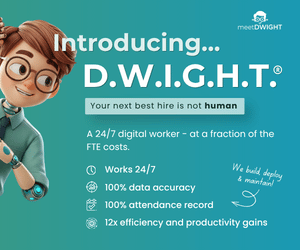
[0:02:56] DDC: We have two go-to-market offerings, David. One is the DWIGHT Studio, which is basically what underpins everything we do. It’s our own IP, our own platform to build digital worker bots and agents on top of. What we’re most commonly known for is DWIGHT as a managed service. We build digital worker bots. As I say, you never guess what his name is, but his name’s DWIGHT. He works 24/7, never goes off sick, never takes any PTO, does the work of up to 12 people but in a fraction of one full-time equivalent wage. Really, the benefit of and where he works is very much in the middle and back officer.
There’s a lot of AI and automation that’s focused on top-of-funnel activity. We’re not that. We’re focused on middle and back office, so onboarding, compliance, credentialing, recredentialing, placing candidates into VMS systems, extracting time card information through to invoicing payroll, and so on. Very much middle and back office focused.
[0:03:51] DF: Dries, one of the things that I think is pretty cool is I’ve seen you at a few different conferences over the years, NATHO, a few different other ones. Your booth is always jam-packed with people, trying to figure out what you do and how to use AI in their business. The first time I talked to you about your product, I was like, “This is so cool. This is something that people need and can help reduce costs.” I think at a time where a lot of staffing firms are looking at how do they work more operationally efficient, you’ve seen people move towards offshoring. I was listening to a podcast yesterday with an AI thought leader, and he’s like, if your business is an offshoring business, AI is coming for it. I think that’s inherently true. I would love for you to share a couple of the use cases in terms of how people are using meet DWIGHT day-to-day in their business and what that looks like.
[0:04:43] DDC: Yeah. People do get very excited about what DWIGHT can do for their business. We’ve literally had people whooping, showing the capability. That’s always quite nice. That’s also a first in all of my career of selling software, so that one’s a good experience.
[0:04:57] DF: I feel like the first time you see a mouse move on the – you just see the computer and you’re like, “Wait a second.”
[0:05:02] DDC: Yeah. We often have to say, this is not a person doing it. This is now DWIGHT actually doing the task. Yeah, in terms of use cases, whether we fit in, so you’re right to call out offshoring outsourcing. We often talk about DWIGHT as being outsourcing 2.0, because he’s more cost-effective and more efficient at doing some of those tasks, again, in the middle and back office. Because ultimately, okay, those resources may be more cost-effective than onshoring, but you still have issues around HR, people calling in sick, staff turnover, etc. Whereas, DWIGHT works 24/7 consistently. It doesn’t take time off.
The benefits you have is here, you have a resource that can do the work of up to 12 people at a fraction of one person’s cost. Then, in terms of use cases, we have lots of different use stories. Most of what we do is actually in onboarding and compliance. The most common one we talk about there is a client of ours, The Winter Group, they had three full-time people that were doing an onboarding process, in and out of Bullhorn, going into, in their case, Paylocity. They had looked at middleware tools because there’s no API link available. Actually, they found those tools wanting, being cost-prohibitive, etc.
That’s why DWIGHT came in, because yes, we can use API, but actually rather uniquely, DWIGHT can use logging credentials. Now suddenly, we can go and integrate and stand-up agentic workers across platforms that typically don’t talk to each other. That’s also where typically staffing agencies have people having to perform the tasks, right? He’s going in and out of the payroll system, then goes back into the Bullhorn, does the background checks, sends emails, etc. They basically had three people do that process. DWIGHT’s now doing that 11 times more cost effective. But also, was taking, and this was during office hours, was taking 45 minutes per candidate to go through the onboarding process. DWIGHT’s now doing it in four minutes. Suddenly, again, that’s 11 times faster.
Particularly around onboarding and compliance, right? If you’re a shift-based workforce, a lot of the candidates who place will be uploading their documents after the shifts are finished, the beauty of DWIGHT is, as soon as that comes in, he can process them overnight. We’ve got an outsourcing client, for example, in the UK who run payroll in light industrial. A lot of their candidates are uploading all of their credentials, etc., on an evening, let’s say on a Thursday night when the shift’s finished. By Friday morning, they’re on the payroll, right? By the time their staff come in, all of those candidates are good to go, because DWIGHT has done the process overnight.
[0:07:32] DF: I think the one part that you said there, this stuck out to me the first time we had a conversation around it. The idea that it’s not just logging into multiple systems, it’s essentially anything that you have a human doing on a computer, where they’re clicking from system to system, copying and pasting data, it could just replicate that. Yeah.
[0:07:54] DDC: There’s other use cases, which I’m sure we can talk about. But you were asking me as well, off camera, before about what’s the difference between LLMs, AI, and what we do. The reality is in our platform, you can go pure agentic and do the LLM stuff. But actually, mostly when we deploy DWIGHT, we do it in a deterministic fashion. We use what’s called robotic personal automation. The reason being that, for the use cases that we’re talking about, you cannot afford for bots to go rogue and agents to go off and do different things they shouldn’t do, right? These are compliance-type tasks, onboarding, like we mentioned, payroll, finance type tasks. The beauty of DWIGHT is he doesn’t go rogue; he doesn’t hallucinate. That’s because typically, what we take on our use cases that are “if this, then that” deterministic approaches to avoid that from happening. Because, yes, there’s a lot of noise around agentic.
I had a play around yesterday using Claude prompts into Gemini. Suddenly, I had a minute and a half explain a video of DWIGHT, completely animated. It’s insane in terms of the capability of what can be done. The reality is a lot of the capability that’s out there isn’t enterprise-grade. It’s not for those kind of enterprise, highly bespoke and highly complicated processes. The amount of times I’m talking to CIOs, or technical people that go – and I’ve basically, I asked them this, right? I said, “How many times have your recruiters, or other people come to you and gone, ‘Hey, look at this amazing thing I’ve built,’ and you’ve gone, yeah, that’s great. But we can’t plug it into anything else we’ve got.” It’s basically rendered useless. That still is quite a frequent conversation.
Whereas, I say, what we’re putting in place is something which also has a clear ROI before our customers even start. We’ve got on our board, we’ve got presidents of actual clients. Some of them even invested in our business in the early days. What they said to me was, “Dries, what was really attractive to us is before we even started the journey, we knew exactly the ROI we were going to get with DWIGHT, because it’s middle and back office-based.” Whereas, a lot of the top or final AI and automation, it all sounds great, but it’s a kind of, we’ll try and –
[0:10:06] DF: Yeah, exactly.
[0:10:08] DDC: Yeah. But you’re unsure what the outcome will be, right? Even from a cost perspective nowadays with the agentic tokens, etc., it’s quite opaque. It’s really hard to figure out exactly what is this going to cost me until you’ve started to use it. Then, whether or not it’s got ROI, and then you start to figure out how much it’s actually costing you. With DWIGHT, it’s a fixed monthly wage from the off the use case that we’re going to deliver on in terms of ROI. That’s the other big difference.
[0:10:36] DF: One of the other, I guess, a couple of the other use case is we had talked about in healthcare side, credentialing and recredentialing. Maybe walk me through what that looks like as well.
[0:10:46] DDC: Yeah. We know from talking to prospective clients that when it comes to credentials, particularly a recredentialing, they do spot checks and it doesn’t always happen consistently. The RN platform will flag to say, “Hey, David’s credentials are about to expire,” but then it’s left up to a human to actually go and take the action. The beauty of DWIGHT is he can pick up that alert, but then do the actual doing of taking action. For example, he’ll look in the CRM and he’ll look at your record, David, and he’ll go, “Okay. Well, here are the credentials that I need back from you,” and email you to say, “I need these things back.” Then deals with the emails coming back. Deals with the attachments. Make sure, essentially, that consistently and all the time and systematically, all of your candidates are credentialed.
He’ll do the chasing, too. Then, if it gets to a point where we’re just not getting the response, then the way our automations work is typically, then we’ll flag it to a human to go, “Hey, I need you to go and call David, because we’ve not had this resolved.” As someone once put it to me, DWIGHT is keeping them out of orange jumpsuits.
[0:11:53] DF: I was actually curious if you had any before and after accuracy on it, what that looks like. Because I would imagine it’s – I mean, I’m using AI for so many things like this, where I’m like, when it is clear and discreet, and you’re like, this is the action. You can remove human error from it.
[0:12:12] DDC: Yeah, you can remove human error. Also, if it’s a case of actually having to go into certain portals and do the validation and the credentialing, again, DWIGHT can go and do that. It doesn’t even have to come to you if we’ve got the information we need, you as the candidate in this case. But obviously, where action is required from the candidates, again, the way DWIGHT works is he’s off different triggers, right? It could be that he’s manually triggered. It could be off an email, could be off an alert, but it could also be a date-driven field. If we know that your credential expires in six months’ time, DWIGHT is systematically either running a report or looking at those kind of fields to make sure that we’re proactively capturing this 100% of the time.
[0:12:49] DF: Yeah, it’s so interesting to be talking to you about this. I’ve been thinking a lot about staffing agencies in 2029, and what is the value chain? Where is value creation happening for what operational activities they have and I feel like yours is probably making a lot of agencies more competitive, because of the cost structure, but also just having a larger impact on the volume and the speed that they can move as well.
One of the things I’ve heard you – I think you said this after the Exec Forum recently. You brought up the idea of not becoming a – so, don’t become a bank, or something. There’s conversations around agencies and the idea of them becoming a bank. I’ve heard some people talk about that as well with payments pushing, and it’s like, we’re holding all this AR. Talk to me a little bit more about that concept and what you’re hearing, and then also how you guys operate in that.
[0:13:40] DDC: Yeah. I think it’s becoming increasingly more common, and, in part, I would say, also with the rise of VMS and MSP platforms. Just very quickly on that, we can do the candidate submission piece, but actually, most importantly to your question, there is getting time card information out of those platforms. Doing the reconciliation, because sometimes it may be that the time has been recorded in the MSP platform, but let’s take healthcare staffing as an example. We’re not exclusive in that, but it’s a good use case. It may be that the hospital is using clocking in and clocking out from Kronos. Then that needs some reconciliation, before we can even think about getting the invoice out the door.
In the meantime, you, as the staffing agency, have already paid your nurses, right? The danger is, and we’re seeing it more and more, particularly where there’s complexity on different clients charging differently, that it’s taking longer and longer to go from getting that chargeable time from the source and the invoice out of the door. The beauty of DWIGHT, because of the speed he works, and again, the 24/7 capability, etc., is what we can do is speed up that process significantly. For example, with GHR healthcare, we’ve been able to reduce DSO by a whole day, as well as saving them the man-hours and manpower of having to do these tasks.
What we’re able to do is extract data source through the reconciliation, all the way through to actually generating the invoices. For some of our clients, we even do the invoice chasing. We’ve got smaller agents.
[0:15:06] DF: Oh, yeah. Nice.
[0:15:07] DDC: Yeah. We’ve got smaller agencies, which isn’t typically our ICP, but they were about to go and hire a credit controller. They don’t even have an invoicing system at all. DWIGHT’s actually taking all of the data from a master spreadsheet file. Does the data manipulation, produces PDF invoices, and then does the chasing as well?
[0:15:26] DF: Oh, that’s amazing. I mean, soon they’ll be able to call them.
[0:15:29] DDC: No. We’re staying away from that. There’s certain tasks that should be left up to humans, especially when it comes to recruitment and staffing.
[0:15:39] DF: That’s great. One of the ideas that you and I also touched on last time we talked, that I am always getting excited about where things are going and the future of staffing. This concept, well, we’ll preface it with, I’ve had some people on the podcast that had some really good futuristic ideas on what staffing looks like two, three years from now. One of them, Cary Daniel from Nextaff, was talking about how it’s like, well when they have the – I can’t remember the name of the robot, but the Elon Musk robot is like, when I can lease those out and be like, “Do you want a human, or do you want the robot to do the job? Or do you want both? How many of each?” Why not? I’m curious. One of the things you brought up was the idea of reselling digital workers. Explain that. Dig into it. I want the audience to hear about this.
[0:16:21] DDC: Yeah. I mean, so think about our own business. We’ve got the DWIGHT Studio on which we build DWIGHT, but there’s nothing really stopping us now with the platform as a service model to give that – I mean, we’re doing it to software businesses, right? The whole software market, by the way, is massively shifting. I liken it to when we used to have on-premise software, then it became SaaS. Now, everyone wants to move away from the on-seat SaaS model, and it’s all about building agents and charging on an outcome-based model. With the DWIGHT Studio, we give software businesses the ability to do that.
Now, how’s that relevant to staffing? Well, think about what we do with DWIGHT right now. We basically are providing our own staffing clients with a digital workforce of these different bots, different DWIGHTs doing different tasks in the middle and back office. We are actively having conversations already with staffing agencies right now about, okay, well, if you are placing people, say, in admin functions, you go to an SIA conference, one of the biggest shrinkages in the type of staffing markets is in admin, right? This has been for a while; it will continue to diminish more and more and more, which makes sense, right? If you’re a staffing firm, your clients themselves are now looking at agentic ways of driving efficiencies.
What we were talking about, David, and what we’re actively talking about with staffing agencies right now is, well, rather than just walking away from that as an opportunity, embrace it. Why couldn’t you provide digital workers alongside physical labor for certain tasks, right? Not for everything, but for certain tasks. You could literally go, okay, yeah, we can go and place Dries, or you can also contract from us three digital workers that fulfill XYZ function. That’s not a futuristic thing. That’s here, because we’re doing it ourselves.
[0:18:07] DF: It sounds futuristic. Then it’s like, well, you actually are already doing this. This idea of, I think, it’s such a fun thought to think about getting a job order. I mean, like, “Hey, I need three AR people to start next Monday.” You just are like, “Well, I can go find you three people. Or would you like me to install this digital worker?”
[0:18:26] DDC: That’s basically just it. The thing is, it’s infinitely more scalable. If there’s a function where you know you’re going to have to knock to have three people, but it’ll end up being six, or seven, it’s like, you need one digital worker. Again, some tasks, and I’m sure we’ll talk about it, some tasks need to remain human in my book. But other things, these are part of the job that people, frankly, do not enjoy doing anyway. They’re the bits you go and automate. Yeah, as I say, that future is here right now. We’ve got lots of staffing agencies going, either being very afraid of AI, or going, this is a huge opportunity. But very few of them have actually figured out how to monetize that as a new revenue stream, as an opportunity. Well, this is part of how.
[0:19:09] DF: It is a way to have it as a completely new line of business, like a SaaS model, and it’s probably sticky as hell. I mean, it’s a good approach. It seems like a reasonable thing to be thinking about, especially – I mean, I don’t know. I haven’t looked at the most recent which jobs are going and which ones aren’t, but the compression of all administrative work. I think one of the more recent benchmarks I saw for Claude, I think it was Claude Opus was that it’s like, was scoring it a 94, mid-90s in the percents for business administration tasks, just like building a PowerPoint deck. If you think about doing that without the modeling and the discreet nature of it that you’re talking about, it’s like, this is where the world’s going. It’s happening.
[0:19:58] DDC: It’s been predicted for ages, right? There’s a piece of research that I used in the early days when we started up. It was UK-based research, but it does translate. It was done by the Institute of Public Policy Research in the UK. It had all different job roles. It was looking at what was going to be augmented or replaced by AI. The one that was going to be completely augmented, or replaced by AI, was admin. It’s not new news, but now we have the tools, and we can help provide tools to do something about it and actually look at it as an opportunity, rather than a risk.
[0:20:32] DF: Yeah. I think embracing the right way does turn into a huge opportunity. For those that are listening to this, I know we’ve talked about what’s possible. How would you suggest they go about exploring this idea, or thinking through this?
[0:20:46] DDC: I would say, David, there’s no reason. We talked about the shift of what software businesses are doing. There was an article in The Wall Street Journal service now have said that total address of a market has gone from 90 billion turnover to 600 billion by shifting from per-seat licenses to agentic. What I’m saying to staffing agencies is, why couldn’t you charge it on an outcome-based, right? It goes even further than instead of a human, you pay a wage for a digital worker, why couldn’t you do it on an outcome base? Because why let all the software businesses have all the fun, when actually, you could be taking opportunity of this as a go-to-market offering, where you’re charging on an outcome-based model. Every time, let’s say credit control generates an invoice, you get a small fee, and you’ve provided that digital worker in. Because if you’re not doing it, the software businesses will be providing it.
I think this is really where, the exciting thing for me is I can see staffing and technology is just going to get closer and closer together. I’m not advocating for a humanless world, to be clear. I do think in certain areas that this is going to become closer and closer together and essentially, software businesses are now more looking at digital workforce as a provision. Why couldn’t the reverse happen where staffing agencies are looking at this as more of a technology-enabled workforce that they’re offering, rather than leaving it up to, let’s say, the antropics of this world, right? Why should they have all the fun, when you could be –
[0:22:17] DF: It’s also interesting when you look at the – over the last few years, there’s been, and maybe this is going on much longer than the last few years, but I feel like there’s been more of a push towards statement of work projects and IT and engineering staffing. I think people want to buy outcomes. They want to say, here’s the price that I’m willing to pay for X to get accomplished. Typically, the way they’ve done that historically is they’ve said, “Well, I need this many people to do it, and I’ll manage them.” Now you’re seeing people say like, “Well, you know what? Let’s take that off your plate. We’ll manage it for you.” That’s the same concept, and it was just taking it another step further and solving it in a different way, which is pretty cool.
[0:22:52] DDC: Other platforms are available, let’s be clear. But again, with agents, you have the problem of these tokens that you have to pay away. It can become quite costly. We provide a fixed fee offering for you to license the platform and then go and do this. We think they’ll be the winners, whether you’re software, businesses, staffing firms, whatever, it’s people that will embrace these type of technologies, be smart about what is the cost outlay to get to the outcome, because there is an argument, like with text messages, there’s an argument to say that the cost per token will come down on agents. Actually, we don’t know that for certain, because a lot of agentic suppliers now actually is going the other way. Once you’re fully hooked on them, what’s to stop them from actually ratching up the company, right?
[0:23:38] DF: I’ve thought about that. I’m so glad we have competition between Gemini, Claude, and OpenAI right now. At any point, if one of them pulls too far ahead, we are going to get killed. I mean, they’re also all running out of loss with the idea that if they can get you deep enough in bed with their memory and get you stuck in that, they know that –
[0:23:56] DDC: Then the cost moving up, right? Exactly.
[0:23:58] DF: As soon as the switching cost is high enough, these are – I believe, this is the cheapest tokens will ever be. This is like –
[0:24:06] DDC: Not everyone thinks like that David, so we’ll see.
[0:24:12] DF: Yeah. I mean, the cost, I’m sure you’ll be able to buy your own on-prem version of it and have a lower-level model to do things. I think that when you get into the more advanced stuff, they’re going to keep pushing the envelope. Yeah, it’s fun to watch it all play out. I mean, Claude’s taken some major shifts in there, too.
[0:24:29] DDC: Yup.
[0:24:29] DF: You said you were actually having conversations today about this concept of reselling the digital worker. Is there a specific use case day one that you’re seeing the highest likelihood of being your go to market on this, or what you’d be offering? You said admin, but I didn’t know if there’s a specific. Is it like, is it AR? Is it the onboarding side? Is it –
[0:24:48] DDC: No. I think it just depends on what segment people serve it, right? The power of this technology, we struggled with it in the early days. It’s so vast that it’s really hard for people to get their heads around. We’ve then come up with this, basically org chart of different DWIGHT for staffing agencies. We know, if you’re a healthcare staffing firm, we know exactly what your problems typically are, and here are some of the DWIGHTs. I think right now, we’re still in that mode where you have to be quite definitive.
The benefit being, I think that a staffing agency can bring as part of that go-to market future world is they understand their customers, probably better than a software vendor, or certainly a Gemini, a Google, or Anthropic or OpenAI would, that’s the real benefit that if you jump on this type of technology now, you have to know how, you can translate the technical into the practical and go, we know this is the struggle you have and here’s a pre-built digital worker that can go and solve that for you. I think that’s the opportunity gap right now.
The however to that would be if your laggards to this, whether you’re a staffing firm as a sector, or an individual staffing firm that maybe tends to move after other staffing firms do, those software businesses will eat this market up pretty quick. One of those things where –
[0:26:05] DF: It will go fast when you can say, all right, instead of hiring these people, it’s out of the box. It works, and it’s easy to use. I think that some of the problems are right now are adoption, because it’s like, how do you map it out? How do you figure out how to actually make it work? When those use cases are fully dialed in, what you guys are doing. That’s –
[0:26:20] DDC: Yeah. What I’m saying is no reason why a staffing agency can’t do that, right? Start with a few friendly clients, stand up with some of these digital workers and then take it out to the rest of your market.
[0:26:31] DF: Yeah. I think that’s a fun one. It’s a fun thing about the transition here. One of the things – I know you’re deploying AI constantly for all of your customers, what are some of the areas that you see where there’s the biggest failures? Where are things not working when it comes to AI today? And how do you see that evolving as well?
[0:26:52] DDC: I’ll tell you what’s working really well for us first. We now have the capability, basically, to look at a user doing a task over an application, and it automatically generates the code for the digital worker to be built and do that within minutes. That’s pretty cool. Obviously, a lot of what we build is very complex. What we’re able to do there is stand up component parts of that very quickly, and then we still have to knit it all together. In terms of where things aren’t working well, I think it’s somewhat back to our previous conversation, which is there’s a lot of people building a lot of stuff. But if it doesn’t hook into your enterprise systems and everything else, then it’s only as useful as it is for that individual. It doesn’t become very useful for the whole company.
There’s a lot of, I think we’re coming out of this now, that there’s still a lot of people that go, we had it in the early days, people would come and go, “My boss told me to buy some AI, so here I am.” It’s like, “What do you mean?” Don’t get all excited about all the cool bells and whistles. Yes, stay curious. Absolutely do that. But actually, where are you losing time when –
[0:27:59] DF: When you’re trying to start.
[0:28:00] DDC: Yeah. More specifically, not just is it a problem, but actually, what’s it costing you in terms of time and money? We qualify out more than we qualify in, because we go really hard on what’s the use case, what’s the ROI, and will you actually get the return. Really coming at it from that perspective first, rather than going, “Hey, here’s this cool, shiny thing. My boss told me to buy some AI.” That doesn’t tend to work so well.
[0:28:25] DF: Yeah. It is funny is that conversation, I’ve had it as well, where it’s like, well, just want to know, where should I go to have a conversation about AI, and what should I do with it? It’s something that I think everybody’s trying to jump into. Are there any specific use cases that you just don’t think it’s up to what it needs to be in terms of the implementation, or the experience that it’s creating today?
[0:28:45] DDC: Yeah. I think voice AI is probably a good one, where we’ve had a lot of stop-start in the sector. I think it’s come on. I do believe it will get there. I’m just not sure it’s there quite yet. A lot of these technologies, they demo really well. You go, wow, my recommendation would be get the references and really, really test it out in terms of people that have been there, done that. What’s working well for them? Why is it working well for them? Because just because it’s working well for them doesn’t mean it will work well for you, and then take it from there. My initial one would be very much around, probably the voice AI piece. As I say, I do think it will get there. But there’s a lot of hallucinations still that happen as well, right?
[0:29:26] DF: Yeah. I think they’ll wait and see. You can still just tell it’s AI at this point. I mean, not always, but a lot of times, I feel you get that nudge as well. I’ll second that. I think it will get there for sure. Also, there’s some areas there where it can be challenging, depending on the level of the conversation you want to have.
[0:29:43] DDC: Yeah, and what you want to do. I think if you, for example, take international recruitment, where you’re taking people from one country into another, the voice AI thing is great, because you can talk to them in their language, which is fantastic. If it’s a case of very binary qualification criteria, then it can work quite well. But if I’m coming to you, David, and I want to place you, let’s make something up into a senior exec role in Japan, I’m not sure AI is going to that place to have that conversation with you.
[0:30:14] DF: Yeah. Yeah, I thought it gets okay for, hey, here are the onboarding questions we need to ask you and collect this information. But if it’s trying to convince, not sure at all with that.
[0:30:23] DDC: Yeah. Also, there’s all sorts of other things that you’ll bear in mind, like your family and all those kinds of things where you still need emotional intelligence applied.
[0:30:33] DF: Yeah. Common topic on this podcast, almost every single person I had, I talked to about this, where do you see AI replacing the humans, versus where do you think the human element of staffing will persist and be there three or five years down the line?
[0:30:48] DDC: Yeah. I mean, I often get asked, will AI replace my recruiters? I would say, it’s the wrong question to be asking. The right question to be asking is, if I could free up 40 hours per week of someone’s admin time, then what more could my recruiters be doing? I think it’s probably the way I see the world. In terms of where does it fit well, as we discussed early, admin type tasks, no reason for that to not be replaced, right? That’s obviously where we come in. But then, ultimately, from a human perspective, as we mentioned early, if you’re talking to a candidate, given that career advice, building relationships with them, again, I do think it depends on the part of the staffing market that you service.
Some jobs are just more transactional, right? If I need a truck driver, a lorry driver, tomorrow to drive from A to B, it’s much more transactional than if I am placing you in a CEO role in Japan. I think there’s some nuance to it, but by and large, talking to candidates, giving them that kind of advice, building those relationships, same with clients, whether it’s running negotiations with them, or again, establishing that kind of relationship. I think the EQ and the human to human, I think in staffing, for me, doesn’t go away, and it won’t. It’s more a case of what can we do to make sure that if your recruiter is billing 500,000 bucks per annum now, how do we get that same person to build a million by making them more efficient, right? Because no one likes filling in CRM and whatever else, and it’s not a value-added task. What can we do to automate that part of the job?
[0:32:19] DF: Yeah, completely. It is funny. I think I heard this so many times at conferences. It should have been one of those comments like, take a shot when you hear it. As the, is AI going to replace the recruiter? It’s like, no. But a recruiter with AI will replace. I was like, if you’re using AI, the bifurcation of the workforce of the people that are adopting it and those that aren’t, I mean, I think the games are going to be exponential. They already seen it already.
[0:32:42] DDC: I think it is a cliche answer, but it still holds true. I think if you look at that from a staffing agency, macro level perspective, the reality is, and because I had this conversation with one of our clients, the president of the company, where I said, listen, we could do a lot for your business. Here are some of the use cases we’ve looked at. By the way, they now run four to five different DWIGHTs within their business. I remember talking to him and going, “But you’re so nice. Your team is so nice. Are you actually prepared to make the change?” His response was, “Dries, if you get the impression that we won’t, you need to let me know. Because if we don’t, we won’t survive in this market.”
I think at a macro level, from a staffing agency perspective is, if you’re not doing this stuff right now, I’m telling you, because I can see our growth rate, let alone how everyone else is growing, that fills the space, your competition are, they’re going to be able to be quicker in filling their candidates. They’re going to be able to do it more cost-effectively, because they’re back and middle office will be running leaner and they’ll have better EBIT and you’re going to be left behind. That’s the reality of the situation is, yes, how can we make the individual recruiters more efficient, but also from a company perspective, you can’t grow linearly. Linearly, is that a thing?
The signs are, the markets are picking up again. Fantastic. Let’s not do what we did in COVID, which is we’ve got loads of candidates and loads of jobs for us to go and fill. I just need more people in the middle and back office to make sure I can do that. We’ve got to grow a lot more sustainably. That’s why you’ve got to think ahead and got to look at these technologies to help you.
[0:34:23] DF: Yeah, I could not agree more, and excited about what you’re doing. Specifically, to meet DWIGHT. I know we talked a lot about the future in terms of where staffing is going and some of the different use cases. Where do you think you guys will be three years from now? What does that look like to you?
[0:34:36] DDC: I mean, the honest answer is I couldn’t tell you, because I was having this conversation earlier today. If I was talking to myself from 12 months ago, and know –
[0:34:46] DF: Change is so fast right now. Yeah, it’s wild.
[0:34:50] DDC: The key thing is we are, and we need to continue to innovate. We are innovating so quickly, keeping pace with everything else that’s going on out there, harnessing what we’re seeing out there in the market and building it into our platform. That’s the key thing for us. We’ve had phenomenal growth. We want to continue the phenomenal growth that we’ve been having and we want to continue to innovate. That’s basically it. Then the rest, the rest comes with it, right?
If you’ve got a great product offering at an affordable price point, we’ve got fantastic reference ability. As long as we continue to do that, then the revenue and everything else will take care of itself. I’m excited to see how this evolves further in terms of this digital workforce and how it continues to. What’s interesting for me is there are some big players in the market that are now starting to use terminology that we’ve been using for two years, like digital worker. That’s always quite pleasing and helps create the category ultimately.
[0:35:44] DF: Yeah, I think it’s going to move faster. I mean, I could be completely wrong on this, but I feel like this is going to be one that moves faster than most and faster than people expect. Not in every area, but in some areas, just because of how it just makes so much sense and key use cases. Well, Dries, it’s really, really nice having you on. If anybody wants to connect with you, or get in touch, where should they go?
[0:36:07] DDC: MeetDWIGHT.com is going to be your easiest way. If you go to the team page, you’ll find me there with my LinkedIn, because spelling my name, as you know, or pronouncing it, is a bit of a nightmare. That will probably be the quickest and most efficient way of finding us.
[0:36:23] DF: I know it’s Dries, and every time I see that, I just want to say it, yeah. We get it right. It’s great having you on here. I really enjoyed the conversation. I’m excited about what you guys are doing and excited to see where you take the business over the next few years.
[0:36:34] DDC: Thanks for having me.
[0:36:35] DF: Awesome.