


Sponsored Article by Teambridge

The latest ASA data shows employment dipped by 8,300 workers between Q1 and Q2, with sales down 8% year-over-year.

Staffing has always been a cyclical business. Demand rises and falls with the economy, while margin pressures and shifting workforce needs create constant challenges. Today is no different. We’re seeing some headwinds, but they’re part of a familiar pattern.
The real story isn’t just the downturn. It’s the turning point. Where some see only tighter margins and higher pressure, we see an opening for reinvention: the chance to build stronger, more resilient staffing businesses powered by AI.
The moments where industries transform
Difficult times are where great innovation, and the biggest winners, are born. Think about Airbnb in 2008 and Uber, my former employer, in 2009. They didn’t just “optimize” the way things were done. They redefined it.
Uber didn’t give taxi drivers better radios. They rebuilt the dispatch system, fundamentally changing what it even meant to be a taxi. That’s the level of transformation AI makes possible in staffing. The question is: who will become the Uber or Airbnb of staffing?
What AI does inherently better than people
What will determine which companies will rise to the top depends on who is able to truly harness the power of AI to innovate past their competitors. AI isn’t magic, but it does have natural strengths that make it uniquely suited to staffing. Let’s break it down.
- Organizing and understanding messy data
Credentialing is a perfect example. Your firm has requirements, the state has regulations, and each client may have additional standards. Humans see chaos. AI sees clarity. It can instantly parse a PDF of credentialing requirements, cross-match with your candidate pool, and tell you who’s eligible.
Recruiting is similar. Instead of manually parsing resumes, AI can screen, surface, and rank top candidates in seconds.
- Spotting patterns before people can
Workforce engagement is notoriously hard to measure. Who’s engaged? Who’s about to churn? AI can flag subtle early signals—declining shift acceptance, slower response times, lower app engagement—before a worker disappears.
Or take financial analysis. AI can comb through the numbers, explain why revenue dipped in an otherwise strong quarter, and even propose corrective actions, all before you’ve even had time to create your first pivot table.
- Conversations at scale
Credential collection, reminders, follow-ups—these workflows consume endless recruiter hours. AI can handle them instantly, with consistency.
A shift opens? AI can ping 500 workers in seconds, with the best candidates responding before your competitors even start dialing.
Those who can leverage these core capabilities and power them with the steer of human creativity and strategy will rise to the top.
The three conditions for AI success
But here’s the truth: not all AI delivers business outcomes. Flashy demos are easy. Driving revenue growth, retention, and efficiency at scale is hard.
For AI to drive real impact in staffing, it needs three things:
- Context. AI has to know your business: your rules, your workforce, your workflows. Otherwise you’re stuck writing massive prompts that falter the moment things get messy.
- Operations. AI has to learn how you actually complete work—how you fill a shift, resolve a callout, onboard a nurse. If it doesn’t know your playbook, it can’t improve it.
- Composability. Using the same out-of-the-box agent as everyone else isn’t innovation. Winners customize, iterate, and move faster than the competition.
Without these? You get empty results.
With them? You get faster fills at higher bill rates, improved retention, and scalability while cutting operating expenses.
Why speed matters more than ever
So now you know where AI excels. You know what it needs to drive real business impact. Where do you go from here?
The huge leaps from major AI players are slowing. Until the next breakthrough, winners won’t be those waiting around for the next model. Winners will be the firms deploying, iterating, and A/B testing in real time.
This is the window. The fastest movers will own the future.
Teambridge AI: built for the realities of staffing
That’s why we built Teambridge AI.
We designed it from the ground up to support the operational realities of staffing. It’s not another demo that promises a lot but, when the pressure’s on, offers little. It’s a new system for impact.
How? It’s made with the exact three core qualities staffing firms need most out of their AI.
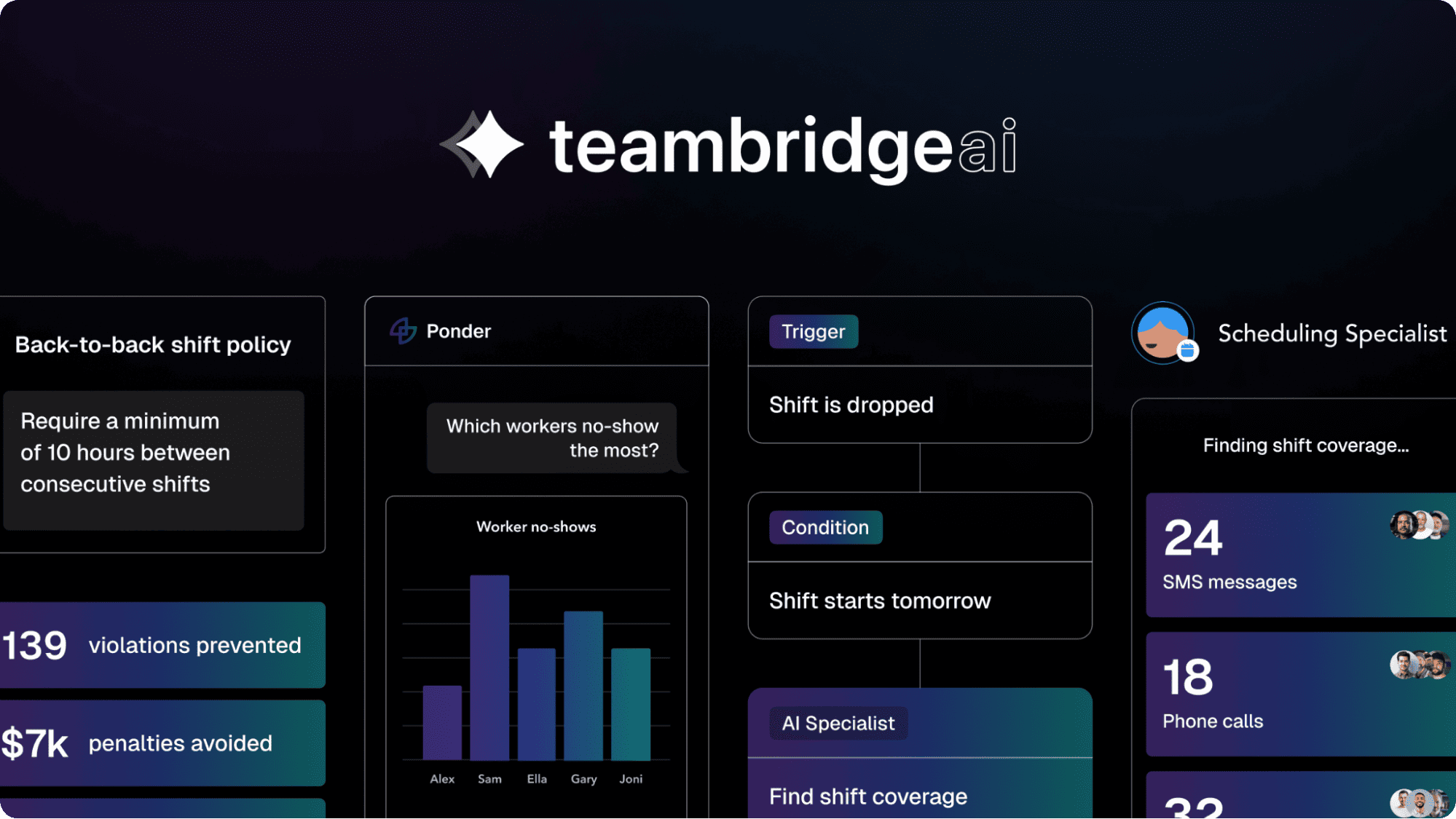
Teambridge AI fully understands your business: your people, schedules, policies, and data. No blind spots. Want to ensure the nurses you staff get at least 10 hours off in between shifts or comply with the patchwork of union rules across states and industries? Or pre-credential candidates against complex state and client standards so their packets are ready to submit faster and you can beat competitors to the best placements. Describe your requirements in natural language, and Teambridge AI turns them into enforceable business logic, automatically applied across your entire business.
It also learns your playbook, not a generic one. How your teams resolve callouts, how your clients like to staff, how your compliance requirements work. If someone calls out sick for a morning warehousing shift hours away, an AI Scheduling Specialist knows exactly who to contact for a replacement.
And Teambridge AI is fully composable. Tailor it to your unique business needs and move faster than competitors, constantly testing and refining without waiting on vendors. Say you notice a dip in revenue over the past quarter because of unmet demand for PAs in northeastern Ohio. You can quickly update your Recruiting Specialist prompt to prioritize the region. Instantly, it shifts focus, engaging hundreds of qualified candidates in the area and asking the right screening questions to move standouts further down your pipeline.
The result? Faster fills. Lower costs. And the ability to scale without the growing pains.
From recession to reinvention
The staffing industry is under immense pressure. But it’s in moments like these that industries reinvent themselves. Just like taxis became Uber and vacation rentals became Airbnb, staffing is about to be redefined.
The winners won’t be those who wait. They’ll be the ones who adopt AI that isn’t just flashy, but operational. AI with context, operations, and composability built in.
That’s the future we’re building with Teambridge AI, so you can make smarter decisions, drive impact where it matters most, and scale faster.
You can learn more here or schedule time with us to see it in action.