


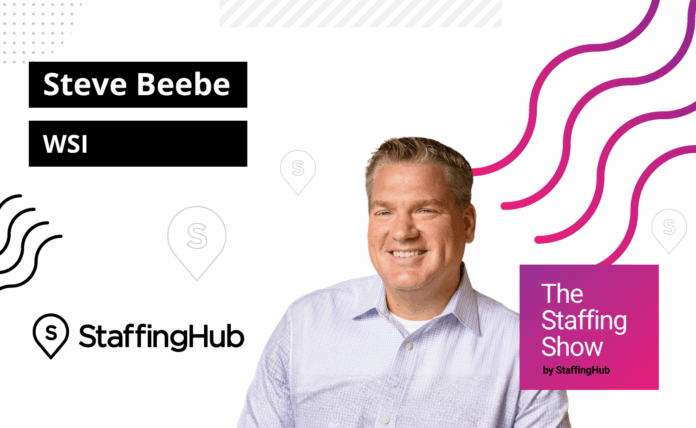
In this industry, relationships are everything! Joining us today is the COO of Workforce Strategies, Inc. (WSI), Steve Beebe, to discuss the firm’s unique approach to staffing and how it’s leading to growth in an otherwise stagnant market. Tuning in, you’ll hear all about Steve’s career, what led him to staffing, what makes WSI so different, tangible ways Steve and his team are beating market trends through purpose-driven recruitment, and what their process looks like. We delve into how WSI’s strategic partnership with Staffing Referrals has set them up for success before discussing their approach to marketing, AI, and so much more! Steve also talks about how WSI handles data trends. Finally, our guest shares WSI’s “secret sauce” and how he sees it evolving in the future. To hear all this and more, press play now!
[0:01:13] DF: Hello, everyone. Thank you for joining us for another episode of the Staffing Show. Today, I am joined by Steve Beebe, the COO of WSI. Steve, thanks so much for joining me today.
[0:01:22] SB: David, it’s a pleasure. I’ve listened to the podcast for a long time. My kids always thought I was a big nerd for listening to a work podcast. Now I get some street credit. I get to play it for them.
[0:01:34] DF: I love it. I love it. Well, I’m excited to have you on and jump into your story. You guys have done something unique the last couple of years in staffing. You’ve grown. I have so many people on here.
[0:01:45] SB: That’s interesting, right?
[0:01:47] DF: Yeah. I have so many people on here, where we talk about flat is the new up, and all of the challenges that are happening in staffing. You guys have two years back-to-back, where you’re actually beating the market. You’ve done that by a handful of things over the years. I’m excited to dig into that with you and tell your story. As we do that, and I guess, before we get into the weeds and the strategy and the technical side of it, would love to just hear your background and how you got into staffing.
[0:02:13] SB: Well, like everyone else in staffing, I grew up wanting to be in staffing, right? That’s a story. Everybody just –
[0:02:17] DF: That was it. Everybody starts off with that.
[0:02:19] SB: Yeah. They said, “What should I do when I grow up? I’m going to go into staffing.” No, it was probably like a lot of people. I went to school for marketing. Didn’t know what I wanted to do. My first job out of college, I thought, well, I like to talk to people, I like to interview people. And so, I applied to work for a staffing firm. Had no idea what they did, or even what the industry was about, and that was in 1993. Found that one thing in life that I could probably do okay, and so I stuck with it. It’s an amazing industry. It’s dynamic. You get to provide people with opportunity to change their lives. The power of a job is just incredible. It’s been a phenomenal industry. It’s provided a great career for me and support for my family. I just, I’m addicted to it.
[0:03:05] DF: I love it. You guys are in the industry doing something that’s a bit unique, which is growing, as we mentioned. I want to know about your transition in staffing and how you’ve gotten to a spot where you guys are beating the market trends, because I know a lot of people are having challenges with the current market conditions. Actually, before we do that, why don’t you tell us a little bit about who is WSI? What type of staffing are you guys doing?
[0:03:28] SB: Primarily, commercial and industrial. We have a direct higher division that focuses on skilled trades and high-end engineering manufacturing. Then, we also recently added an RPO division.
[0:03:39] DF: How big is your team today?
[0:03:41] SB: Right around 65 employees right now.
[0:03:44] DF: Awesome. That’s great. Are you guys, in terms of where you’re going as a business, is the growth coming from, if you’re open to sharing this, the commercial side, the skilled trade, where are you seeing the wins these days?
[0:03:57] SB: We’re really seeing it across the board. The skilled trade has definitely added substantial growth that we’ve seen over the last 18 months or so, a huge need in the market. That has been a very large growth trajectory. But most of our business is coming from high-volume light industrial.
[0:04:14] DF: Oh, that’s amazing. You’ve even had growth there, which is, I think, one of the segments that we hear a lot of challenges. What are some of the things that you guys are doing strategically differently than you think what the zigging when everybody’s zagging in the market?
[0:04:26] SB: I think there’s a few things. I think that one of them, it really starts with data and transparency, right? Providing our clients with data and that builds trust, and then trust really helps build those relationships. I think part of it is providing dashboards to every client, letting them know what is happening with their business. I really think that clients shouldn’t have to ask us for information. They should just have that available to them. We have real-time dashboards for all of our clients. That includes spend, turnover, fill rate information, time to fill, really provides them visibility to help manage their workforce more strategically, and not so much reactionary. Our clients very much love that.
Then, providing those metrics that help tell that story. We talk a lot about staffing being an art and a science. The art is working and managing people, and that really is an art, and the science is data. We’ve tried to combine those two. On top of the data piece of it, we built an in-house marketing team, and the purpose of that group is really to tell our clients’ story. People don’t want a job, or they don’t want to work just for the job. They come to us looking for a purpose. We see that as our opportunity to sell our client opportunity and not just sell another position or another job.
Since we started doing that, telling our client stories, making that culture of the client come to life, and tell the why behind the what, our clients have responded very well to that, and candidates respond very well to that. They don’t want to be treated like just another number. We call it purpose-driven recruitment, and really recruiting to a purpose and not recruiting to an opening.
[0:06:11] DF: One of the common themes I’m hearing repeatedly, especially with the companies that are growing in this space, is that they’re less of the transactional recruiting, more of the partnership level, and getting strategic about it. It sounds like you guys are doing that, but doing it from a – you’re going in and understanding companies’ core values, understanding who’s going to be a good fit, and then really trying to find the canvas that aligns with that. What’s that process look like?
[0:06:37] SB: Really, it starts with sitting down with the client and asking them in their own words to tell their company story. What makes them different? Why do people want to stay there? Why should people want to work there? That becomes the foundation. Then we begin to storyboard what type of story do we want to tell to candidates? We work through that process with our client.
During that time, we get to know our clients pretty well. It’s a great process from their side too, because a lot of companies find it difficult to express, or really articulate what makes them different, what makes them want to be, or to be that employer of choice. It’s a fun process that we learn a lot about them, and I think that hopefully, they learn a little bit about themselves as well.
[0:07:22] DF: Are there ever times where clients are resistant to spending the time upfront in terms of doing that? I feel like you’re really bringing your marketing background to light in terms of, like, how do we actually help connect these dots and tie the story along with the purpose of the brand to get the right person there? Have you found that customers are like, “Hey, we just need a placement. We don’t need to spend time on digging into this.”
[0:07:46] SB: Yeah, I think that when we first started doing this, this was pre-COVID. I think more and more companies were reluctant, or maybe didn’t see the ROI, or the value in being an employer of choice. I think that back then, it was like, well, we don’t need to go through that process. We just need these 20 positions filled. I think during the last few years, more and more companies understand, we really want people to want to work here, and we want people to resonate with what we do here. I think they’re more and more open to that now. I mean, there’s still companies out there, and I think especially with larger companies with more defined marketing teams, they have some reluctance to giving up a piece of their brand to an outside firm.
I think that for the most part, when we sit down with them, we talk about what we want to do, and we align it with their brand and their logo and everything else. They realize they’re not losing anything. They’re just gaining ability. Most of our marketing team is sales-focused, not recruiting-focused. We have the capability that they normally would not have.
[0:08:50] DF: That’s amazing. You also mentioned the data and the dashboards. Are you literally giving your end client real-time dashboards to deal with? Are you delivering this monthly, quarterly? How are you approaching that part of the relationship?
[0:09:05] SB: It’s a real-time dashboard that they have access to through a web link. They can come in and take a look at what their turnover is by department, by shift, by position. Really puts that information in their hands. We also do quarterly partnership reviews. The trouble with those is they’re three months lagging, right? I’m putting, giving them real-time information allows them to see right now what’s happening in their business.
[0:09:33] DF: As you’re talking about all this, it sounds like the quality of hire is paramount for you guys in making sure that you’re getting the right person to the right job. When you’re approaching the talent sourcing side of it, I know you and I had talked previously about how you’re doing your sourcing strategy differently, how you’ve worked through different job boards. Would you dig into that a little bit and talk about how you’re approaching that?
[0:09:56] SB: Yes. For many years, we were on the job board treadmill and just kept spending dollars and seeing worse results, more and more turnover, so much recidivism. We were recruiting the same candidate over and over and over. It was frustrating. We didn’t see a differentiator in it. We’d had some luck in the past with promoting referrals, but we weren’t able to get much volume there, and just trying to do it internally was not enough. We didn’t have a way to track it effectively, and we didn’t really have a way to leverage it across our entire workforce.
A few years ago, we started working with your organization at Staffing Referrals. It’s been incredible. Over the last two and a half years, I think we’ve seen 8900% ROI from our Staffing Referrals. I mean, the results are so dramatic. When you look at retention rates, eight times what it is from a job board.
[0:10:49] DF: That’s crazy. Yours is record high, by the way. I know we’ve had a – your numbers are insane.
[0:10:57] SB: I don’t know what we would do without you and your team. Like I said, it’s been incredible. Our reliance on job boards has increased dramatically. Like I said, the turnover, the impact on turnover has been so significant.
[0:11:11] DF: Yeah. You just get the people going to work with a friend that stay on contract longer. Do you find when you’re talking to clients, do they care where you’re getting the talent? Do they care if you’re using a job board or not? I imagine it’s on, but curious if that matters.
[0:11:25] SB: Absolutely. We’ve included that virtually in our sales proposal process, because companies do care. They notice the same things that we’ve noticed in terms of diminishing returns from job boards, and they wanted to know how we get our people. In a great company culture, the employees become the best recruiters. We talk all the time. We went from having an office with 10 to 12 recruiters. Now, we have an office of 300 or 400 recruiters in it, because all of our employees now are temporary employees are all the story. When you can do that and leverage that, it makes you so powerful in the market.
[0:12:04] DF: Yeah. You guys have been really hyper-focused on building the brand and the talent community in a very intentional way. One of the things that I’m curious about is just in terms of getting your recruiters to change behavior. Because I know job boards can be easy. What has that been like? For the audience that’s listening, you and I actually, we had one shot at using Staffing Referrals, what, maybe four or five years ago, where we gave it a few months and didn’t see the results that we wanted. Then we came back together as more of a strategic partnership, and it’s been really great. What are some of the challenges that you’ve had in terms of getting the team to change behavior, getting alignment, and getting buy-in into how you’re sourcing?
[0:12:46] SB: It definitely was a mindset change. I think our recruiters were so comfortable with the volume that job boards produced. I think that we thought we needed 1,500 candidates a week to fill the top part of the funnel to keep the placements coming at the rate we need to. What we really needed to do is we needed to fix that leaky bucket that we had. We were trying to fill that leaky bucket with water. It was just leaking out as quickly as we filled it. We had to convince them that turnover was the key. Lowering turnover, increasing customer satisfaction by placing the right people. But that was a huge transition. You mentioned that it didn’t work the first time.
I think that in our industry, it’s easy for us to go out and spend money on technology platforms. We think that’s going to be the silver bullet. Just purchasing a tech platform is going to solve every problem that we have. We’ve said, okay, we’re going to focus on less integrations and make them more powerful. Getting buy-in before you even do anything, right, and making sure you have the training before you get too far into it. Our two strongest partnerships now are Staffing Referrals and Sense. Both are absolutely killing it. What we realized is we didn’t need more candidates. We just needed better communication, better engagement, and we needed to utilize our current candidates more effectively.
[0:14:08] DF: That’s awesome. You have the database. You didn’t need to pay for new people into the database. I don’t remember the, I was at a conference, maybe it was last year that somebody was telling me that the – I was like, one out of eight placements for staffing agencies are already in the database. It was some wild number that you’re like, basically, you set this. You’re recycling the candidate. You’re paying for them a second, third time. You’re just doing it in different ways if you’re not being strategic with the network you built.
[0:14:39] SB: I think two things to that. One is candidates become more disengaged and feel like more of a number the more times they go through the system. The other, just an odd thing that we’ve seen in our organization, is communication and trust has changed so much over the years. The entities and the things that we used to trust, we don’t really trust anymore. There’s really very little institutional trust amongst job candidates right now, but there’s a lot of individual trust. I won’t go to a traditional outlet to find out about a company. I’ll go to a friend and ask them and what a total stranger knows on a Google review, or on a job board review.
That falls in line with really focusing on candidate referrals, right? Because we trust our friends more than we trust traditional news outlets anymore. I think that’s one of the reasons it’s been such a great powerful tool for us. Then obviously, buy-in. Everyone in the organization has to be doing it.
[0:15:40] DF: Yeah. You guys have then gone to the moon the second time around, where you’ve just been on a little bit of a rocket ship every time I look at your numbers. It’s exciting. One of the other areas that you and I had talked about briefly was just being AI first, using marketing as a differentiator. Could you tell me a little bit about some of the things that you guys are doing when it comes to AI?
[0:15:59] SB: Yes. One of the things we’re using in our organization, we’re modeling in our organization to solve everyday problems. Part of our marketing team is an AI expert, I guess, if there’s anyone recruiting AI. They’re teaching us how to use it in our everyday job. We’re using it to solve client problems. We’re using it to generate client material, from pulling data from job boards and finding out salary and wage information, really using it to benchmark what’s happening in the industry. We’re using it to streamline our internal processes. We’re using it for initial stages of candidate screening, so we can get to candidates more quickly. We’re using it for our dashboards and populating those things.
Trying to find a way is, in the staffing industry, with margins have been declining over the last few years, trying to find a way to become as high touch and as high service as we can to our candidates and clients, but also being conservative from an internal staff standpoint.
[0:16:59] DF: I mean, you guys have basically, just in terms of companies I talk with, you’ve done a very good job of building an in-house marketing and branding expertise in a way that’s unusual to see in the market. I feel like a lot of times, we’re going to throw a little bit of money at it, but it tends to be in staffing, I think, under-leveraged. What are some of the reasons behind deciding to do that and what are some of the challenges that came along with it?
[0:17:21] SB: I think initially, like you said, the industry is going in the opposite direction in terms of cutting marketing headcount, cutting corporate headcount in general, but especially marketing. Because it was hard for marketing to provide an ROI for what they do. For us, we saw what we were spending on recruiting. We saw what we were getting from it. We saw we needed a way to get more at bats with clients and prospects. We invested in that marketing team for that reason. Initially, we had some misses and we were spending a lot of money on social media and that really wasn’t producing the results that we thought it would. We took a step back and we really started taking a look and really asking our clients, what do you need? What do you want from us? I think that’s where purpose-driven recruitment came from. We started to see results almost immediately with that.
It was, I think, so many staffing firms and employers out there really try to use their job descriptions as a marketing piece, as a recruitment ad. That’s not what a job description is for. They don’t talk about the things that matter to candidates, which is, what’s the culture of the company? What is a day in the life? This $18 an hour job and this $18 an hour job are not the same and this is why. What does the company believe in?
I think once we started doing that, it was a differentiator for us. Then from that, things just fell into place, and we started to see the vision that we really need to increase our custom-tailored approach to customers and associates, but also maintain those efficiencies that we have to have. Our marketing budget and our marketing team is paid for by our decrease in job board spend.
[0:19:04] DF: That’s amazing.
[0:19:05] SB: Net, net, no difference from a budget standpoint.
[0:19:08] DF: To basically put it towards higher value things, internal marketing and client marketing that allows you to actually drive margin. Meanwhile, been able to cut the job board spend over the last couple of years. Do I remember correctly that the day in the life videos was that something that you guys were doing, and you talked about it? Yeah. Just share with the audience a little bit about that.
[0:19:28] SB: Sure. We started doing that. I think that we do pre-placement tours and we try to show someone what the job entails. When you think of how do you promote that, how do you leverage that in the market? I think that providing people with a realistic glimpse of what it looks like when you walk in the door, and you walk through what a normal day looks like and make it, so again, looking at someone doing that, parts of that job saying, “I can do that, or I’d like to do that, or that looks of interest to me.” I think that that is so much more powerful and impactful than reading a job description that must be able to lift 50 pounds, must be able to stand for eight hours a day.
We try to give realistic job previews to candidates coming in and allow them to be able to show them three or four different videos and have them say, “That’s the one. That’s the place I want to work.” I think that putting that power into the candidate’s hands makes the candidates so much more engaged going in, because it wasn’t, “I was placed there.” It was, “I chose this place.”
[0:20:30] DF: That’s amazing. It feels like you guys are focused on the service over the price and over speed. What are some of the challenges that come along with that? Do you have full adoption from recruiters? Does talent ever, does it feel like it slows things down in terms of speed of delivery, or how do you approach it?
[0:20:47] SB: I think the recruiters love it because they love making that great placement. The frustrations that we saw during COVID and right after, burnout was so high, because you just felt people were recycling through, and you didn’t probably feel like you were making a difference. As we’re seeing our turnover rates decrease and the longevity and watching people get hired in, I think the buy-in from the recruiter side was really easy. I think the difficult part is for those companies that may not have as strong of a culture and may not have as great of a story to tell. I think that’s probably the little bit more difficult piece to it. But for the most part, our clients have adopted it, they’ve embraced it and they’re excited for it, and they love being able to tell their story to candidates.
[0:21:31] DF: That’s great. I wanted to jump back over to the data side of this, because there were a couple other areas that we talked about. I know we talked about the dashboards that are delivering to clients. Two of the other things that you had brought up in previous conversations that we’ve had had was one, about the using historical trends and forecasting. I’d love you to dig into that a little bit. Then I also thought it was interesting about how transparent you are in terms of the source and how you’re actually finding the talent and maybe just share a little bit about how you’re using those as communication levers within the client-side of things as well.
[0:22:06] SB: Perfect. Yeah. From a data trend standpoint, I think most of the time, companies get a static number in terms of turnover and what their spend is and what their usage is, which in isolation doesn’t really have much value. We can do quarter-over-quarter analysis of what their numbers look like last year at this time, what they look like this year at this time, and really start to do some prediction on where their numbers are going to be going and what it looks like compared to last year. Sometimes those results are very positive, right? They’ve implemented new training programs, or they have a new supervisory team. Now, you’re seeing all these numbers trending in the right direction.
Sometimes you see the opposite. Hopefully, when we reach out to our associates after their first day and first week and first month, and three months, we can tell the story of what the candidate perception is, and again, that’s in real time as well. You can start to not just find out what’s happening, but why is it happening? I think one of the biggest issues that users of temporary help have is you can’t fix a problem that you don’t know you have. When there’s a large no-column of show job abandonment rates, it’s like, what’s causing that, and we don’t have a feel for that. It’s easy to blame the candidate at that point.
Sometimes it’s just a minor adjustment in terms of what does that first day experience look like? Can we start them a little bit later, so it’s not the rush of a shift start, right? Or, can we change the onboarding process to provide more dedicated one-on-one training or mentorship? I think those are the things that, again, we’re not talking significant changes. It’s just little tweaks to the system that can make a huge difference.
[0:23:48] DF: You’re hyper-focused on the candidate experience and client experience to understand, and then using data and tools to make sure you can measure it along the way. Are there any specific examples of metrics, KPIs, any of those that are north stars for you, or anything that a client would expect to see in their dashboard?
[0:24:07] SB: We track the big ones that everyone tracks. Turnover, time to fill, schedule adherence in terms of how many people am I supposed to have? We track those, but we also track things like time to productivity. How quickly does that person get up to speed?
[0:24:22] DF: Oh, that’s cool.
[0:24:23] SB: First week turnover. Is there a huge drop after the first week? We try to track that every week for the first 45 to 60 days, because we can really start to see it’s a different lever to move to be able to change those numbers. We track those things as well.
[0:24:41] DF: You’re also, it looks like, leaning into the retention side of things pretty heavily of how like, do we – we win when you win, which is keeping people on contract longer and trying to proactively identify what’s happening that would potentially be pulling somebody out and then sharing that with the customer, terms like, “Hey,” here’s where you are going to them with, “Here’s some things we think we might need to adjust that’s actually causing turnover”?
[0:25:04] SB: Yes. We sit down with the clients every month and go through what should those priorities be, and to your point, what should that true north look like for this client? That’s been the biggest complaint against our industry, and probably one of the reasons why a lot of clients have gone to hiring internally, as opposed to using an outside agency, is just the frustration of that constant churn. As an industry, we really have to correct that, because that’s how we earn our keep and how we make sure that we’re both pertinent and valuable to them.
[0:25:35] DF: Yeah, that’s great. I know one of the things you talked about at the beginning is you’ve got the split focus with skilled and also the high-volume side of business. Going forward, where do you see the future of your business going? Is it shifting in any one direction towards the high-volume side of things, or do you see it continuing on the same path from the segments you’re in today?
[0:25:56] SB: I think it’ll continue to evolve our skilled trades division, certainly is growing and has a large number of openings and orders. I think supply will always be a challenge there. What will limit that, the growth of that division will be more on the supply side, as opposed to the demand side. I think volume will always come from more of a traditional staffing perspective, like drill. But from a skilled trades standpoint, the workforce is definitely changing, and we need more highly skilled workers to be able to step in and do the jobs of the future. I think that that’s an area that will grow considerably and continue to grow in the next five to 10 years.
[0:26:36] DF: Absolutely. I know that you guys have done a lot on the marketing side of things. You talked about your tech stack a little bit. Are there any other areas within – we’ve talked high-level on the marketing side and some of the data elements? Or are there any other tech stack areas that you’re excited about, or things that you guys are doing that’s unique? Do you think others maybe aren’t aware of that you’re open to sharing with the audience?
[0:27:00] SB: I think, really, just maximizing our tech stack, what we’ve done. We do some AI initial screening now. Reality of it is even reducing our job boards and really focusing on referrals. Getting to candidates more quickly is an important step for us, right? When someone applies with us, they’re probably applying with other agencies, or other places; a candidate does not want to go to five interviews. They want to go to one or two interviews and get a job. Lead to those candidates more quickly is really critical.
We’ve tried many things in the past of building up an external recruitment team to be able to reach out to those candidates, and role our target was to get to them within six, 24 hours. When you scale that, it becomes very difficult. And so, we use AI, an AI bot to reach out, call them, and get them more quickly. Again, using AI on the front side and using people to build relationships on the backside is our secret sauce right now. Probably not that secret, probably that’s what everybody does, but it’s worked for us so far.
[0:28:09] DF: That’s great. If someone is listening to this and their agency is struggling, say it’s down 15% to 20% this year, what are one to two things that you would tell them to focus on if you are in their shoes?
[0:28:22] SB: I think it’s absolutely critical to get as close to your customers as you can. Having as many meetings as you can when things are going well and building that relationship is absolutely critical. Again, what you said earlier, we want to get away from being transactional. The best way to get away from being transactional is to build meaningful relationships with your customers across three different levels. Definitely, get in front of your customers more, focus on the candidate experience. If you were to pull most individuals that go to work for a staffing firm, or apply to a staffing firm, they’re never coming to us at a really great point in their life. A lot of times, they’re searching for work, or searching to support their family.
To be more understanding, to be empathetic, to value them, to provide them instant feedback and communicate effectively with them in the way they want to be communicated with and to trust them and listen to them. I think that those are so simple, but it makes a huge difference.
[0:29:22] DF: Yeah. It’s funny that I feel like, one of the core themes in the conversations I’ve had in the last few months with anybody that’s growing in the industry and I was being a partner with your customer, moving away from the transactional side of it, understanding what their real needs are, not just a job order that they throw your way. Do you guys have a big sales team? Is that part of the approach to it, or how have you been able to be on edge of that?
[0:29:43] SB: We’re investing in our sales team. Yeah. It’s funny. I think we’ve grown very well by keeping a very small sales team. But I do think we have a very compelling story to tell. We’re going out in one of our big – we’re an EOS-powered company, and one of our big rocks for this quarter is to build out our sales team more, because I think we’ve got such a great story to tell. We just need more at-bats to tell it.
[0:30:09] DF: I think a lot of people are leaning into the sales side and it sounds like you guys are doing well, despite the small sales team. We’re also an EOS partner to our platform over here as well. It’s a good operating system to work from.
[0:30:21] SB: It is a great operating system.
[0:30:24] DF: With that, I’m going to jump into the speed round, just have a few questions here to round it out. What advice do you wish you were given before entering the staffing industry?
[0:30:32] SB: I think just, when I started off, I was right out of college and I think I defaulted to being too serious and not having as much fun. I think that it’s just relationships are everything. Get to know people. Understand everything about them. Relationships are everything.
[0:30:51] DF: I love it. What’s some of the worst advice that you’ve ever received about how to grow your business?
[0:30:59] SB: Price is everything. I think that when you first start selling, if I just lower my price by three points, I will win all this business. Then that doesn’t work. Just a little secret. That doesn’t work, and no one’s happy.
[0:31:15] DF: The last one I got for you is what productivity hack, or daily routine have you implemented in the last handful of years that has had the biggest impact on your life?
[0:31:24] SB: I think a couple of things. One is preparing and looking at your schedule the night before. It makes a difference for me. Because I used to walk into every day like it was Groundhog Day. I don’t know what’s going to happen. I think focusing more on individual productivity, and then EOS has been a huge thing for us. I used to chase everything, and every idea was the best idea ever. The discipline of EOS and making sure that the important things remain, the important things, and the distractions are minimized has been great for me, because it’s not normally the way I’m wired.
[0:32:01] DF: I love it. I love it. Steve, this has been an awesome conversation. It’s great having you on the show, and love that you’re in a growth phase during a challenging time. Do you have any closing comments that you’d like to share with the audience?
[0:32:14] SB: No, the staffing industry is an amazing industry to be in and it’s a great opportunity to change people’s lives. Highly recommend it. And David, thank you to your organization for all the great work you do. Everyone out there, if you want to jump off the treadmill of job boards and job boards spending and playing that game, I strongly encourage you to reach out to David and his team, because they’re amazing.
[0:32:38] DF: I appreciate the kind words. Well, thanks so much for being on, Steve. I hope you have a great day.
[0:32:43] SB: You as well. Thanks David.