

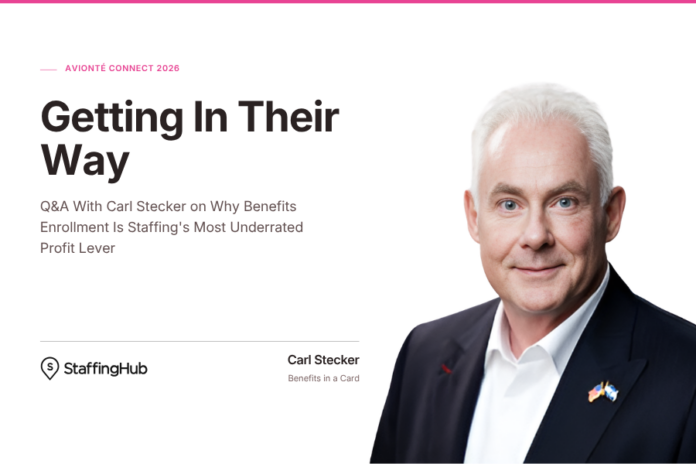
Every staffing firm swears its benefits are competitive. Carl Stecker will tell you that doesn’t matter if nobody signs up.
Stecker has spent more than 30 years building benefits programs for staffing firms and has seen every way this industry underserves its temporary workforce. As founder and CEO of Benefits in a Card, he’s watched participation stall even at firms with the strongest plans, and he’s built the data to show exactly what that stall costs: retention, replacement expenses, and millions in EBITDA that never show up on anyone’s dashboard.
At Avionté CONNECT 2026, Stecker sat down with StaffingHub to talk about why the real gap in benefits isn’t plan design, it’s the journey. He breaks down why bigger firms tend to post the worst participation, why texting workers about enrollment barely moves the needle, and why he’s building a calculator that shows clients their retention lift in real time, updating every time payroll runs.
Q. What’s the biggest challenge you’ve seen staffing agencies face this year in improving their benefits and the journey they take candidates through?
Carl Stecker: The biggest challenge is one I saw across the board this year, and it shows up worse in larger companies. The bigger the company, the worse their benefit journey tends to be.
That’s why we spent the money two years ago to go from 260 integrations to 270. It wasn’t only about security. It was about getting into the path of the worker. We’ve spent 30 years beating on carriers and designing products with them, even starting our own company, FreeRx.com, back in 2022, all to knock down pricing and get affordable care to people. None of that matters if participation stays low.
Everyone who signs up for benefits stays 45% longer, on average. That makes participation one of the biggest financial levers a staffing firm can pull. We met with a company that had 2.8% participation in their benefit plan. Getting that to 12.8%, just a 10-point increase, translates into that 45% retention lift, which equals $27 million in EBITDA for that business.
I was just on a webinar with David Johndrow, who owns TechHalo and built our AI enrollment platform, Sky. David was president of Staffmark back in 2000 and 2001, and his division ran nearly 3% higher EBITDA because he made sure people got their benefits. He understood the lift.
I don’t think it’s about the benefits anymore. Everybody has decent benefits at this point. It’s the journey that’s broken, and that’s where I see the low participation. We had a client on Avionté for years before we finally did the integration. Once we worked out the kinks, it was a $2.9 million lift for them, a company with 1,500 employees, just from signing up more people. That’s a smaller group. In a bigger organization, the lift is bigger, but they’re a bigger organization too. Even in a 1500-life group, a $2.9 million margin increase is massive.
Q. Why is participation so much lower at some of these larger companies than the benchmark?
CS: You’ve got to have your offering inside the ATS platform, inside onboarding, whatever system that is. You’ve got to get in their way, and you’ve got to do it right at onboarding.
We send text messages after people hit payroll, then another one a week later. We send emails too. It works, a little. But not a lot. The only way to be successful is to get in their way, and I don’t mean that to sound intrusive. It’s about timing. That’s the moment they need to make a decision and move on. If you send someone a text, they mean to reply. Most of them don’t.
Q. A lot of staffing firms still treat benefits enrollment like paperwork, a box to check during onboarding instead of a strategic lever. What’s that mindset costing them?
CS: If a company sends me their census data, I can tell them exactly what we can do for them. Our team knows how to read it, and we can advise from there.
Companies that treat this as a checkbox, and a lot of them do, are making a costly mistake. It’s not just about keeping someone longer, though that alone is worth roughly a $1,300 lift per hire from that 45% retention gain. What most people miss is if that person doesn’t elect coverage and leaves before hitting that 45% mark, you’ve got the full cost of recruiting a replacement, running a background check, and onboarding them all over again. So you’re not just missing the $1,300. You’re spending another thousand dollars on ancillary onboarding costs on top of it. Add it up.
Q. You’ve said a lot of firms offer solid benefits, but their own workforce barely knows about them. Why does that gap exist?
CS: Because we’re not getting in their way. I know I keep coming back to that, but after 34 years in this space, shaking every tree I can, that’s the honest answer.
We didn’t spend millions on integrations because we didn’t believe in this. We’re helping people and helping companies grow more profitable while they serve their employees. I tell people often that I wake up every morning for the single mom making $17 or $18 an hour, working to keep clothes on her kids’ backs. I have no shame saying that’s how I grew up. That’s what my mom did to raise me, and I feel obligated to that audience.
It matters to America to put these people to work and get them the benefits they need. When they sign up with us, they get FreeRx, a thousand free medications, free urgent care, and a 70,000-location pharmacy network for $5.99 to $6.99 a week for their entire family. That’s helping people. We’re saving them a fortune.
Q. You run a call center that fields calls from this workforce every day, so you get a view of the industry most people don’t. What do staffing firm owners misunderstand about what their workforce actually wants from a benefits program?
CS: Everybody needs to sit back and think more about the people they’re employing. They have needs: proper coverage, good plans, things they can afford, and something that makes their life easier.
And it all has to work on a phone. If your staffing company needs a computer instead of a phone to run anything, you’re behind the times.
Q. The industry tends to treat turnover as the cost of doing business, something that just happens. How much of that turnover is preventable?
CS: It’s not, when you can change it. Forty-five percent, on every new hire, with a real benefits plan. It’s black and white. I’ve got 26 years of data on this, and for some clients it goes back even further. Some of our clients see people stay 100% longer. Forty-five percent is just the average across our whole client base.
Q. That kind of number has to land hard with clients. Is that why you’re building a calculator to put it in front of them?
CS: We already built it. Now we need to integrate it into our client portal. I’m pushing my tech team hard on this. I want it to update every time payroll loads, so clients can see their retention lift in real time. I want to hand that to clients directly. It’s coming.
As a CEO myself, if I saw that number and saw the lift I was getting, I’d be all in.
Q. You’ve spent a couple of days walking the floor here at CONNECT, talking with people and building connections. What’s gotten you most excited in those conversations?
CS: Seeing people start to get it. They’re understanding more, and they’re catching on to why these integrations matter.
Whether you’re on Avionté or one of our other integrations, firms don’t have to send payroll manually anymore. It’s already there. Deduction feeds go back to Avionté automatically. Your benefits program basically runs on autopilot, and your compliance sits at 100% because you get an accept or decline from everyone who comes through the door. I can hand that data straight to your ACA compliance provider for 1095 and 1094 forms, and it’s done. All the headaches around benefits just disappear. That’s what these integrations have given us, and it’s why we spent so much to build them: to create a better environment for our customers.
Q. A year from now, what will staffing firms be doing differently than they are today?
CS: They’ll have an integrated suite of products with whichever provider they choose. That’s where this industry is heading.
We jumped on integrations before we saw this retention lift coming. It turned out to be a blessing, but that’s not why we started. I learned that every integration on the market ran on flat files, CSV files, payroll moving through Excel over Wi-Fi. That freaked me out. It’s so insecure. With AI in the mix, data breaches in staffing are up 1,800%. You saw what happened to Manpower, and you’ve seen what’s happened at other big companies. If I can protect my clients from that, that’s what we’re going to do. Protecting the industry mattered more to us than driving participation, though it turned out to be a win on both fronts.
About halfway through building the integrations, we had another idea: what about clients who aren’t integrated at all? So we built an application where they can drop their payroll in, and it converts it to API, encrypts it, and sends it straight to our system. Their deduction feeds come back the same way, in API, then unpack on their end. That gives clients outside our integrations the same military-grade security as the ones inside them. That was key for me.