


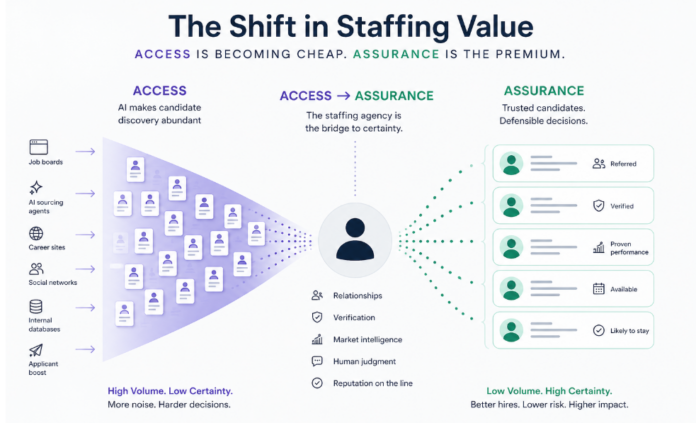
By 2030, AI sourcing agents will be a default feature inside the tools enterprise hiring teams already use. Not a separate product. Not a premium add-on. Just there. Inside the ATS. Inside the job board. Inside the CRM. Inside the workforce management platform.
It’s already starting. Indeed launched Talent Scout, an AI agent that surfaces candidates, runs outreach, and gives employers market intelligence without a recruiter touching the workflow. LinkedIn, Bullhorn, Avionté, and a long list of platforms are doing some version of the same thing.
Here’s the part that matters: candidate discovery is becoming less scarce.
That does not make staffing agencies obsolete. It changes what buyers will pay a premium for.
For decades, the agency pitch has been some version of “we can find people you can’t.” That value isn’t gone. It’s getting compressed. AI can build a search, rank profiles, write outreach, summarize resumes, schedule interviews, answer candidate questions, and produce a shortlist. Those capabilities won’t stay locked inside specialized recruiting teams. They’re being absorbed into the platforms employers already pay for.
When access gets cheaper, the market stops paying a premium for access alone.
The premium moves to assurance.
Can you stand behind this candidate? Are they real? Are they qualified? Are they accurately represented? Are they actually available? Are they likely to accept, show up, and stay?
That’s the trust premium. And it’s the shift staffing leaders and enterprise workforce executives should be paying attention to.
The fee isn’t disappearing. The justification is changing.
I’ve been on roughly 1,200 customer calls with staffing agency leaders over the last few years. The pattern I keep hearing is not “AI is going to kill us.” It’s quieter than that. It’s “our fee is harder to defend than it used to be.”
That tracks with what’s happening in the market. Staffing Industry Analysts estimated that U.S. staffing revenue fell about 10% in 2024. SIA’s March 2026 update projects only 1% growth in 2026, to $180.2 billion. Growth is harder to earn. Pricing power matters more.
At the same time, enterprise buyers are building more of their own talent infrastructure. MBO Partners and SIA reported in 2023 that nearly 80% of organizations either had a direct sourcing program in place or planned to explore one within two years. That’s not just a cost play. It’s an effort to own the talent relationship: more visibility, faster access, more control over quality and compliance.
And AI is moving deeper into the transactional layer of recruiting. PeopleScout has predicted that AI agents could handle up to 80% of transactional recruitment activities, including resume screening, candidate Q&A, scheduling, and compliance documentation. The exact number doesn’t really matter. Whether it lands at 40, 60, or 80%, the direction is hard to dispute. Routine recruiting work is being automated.
Put these three forces together: shrinking market growth, more direct sourcing, and more workflow automation inside enterprise platforms. The agency value proposition that rests primarily on candidate access starts to erode.
The agencies that build something different won’t.
The funnel is getting noisier, not smaller
Here’s the part most coverage of AI in hiring misses.
Candidates have AI too.
They can tailor resumes for ATS filters, generate cover letters, rehearse interview answers, and apply to jobs at a scale that wasn’t possible three years ago. GCheck’s 2026 Trust in Hiring Report found that 93% of recent U.S. job applicants admitted to at least one form of embellishment or misrepresentation during hiring. Twenty-seven percent reported using AI during a live interview to generate real-time answers.
That’s one vendor-backed survey, so I’d treat the exact percentages with some skepticism. But the direction is consistent with what hiring teams already report: more applications, weaker signal, harder decisions.
The hiring problem is no longer just candidate scarcity.
It’s candidate certainty.
Enterprise hiring teams are not only asking, “Can you find people?” They’re asking, “Can we trust this signal? Can we defend this decision? Can we move faster without taking on more risk?”
That changes the agency pitch.
The old pitch: “We found this person.”
The new pitch: “We can stand behind this person.”
That’s a much higher bar. It means the agency is not just forwarding a resume. It’s bringing context the client can’t easily generate on its own: who referred the candidate, whether they’ve worked before, how they performed, whether their credentials are current, whether they’re actually available, what they care about in a role, whether they’re likely to accept and stay.
That’s where the fee earns a new justification. Clients aren’t paying for access to a name. They’re paying for reduced uncertainty around the hiring decision.
The data is already pointing this way
This isn’t a prediction. It’s already showing up in how the fastest-growing agencies operate.
StaffingHub’s 2025 State of Staffing research found that fast-growth agencies aren’t winning by spending more on candidate volume. They’re investing differently. Sixty-two percent are planning new technology purchases, compared to 37% of agencies overall. They’re using AI deliberately in revenue-generating areas like candidate qualification and matching, not just sourcing.
They’re also leaning hard into referrals. Eighty-six percent of fast-growth firms have formal referral programs versus 60% of no-growth agencies. Seventy-one percent of fast-growth agencies rate referrals as extremely important to their business.
That’s not an accident. A referral creates a trust signal that cold sourcing can’t replicate. It doesn’t prove fit by itself, but it gives the agency a stronger starting point: known origin, relationship context, social proof.
The other shift in the data is what gets measured. Quality of hire has overtaken time-to-fill and cost-per-hire as the top performance metric for talent source ROI. Speed and cost still matter. But the executive question is moving toward outcome.
In other words, the market is starting to pay for confidence, not just throughput.
Commodity staffing sells access. Strategic staffing sells assurance.
This is the line agencies are going to land on one side of.
Commodity staffing fills requisitions. The work looks like sourcing, screening, submitting, and placing. The fee gets justified by speed and access. As AI tools embed deeper into the platforms enterprise buyers already use, the comparison gets harder. Why pay an agency premium for what software is starting to do at marginal cost?
Strategic staffing sells something AI can’t replicate overnight: trusted talent supply, verified fit, redeployment of known workers, referral density, local market judgment, and workforce intelligence the client can act on before a requisition is even open.
The most valuable client conversations don’t start with “send me resumes.” They start with:
- “We need 100 people onsite next month.”
- “We’re seeing attrition in this skill set.”
- “We’re entering a new market and need to understand what talent is actually available.”
Those conversations don’t get won by having a bigger database. They get won by being upstream of the requisition, with relationships and information the client doesn’t have on its own.
On the candidate side, the same thing applies. Recruiters become stewards of trusted supply. Not just people who call when a job opens, but people who maintain relationships, validate skills, capture referral context, and keep talent warm before demand exists.
AI can surface a candidate. It can’t manufacture years of relationship history, validated performance, or the confidence that comes from having placed someone before.
The metrics are going to evolve too
By 2030, the strongest agencies won’t be defined by the size of their database. They’ll be defined by the strength of their trusted supply.
The metrics that matter will follow. Submissions, interviews, fills, time-to-fill, gross margin: all still relevant. But the better operators will also measure:
- Referral source quality
- Known-worker redeployment rate
- Candidate engagement depth
- Credential confidence
- Availability accuracy
- Submit-to-hire ratio
- No-show and early turnover rate
- Quality of hire by source
- Client satisfaction by source
These aren’t vanity metrics. They’re proof points for the trust premium. They let an agency show a client why the fee isn’t a charge for finding names. It’s compensation for reducing risk.
What this means right now
A few things I think are true:
AI will not remove the need for staffing agencies. It will remove the tolerance for weak agency value propositions. The firms that try to compete on pure candidate access will get compared to software, self-service tools, and the client’s own direct sourcing program. That comparison gets harder every quarter.
The firms that use automation to strip waste out of the process and reinvest the time into trusted talent assets will compound. Client trust, candidate relationships, referral networks, verified supply, and workforce judgment don’t get easier to build for competitors. They get harder.
The fee may still be called a placement fee, markup, or success fee. But the reason clients pay it is changing. They will not pay premium economics for a list of names they believe software could have generated. They’ll pay when the agency improves the quality, speed, and defensibility of the hiring decision.
That’s the shift from access to assurance.
The strongest staffing firms in 2030 won’t say, “We know where to find people.” They’ll say, “We know who to trust, why they fit, and how to help you make a better workforce decision.”
That’s what staffing agencies will get paid for next.
 David Folwell is the host of The Staffing Show podcast by Staffing Hub. He is also the president and founder of Staffing Referrals, the only automated referral management (ARM) platform designed specifically for staffing firms.
As an avid tech enthusiast, Folwell is constantly helping businesses overcome their biggest challenges so they can grow faster. He is an advisor for multiple technology startups and is an active participant in staffing industry events around the country.
For fun, David runs ultra-marathons, listens to Tim Ferris and Sam Harris podcasts, snowboards, and travels.