

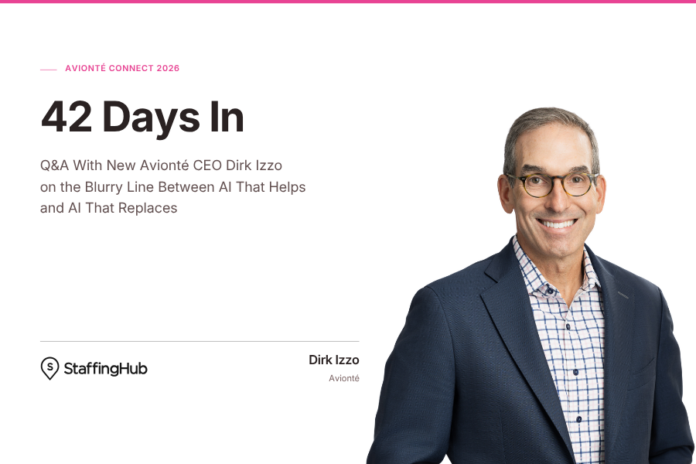
Forty-two days into the job, Dirk Izzo walked into his first Avionté CONNECT as a CEO who’s never worked in staffing. He’s spent his career scaling software companies in hospitality, payments, and retail, which means he’s sizing up this industry with fresh eyes, and he’s already found the parallel that makes sense to him: in payments, you scale alongside your customer’s success. He wants Avionté to work the same way.
Two other people in this series brought Izzo up unprompted. Odell Tuttle called his outsider perspective an advantage. Dan Mastropolo said the industry has been too stagnant and hoped a CEO from outside it would push things faster.
Recently, Izzo sat down with StaffingHub to talk about what he’s building toward: a conversational AI interface on top of Avionté that lets staffing firms simply say what they need and have the platform orchestrate the work behind it, and a mobile app he anticipates going from 20% to 80% of customer adoption within a year. He also weighs in on the increasingly blurry line between AI that frees up a recruiter and AI that starts doing the recruiter’s actual job.
Q. What were you most excited about in the conversations you had a couple weeks back at CONNECT?
Dirk Izzo: CONNECT was absolutely amazing. It was my first CONNECT ever, but I’ve been to a lot of trade shows and customer events over the years, and this was one of the best I’ve been to. What I loved most was getting to interact with so many of our customers, and genuinely seeing how much they love our people, our culture, and our products. That’s a huge win to walk into as a new CEO.
On top of that, as we validated our strategy over those couple of days, it was really impressive how much it resonated with people and how much they believe in where we’re going. They just want us to get there quickly. So we’re going to double down and accelerate a lot of what we talked about. It was great validation, 42 days in, that we’re headed in the right direction and people just want us to move faster.
Q. What have been your first impressions of coming into the staffing industry?
DI: It’s a completely different industry than anything I’ve worked in before, and I love it. It’s a people-based industry supported by technology, and in that kind of environment, the people are what matter most. I got to interact with so many great people across different agencies at CONNECT, and with our partners too, and it was clear how well their cultures and our culture at Avionté mesh together.
There are a lot of parallels to my past career. I haven’t worked in staffing, but the concept behind payments is similar in an interesting way: you scale up as your customer has more success. That’s what we’re aiming for here too. We want to be the best possible partner in helping our customers do their jobs as efficiently as possible, and as they succeed, we succeed.
Q. You said a lot of your conversations at CONNECT validated your strategy for Avionté. What do you see for the company in your first year?
DI: There are a number of areas we’re focused on. I’ll talk about the product side specifically. The most important thing for me, and I said this at the conference, is taking care of our customers. If we take great care of them, they’re going to stay with us and want more help from us going forward. And we have to take care of our employees too, since they’re the ones taking care of our customers. That’s a given, and it’s the base platform we have to bring to market.
On the product side, there are a couple of areas where we’re going to accelerate. One is combining our front office and back office capabilities so they work as one, freeing up a recruiter’s time to spend more with the employer and more time managing and engaging talent on the back end, which is critical.
The second is AI. Obviously, everybody’s talking about it. The interface you get in Claude or ChatGPT is exactly the interface we’re going to build on top of Avionté. You come in and say, “I need this,” and it runs through the whole process: looking at your pool of resources, matching against your criteria, figuring out whether to interview candidates through an agent or in person, and running through that entire flow. We’re looking at leveraging technology across the board to get you the best available talent in your pool, ready to deploy against what that employer needs.
On top of that, mobile is a big thing. We talked a lot about talent engagement at the show. The talent pool is shrinking: we’ve got a demographic aging out, a smaller demographic aging in, and immigration constraints putting additional pressure on the pool, especially in light industrial. So how we engage talent and keep them engaged matters enormously, and the mobile app is going to play a major role in that.
Q. If something can’t be done on the phone, staffing firms are in trouble — that came up constantly at CONNECT. Are there specifics you can share on that?
DI: I think about how people interact, especially the younger generation, because they were born with a phone in their hand. The smartphone was already there when they arrived, and now that generation is aging into the workforce. They don’t want to look at email or take a phone call. They want to interact through an application or a text message. That application has to be super easy to use: see what jobs are available, pick the ones that fit, apply, all with their thumbs.
Once they’re in, they need to onboard quickly, time in and out, and get paid, all from that same phone. That’s what we have today, and we’re going to keep enhancing it to make engagement easier. The more engaged talent gets, and the stickier they are to that application, the easier it becomes to redeploy them.
Q. There’s also a lot of talk about staffing agencies eventually working with their ATS through AI agents instead of going directly through the UI. What does that shift look like from your vantage point?
DI: It’s funny, because I think over the next couple of years this is going to look dramatically different agency by agency, even person by person. Some people are going to want to go in, see the list, manipulate things themselves, look at resumes, call candidates directly. Others are going to lean on the agent. Over time, I think people get more comfortable with what the agent can actually do to surface the best available talent for a role.
The long-term vision is something like a Claude or ChatGPT interface, where you type in what you need and it knows what flows to kick off, which agents to deploy to find, engage, and onboard the right talent, all happening behind the scenes. You end up really just interacting with the talent directly at the last step, and with the employer to maintain that broader relationship.
I also think AI is going to cascade across the entire platform, not just applicant tracking and matching. It’s going to touch onboarding, clocking people in and out, automating pay, including instant pay, and invoicing the employer. AI agents are going to be deployed across the whole platform, not just the applicant tracking piece.
Q. Where’s the line between AI that helps a staffing firm and AI that starts to replace what a staffing firm actually does?
DI: It’s a very blurry line, honestly. I do believe that deploying AI well is going to free up recruiters to spend more time with employers, making sure they have the right talent, understanding how to rank and prioritize the value that talent is actually providing. Did they show up on time? Did they do good work? Were they appropriately dressed? We can engage the employer on that and score our talent accordingly.
The other thing it frees up time for is engaging the talent. We can’t forget that people are people. At some point, they want to talk to a person, they want to be engaged by a person, the same way you and I are having this conversation right now. This could have been an interview with a bot as far as anyone watching would know, but it’s more personal because it’s the two of us talking. A lot of the mechanics of the job will change and get automated by agents. But the core of it, understanding an employer’s needs and understanding what talent wants, and having that relationship, that’s going to be the real differentiator for these recruiting firms.
Q. A year from now, what do you think staffing firms will be doing differently than they are today?
DI: Staffing firms are all over the place right now. I shared some numbers on how many are actually using AI, and it was pretty daunting: less than half of firms are using AI today in any real way. A year from now, I think every staffing firm will have dabbled in AI in some form, whether that’s basic workflow automation or an actual agent doing matching or some other part of the process.
Mobile is going to become a really big thing too. Twenty percent of our customers use mobile today to engage their talent. I think that inverts to 80% within a year, because the shrinking talent pool means we have to engage people differently than we ever have before.
I also think the digital flow from a vendor management system into an ATS is going to become a requirement in the next year. Having that digital supply chain signal feed directly into your platform is going to be critical, and it’s something we already offer through Simple VMS. We’ll keep building that out, but automating it is becoming essential, because people want roles filled in 48 hours. If someone still has to receive an email, manually enter it into an ATS, then run a search, that takes too much time, and it should be fully automated. That VMS signal should go straight to an agent to find, match, and onboard talent in real time.