

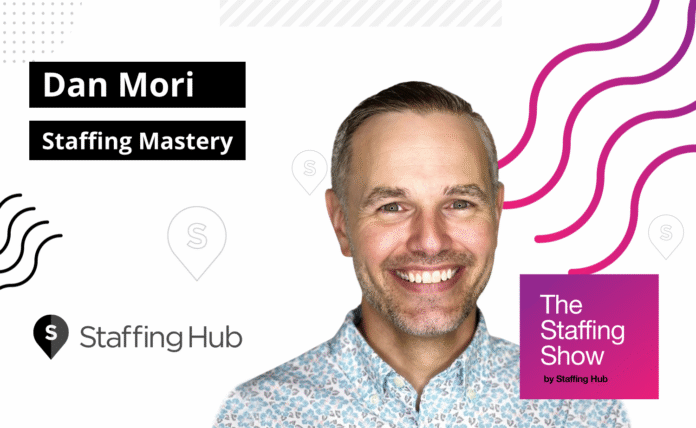
Many leaders say they want a culture of accountability, but building that culture starts with how they choose to lead. In this episode of The Staffing Show, Hilary Baker sits down with Dan Mori, founder of Staffing Mastery, the Staffing Dashboard, and the Staffing Sales Summit. Drawing on years of working with staffing leaders, Dan explains why accountability is often a leadership issue rather than a people issue, and how unclear expectations and reactive behavior often result in a culture based on fear rather than continuous improvement. He outlines practical tools to help you clearly communicate your vision and financial targets with your teams, and how to build an environment that allows team members to learn from their mistakes and take accountability. The conversation also explores what leaders should look for when hiring, how agencies are navigating AI adoption, and what separates firms that create lasting value from those that become replaceable. Dan closes by sharing what leaders can expect at the upcoming Staffing Sales Summit and why this moment represents an inflection point for the industry.
[0:01:13] Hilary Baker: Thank you for joining us for another episode of The Staffing Show. My name is Hilary Baker from Staffing Hub. I’m filling in for David Folwell today. I am super thrilled to be joined by one of staffing’s go-to experts on modern sales strategy, Dan Mori. He doesn’t need a ton of introduction here, but he is the founder of Staffing Mastery, Staffing Dashboard, and the Staffing Sales Summit. He has spent years helping agencies bridge the gap between what salespeople promise versus what agencies and their teams can deliver. Dan, I know that you and David have had some awesome conversations on the podcast in the past, so I really appreciate you letting me borrow the mic today.
[0:01:58] Dan Mori: Yeah. Hilary, I’m excited to be on this side of your interview leading The Staffing Show. This is, I don’t know, I’m grateful to be here as always, but I’m excited to be here being interviewed by you today.
[0:02:09] Hilary Baker: Awesome. Well, I want to go somewhere just a little bit different today. My inbox in LinkedIn has started getting hit with some of your leadership content, which I’ve really appreciated and has –
[0:02:21] Dan Mori: Oh, thanks.
[0:02:22] Hilary Baker: – resonated really well with me, so I appreciate it. I just want to dig in a little bit. One piece in particular that you put out recently, I think it was last week, it’s called “Accountability Starts with a Leader.” If listeners, if you haven’t seen this, it’s on LinkedIn, and I’m sure if you sign up for Dan’s newsletter, that would have hit your inbox as well. Basically, the core argument is that accountability problems are not always – it doesn’t always lie with the person, it’s leadership problems as well. Dan, what made you want to put this message out there right now?
[0:03:02] Dan Mori: First and foremost, thank you for the positive feedback on the newsletter. It’s affirmation that the move that we made transitioning from Staffing Monthly, the digital publication, over to Staffing Mastery Insights, focusing on deeper, more actual insights has been a valuable one, and that’s what we’re trying to do. But this particular topic around leadership, I wanted to dig into this a lot more this year, because we’re still facing really turbulent times in this industry, where the pandemic was crazy, we’re facing a multi-year downward decline in demand for our services. It’s really going to take strong leadership to guide organizations through these turbulent times.
I’ve worked with countless leaders in my time, and I’ve seen the same patterns show up over and over again. And I’ll tell you, this particular topic around accountability is because I’ve heard this phrase so many times that says, we want to instill a culture of accountability. I’m like, “Oh, it’s great. That sounds amazing, right? That’s what we all want.” Apparently, that sounds wonderful. I think the people want that, the leaders want that. However, the way that I’ve seen leaders go about doing that misses the mark. I think where it starts is, leaders influence culture of organizations. If you’re a leader and you do not like the culture of your organization, that’s a leadership issue, not a people issue, hands down, right? If you want to culture accountability, it’s a leadership issue.
When I see culture, or when to see accountability deployed, it’s usually deployed in an punitive way and it creates this fear-based culture. I think if you unpack that statement and you say, “Okay, we want a culture of accountability.” That sounds great, but no one’s going to want a culture of punitive measure, right? No one wants that. I felt it was important to share my thoughts about how a culture of accountability is really built from the leadership throughout the organization.
[0:04:55] Hilary Baker: You’ve seen, it sounds like, a lot of leaders react to things going wrong, instead of ensuring clarity upfront. How does a leader catch themselves before they fall into that trap?
[0:05:11] Dan Mori: I love that question, and the reason why is because I’m guilty of this. I saw this in myself, and a lot of what I’m writing or through my own life lessons of learning this is that I too used to want a culture of accountability and I too would react and hold people accountable when something went wrong. Usually, what was happening is expectation wasn’t matching my reality. The results weren’t what I wanted. I got frustrated, and sometimes I would get angry. In that moment, I would react from frustration and anger and I would be like, who’s to blame? Whose fault is it? Who didn’t do the thing that they were supposed to do? I’m going to go get to the bottom of this and figure out why did they do the wrong thing?
What I’ve honestly learned through my own growth and development in this industry from some great mentors is that that was really short-sighted. When you act emotionally, or actually react emotionally and you want to be punitive and punish failure, you’re not actually instilling accountability. You’re not instilling an effective culture. You’re making people afraid and you’re really losing sight of the greater goal. The greater goal is continuous improvement. You want to keep getting better. If you keep reacting out of frustration and punishing failure, what’s going to happen is you’re going to shrink the comfort zone of your people and they’re going to continually play it safe, and they’re not going to take risks. They’re not going to step into new things. They’re not going to want to learn new things, because they’re going to be so afraid of failure that they’re never going to move in that direction. They’re always going to result to what’s familiar and unfortunately, as the markets move on, familiar gets outdated and it doesn’t produce the results that you want.
Yeah. I see leaders react based on frustration, not taking a step back and saying, “Hey, why did this actually happen?” Is it that I did not clearly communicate what the expectations were? Have I not shared with this particular person what their contribution is to what a successful outcome looks like? Have I not trained them how to do the work in a way that will deliver the successful outcome that I as the leader want, or maybe have I not equipped them with the tools or the resources they need to get that result?
I think as a leader, if you start looking there first, then you’re going to find the answers that you want, and you’ll be able to lead through that in a more positive way that will actually create that cultural accountability.
[0:07:23] Hilary Baker: There, you just laid out three main gaps. The unclear vision gap, the vague expectations gap, and then the people not really being equipped with the resources that they need to succeed. That’s a gap in and of itself. Which of these do you see most often in the staffing agencies that you work with?
[0:07:43] Dan Mori: I see all of them a lot, but if I had to really pick one that is the primary culprit, it’s lack of clarity. I think that we as leaders, and again, I’ve been guilty of this myself, is we have this really clear vision in our head. And in our head, it makes complete sense. Then we go out and then when we try to cast that vision to others, we’re saying it in ways thinking that the people that we’re talking to are inside our head, they can see things the exact way that we see them and that is just 100% untrue, and it’s impossible. We don’t communicate in a way that’s going to really clearly deliver the message to people, and what happens is it leaves them for guesswork. It leaves them saying, “Okay. How do I fill in this gap?”
Then, it’s funny, there’s this other word that I’m going to get into later with Staffing Mastery Insights of empowerment. What’ll happen is then we empower people to fill in these gaps and then not everybody’s filling in the gaps in a standard uniform way and that’s where chaos starts to ensue. I would say, really a lack of clarity. I think if leaders can get more clear on what they really want and clearly communicate in a way that everybody understands where the organization is going and what each producer, contributor needs to do to help get them there, I think that would probably bridge 90% of it.
[0:09:04] Hilary Baker: You’ve talked a lot about how vision is communicated unclearly. Can you tell me what it looks like when it’s done really well?
[0:09:14] Dan Mori: Yeah, absolutely. I will tell leaders out there something that this is what I rely on. Because if you’re a founder, or an entrepreneur and an owner, you’re going to be even more susceptible to shiny object syndrome, or incoherent thoughts at times, because your mind is always racing at a million miles an hour. Even senior leaders that might not be the owner, they tend to run faster and think at a higher level. Something that I’ve learned to do that I would encourage you to do is literally create communication templates. If anyone is really unsure about where to get started with that, you can reach out to me. I’m happy to share stuff that I’ve created as well. Just hit me up on LinkedIn.
I actually have a set of templates. I actually said, hey, what is it that I want to communicate? What is the absolute truth that I want everybody to know? I literally built these, I don’t know if who’s listening can relate to this, but the mad lib style, fill-in-the-blank templates that I can just say, “Hey, this is what I want to communicate to the team.” I think, what is it that I want communicated to them? Why is it important for them to know this? Then, who specifically needs to take what from this message? That’s my framework going into creating these templates. I would say, hey, I’m going to start with the overarching goal, the thing that is most visible that we can connect to, and that’s the financial target. This is what we want to achieve this year. It’s X amount of revenue and more importantly, Y amount of gross margin, right? That’s what we’re trying to achieve.
Then I get very particular and I want to convert that, or translate it into the language of the producer, because recruiters and salespeople, they don’t typically – they’re aware of numbers, but they don’t think about, “Oh, I’m going to do X amount of dollars’ worth of work today.” They don’t think like that. They think, “I’m going to fill this many orders, or I’m going to get this many clients or whatever.” Then I will specifically translate it and say, if we’re going to do this much revenue, this is where it’s going to come from. Our existing clients need to generate this much. Here’s how we’re going to do this. There’s going to be these account management plans. Account managers, you’re going to have to do this, this, this and this. Recruiters, sourcers, you’re going to have to be able to fill this many jobs to create this positive headcount. This is your work. Salespeople: there’s going to be some new logo acquisition that we need to focus on. Here’s the work that you’re going to have to do. Here’s the campaign structure that we’re going to follow this year.
If we do these things, then it’s going to hit this end result. Then here’s how we’re going to measure our work, our progress and our results. I talk about the KPIs and I’ll lay them out. I put a glossary of terms. I know it’s geeky as that sounds. I don’t leave things up for interpretation. This is what headcount means. This is what a cold call means, so on and so forth, so everyone knows this. But I connect it down to the people in the organization. Then, I actually will lay out, this is how we’re going to actually measure our progress, as far as the cadence goes.
We have this annual goal. We’re going to run four quarterly plans. Then we’re going to have our monthly reviews that are fairly informal. Then we’re going to have our weekly huddles. We’re just going to make sure that we’re doing the work that we lay out in this plan to get to this goal. That’s how I communicate it. That’s pretty much the crux of my main template that goes out at the beginning of the year. Then there’s a pared-down version that goes out every quarter as we lay out the quarterly plan. Then I have literally a per weekly huddle meeting template that just takes me through, okay, producers, what did you produce this week? Everyone knows how to respond, because I’ve given them a template. They know exactly, “This is the work that I did. This is what I was supposed to do. These were my goals for the week. This is what actually happened.”
The reason that I lay it out like that, Hilary, is because this way everyone knows exactly how to show up and respond in a uniform, standard way. So, that when they say, “This is what my goals were for the week,” now I know that they know down to the weekly level what their goals were, what they had to accomplish. Then when they say, “This is what actually happened,” I can identify as the leader, what is the gap of execution there? That way, if we’re focusing right there, we can actually be a leader that thinks at 10,000 feet, but can help our people operate at the ground level. That’s really how I would approach effectively communicating to an organization in a really quick overview.
[0:13:07] Hilary Baker: It sounds like a really tight operating system that you have dialed over the years.
[0:13:11] Dan Mori: Thank you.
[0:13:13] Hilary Baker: No, that’s amazing. It sounds like, the vision is – it’s the same package, but you wrap it differently for different roles, which makes a ton of sense.
Another thing that hit my inbox this morning was a piece about making mistakes, how great leaders can handle them without destroying trust, without hindering performance. What does that look like when it’s done well?
[0:13:37] Dan Mori: Absolutely. This is the second rule, right? There are two fundamental rules that every leader must know. We just talked about the one with clarity and leading for accountability. The other one is your people need to know that they can make as many mistakes as they want, or they need to to learn, but they can’t make the same one twice, because this is a learning environment. If you keep that as a bedrock mantra within your organization, you’re going to teach people that you’re all about learning and growth and development. Honestly, what this looks like, this is going to sound really, really crazy, but this is just how I see humans respond.
First off, let me just start this way, Hilary. It is human to make mistakes. We’re going to make mistakes. People are going to mess up. The phrase “human error” is pretty common, right? Now, it’s how leaders respond to those mistakes that will allow your people to either grow and develop, or shy away from taking risks, or growing and developing in the future. I like to tell all my people during orientation and routinely throughout that exact phrase. “Listen, when you’re here, I want you to learn. I want you to try things. I want you to try to grow within our system. Sometimes, I want you to bite off more than you can chew to see how capable are you. You’re going to make mistakes and that is okay. You can make as many mistakes as you need to. Just don’t make the same one twice, because I need you to learn from it, because if you learn from it, you’re going to get better, which means you’re going to become more successful and that’s what I want for you.”
They start to understand why I want that, and then I’m going to be okay with it. Then I let them know, but when you make a mistake, I want you to know what this looks like for you, okay? I want you to know how I’m going to respond to it. If you make a mistake, the very first thing that I need you to do is acknowledge it, right? Just acknowledge it. Say, “Hey, a mistake was made.” Then I want you to own it. “This was my mistake. My bad. I’m sorry.” Apologize. Show like, hey, take that fully on. “This mistake was made. This is what was supposed to happen. This is what actually happened. That mistake is on me. I’m sorry.”
Then I want you to really think about it and reflect, what is it that went wrong? Why did it go wrong? What are you going to do differently to prevent it from happening in the future? Again, it’s all about growth and development and learning from our mistakes, so we can get better as people and producers, right? That’s how it looks like when they respond. As we’ll say, “Hey, what? This is my bad. I did this wrong. I should have said this in the meeting, or I should have captured this information before sending a proposal, or I should have done this thing differently. What I’m going to do differently in the future is this.”
Then you as a leader, you get to let them know, yeah, that’s an appropriate next step. That’s an appropriate corrective action, or you get to guide them through that process, so they start making better corrective actions. What’s really, really cool because a leader can’t be there every minute of every day, don’t try to be that micromanager that it is. If you teach your people how to self-correct and take the effective corrective actions, when they make a mistake in the future, the process might look like this. “Hey, I want to let that I messed up. I own it. I caught it. This is what I did.” Then leaders will be like, “Yeah, that was actually the right response. Thank you.” Now you’re moving in a pace that’s faster.
Your people will appreciate that, because now they’re not afraid to make a mistake. They don’t feel their job is going to be a jeopardy, that their reputation is going to be a jeopardy. That’s how we do it. Where I was going in the beginning, when I said it’s going to sound crazy, this is actually the same accountability measure that I teach my children. I’m like, “Hey, you’re going to mess up. You’re going to make a bunch of mistakes. But the first thing is I want you to acknowledge it. Just to recognize that a mistake happened. Be aware of it, that the result that we were going for didn’t happen. If it’s your fault, own it, to say, “Hey, this one’s on me. I’m sorry.” And mean it. Be genuine that you didn’t want that to happen and own that mistake and then reflect on it and say, “Hey, you know what? In the future, this is what I’m going to do differently.”
That’s the process that they go through as they learn and develop as human beings. It allows them not to feel guilt, or shame, or resentment when mistakes happen, but to allow them to like, hey, this is a learning opportunity. This is the process that I’m going to learn through to get better, to help me do better in the future. It works well in that application as well.
[0:17:40] Hilary Baker: What’s the consequence that you see in staffing agencies who don’t take that approach, or more like, “Well, you did it wrong.” We either are going to sweep it under the rug and just keep forging on, or worse, it becomes that culture of punishment.
[0:17:57] Dan Mori: Yeah. I’m so glad that you asked that question, because that’s the big one, right? Is it organizations, or agencies that don’t get this right? What will happen? Two major issues. One, if your people are afraid to admit mistakes, they will stop admitting them. As a leader, you might miss when mistakes are happening in your organization, so you might actually not be able to protect the organization from the consequences of the mistake. It might be something like, maybe a client calls in and they entered an assignment, right? Then the recruiter made a mistake and they didn’t actually add it in the system. It goes all the way through payroll. Payroll pays the person, now that the field employee gets a paycheck from that they shouldn’t have earned it, and that you can’t bill to a client, right? The client gets a bill for it, because no one caught it, because one person made a mistake and they were afraid to say something about it. It snowballed into this bigger issue, right?
That’s the first thing that happens is now mistakes go unchecked and the leader can be unaware of the downstream consequences and they’re often a lot bigger, because they’re allowed to grow. Even worse than that, and that one’s really bad, but even worse than that is that it creates a culture of safety, which leads to a culture of mediocrity. If people are unafraid to do the bold thing, or grow, or expand and they want to stay in this tiny little comfort zone, your organization will never grow. You will just stay safe. You will play it safe. Mediocrity will set in. Then what happens is you become the basic agency of your marketplace, which means your clients will eventually move away from you. That’s the major long-term impact of not getting this right.
[0:19:33] Hilary Baker: What are some of the characteristics of hires that leaders should be looking for that will fit really well into that culture of learning and growth?
[0:19:43] Dan Mori: Yeah, love that. First one is self-awareness. Some people aren’t even aware that they make mistakes, right? You really want to look for people that are actually self-aware and that they understand how their contributions impact things that are larger than themselves, or outside of themselves. That’s a really big one, self-awareness. Sometimes you can have people that are self-aware that still do not accept responsibility. You have to make sure that they can actually accept responsibility and ownership over their own actions.
Some of the ways that you can check for this in an interview is look for how they describe things. If they describe past failures, or past where they didn’t achieve the goal, or whatever and they start to label external forces and they basically list out all the blame factors that are outside of themselves first, then there’s a pretty good indicator that this is somebody that is not going to operate well within that accountability. They’re going to say, “Yeah, this mistake was made, but it was this person’s fault.” Okay, well, that breaks the cycle, right? That breaks that loop of you know what? I’m going to own this, let’s move forward. Those are the two big ones, self-awareness and self-responsibility.
If you can get someone that can actually reflect and learn, that’s amazing. But actually, the self-reflection and the self-learning, as long as you get those first two, the self-awareness and self-responsibility, if you get those two in a person, you can actually teach somebody how to self-reflect, correct, adopt, and grow. Those are the two bedrock ones I want in somebody.
[0:21:03] Hilary Baker: Okay. Let’s zoom out a little bit. Last time you were on the show, you and David were talking about AI disruption and direct sourcing becoming a real competitor. We are a couple of months into 2026 now. I don’t really know how, or when that happened, but are you seeing agencies really responding to that? Or is there still an element of denial that you’re seeing?
[0:21:31] Dan Mori: There’s still an element of denial. It’s so funny. I want to tell you a story about a completely unrelated thing that I just encountered, not in staffing, but I know this person and they are an author, right? They produce a lot of content. They had a system where they would actually conceptualize the ideas and they filed really like in Andy Warhol production style. They would conceptualize a lot of ideas. They would put the ideas out to a team of ghost writers that would help fill in the main concepts and then they would get the stuff back and they would really finish up the last 20% and then ship the product. It was an amazing system. It’s a real business model for this.
When AI came into place, what was happening is that team of ghost writers that were doing the middle 60% to 70% of the work, they started using AI. They started adopting it, right? Then this author was like, “Okay, we’re getting some good response.” But then the author realized, “Wait a second. I can just do the same thing now.” They end up just cutting out all of the ghost writers and just implementing those tools. The reason I share that story is these people, even though they were adopting the technology to try to make them become more valuable to their customer, at the end of the day, they worked in a fashion that actually eliminated their role, their function, their value. I’m starting to see agencies do that.
There’s probably three camps. There’s two primary camps that agencies are going into and then there’s this one very small camp that I’ll talk about at the end. The first two, the denial camp, the people that are like, hey, A, this is a people business. It’s always going to be a people business and we’re going to focus on the people side of it. We’re not going to let technology take our jobs. We’re not going to over tech, or over automate this. That’s where they’re at. Those people are getting crushed right now, because the customer wants more technology. They’re seeing the same thing from ChatGPT and Grok and Claude and all these AI tools that everyone else is seeing and they’re like, “No, that’s the future. That’s who I want to work with.” Those agencies are experiencing declining demand greater than any other, the three camps, right? That’s bad.
If you’re in that camp, just accept the fate of it. This is the new technology. This is literally when we got websites, or when we got job boards, or when we got LinkedIn. This is just a new tool that we have to adopt. Which brings me to the second camp. These are the people that are like, “Hey, this is great. I’m just going to let AI do a lot of the heavy lifting and a lot of the work and a lot of the value creation that I’m providing to my customer.” Sounds great. What’s going to happen is if you don’t do this in a novel way, you’re going to actually show your customer that they do not need you, just like the ghost writers of my story. If you actually do this in a way that’s pretty basic, that your customer could easily replicate, they will move away from you. The tools are available for them to do this at a greater rate than at any time before.
That leads me to this third camp. There is a small group of people that said, “Hey, in order for this to really work for me in the short term, but especially the long term, I need to figure out a way to use all of these tools at a rate that is faster and a quality that is better than my customer will be willing to invest to do it. That makes me still valuable and useful to my customer that will put me in that position.” They are the ones that are actually utilizing these AI tools to really build their database up in a way that’s unique to them. They’re actually categorizing all of their talent in a much different way now.
They’re actually going down to the skill that people have, not just in a tagging sense where they’re like, okay, how many CNC machinists do I have? Or, how many RNs do I have? They’re actually able to segment their database down into the very particular skill sets that people have, and they can actually start to look for, what are the most valuable skill sets in the marketplace today? What are the most valuable skill sets going to be likely tomorrow? Now they can actually form their recruiting and start pulling from all of the general sources, like job boards and things like that all over and start building their database in a way that is going to be more unique to them, not readily available to the client. They can build all these automated workflows out in a way that the client is not likely to invest in creating that infrastructure.
It’s going to be like, “Okay, I’m going to partner with this person because I don’t want to invest the time and money to recreate what they’ve done to get the access to the people that they have unique access to.” That’s really the way that I see the market going right now. It’ll be fun to see how this continues to unfold this year as we get more tools and more automations that hit our industry, but that’s where I see it right now.
[0:25:58] Hilary Baker: What would be a piece of advice you would give to an operator who sees himself in camp two, but really wants to get to camp three?
[0:26:05] Dan Mori: Take a step back and ask this question. How easily could my client do what I’m doing? If that answer is pretty easy, then you are on the brink of not being very useful, or necessary to your client. That’s the first step. If you’re like, how easy could my client replicate what I’ve done? And you’re like, this is going to be really hard and you’ve created a technology moat, because you’ve packaged these tools in a unique, valuable way, then you’re probably safer and more on your way into camp three. But that’s the first question that I would ask.
[0:26:40] Hilary Baker: Yeah, that makes a ton of sense. How do you help leaders – because I feel like there can be a big risk of wanting to take that step from camp two to camp three, of falling into the shiny object trap. More tools does not necessarily mean you will be providing more value. How do you help leaders re-center when you see them floating in that direction?
[0:27:06] Dan Mori: Yeah, I love that question. Absolutely. David is lucky to have you filling in for him today. Great question.
The biggest thing to really think about as a leader, and this is our job, when we think about the leader, or the captain of the ship, so to speak, our job is to keep our eye on the horizon. The horizon is, what is the value that our clients really need from us that make us necessary for the client? Ultimately in our industry, it is getting the person that is the best fit for their open role that they could not easily get, right? That’s the end deliverable that we want to deliver.
If you want to think about, how do we get to that end, well, how do we create a database that’s going to have unique high-quality people that are going to be unique to us, that are only going to really live primarily in our database and maybe not everywhere else, right? That’s the first thing. How do I do that piece right there? Then the second one is, how do I quickly get access to that person to be able to respond when my customer has the need when they have it, because I can’t predict that, right? You never know when my customer is going to need a particular role. Those are two things. How do I get that person and how do I quickly access them when I do have them?
If you want to understand that simple workflow right there, then you can actually map it out. I’m a huge proponent of whiteboards, but you could do this on paper, or any, I guess, design app that you have and say, okay, what are all of the steps that have to happen to make those two things come to life? Then where do my humans need to be involved that are going to be my QC that are really going to understand things like culture and fit and the nuances of a job, or a work environment that no AI, or technology is equipped to handle right now, right? Then, what are the things that are not as valuable, or the AI is going to outproduce the human? Meaning, scale or speed, or the 24/7 access, which I’ll give a shout out in a second about that one. Then you have to layer those things in.
Right now, there’s a lot of tools out there. As a leader, you’re going to have to be willing to do trial and error on some things. You’re going to have to say, “Hey, I’m going to try out a couple different tools.” I did this with note takers. I actually used to have three different note takers going on in my meetings all the time. I would see which one is giving me the best output that I need, and then which also is going to give me the best ROI. I landed on one particular one and then I killed the other two off. You’re going to have to try some different things, but you should know very specifically, where does it fit into the process? What role is it playing within the process? Is it doing a quality task that a human should be doing? Do you have your humans doing a speed, or a scale task that technology should be doing? You should be able to map those out. That’s really the role of the leader.
Going back to the – actually, as this is technically probably a two-part example. Steve Popovich, who is head of tech implementation for my staffing company has worked to add Amplify. This is an amazing tool. He’s actually got it to the point where now I think it’s 40-plus percent of our screenings are happening outside of normal business hours, which is massive, right? Because that’s really, if you think about all those candidates that are being screened out because we’ve implemented technology and we’re cue seeing it against humans that are checking to make sure that it’s valid, we’re getting 42% of our screening happening outside of business hours.
That means those people probably would not have been screened prior to this technology implementation. Now we’re getting better access to people. They’re dropping in our database. They’re being QC checked by the recruiters that know the clients, they know the needs, all that stuff. That’s aligning those two workflows. The same thing, we had a great fear about being over reliant on job boards. The data came out a couple of years ago that I think 70% of placements in this industry were coming from a job board and they were sourced within the last 30 days. That’s massive. If you have an entire industry that’s propped up on that, that means we’re very easily replaced by our client. We said, we can’t be that way. We have to basically diversify our candidate sources and we need to be more unique in our database. We can’t just take all the resumes from one particular job board and drop them into our database. That’s not enough to be valuable and necessary to our clients. That’s where we went into building out the referral program.
Obviously, with the help of Staffing Referrals, we automated that piece of it. Now month over month, we’re starting to see a greater return from the people that are referrals into our database. Things like that, you have to think about how do I automate parts of the process, where humans just don’t have the ability to scale. I’m never going to require my people to work 24/7, and that’s where technology comes in. As a leader, that’s how I look at it.
[0:31:36] Hilary Baker: That’s amazing. I think that it just speaks to how you really need to work to create value within your own organization, so that you can pass it on to your client, which feels like a great natural segue to talking about the summit that’s coming up in a couple of weeks, because that’s, you know, what you’re going to cover through a lot of the agenda. You’re talking about the leadership part. You’re talking about system instability, rethinking how you sell and how you communicate that value that you’re creating internally. That’s core to your agenda. Let’s talk about the summit. It’s in March. It’s in Orlando. This is year three. Tell me about what’s different this year.
[0:32:18] Dan Mori: A lot is different this year. We’re 50% bigger than we were last year. That’s something. We are going to sell out again. If we’re not already sold out as the recording of this, it’s probably days away. We’re going to sell out again. That’s not different. That has happened. We’re in a different venue. We actually have moved away from Margaritaville. Nothing against that space. It was a lot of fun. It was great, but we needed a space that fit this group this year. We’re at the Reunion Golf Resort in Reunion, Florida, which is just outside of Orlando.
We also have the track of leadership and producer is still there. However, the biggest difference that we have this year falls in two main categories. One, we’ve recognized that this industry has relied on this old, outdated playbooks for far too long. We were addressing some of that last year. We were getting into a little bit of the structure of a modern staffing sales system. Now, everything that’s on the agenda that’s not tech and AI related, which I’ll get to in a second, is all about how do people need to sell from a modern standpoint that’s going to align with the modern buyer, right? Because it really is a dance. We need to sell to the buyer, the way that they want to be sold to, which is fundamentally and structurally different than it was even two years ago, right?
Everything we’re building from that standpoint is going to be a workshop to teach you, how do you need to build the system? How do you need to hire salespeople? How do you need to train and develop salespeople? How do you need to lead and manage salespeople? They can actually execute at a high level, this modern staffing sales approach. Obviously, technology and AI plays a piece in that. This year, we actually have four dedicated sessions. I resisted the urge to make every session about AI, like literally everyone else does, because it’s not all about AI. AI is a tool and it needs to be used appropriately. We have four dedicated sessions throughout general leadership and our producer tracks that will actually showcase real-world examples of how to do stuff, which tools to do it with, to basically support this modern staffing sales system.
How are producers using AI to increase their influence? How are they using it to increase their skill sets? How are leaders using AI to have higher producing sales teams? Those are two main differences that you’re going to see in the content.
The last thing that really is still the same as a fundamental is that every year when we go through creating the summit is it’s always small by design. This is not a massive conference. It is in fact a summit. It is designed for literally the top 1% of the industry that is committed to growing and developing and being their best and executing at a high level. Because of that, we don’t bring fluff. There is nothing superfluous. There is nothing surface level. Every single speaker that’s on the agenda is someone that has worked in this industry that has produced successfully in this industry. They’re a practitioner and they’re teaching others how to do it in this industry and they’re working with the best-in-class people and every session is a workshop. This is not a panel. This is not theory. Every single speaker has the charge of teaching you something that you can go implement Monday morning. That part has been really well received.
How we actually bring our speakers back, we stack rank the top 80%, get invited back if the next year’s topic is still relevant. Then we leave room for the 20% to bring new people in. We’ve got some new speakers coming in here. Kendra Cato being one of them. Anna Frazzetto being another one. Claudette Cunitz being another one, talking about things from sales management, AI, how to build influence. It’s going to be a pretty spectacular event.
[0:35:53] Hilary Baker: I wanted to ask about the last session on the agenda, which is focusing on two specific KPIs, average weekly value of headcount and gross margin retention. Tell me how you landed on those two.
[0:36:08] Dan Mori: I’m actually going to do some breaking news on this. The last session of the summit is always me. I never want to put a speaker in that spot, because that’s the dreaded spot, where people are checked out and they’re ready to catch their flight bags in the back of the room, all that stuff. I would love the summit to be immune from that, or not. We still do have about 90% participation at the last spot of day two, so that’s actually pretty fantastic. But here’s the breaking news, I’m actually not going to teach those two metrics. If the reason that you bought your ticket was specifically for that session and to learn about those two things, just shoot me a message on LinkedIn and I will get you all the information that you need to know about those two things.
I’m going to do something that no other conference does. I alluded to it a little bit in my agenda, because I was on the fence. I was straddling, thinking, I really wanted to go the way I’m about to share, but I’m like, no, I got to teach something. I got to be actionable with these KPIs. I got to do metrics. This is like, I love data. But I’m going bold. I’m not going to be teaching metrics. I’m not going to be teaching data. I’m going to be teaching the most actionable, monetizable framework that I’ve probably ever used when attending a conference. This is my event ROI framework. What I’m going to take people through, I know this isn’t going to answer your question, but it is going to answer your question. I’m going to show people, literally, how to take what they learned at the summit, right? Over this day and a half period that I’m going to be concluding and how to pick the right session to apply to the biggest constraint that they’re facing, so they can actually solve their biggest challenge and make the most money and ultimately, the most return on their investment for getting there.
This is something I’ve always done. Hilary, if you ever talked to some of my employees that are still with me today, or my older ones, when I used to go to an event, I get so excited. I’m like, “Oh, my God. I learned this. I learned this. I learned this. We got to do this. We got to do this. We got to do this. We got to do this.” It would just bombard people. Every time I went away to an event and I would come back, people would be like, “Oh, Dan went to another event. What’s the flavor of the month this time?” I realized, that hurts the organization.
In my own personal journey of growth and development, I realized that at any given time, there’s one constraint impacting the organization and it’s particularly the sales part that needs to be the primary. That’s just the way that it is. You got to fix the biggest problem first. You can’t just tidy up around the elephant in the room and solve smaller problems. You got to address the big one. I learned, how do I pick the biggest problem that’s holding me back from my sales growth of an organization, and I go into the summit with that framework, or any event with that framework in my mind, and then I identify, listen to every single session through that lens, okay, how would this help me solve this problem? How would that help me solve this problem? Which one’s going to have the biggest impact?
After a while, I’m like, this is just a simple framework. I literally created a template that I follow, that I had my own notebook. That’s how I would go through the session. I’m going to teach that to people. I got to the point where I’d say, okay, if I really implement this really well, I’m going to make this much more money. Going to this event cost me whatever, 7 grand, 10 grand, whatever it was. This is how many ROI I’m going to make by going to this event. I would make it my goal to always have a positive ROI for the event. That way, the event is never an expense. It’s actually a jumping point to get to where I want to go. I’m going to teach that. Then I’m also going to give the people that are there in the final session to stick with me. I’m going to give them a really amazing tool that’s going to help them do that same process in their business Monday morning, because I’m held to the same charge.
[0:39:38] Hilary Baker: That sounds incredible. Really nice pivot. I love it. If somebody is on the fence about either going this year, or keeping it on their radar for next, what would you say to them about why this year specifically matters to attend an event, like the Staffing Sales Summit?
[0:39:56] Dan Mori: Yeah. Let me disclaim this. I want people that are serious about growth in the room. I’m not worried about selling tickets, or selling out. That’s going to happen. That’s happened the last two years. Again, if it’s not already sold out as we’re recording this right now, it’s going to be a day or two and these tickets are going to be gone. I’m not here pitching people on to go buy a ticket, because I need to sell tickets. We’re going to sell out. That’s a given.
That being said, to answer your question, Hilary, why should people be in the room this year if they’re on the fence about doing it? This is an inflection point. We obviously had the pandemic industry influx. We’ve been on a four-year demand decline that we’ve been experiencing. We’ve faced rates, competitive rates, margin compression, all these things. Our industry has shifted structurally. Buyers are buying different. Buyers need different solutions from their staffing agencies. What’s happened right now with the influx of AI and technology, we’re at an inflection point. The people that get it right this year are going to be the ones that are going to be on the fast track to success to dominate in the market in the years to come. The ones that sit back and they wait and they want to see how things play out, they’re going to get left behind. Because if you recognize that technology is being introduced really fast and it’s being adopted in the staffing industry faster than any time in history, the distance that people that sit and wait on the sidelines right now are going to have to overcome is going to be insurmountable. This is an inflection point.
If you want to learn how the top 1% of the committed sales experts in this industry are going to be leading through this turbulence that we’re facing, that’s what we’re teaching in this room, right? If you’re in a situation where you’re like, “Oh, I can’t afford to get there,” I hate to say it, but if you can’t afford to be there, you can’t afford not to be there, right? This is an investment and I’m going to be doing something, as we just talked about, at the end of the event. I’m going to teach you how to get a positive return, how to use, how to implement what you’re going to learn in this event to make it a positive return on the investment of getting there to the multiples, right? I’m going to show you exactly what that looks like.
If you’re like, “Oh, I don’t want to make this investment. I can’t really afford it,” go to the event. Just go to the event. Learn this thing. I will teach you how to make your money back and then some with this event and you will realize that you were in the right room and you made the right decision for your future for your agency.
[0:42:11] Hilary Baker: Where can people go to find out more about the event, Dan?
[0:42:15] Dan Mori: Absolutely. I’m sure there’s a link on StaffingHub, because you guys are amazing partners, but there’s also the website, staffingmastery.com. If you go to that, the top menu shows the Staffing Sales Summit. Just click there. It’s got all the agenda, all the speakers, the entire flow of the event, from our round tables to our mixers. All of that is there. You can see every single session laid out. You can see the session summaries. You can go there and get your ticket. Then when you get your ticket and register, you’ll also get the room link to book there. Yeah. I hope to see you in the room.
[0:42:44] Hilary Baker: Yeah, for sure. Then another thing I wanted to ask you, too, is a lot of this conversation was the result of things that landed in my inbox, like I mentioned a couple of times. How can people sign up for your newsletter?
[0:42:57] Dan Mori: Just go find me on LinkedIn. Search Dan Mori. You’re going to see, I’m pretty visible on there and then just hit view my newsletter and then just sign up right there. Or if you want, you can actually again go to Staffing Mastery and sign up for the email version. They’re slightly different than putting stuff out on email versus LinkedIn, but definitely go do that. I will tell you, Hilary, I’m a data guy. You know this about me. I was running Staffing Monthly, the digital magazine for a number of years, which was a great project. A lot like you’re getting to do here. I felt like a self-serving compliment. I didn’t mean it this way. I was able to interview thought leaders in the space and learn so much from them, right? It was an amazing journey, and we got a lot of value out of it that we put in the marketplace.
Over a year ago, David Folwell mentioned to me, he goes, “Man,” he goes, “I love your content. It’s amazing. But you’re packing the years’ worth of content in one interview and no one has time to sit down and watch a 45-minute video anymore.” He’s like, “So, you really should be thinking about doing something differently.” I was like, “Oh, man. But I don’t want to change. This has got a good things going. The system is working.” I was falling into my own traps that I preach against about, comfort and familiarity.
I did a deep dive about Q3, Q4 last year. I looked at all the data and I started looking at what people were resonating with and what they were not leaning towards. It was this content. Then I realized, you know what? There’s a different way to dispel this. I’m like, I’m just going to put it out there in a way that people can read through this in a minute or two in their inbox, or on LinkedIn, and they take away something actionable. Just one very simple thing. That’s where we transitioned to Staffing Mastery Insights, and that’s what I do.
Every email or newsletter that goes out can be read in less than two minutes. It’s once a week and it’s focused on one particular topic. If it’s a complex one, I will break it up over multiple weeks, like the one we just did last week and this week about the two rules that leaders must follow to build a culture of accountability. Staffing Mastery Insights. You can also go check out our YouTube channel. We’ll put videos out there that support the newsletters as well. We might link to those occasionally. But yeah, that’s how people can find it.
[0:44:56] Hilary Baker: Great. We will put all of those links in the show notes for all the listeners out there as well. Dan, this has been an amazing conversation. We always love having you on the show, so we really appreciate you taking the time to join us today. Yeah, I am excited to see you in a couple of weeks at the Staffing Sales Summit and talk to you soon.
[0:45:14] Dan Mori: Awesome. See you, Hilary. Thank you so much.