

What happens when you treat healthcare staffing less like a numbers game and more like a discipline built on outcomes, accountability, and human connection?
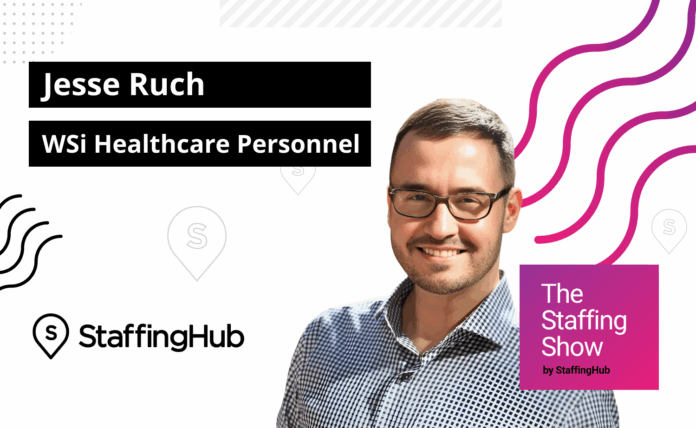
Jesse Ruch is the Managing Partner at WSi Healthcare, a healthcare staffing agency offering employment opportunities to individuals working in healthcare since 1988, and today he joins us to unpack the origins and evolution of the business, his path into the healthcare hiring industry, and the major changes reshaping staffing in recent years.
The conversation explores how WSi adopts new technology without compromising service standards, using an outcome-based approach to building its tech stack and creating focus through niched support structures. Jesse also shares how core values, accountability, training, and standardization support consistent results, the nuances of direct business versus MSP and VMS relationships, and why depth of specialization, data-driven decision making, and genuine human connection remain central to effective recruitment.
[0:01:13] DF: Hello, everyone. Thank you for joining us for another episode of The Staffing Show. Today, I’m joined by Jesse Ruch, who’s the Managing Partner at WSi Healthcare. Jesse, super excited to have you on the show today.
[0:01:24] JR: Thanks, David. I appreciate being here. It’s nice to be on your show.
[0:01:27] DF: To kick things off, so we can give listeners a little bit of a preview into who you are and how you got into staffing. Tell me a quick version of who WSi Healthcare is.
[0:01:38] JR: WSi Healthcare Personnel, we’re a full-service healthcare recruiting firm making meaningful placements across all positions and disciplines in the healthcare continuum. You know, David, we’ve been working in the direct hire, contract, per diem, and staffing space for close to 40 years. We are headquartered in Greenwood Village, Colorado and have been making quality career placements in about 10 different states. I’m so excited about the future of WSi and our industry in general.
[0:01:59] DF: Awesome. Well, excited to have you on the show. Today, we’re going to be jumping into AI, the use of tech versus human, kind of different approaches to it. One of the things I always like having on and having conversations about it, Jesse, WSi, you guys are growing again this year, which in healthcare staffing, anybody that’s having growth is always interesting to hear how you’re doing it, what you’re doing differently. We’ll be digging into that later in the show as well. Before we do that, I always like to get just a quick story on how did you get into staffing? Nobody ever chooses. I don’t know if I’ve had anybody say, “I just always wanted to be in staffing,” but I always like to hear a quick background on how you got into staffing and then we’ll jump into the tech versus human side of these things.
[0:02:40] JR: Thanks for that question. You know, David, actually, I woke up when I was 10 and I thought, “Oh, one day, I’m going to be an account manager in staffing.” You are absolutely correct, says probably nobody. I have an interesting story. I remember when I first interviewed for the role at WSi. I was in my 20s, and I had been working in the mortgage industry at a telemarketing company. Well, I remember like it was yesterday. My schedule was 2pm to 10pm. That was my schedule.
We were hooked up to an auto dialer. This thing would crank out 800 phone calls a shift. All we did is ask about mortgage rates on homes. It was a wild experience. I don’t recommend it. But I did pretty good. I had a pretty high close rate back in those days for the mortgage industry and I enjoyed it. I was looking for a change in a normal schedule, so I responded to an ad back in those days in the Rocky Mountain News. It was a print ad. It just said, basically, “Recruiter, in office, sales. Do you enjoy talking on the phone? If so, please reply.” Real simple.
I sent my resume and I got a phone call from Alicia, who is our current CEO actually, and they interviewed me. I remember her asking me lots of questions about outbound dials. Asking me how comfortable I was on the phone and asking me, “Do you like being on the phone? Is it something fun for you?” I guess, I answered appropriately and she liked me, so she offered me the job. That was way back in 2003. The rest is history. That’s how I got my start in recruiting.
[0:04:08] DF: Awesome. Awesome. That’s great. You already had the phone skills dialed in when you came onboard. I know you’ve seen a lot of changes over the years in healthcare staffing, going from vaccine resumes to AI everywhere as we are today. What are some of the major changes that you’ve seen in the last few years that are impacting healthcare staffing?
[0:04:27] JR: Gosh, that’s a loaded topic. There’s been so many changes in the past few years. I appreciate you trying to focus it in on just that. Because, yeah, when I first started, I had clients that didn’t even have email yet. The last couple of years, I think you would have to be living under a rock, really, to not understand the impact that AI has had on our industry, right? I think the onset of automations and the ability to become more efficient has really been center stage. One of the big trend lines.
Healthcare staffing, also, has had its own fair share of ups and downs over the past few years. From just the way we engage with candidates, even with texting. I mean, that is not that new, but the level of engagement that we see now from texting with candidates is so different than it was even five years ago. I would say that, really the biggest changes have been to recruiter workflows, credentialing workflows, how we pay people. Same day pay is such a great addition and value factor for us as a group. I think that has really been game changing as well.
[0:05:31] DF: That’s amazing. How long ago did you guys introduce same day pay?
[0:05:34] JR: We introduced same day pay, I want to say, about a year and a half, two years ago. It’s been pretty popular. Our candidates really enjoy it.
[0:05:42] DF: Yeah. I feel like some of the faster growing agencies implemented that. I think that some were like, “Oh, is that really that important?” I feel like any of those little things that make you different can have a pretty big impact. What are some of the other unique ways that you guys are approaching automation versus the human conversation?
[0:05:59] JR: We have been very deliberate and careful about where we’re adding AI and automations into our mix. I think there’s such a fine line as an industry that we’re all reaching to find. It’s an invisible marker, where technology meets people. Trying to figure out where that is has been challenging. For us, we’ve stuck to some of the things that we believe are not going to impact our service standards. Candidate engagement, things that can be done on a bigger scale that take recruiter effort and time that we can build into our tech stack has been helpful. We utilize Sense, which we love and has been also really helpful for us. It continues to grow and its footprint continues to expand on what they can do. You just have to be mindful on where you put it and how you add it.
[0:06:50] DF: Yeah, yeah, absolutely. I think you guys have been – conversation we’ve had previously, sounds very intentional about where to use automation versus where not. I think some people are trying to automate every aspect of it away. How do you guys, when you’re deciding which parts to automate, which not to, do you have any process behind that, or thoughts around that?
[0:07:12] JR: Yes. I think as an industry and as an organization, you really have to come from a place that’s outcome based to make that determination. I think when you look at your tech stack and you start to understand where you could be losing efficiency, that’s the first place you should look. I’m not a huge fan of trying to take the human element out of staffing. I’m a firm believer that relationships build this industry.
I think AI definitely has its place, but I don’t know many AIs that can tell a story about their dog, or that can talk about their kiddos, right? I think those meaningful discussions and conversations that we have the ability to have with our candidates and our clients — we really have to make those center stage in all that we do. AI and automation, it has its place and I enjoy it. I love to see the efficiencies that it creates, but truly what we’re trying to accomplish is making more space for better conversations for our people.
[0:08:11] DF: Yeah. You’re using it fully, I think this is the common thread that we hear people talk about is they automate the mundane things to give time back to your team to build the relationships. What are some of the – the fact that you guys are growing this year and another year where healthcare staffing is having challenges in terms of companies that are trying to figure out how to grow, without sharing maybe your exact numbers, or any of your secret sauce, but what are some of the things that are driving your growth that you’re open to sharing with the audience?
[0:08:43] JR: Yeah. One thing I think that’s really important is WSi has maintained a truly niched out support structure amongst our staff and our account managers and recruiters. I think providing focus and space to really become subject matter experts in your field really helps build that trust with your clients. It really helps to maintain your knowledge base. When you’re talking to candidates and you’re a nurse, you know your account manager understands what that means. I think companies sometimes have the thought that if you’re a master of everything, that somehow that can expand your reach.
I wish people best of luck with that type of role. I have just found that it is much easier to have specialists that are dedicated to each different discipline that you’re trying to focus on in order to create growth.
[0:09:38] DF: Got it. You’re actually, internally at WSi, your recruiters are specialized down into the different verticals within nursing and expert within those, so they can talk at a deeper level?
[0:09:50] JR: Yes, that’s exactly right. What you’ll find is that the person who specializes in staffing and hiring CNAs, that’s all they do all day.
[0:09:58] DF: Got it.
[0:09:59] JR: They do that and you’ll find our nursing, Northern Nursing Manager she works with nurses all day. Yes. I also think a great approach, and I think this also speaks to our strategy is to make sure that you maintain relationships and deepen them whenever possible. There’s so many levels to organizations. If you’re staffing a nurse at that company, perhaps they need a front office person, or maybe they could need a biller, or maybe they need a leader at their company. Really trying to drill down into making relationships larger and helping them on a grander scale is certainly a great strategy as well.
[0:10:38] DF: I love that. One of the other areas that I imagine ties into your growth and also into the relationship building. I think last time we talked to you, I don’t think I’ve heard this term, but you said something around the values of the attitude of gratitude. I think something around that. Do you remember that? Do I have that right?
[0:10:56] JR: You absolutely have that right. I’m a huge believer of having a positive attitude every day. I think that’s something that as humans, we get to choose. I think we have our off days, but I think if you come to work every day with a smile and a positive attitude, you’re in a better spot to move mountains, right? I think that the broader conversation we were having is about WSi’s core values. Another thing that does differentiate us from, I think, many other organizations is our core values.
We have six of them and we work very hard to hold each other accountable to our six core values, and also to live and breathe them every day. They’re more than just words to us. Our team, we like to hold each other accountable to attitude of gratitude. We’re adaptable. We’re accountable. We’re dependable. We’re self-motivated and we’re honest communicators. That boils down to how we work with our clients and our own internal staff.
[0:11:51] DF: With that, I know you had also talked about your training program. I don’t know what the average tenure of a training program is in staffing, but I do know that the one common theme I’ve been hearing from staffing firms that are growing is that training seems to be a big part of their success. I think process orientation tends to be a big component of that as well. Tell us a little bit about what your training program looks like, how long it is, and how that impacts candidate and client satisfaction.
[0:12:16] JR: Thank you. I appreciate that question so much. I’m actually quite proud of WSi Health Care’s training solutions that we have. We put everybody and every new person on our team through a several week process of getting them used to our system and ensuring that they really understand how to work all of our tech. Because like most firms, we have many components to what we do. It just takes a while to get the hang of it, right?
I think after that is really where you allow people to permeate, to understand their discipline, get to know their candidates a bit. Then we have an additional training program that we utilize, where we’re really leaning into more technology, how to use AI to build your sales technique and how to build on your value statements and how to leave a great voicemail, how to really resonate with your clients, become a specialist in your field. That is integrated with our staff. We also love to do group training sessions, where we work with each other on scripting and we really try hard to make sure that our language is meeting the needs of our clients and that our marketing is actually working.
[0:13:21] DF: I think that that is – I mean, for the listeners today, that common theme that continues to come up is the agencies that are growing are process oriented, operation oriented, adding additional layers of training, I think, for that standardization and staffing versus the hiring and praying that is going to work. I think there’s a more direct approach to that.
One of the other areas that you and I had talked about, which I thought was pretty interesting is you guys have been intentional as well about the direct business versus MSP and VMS. Just talk a little bit about how you guys are approaching that and what does your mix look like? Because I think the last, gosh, I don’t remember the exact number on it, but I think the last out was somewhere around 70% of all healthcare staffing placements are going through an MSP at this point. Would you share a little bit more about how you guys are approaching that?
[0:14:09] JR: Yeah. I’ve always believed that MSPs and VMS systems have their place in the healthcare ethos, and I think that I know a lot of firms who are very successful that partner with them. Our direction has always been trying to work directly with facilities to really get that two-way communication directly with hiring managers when we can. We do have MSP partnerships, or have in the past that allow us to have that two-way communication. Although we don’t lean in fully to MSP and VMS business, we do have some fantastic partnerships that we enjoy. The more that you can broaden your coalition from a client perspective on a direct basis, I think the easier it is to get people placed and the less back and forth you tend to see in your transaction, I suppose. They think that that ease of communication between you and the facility, as well as your candidate just makes things a little smoother.
[0:14:59] DF: Yeah. You guys are, I don’t remember the exact numbers. I don’t know if you want to share them here, but I think you’re on the – there’s a large portion of your business that’s going direct compared to what the industry standards are. Is that correct?
[0:15:10] JR: That is correct. Yeah. We tend to do more direct placements, direct with our clients. [Inaudible 0:15:16] do a third party. Like I said, we do appreciate our MSP and VMS partnerships. But by and large, the majority of our business is direct.
[0:15:26] DF: That’s awesome. When you are going through MSP, are there specific things that you look for in the relationships that you do choose to support? Is there any strategy to that? Or I know from what I’ve – coming off of Healthcare Staffing Summit, I do know that the MSP experience right now that there’s some frustrations on that front in terms of the fees. I think I’ve heard seven to eight and a half percent, and I was hearing all kinds of crazy things on that front, so I’m wondering if there’s approaches that you take, or any lessons that you’d be open to sharing.
[0:15:57] JR: Yeah, gosh. That’s such a great question. You’re absolutely right. I think margin pressure is such a real thing in our industry. It really becomes a struggle to make some of the VMS relationships work when you consider rising pay rates for candidates and you consider bill rates that are lower. It doesn’t leave a lot for your agency partners.
What we typically look for is a two-way communication with them, where they partner with us and they listen and they help us become better partners with them. I think when you have a meaningful relationship with a VMS partner, you’re talking to them. You’re able to express your issues and the problems that you see with filling more roles with them. Because sometimes the credentialing is also really challenging in the healthcare space. We might have a direct client that has one set of rules, but then a VMS that has another. That also becomes a little convoluted when you’re really trying to serve two masters, right? We really try to find places that are open to being open with us on what they need and will create a two-way street for us to sometimes even negotiate around some of those VMS and MSP fees, because it does happen.
[0:17:05] DF: Yeah. That makes sense. You’re not just jumping in and taking any job order, which I think that it is interesting to see the different strategies that people have in place where some are taking a new job order and letting every recruiter go after it. When it comes to the job orders that are coming in, I’m just curious if you have any – it sounds like you’re aligning them based off of specialty. Do you let recruiters just pick whatever job orders they want? Do you have an approach to prioritizing who goes after what and how they get the job orders lined up?
[0:17:35] JR: Yes, we definitely have a strategic approach to that. Not only are our account managers and recruiters niched out by discipline, they’re further niched out by location. You could put it like this, any nursing role that comes in in Colorado goes to this person. I think having that delineation and that focus on that order substantially increases your ability to fill it.
I think I do know of a couple organizations that do a more broad approach to fill the orders, where they will have one person who will do CNA, admin, RN. I think it’s really hard to produce candidate flow that way when you have so many tendrils out trying to accomplish the same thing. I think really taking a focus on each role for one person to fill is really helpful to actually get the job done.
[0:18:24] DF: Yeah. I think you’re a perfect example of what the depths of specialization and the impact that that can have, because I feel like a lot of firms are like, “Oh, we’re specialized. We do healthcare. Our recruiters can do that.” Usually, it’s deeper than that. But the level of specialization can go and also focus and constraints that you can put on it to make sure that people can talk about the hospitals. They can talk about the specifics of what people are getting into. I think that can be really impactful in terms of how you approach the market, which is awesome to hear.
I know we’ve talked about the automation side a little bit and another area that you and I have just briefly touched on was the avoiding shiny object syndrome and making sure that you’re not chasing all of the different tools. Any thoughts around, there’s so many AI tools that are hitting the market and if you have software right now, I mean, even our software, we’re launching AI, everybody’s launching AI. Are there tools that you’re using on the AI front where you’re getting success, and would be open to sharing? Or are there any lessons learned in terms of what you think should be avoided at the current stage today?
[0:19:28] JR: I think that goes back to the broader expansive view of what AI will create for us as an industry and evaluating that versus what your outcome is, or what you want it to be. Because every day, just today, I think I got three new emails with three new tools and three new AI things that are going to replace the world and make my life a much better place and organize everything. I’m never even going to have to source again today, David. Did you know that?
Yeah. I am always evaluating things. Shiny object syndrome that you mentioned is a real thing, and especially amongst, I think, leaders that are striving to make their teams more streamlined and trying desperately to help create efficiencies throughout the organization. I’ve looked at, I don’t even know how many, but I’ve looked at a lot. For me and for us here at WSi, I think what we have done well is looking at the result we’re trying to achieve and going backwards from there.
For instance, if I’m having an issue with reaching out to candidates about where they are in the process of our credentialing, and I’m noticing that recruiters don’t have enough time to make that second touch, or that second phone call, or that our credentialers, they might be bottlenecked there with too many people in the pipeline, in that instance, we’re going to look for a tool that’s going to assist us to do that function, because we are trying to create a better experience for our candidates and hold their hands through the entire time. We actually did do that, but we created a journey with Sense in order to make that functionality happen. I also think that a lot of organizations don’t use their tools to the fullest extent.
[0:21:08] DF: Yeah. There were years where there were so many companies I would talk to, they’d be like, “We have full recruiting automation.” I’m like, “Oh, what do you have running?” They’d be like, “Well, we tell everybody, happy birthday.”
[0:21:21] JR: Exactly.
[0:21:23] DF: I think it’s come a long ways from that. But are you doing full candidate journey mapping and getting it at that level where you detailed it all out when you look at where you’re applying the different technology and different Sense journeys?
[0:21:36] JR: We try to A-B test things and see how they pan out. I would love to say that you can create a workflow and the concept of it, it looks so solid when you build it. The concept of it seems fantastic. Then when it’s received, the candidates are dissuaded. They don’t like it. They don’t react the way that you would necessarily think they would. Then you have to change it. So much of this is just A-B principle, right? Test it, see if it works. If doesn’t, get rid of it.
I think as we move forward as a group, that will be the question like, okay, do our people like it? Do our clients enjoy it? Is it providing value to our services in the end? If the answer is yes, then we should keep it. If the answer is no, then let’s not go down the road.
[0:22:23] DF: Yeah. It sounds like you’re doing the testing on it and a lot of iterations on it, which I think is one of the fastest paths and trying to – instead of trying to perfect it, it’s roll it out and then iterate and learn from there, which is a typically a faster path to go down. I’m going to jump back to, I know we talked about the attitude is gratitude, some of the values and it sounds like, mindset is a huge part of your approach to leadership and how you have pushed through some of the challenging times in staffing, which there have been over the last few years. What are some of the things that you do on tough days to reset? Any routines that you have, or any things that you do want to make sure you’re coming in with the right attitude?
[0:23:00] JR: Oh, man. I am a big believer in doing a mindful exercise every morning. I know it sounds a little corny, but I literally do it. I do positive affirmations in my own life every day. I just believe in it. We’re all as a society on the struggle bus the past few years, right? When we had COVID, which was a once in a lifetime event and we as a group, humans in general have just been through a lot and healthcare staffing, the stories coming out that you’ve heard over the past five years have been really harrowing.
I think to keep yourself in a great space for your team and for the people around you, there are certain things you have to do. I’m mindful about my exercise routine. I try to really eat right when I can, and try to really permeate a smile for people, because I think it matters. I think having gratitude for where you are and being thankful for the work we get to do. We as recruiters, I think, sometimes aren’t aware of the nature of our job and how impactful we can be for people. We can change their whole lives by a placement. We can get them more money. We can get them a nicer place to live. We have a lot of ability to impact others. I think coming from that place every day and being excited about what you get to do every day is so important in our industry.
[0:24:13] DF: Yeah. I think that is so true. I love that you’re doing the mindfulness stuff. I think that’s such an impactful element. Are there any things that when it comes to actually managing the team, do you bring any of that, obviously, the attitude and your personality and how you’re showing up, I think has an impact. But are there any elements of that from a leadership perspective that you bring into the organization? I don’t know if you do or not. Just curious if that’s something that you do.
[0:24:36] JR: Yes, that’s a great question. We do like to make sure that we are living our core values. One of the exercises that our team does once a quarter is we nominate each other as the quarter progresses for our various core values. They will get online and they’ll do a nomination for a team member for being adaptable. Or they’ll do a nomination for being dependable, or self-motivated. Some of those little things, people really love to talk about. They love to see their peers nominated. They enjoy talking about it. It really does help to raise the attitude in the office. The other thing we do at WSi is we are pet friendly in our office.
[0:25:14] DF: That’s great.
[0:25:14] JR: Yeah. We actually interview with that. We talk to people before we hire them about having dogs in the office, what their comfort level is. I’ll tell you, little furry fun people are really great to have around.
[0:25:24] DF: I think that’s a great thing. Somebody had said on the podcast recently, it’s like, they’re telling me, yeah, when people come into our office, they see everybody’s got dogs and it’s a fun environment. We want to work here immediately. That sounds great. We’re going to go into the speed round here. But before we do that, I wondered if there was any closing comments generally about the industry before we jump into the speed round.
[0:25:44] JR: I’d like to just give some kudos to the entire WSi team on this call, because I’m just so proud of every single person in every single department that we operate in. I think we all work together really cohesively in a really challenging world. There’s very few days when I walk out of my office without a smile on my face, because I feel like we all work together so well. I think that the better team you can build, the more trust you have between each other, the better off we’ll all be.
[0:26:09] DF: I love that. That is a great thought. All right, now we’re going to hop in. What is the most underrated recruiter skill in 2025?
[0:26:17] JR: Connection. Connection and the ability to communicate with other humans and understanding that automations can do some things for you, but your ability to really connect in a meaningful way with your candidates and clients, that’s not going anywhere. You need that skill.
[0:26:32] DF: Love it. One metric every staffing leader should watch?
[0:26:36] JR: I think time to fill is probably one that is really key to success in the fast-paced world of staffing. I also think a company NPS score is helpful as well.
[0:26:46] DF: Biggest misconception that clinicians have about agencies?
[0:26:51] JR: That we are here to pay you less and that we are not on your side. I think sometimes clinicians have worked with, especially during COVID, agencies and companies that haven’t treated them well. I’m here to say that we love you and we want to be your best friend. We’re here to get you the most pay we can and provide the most value as a company that we can.
[0:27:14] DF: Awesome. If anybody wants to find you after this, what’s the best way to reach out to you?
[0:27:17] JR: Sure. I’m a phone guy, so please call me. My direct line is 303-316-4370. You can email me as well. That’s JesseR. [email protected].
[0:27:32] DF: Awesome. Well, Jesse, I really enjoyed having you on the show. It was a great conversation. Excited for your success this year and we’re rolling into 2026 with another great year.
[0:27:42] JR: Thank you so much, David. I really appreciate your time today. It was great talking to you.
[0:27:45] DF: Awesome.